Build sales intelligence into your product with a single API. Discover companies that match your ICP, uncover buying signals, identify key stakeholders, and return verified company and contact data without building your own data infrastructure.

What Is a Sales Intelligence API?
A sales intelligence API is a service that scores B2B accounts on fit and buying signals, then returns verified stakeholder contacts, so another application can rank and act on accounts programmatically. It lets a product team build account prioritization into their own tool instead of sending users to a separate dashboard.
It works at two levels: account intelligence, whether a company is worth pursuing, and prospect intelligence, which specific person there is showing real interest right now. Both come back in the same response.
What Can You Do with Pintel.ai’s Sales Intelligence API?
Pintel.ai’s Sales Intelligence API gives you access to company intelligence, contact data, buying signals, and stakeholder insights that can be embedded into your applications, workflows, or CRM.
Whether you’re discovering new companies, enriching existing accounts, or building custom GTM applications, the API delivers the intelligence you need through a single integration.
Find Companies That Match Your ICP
Start with a description of your ideal customer profile instead of an existing account list.
Example:
Find US fintech companies with a mobile app on Google Play, more than 200 employees, recent funding activity, and a Head of Product.
Pintel.ai searches across structured and unstructured data sources to return matching companies, company intelligence, buying signals, key stakeholders, and verified contact information through a single API.
Enrich Existing Accounts
Already have a list of target companies?
Use the API to enrich company and contact records with verified data, uncover buying signals, identify decision makers, and complete missing information without changing your existing workflow.
Build Smarter Sales Applications
Embed sales intelligence directly into your CRM, sales engagement platform, customer-facing application, or internal product.
Use the API to power account discovery, company search, contact enrichment, buying committee mapping, prospect qualification, workflow automation, and personalized outreach with real time sales intelligence.
Where Sales Intelligence Breaks Down Without an API
Most sales intelligence tools are built as a dashboard first. That works for a RevOps team logging in to review a list. It breaks down the moment another product needs that same intelligence natively.
A Dashboard Does Not Fit Inside Your Own Product
A login-based tool cannot power a feature inside a different application. Pintel.ai’s API returns the same scoring and signal data as structured JSON, built to sit inside your own interface rather than a separate one.
One Signal Returned Through an API Is Still a Guess
An API that only checks a website visit or a job posting is passing along noise. Pintel.ai’s API checks combinations, funding rounds, hiring spikes, tech-stack migrations, and more, before returning an account as in-market.
Static Exports Do Not Update as Signals Change
A one-time CSV export is stale within days. Pintel.ai’s API supports both a real-time call for a single account and a bulk endpoint for scoring a full list in one job, so an application can re-check accounts on its own schedule.
Firmographic Filters Alone Return Too Wide a List
Revenue, headcount, and industry filters return accounts that technically match but are not the right fit. Pintel.ai’s API accepts a plain-English ICP description and applies it against the account list before returning results.
Coverage Gaps Break Silently Outside Core Markets
An API built around one region returns thin or empty results outside it, with no way for the calling application to know why. Pintel.ai’s data engine reaches regional and multilingual sources, keeping coverage consistent across EMEA and APAC.
Each of these gaps shows up first as a missing field in an application, then as a feature users stop trusting. The mechanism below is what closes all five at the API layer.
How Pintel.ai’s Sales Intelligence API Works
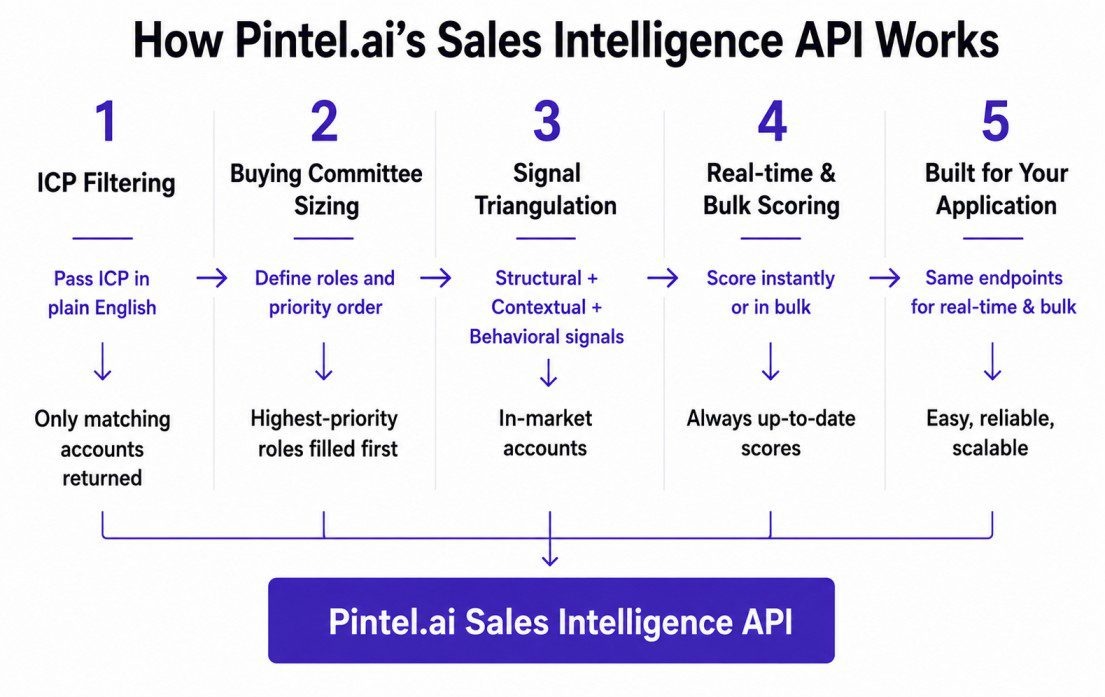
Plain-English ICP filtering: pass an ICP description as a parameter, such as “companies that build software and have testing professionals in-house,” and Pintel.ai’s API returns only the accounts in your list that match, instead of a raw firmographic filter.
Buying committee sizing: define the job roles and how many contacts you need per role, ranked by priority. Pintel.ai’s API fills the highest-priority role first, so an account with the right firmographics but no matching people returns a thin result instead of a false positive.
Signal triangulation: Pintel.ai’s API checks structural signals (funding rounds, leadership hires, hiring spikes, tech-stack migrations, etc.), contextual signals (third-party topic research), and behavioral signals (site visits, content engagement) together before scoring an account as in-market.
Real-time and bulk scoring: Pintel.ai’s API scores one account the moment your application needs it, while the same endpoint structure supports bulk requests for scoring a full account list in one job.
Where this breaks for most teams: one outbound team tracking healthcare accounts in Central and Eastern Europe combined three signals through Pintel’s engine, facility expansion plans, new medical equipment investment, and infrastructure-related hiring, and surfaced 50 in-market companies from a single sector sweep.
Account Signals vs. Prospect Signals
An account and a person need different scoring logic. Combining signals makes sense for a decision as big as “is this whole company worth pursuing,” which is why account scoring triangulates funding, hiring, and tech-stack signals before ranking a company as in-market. Flagging one specific person as worth a look is a smaller, faster decision, and it does not need the same bar.
For prospect-level signals, Pintel.ai’s API treats each one as a standalone trigger. Any single signal below is enough to surface a person, no combination required, which keeps the list of real people to contact larger and the logic simple to reason about.
- Role read from the full profile, not the title: Pintel.ai’s API distinguishes a QA engineer working on software from one working on hardware, even when both carry the same job title.
- Page-specific visits: a pricing page, a feature page, or a comparison page visit, tied to a named individual where identifiable.
- Content downloads tied to a specific pain point: a whitepaper or guide about a named problem signals what that person actually cares about.
- Social engagement: liking, commenting on, or sharing a post relevant to your category.
- Followed your company or an executive’s profile: a low-effort but real early-awareness signal.
- Webinar or demo attendance: a single event, simple to detect and act on immediately.
- Review site activity: visiting or reviewing your listing on G2 or Capterra.
- A single relevant job posting at the account: one open role that maps to your category is enough to flag, without waiting for a second or third posting to confirm it.
- Engagement with a competitor’s content: a standalone category-awareness signal, useful on its own.
Pintel.ai returns each of these independently in the API response, tagged to the prospect it belongs to, so a calling application can act on a single trigger instead of building logic to wait for several to align.
Who Uses a Sales Intelligence API
The same API sits behind different products depending on who is calling it.
- Vertical SaaS products: add native account-scoring or “accounts to watch” features without building a signal engine from scratch.
- Internal sales tools: power a “why this account, why this person” panel that shows a rep the score and the specific prospect trigger behind it, inside a tool they already use.
- Custom outbound applications: replace a raw, unranked account list with one that arrives pre-scored and pre-tiered.
- BI and reporting dashboards: surface signal-based account tiers alongside existing pipeline and revenue metrics.
- CRM add-ons and marketplace apps: layer scoring and signals onto records a customer already has in Salesforce, HubSpot, or Pipedrive.
- Partner and agency platforms: offer account prioritization as a feature to clients without operating a research team internally.
What the Sales Intelligence API Returns
| Data Type | Fields Returned |
|---|---|
| Account score and tier | ICP fit score, custom tier or rank, based on the criteria you define |
| Buying committee | Verified contacts by job role, ranked by priority, with the count you specify per role |
| Account signals | Structural (funding rounds, hiring spikes, tech migrations, etc.), contextual (topic research), and behavioral (site visits, content engagement) signals, triangulated behind the account score |
| Prospect signals | Individual-level triggers (role match, page visits, content downloads, social engagement, etc.), returned standalone, no combination required |
| Contact data | Verified email, direct phone, job title, and LinkedIn URL for each returned stakeholder |
Where the Scored Data Lands
Pintel.ai’s API returns a direct JSON response for any application that calls it, and syncs scored accounts automatically for teams running a connected CRM.
- Salesforce: scored accounts and buying committee contacts write back to account and contact objects.
- HubSpot: account tiers and signals sync to company and contact properties automatically.
- Pipedrive: scored accounts update organization and person records through the same connection.
- Any other application: a custom-built tool or internal platform can call the API directly and render the response in its own interface.
Built for Developers
Pintel.ai’s API returns structured JSON over a standard REST interface, so it fits into an existing application without a custom scoring layer to build. A single call scores one account for real-time moments, and the same endpoint structure supports bulk requests for scoring a full list in one job.
Every response includes the score and tier alongside the signals that produced it, so the calling application can show why an account ranked where it did, not just the final number.
Full authentication details, rate limits, and endpoint documentation are shared during onboarding, since these are configured to fit each team’s expected call volume.
Setup is not left to your engineering team alone
Pintel.ai’s GTM engineering team works directly with you during onboarding, mapping the ICP definition, signal weighting, and job roles to your specific requirements, and helping wire the API into your application or CRM. Implementation is a guided setup, not a documentation page and a support ticket queue.
Sales Intelligence API vs. Single-Signal APIs
| Single-Signal API | Pintel.ai |
|---|---|
| Confirms an account exists, not whether enough stakeholders are there to pursue it | Returns buying committee contacts by role, ranked by priority, in the same call |
| Flags an account on one signal, prone to false positives | Triangulates 3+ signals before returning an account as in-market |
| Filters by firmographics only: revenue, headcount, industry | Accepts a plain-English ICP description and filters for actual fit |
| Built for one mode, either a dashboard export or a single lookup | Real-time and bulk scoring through the same API |
| Coverage thins out fast outside North America | Reaches regional and multilingual sources across EMEA and APAC |
Security and compliance: Pintel.ai is ISO 27001 certified, SOC 2 (AICPA), GDPR compliant, HIPAA compliant, CCPA compliant, and VAPT certified.
Where the Sales Intelligence API Fits in a GTM Workflow
Sales intelligence is one layer in a longer flow from raw account to working pipeline. The API sits at the scoring stage.
Discover: plain-English ICP filtering narrows a target list to accounts that genuinely fit, ahead of the signal check.
Score: signal triangulation and buying committee sizing rank which accounts to work first, building on the timing signals covered in buyer intent tools and the weighting logic in a lead scoring framework.
Enrich: once an account is scored, the same waterfall engine behind contact enrichment APIs fills in verified stakeholder details before the first message goes out.
Activate: scored accounts and contacts sync into CRM workflow automation, turning a ranked account into a routed task or sequence step.
Frequently Asked Questions
What is a sales intelligence API?
A sales intelligence API is a service that scores B2B accounts on fit and buying signals, then returns verified stakeholder contacts, so another application can rank and act on accounts programmatically instead of through a separate dashboard.
How does Pintel.ai’s sales intelligence API work?
A single call runs an account through plain-English ICP filtering, checks it against 30+ data sources, triangulates structural, contextual, and behavioral signals, and returns a score, buying committee contacts, and the signals behind the rank.
Can I embed sales intelligence into my own product with this API?
Yes. The API returns structured JSON built to power a feature inside another application, such as an account-scoring panel, a prioritized list view, or a signal feed, rather than requiring users to work inside a separate Pintel dashboard.
Does the sales intelligence API combine multiple buying signals?
At the account level, yes. The API checks combinations, a funding round plus a hiring spike plus a tech-stack migration, before returning an account as in-market, since that is a bigger decision worth confirming with more than one signal.
What is the difference between account signals and prospect signals in this API?
Account signals are combined before ranking a company as in-market. Prospect signals, such as a page visit, a content download, or a role match, are returned standalone, so any single one is enough to flag a specific person as worth a look.
Does the API require multiple prospect signals before flagging someone as interested?
No. Each prospect-level signal is treated as its own trigger. Requiring several to line up before flagging a person mostly shrinks the list without adding real confidence, so the API surfaces a person on any single relevant signal.
Can the sales intelligence API return buying committee contacts, not just a score?
Yes. You define the job roles and how many contacts you need per role, ranked by priority, and the API returns verified contacts for those roles alongside the account score in the same call.
Does the sales intelligence API cover accounts outside the US?
Yes. Pintel.ai’s data engine reaches regional and multilingual sources across EMEA and APAC, so account scoring and signal coverage stay consistent outside North America instead of thinning out.
Does the sales intelligence API integrate with a CRM?
Yes. Scored accounts, verified contacts, and buying signals sync to Salesforce, HubSpot, and Pipedrive through the API. Any other system can call the API directly and handle the response on its own.
What do I need to start using Pintel.ai’s sales intelligence API?
A REST endpoint, authentication credentials, and rate limits are set up during onboarding based on your expected call volume, so both a real-time lookup and a bulk scoring job connect through the same API.
Do I need my own engineering team to set up Pintel.ai’s sales intelligence API?
Basic integration work happens on your side, but Pintel.ai’s GTM engineering team works directly with you during onboarding to map ICP definitions, signal weighting, and job roles to your setup, rather than leaving implementation to documentation alone.