AI data enrichment tools use AI to find, interpret, and enrich company and contact data from multiple sources. They can research company websites, parse job postings, identify relevant decision-makers, enrich contact details, interpret buying signals, and evaluate account and prospect fit against a plain-English ICP.
This guide compares 7 AI data enrichment tools across 6 capabilities that show how AI can improve B2B company and contact enrichment, from ICP understanding and data discovery to buying signals, account reasoning, and company and prospect scoring. Tools focused primarily on database coverage and conventional enrichment are covered in our standard data enrichment tools comparison.
What Are AI Data Enrichment Tools?
AI data enrichment tools are software platforms that use machine learning and natural language processing to find, qualify, and enrich B2B contact and account records by reading unstructured sources, interpreting company context, and surfacing buying signals, going beyond static database lookup to understand whether an account fits a complex ICP and when it is ready to engage.
Standard enrichment answers: “what fields are on file for this company?” AI enrichment answers: “does this account fit my ICP, what are they signaling, and is this the right contact?” The six columns in the comparison below are the framework for evaluating every platform in this list.

AI Data Enrichment Tools Compared: 6 AI Capabilities (2026)
These 7 platforms were scored against 6 AI capabilities that define whether a tool is genuinely using AI or just surfacing database records faster. Each column is explained in full after the table.
| Tool | Complex ICP? | Account Discovery? | Signal Enrichment? | False Positive Filter? | Account Reasoning? | Agentic Workflow? | Pricing |
|---|---|---|---|---|---|---|---|
| Pintel.ai | Yes (plain-English + profile reading) | Yes (web + registries + non-indexed) | Yes (structural + contextual + behavioral) | Yes (full profile reading) | Yes (account context summaries) | Yes (native, end-to-end) | Custom |
| Clay | Partial (Claygent prompt-based research) | Partial (via connected sources) | No (manual signal source setup required) | Partial (recipe-dependent) | Partial (Claygent summaries) | Yes (workflow builder, requires setup) | From $149/mo |
| Common Room | No | No (existing community only) | Yes (community + behavioral signals) | No | Partial (community trajectory) | Partial (signal-triggered alerts) | Custom |
| Unify | Partial (product + website signal matching) | No (existing visitors and signups only) | Yes (PLG + website behavioral signals) | No | No | Yes (warm outbound automation) | Custom |
| 6sense | Partial (intent + firmographic scoring) | No | Yes (third-party intent signals) | No | Yes (buying stage prediction) | Partial (requires ABM platform integration) | Custom (enterprise) |
| Copy.ai GTM | Partial (AI research workflow) | No | No (workflow layer only) | No | No | Yes (GTM workflow automation) | From $36/mo |
| RB2B | No | No (website visitors only) | Partial (behavioral, website-visit only) | No | No | Partial (Slack and CRM push on visit) | From $19/mo |
This comparison is based on first-hand platform knowledge, publicly available product information, and commonly reported user experiences. Contact each vendor directly for the latest pricing and product details.
Only Pintel.ai delivers all six capabilities natively. The sections below explain what each column actually tests, then break down every tool in full.
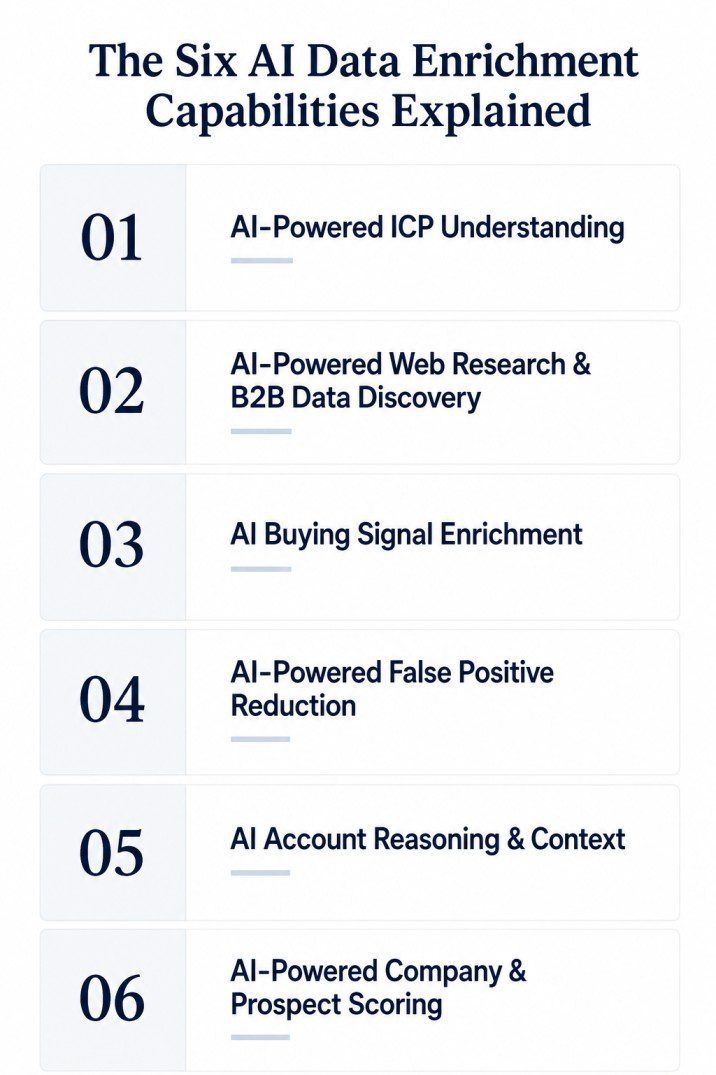
The Six AI Data Enrichment Capabilities Explained
Not all AI data enrichment tools offer the same capabilities. Before comparing platforms, it’s important to understand what each capability measures and why it matters for modern GTM teams.
The Six AI Data Enrichment Capabilities Explained
These six capabilities define what we look for when evaluating AI data enrichment tools for B2B teams — from understanding an ICP and enriching B2B company and prospect data to discovering buying signals, reasoning about accounts, and prioritizing the right opportunities.
1. AI-Powered ICP Understanding
Traditional B2B data enrichment turns an ICP into fixed filters such as industry, revenue, employee count, and location. AI data enrichment can handle ICPs that combine several conditions across company data.
Example: “Find B2B SaaS companies with 200–1,000 employees that use Salesforce and are actively hiring sales reps.”
The key is whether AI can understand these requirements together rather than requiring every condition to exist as a separate database filter.
Evaluate: ICP interpretation, multi-condition matching, technology and hiring context, and account-level fit.
2. AI-Powered Web Research & B2B Data Discovery
Traditional enrichment relies on information that has already been structured in a database. AI data enrichment can research company websites, product pages, job postings, and other public sources to uncover B2B company data that may not exist in the database.
Example: A SaaS company may have recently launched an enterprise product or started hiring for a new sales team, but that information may not yet appear in a standard company record.
The key is whether AI can find, interpret, and add useful information to an enriched record rather than simply retrieving existing fields.
Evaluate: web research, unstructured data extraction, source coverage, technology and product discovery, and ability to enrich records with newly discovered information.
3. AI Buying Signal Enrichment
Traditional enrichment tells you what an account is: its industry, size, technology, contacts, and other static attributes. AI data enrichment adds context around what is changing at the account and whether those changes indicate potential buying activity.
Example: “Identify SaaS companies that recently received funding, increased sales hiring, and are expanding their enterprise team.”
The value comes from detecting multiple signals and connecting them to the account rather than treating each event as an isolated data point.
Evaluate: signal coverage, signal freshness, multi-signal detection, and whether buying signals are automatically connected to account enrichment.
4. AI-Powered False Positive Reduction
B2B data searches can return irrelevant accounts or contacts because a keyword or title happens to match. AI can use the surrounding context to determine whether the person or company actually fits the intended requirement.
Example: “Find sales leaders responsible for enterprise GTM at B2B SaaS companies.”
A search for “sales” could return SDRs, recruiters, consultants, or unrelated roles. AI should be able to distinguish the relevant person based on their actual responsibilities and company context.
Evaluate: contextual matching, role understanding, title ambiguity, and reduction of irrelevant account or contact matches.
5. AI Account Reasoning & Context
B2B enrichment can provide individual data points such as employee growth, technology adoption, leadership changes, hiring activity, and funding. AI data enrichment can connect those data points to explain what is happening at the company.
Example: “This SaaS company raised funding, increased sales hiring, and recently started hiring enterprise account executives.”
Instead of presenting three separate fields, AI can turn them into an account-level explanation that helps sales teams understand why the account may be worth prioritizing.
Evaluate: multi-signal reasoning, account summaries, context generation, and whether AI explains the significance of individual data points.
6. AI-Powered Company & Prospect Scoring
AI data enrichment shouldn’t stop at finding and enriching an account. It can also score companies and prospects against specific requirements so sales teams know which records deserve attention first.
Example: “Score SaaS companies based on ICP fit, technology stack, company size, recent hiring, and buying signals, then prioritize the accounts with the strongest fit and intent.”
At the prospect level, the same approach can evaluate role, seniority, responsibilities, account fit, and buying context rather than simply ranking contacts by title.
The key is whether AI can apply multiple requirements, produce a meaningful score or priority, and determine which enriched records should move forward.
Evaluate: company scoring, prospect scoring, requirement-based prioritization, multi-signal scoring, score explainability, and automated actions based on score or qualification.
How We Evaluated These AI Data Enrichment Tools
- Complex ICP handling: does it accept plain-English ICP criteria without filter panels?
- Account discovery: can it surface accounts that were never on a pre-built list?
- Signal enrichment: does it cover structural, contextual, and behavioral signals automatically?
- False positive filtering: does it read full profiles or match title keywords?
- Account reasoning: does it synthesize context into account narratives or return raw data points?
- Agentic automation: can it run end-to-end without manual workflow configuration per account?
Best AI Data Enrichment Tools: In-Depth Analysis
Pintel.ai: Full-Stack AI Enrichment Across All Six Capabilities
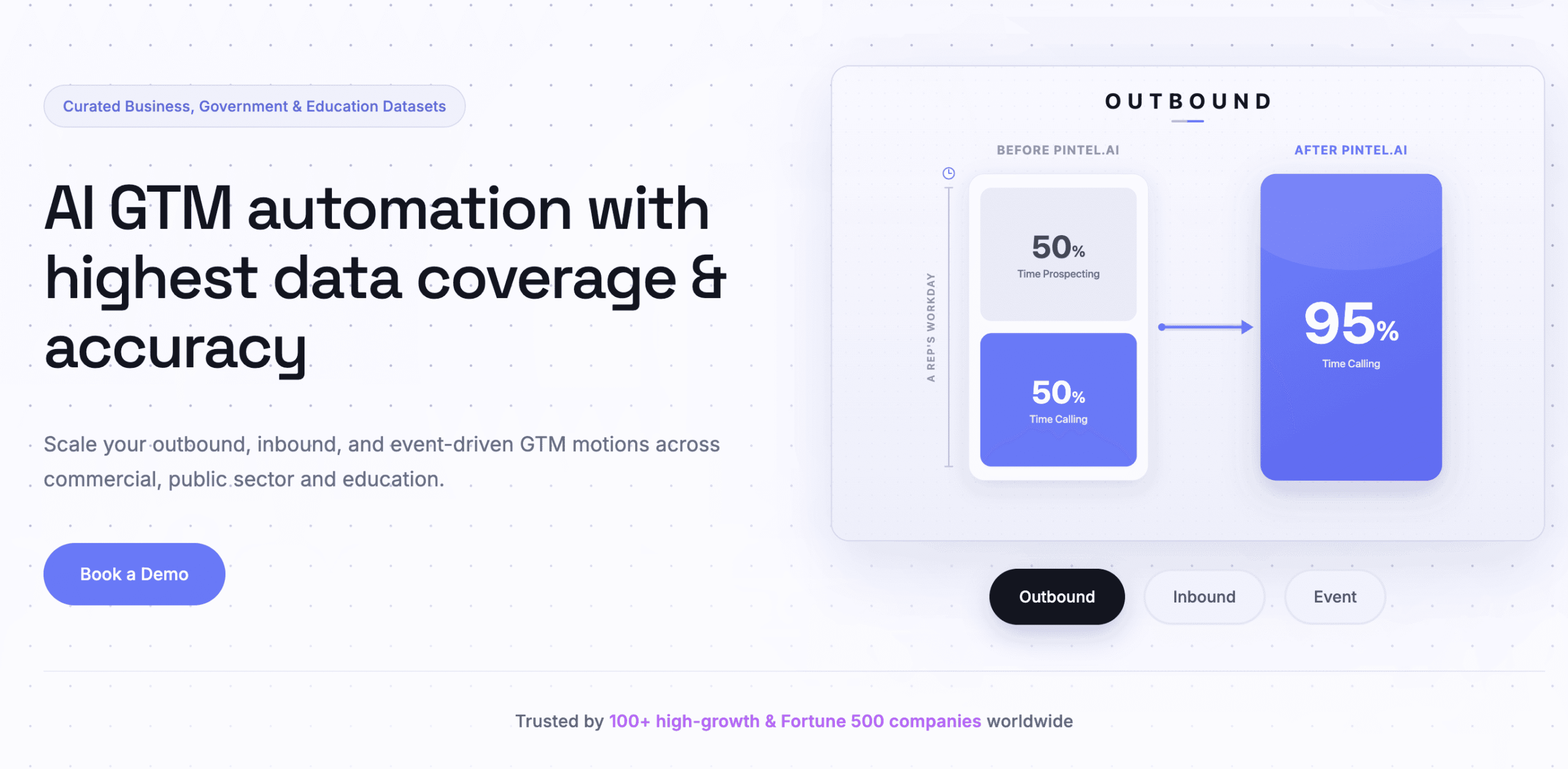
Pintel.ai is an AI-powered GTM platform that helps sales teams discover high-fit accounts, identify the right decision-makers, enrich verified contact data, surface buying signals, and automate outbound workflows in one platform.
AI ICP Understanding
Describe your ideal customer in plain English instead of relying on filter panels. Pintel evaluates company profiles, technologies, hiring activity, business models, and other contextual signals to identify accounts that match complex ICPs.
For example, one B2B SaaS company needed to target organizations that actively ship mobile apps and identify the person responsible for mobile QA. Traditional databases required manual App Store research, LinkedIn verification, and title guessing. Pintel automatically identified matching companies and the right decision-makers based on actual responsibilities rather than job titles.
AI Prospect Research and Contact Enrichment
After identifying target accounts, Pintel researches each prospect, enriches verified work emails, mobile numbers, and direct dials through waterfall enrichment across 30+ vetted providers, and builds complete prospect profiles ready for outreach.
AI Buying Signal Intelligence
Every account is enriched with structural, contextual, and behavioral buying signals, including leadership changes, hiring activity, funding events, technology adoption, website engagement, and topic research. These signals help prioritize accounts that are actively moving toward a buying decision.
AI Hyper-Personalized Outreach
Using account research, prospect context, and buying signals, Pintel generates AI-powered personalized outreach tailored to each prospect’s role, company, and recent business activity, helping sales teams start conversations with relevant messaging instead of generic templates.
AI Agentic Workflows
Pintel monitors accounts, refreshes contact data, re-evaluates ICP fit, detects new buying signals, synchronizes qualified accounts with Salesforce, HubSpot, and other CRMs, and keeps outbound workflows updated without manual list rebuilding.
Note: These AI capabilities are modular and do not have to be used in a fixed order. Teams can start with account discovery, contact enrichment, buying signals, prospect research, CRM enrichment, or any combination that fits their GTM workflow.
Limitations: Custom pricing only. No self-serve tier for early-stage teams. Best results require a clearly defined ICP upfront.
Best for: GTM teams targeting complex ICPs that need account discovery, contact enrichment, buying signals, and AI-powered outbound workflows in one platform.
Security and compliance: ISO 27001 certified, SOC 2 (AICPA), GDPR compliant, HIPAA compliant, CCPA compliant, and VAPT certified
Pricing: Custom
Clay: Strong for Custom AI Research Workflows, Weak on Native Signal Data
Clay connects to 100+ data sources and uses Claygent, its AI research agent, to read company websites and return structured data from unstructured sources. No proprietary signal data or database: coverage and accuracy depend entirely on which sources you connect, and meaningful use requires substantial RevOps setup.
- Claygent answers custom prompts about company fit from the open web and LinkedIn
- Workflow builder handles multi-step enrichment with conditional logic
Limitations: No proprietary database or signal layer. Teams without dedicated RevOps capacity underutilize it significantly.
Best for: RevOps teams with workflow-building capacity who want full control over their enrichment source stack. Pricing: From $149/mo
Common Room: Strong for Community Signal Intelligence, Limited Outside Community-Active Accounts
Common Room tracks engagement across GitHub, LinkedIn, Slack, Discord, and Reddit, surfacing buying intent from community activity. No contact enrichment, no firmographics, no ICP discovery. Value is zero for accounts whose buyers are not active in indexed community platforms.
- AI surfaces account-level signals from community engagement patterns
- Identifies champions inside target accounts based on digital activity
Best for: PLG and developer-tool companies with buyers active on GitHub, Discord, Slack, or LinkedIn communities. Pricing: Custom
Unify: Strong for Warm Outbound Signal Automation, Narrow Without Inbound Traffic
Unify identifies website visitors and product usage signals, enriches them with contact data, and automates triggered outbound. Value is directly proportional to inbound traffic volume. No ICP discovery or contact enrichment for cold accounts.
- Person-level and account-level visitor identification with contact enrichment
- PLG product usage signal triggers for free-to-paid conversion workflows
Best for: PLG companies with meaningful website traffic converting behavioral signals into triggered outbound sequences. Pricing: Custom
6sense: Strong for Predictive Intent Scoring, Not a Contact Enrichment Tool
6sense Revenue AI predicts which accounts are in-market using anonymous buyer research activity across B2B publisher networks. It scores accounts for intent and buying stage but does not return emails or phone numbers. Requires an existing contact data layer and enterprise-level implementation.
- Buying stage prediction: awareness, consideration, decision stage per account
- Intent signals from anonymous content consumption, not from first-party behavioral data
Best for: Enterprise ABM teams needing intent intelligence layered on top of an existing contact data stack. Pricing: Custom (enterprise)
Copy.ai GTM: Strong for AI Workflow Orchestration, No Proprietary Data Layer
Copy.ai GTM is a workflow automation platform that uses AI agents to gather account context from public web sources and automate research-heavy outreach preparation. No proprietary contact database, signal data, or ICP discovery. Sits at the orchestration layer and requires external data sources for all enrichment.
- AI agents gather account intelligence from the web and LinkedIn
- Prebuilt GTM automation workflows without Clay-style recipe building
Best for: Teams wanting AI-orchestrated research workflows on top of an existing data layer. Pricing: From $36/mo
RB2B: Strong for Website Visitor Identification, Narrow Scope Beyond That
RB2B identifies the specific LinkedIn profile of individual website visitors and pushes real-time Slack or CRM alerts. Scope is limited entirely to website visitors who are LinkedIn-active. No account discovery, contact enrichment, or signal enrichment beyond the website visit event itself.
- Person-level visitor identification matched to LinkedIn profiles
- Real-time alerts on high-intent page visits (pricing, product pages)
Best for: B2B SaaS teams with inbound traffic wanting to identify specific individuals browsing pricing or product pages. Pricing: From $19/mo
With all seven tools compared, the practical question is which capability gap your team hits first, and which platform closes it without introducing a new one.
Which AI Data Enrichment Tool Is Right for Your Team?
The right choice depends on where your accounts come from (cold discovery, inbound traffic, or product signals), how complex your ICP is, and whether you need contact enrichment alongside signal intelligence.
If your ICP has criteria no filter panel supports, no tool except Pintel.ai identifies those accounts from scratch and enriches them with contacts and signals in one workflow. Clay can approach it but requires building and maintaining the research recipe. The lead scoring framework guide covers how enriched account data feeds into prioritization.
- Complex ICP, global markets, niche verticals, or non-indexed sectors: Pintel.ai
- Custom multi-source enrichment with RevOps capacity to build and maintain: Clay
- PLG with product and website behavioral signals: Unify
- Community-led growth with GitHub, Discord, or Slack signals: Common Room
- Enterprise ABM with high-volume intent prediction: 6sense
- Website visitor identification for warm outbound: RB2B
- AI workflow orchestration on top of an existing data layer: Copy.ai GTM
Most outbound teams need contact enrichment, account discovery, and buying signals in one platform before they need workflow orchestration layered on top. The inbound lead enrichment guide covers the separate workflow for qualifying inbound signals.
Final Takeaway
AI data enrichment answers a different question than standard enrichment: not “what fields can I append?” but “does this account fit my ICP, what are they signaling, and is this the right contact?” Most tools here address one or two of the six AI capabilities. Only Pintel.ai covers all six natively.
The company data enrichment guide covers how account-level enrichment feeds into outreach strategy. The CRM hygiene tools comparison covers keeping enriched data accurate over time.
Frequently Asked Questions
What Are AI Data Enrichment Tools?
AI data enrichment tools are platforms that use machine learning and natural language processing to find, qualify, and enrich B2B contact and account records by reading unstructured sources and surfacing buying signals, going beyond static database lookup to understand complex ICP fit and buying timing.
How Do AI Data Enrichment Tools Differ from Standard Enrichment?
Standard enrichment matches records against a pre-built database. AI enrichment reads company websites, job postings, and behavioral signals to answer whether an account fits a complex ICP and when it is ready to engage. The difference is interpretation, not database size.
Can AI Data Enrichment Tools Understand Complex ICPs?
Some can. Platforms like Pintel.ai accept plain-English ICP criteria and evaluate full company profiles to identify matching accounts. Most tools claiming AI still use standard firmographic filters and return false positives for any ICP criterion with no equivalent dropdown option in a filter panel.
What Is Buying Signal Enrichment in AI Data Enrichment Tools?
Buying signal enrichment adds timing data to account records: structural signals like VP hires and funding, contextual signals showing active topic research, and behavioral signals like website visits. It tells you when an account is ready to engage, not just that it fits your ICP.
Which AI Data Enrichment Tool Is Best for Teams with Complex ICPs?
Pintel.ai is strongest for complex ICP enrichment. It accepts plain-English ICP criteria, reads full company profiles, discovers accounts from non-indexed sources, and enriches them with buying signals end to end without requiring a dropdown filter for every criterion.
Do AI Data Enrichment Tools Work for Niche Vertical Markets?
Standard tools fail in niche verticals because government, education, healthcare, and manufacturing companies are systematically under-indexed in US-built B2B databases. AI enrichment platforms with proprietary engines for non-indexed registries, school directories, and local business data cover these verticals where standard tools return blanks.