A capture manager needs to know who won a competitor’s last three contracts, what the agency paid, and when that contract expires. A Google search does not answer that. The information exists inside a government contracts database, not a search engine.
Most guides in this category mix up two different tools: platforms that track live bids and RFPs, and platforms that let you search historical contract records. This guide covers the second type, comparing 10 government contracts database platforms on data scope, historical depth, and pricing.
What Is a Government Contracts Database?
A government contracts database is a searchable system of contract records: who won a contract, what agency awarded it, the dollar value, and when it expires. It answers research questions, not “what is open right now.”
That is a different job than a bid tracking platform, which monitors live solicitations and Sources Sought notices so a team can respond before a deadline. A government contract database answers “who has won this kind of work before, and for how much.” A bid tracking platform answers “what can I bid on today.”
Is a Government RFP Database the Same Thing as a Contracts Database?
Not quite. A government rfp database is usually built around live, open solicitations, the RFPs and Sources Sought notices a team can still respond to. A government contracts database is built around records that already closed: awards, values, and expiration dates. The two overlap in some platforms and stay separate in others, which is exactly what the comparison below sorts out.
Some platforms in this list do both. Others specialize in one side. A team searching for a government rfp database is usually after the bid side, live solicitations and Sources Sought notices, while a team searching for award and spend history wants the record side. Knowing which side you need before you start comparing tools saves a lot of wasted demos.
10 Government Contracts Database Platforms: Quick Comparison
Here is how the 10 platforms compare on government tier coverage, historical depth, and pricing.
| Platform | Government Tier Coverage | Historical Depth | Starting Price | Best For |
|---|---|---|---|---|
| Pintel.ai | Federal, state, local, education, healthcare, and similar verticals | Contract records plus real-time pre-solicitation signals | Contact sales | Teams that need contract records and agency contacts in one platform |
| USAspending.gov | Federal only | Full federal award history, 90-day DoD delay | Government portal | Baseline federal award and spend lookup |
| FPDS-NG | Federal only | Contract actions back to 1979 | Government portal | Contract-action-level search by vendor, PIID, or NAICS code |
| SAM.gov | Federal only | Current solicitations, limited award history | Government portal | Federal vendor registration and live solicitation baseline |
| GovTribe | Federal, with state/local add-on | Opportunity, award, and vendor profile data | From $1,350/yr | Small BD teams researching federal awards on a limited budget |
| HigherGov | Federal plus 7,000+ state, local, and education agencies | 65M+ contract and grant awards | From $500/yr | Broad government-tier coverage at low cost |
| GovSpend | State, local, and education, federal via Fedmine | Purchase orders and spend data from 1,400+ sources | From $8,500/yr | Teams focused on state, local, and education purchasing data |
| GovWin IQ (Deltek) | Federal-heavy, broadest archive | Deepest dataset in the category, analyst-verified | From $12,000/yr | Enterprise teams that can absorb the highest cost in this list |
| Bloomberg Government | Federal, policy-focused | Contract data as a secondary feature to policy intelligence | From $7,500/yr | Teams that also need legislative and budget intelligence |
| BidNet Direct | State and local | Live bid board, not a historical award archive | From $9/state/mo | Vendors chasing state and local government contracts for bid |
This comparison is based on first-hand platform knowledge, publicly available product information, and commonly reported user experiences. Contact each vendor directly for the latest pricing and product details.
Pricing and coverage only tell part of the story. The reviews below explain what each government contract database actually does well and where it runs out of depth.
How We Evaluated These Government Contracts Database Platforms
This comparison rates each platform against five criteria specific to researching government contracts, not a generic software checklist.
- Government tier coverage: whether the platform reaches federal, state, local, education, and healthcare records, or stops at one tier
- Historical depth: how far back contract and award records go, and how often they refresh
- Search and filter precision: whether you can search by vendor, NAICS code, agency, or contract vehicle, not just keyword
- Beyond the record: whether the platform stops at raw contract data or adds agency contacts and pre-solicitation signals on top
- Pricing transparency: whether starting price is published or requires a sales call to uncover
What to Look for in a Government Contract Database
The most common mistake teams make is picking a government contracts database based on total record count alone. A platform with 65 million awards is not useful if none of them cover the agencies you actually sell into.
A better way to evaluate is the Contract Data Depth Check, four questions before you commit to a platform:
- Tier match: does it actually cover federal, state, local, or education agencies in your target market, not just claim broad coverage?
- Historical range: can you see award patterns over several years, or only the last few months?
- Field-level search: can you filter by vendor name, NAICS code, or contract vehicle, not just a keyword box?
- Signal layer: does it stop at historical records, or also flag upcoming recompetes and pre-solicitation activity?
A database that only shows what already happened is a research tool. One that also flags what is likely to happen next is a capture tool.
10 Government Contracts Database Platforms Reviewed in Detail
With those criteria in mind, here is what each platform actually delivers.
Pintel.ai: Strong for Contract Records, Agency Contacts, and Pre-Solicitation Signals in One Platform
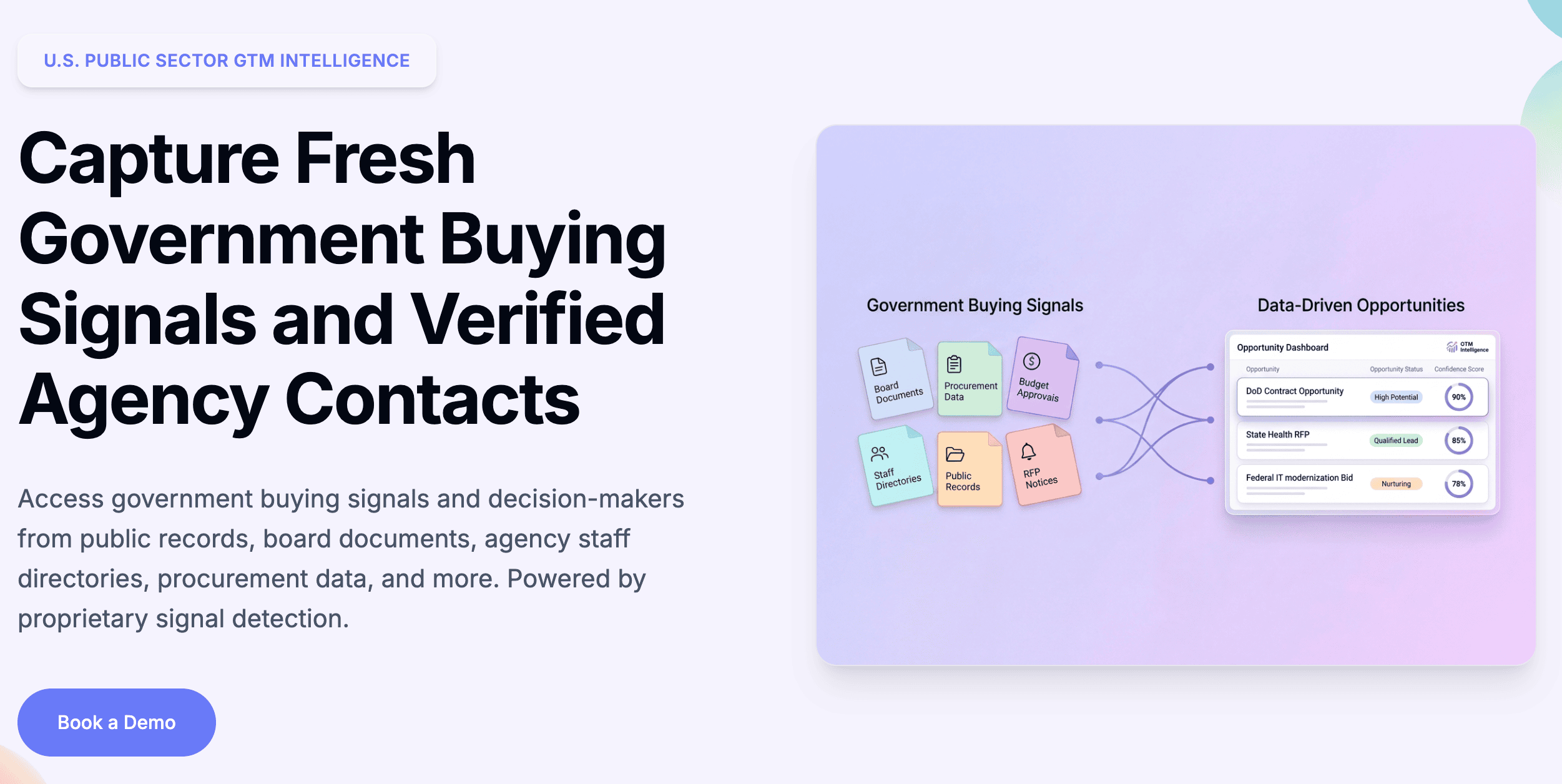
Pintel.ai helps B2G revenue teams identify government contract opportunities, discover verified decision-makers, uncover buying signals, and research agencies from a single platform. Built for modern public sector GTM teams, it combines AI-powered research with verified government intelligence to help teams find and pursue opportunities faster.
Strengths
- Government contracts, verified government contacts, and buying signals in one platform
- AI-powered research that delivers actionable government intelligence
- Contract renewal tracking and incumbent vendor discovery
- Early visibility into procurement, funding, and modernization initiatives
- Comprehensive agency research for smarter opportunity qualification
- Verified government contacts for targeted outreach
- CRM-ready intelligence for sales and business development teams
- Built for modern B2G prospecting and account planning
Limitations
- Built for modern government sales workflows rather than traditional contract record management.
Best For
Government contractors, B2G sales teams, capture managers, and business development professionals looking to identify opportunities, research agencies, and engage government buyers more effectively.
USAspending.gov: Strong for Free Federal Award Data, Weak on Search Sophistication
USAspending.gov is the federal government’s own spending transparency portal, built to satisfy the DATA Act of 2014, but its search tools are built for public transparency rather than competitive research, so filtering by contract vehicle or set-aside type takes more manual work than a purpose-built BD tool.
Strengths:
- Free, official source for federal contract, grant, and loan spending data
- Spending Explorer and Data Lab dashboards turn raw award data into agency-level and category-level views
- API access for teams that want to pull the same data into their own systems
Limitations:
- Federal data only, no state, local, or education coverage
- Defense Department award data carries a 90-day reporting delay
Pricing: Government portal
Best for: Teams that need a free, authoritative starting point for federal award and spend research.
FPDS-NG: Strong for Contract-Action-Level Detail, Weak on Usability
FPDS-NG is the system of record agencies use to report every federal contract action, giving it more granular detail than USAspending.gov’s summarized view, but the interface is dated and built for compliance reporting, not speed.
Strengths:
- Contract action data back to 1979, including base awards and modifications
- Search by vendor name, PIID, NAICS code, or contracting office
- 27 standard reports available to the public, plus custom report options
Limitations:
- Interface and search experience are dated compared to commercial alternatives
- Federal data only, with no built-in signal or contact layer
Pricing: Government portal
Best for: Teams that need contract-action-level detail beyond what USAspending.gov summarizes.
SAM.gov: Strong for Federal Registration and Live Solicitations, Weak as an Award History Tool
SAM.gov is the mandatory registration and solicitation portal for federal contractors, but its award history and search depth are limited compared to a dedicated government contracts database, so it works better as a free government rfp database for live opportunities than a research tool for past awards.
Strengths:
- Required registration point for any federal contract vendor
- Free listing of current federal solicitations, RFIs, and Sources Sought notices
Limitations:
- Limited historical award depth compared to USAspending.gov or FPDS-NG
- No state or local coverage, and no agency contact data
Pricing: Government portal
Best for: Federal vendor registration and a baseline view of currently posted opportunities.
GovTribe: Strong for Affordable Federal Research, Weak on State and Local Depth
GovTribe combines opportunity search, award history, and vendor profiles into one workspace at a price point far below enterprise alternatives, but its state and local coverage is an add-on rather than a core strength, so teams selling primarily outside federal agencies will find thinner records.
Strengths:
- Federal opportunity, award, and vendor profile data in one workspace, starting at $1,350 a year
- Semantic and keyword search with filters for NAICS/PSC codes, agency, and contracting vehicle
- Saved searches with alerts when new results match
Limitations:
- State and local coverage requires a separate Launch Plus or Growth Plus tier
- Historical depth is thinner than GovWin IQ’s archive
Pricing: From $1,350/yr
Best for: Small federal BD teams that want affordable award and vendor research.
HigherGov: Strong for Broad, Low-Cost Coverage, Weak on Analyst-Verified Depth
HigherGov covers federal, state, local, and education agencies at a starting price far below most competitors, but its research is largely automated rather than analyst-verified, so the depth on any single high-value opportunity is thinner than GovWin IQ’s human-researched entries.
Strengths:
- Searches more than 65 million contract and grant awards across federal, state, local, and education agencies
- Covers more than 7,000 state, local, and education agencies alongside federal data
- Starting price of $500 a year, among the lowest in this category
Limitations:
- Research is largely automated rather than analyst-verified
- Competitive intelligence depth on a single opportunity is thinner than GovWin IQ
Pricing: From $500/yr
Best for: Teams that want the broadest government-tier coverage without an enterprise budget.
GovSpend: Strong for State, Local, and Education Purchasing Data, Weak on Federal Depth
GovSpend aggregates purchase orders, vendor payments, and budget data from more than 1,400 state, local, and education sources, but its federal coverage runs through the Fedmine acquisition, not a core strength, so federal-focused teams will find deeper options elsewhere.
Strengths:
- Aggregates purchasing records from 1,400+ state, local, and education sources
- Covers purchase orders and vendor payments, not just published solicitations
- Fedmine module adds federal contract data through 19 aggregated datasets
Limitations:
- Federal coverage is an added module, not the platform’s core strength
- Pricing is not published and requires a sales call to confirm
Pricing: From $8,500/yr
Best for: Teams selling primarily into state, local, and education agencies.
GovWin IQ (Deltek): Strong for Historical Depth and Analyst Research, Weak on Price and Interface
GovWin IQ has the broadest federal historical archive in this category, backed by more than 150 analysts who verify opportunities directly with agencies, but it is also the most expensive platform on this list, and its interface is widely described as dated.
Strengths:
- Broadest and deepest federal contract archive of any platform in this category
- 150+ analysts who research opportunities directly with agencies, often 6 to 18 months before an RFP posts
Limitations:
- Priced from roughly $12,000 to more than $42,000 a year, the highest in this comparison
- Interface is commonly described as dated and click-heavy
Pricing: From $12,000/yr
Best for: Enterprise government contractors that can absorb the cost of the deepest analyst-verified archive available.
Bloomberg Government: Strong for Policy and Budget Intelligence, Weak as a Dedicated Contracts Database
Bloomberg Government started as a news and policy intelligence service and added contract data afterward, so its legislative, budget, and agency leadership coverage is strong, but contract search remains a secondary feature without a dedicated platform’s recompete or compliance tools.
Strengths:
- Strong federal budget, appropriations, and legislative intelligence alongside contract data
- Tracks agency leadership changes and policy shifts that predict future procurement activity
Limitations:
- Contract search is a secondary feature, without recompete prediction or compliance scoring tools
- No state, local, or education coverage
Pricing: From $7,500/yr
Best for: Teams that need policy and budget intelligence layered alongside basic contract data.
BidNet Direct: Strong for State and Local Bid Access, Weak as a Historical Award Database
BidNet Direct centralizes state and local government contracts for bid across all 50 states, but it is built as a live bid board, not a historical award archive, so it will not answer “who won this contract last time” the way a dedicated database does.
Strengths:
- Centralizes bid opportunities from more than 90,000 government agencies across all 50 states
- Tiered pricing starting around $9 per state per month, scaling to full state and local coverage
Limitations:
- Built for live bid discovery, not historical award or spend research
- No federal coverage
Pricing: From $9/state/mo
Best for: Vendors monitoring state and local government contracts for bid across multiple states at once.
How to Choose the Right Government Contracts Database
The right platform depends on which government tier you sell into and whether you need history, live bids, or both.
If you sell only to federal agencies: USAspending.gov and FPDS-NG cover free award research. GovTribe or HigherGov add opportunity search and vendor profiles at a low cost. GovWin IQ is worth the price only if the analyst-verified pre-RFP research changes your win rate enough to justify it.
If you sell to state, local, or education agencies: GovSpend and HigherGov both reach thousands of non-federal agencies. BidNet Direct is the more affordable option if your priority is live bid access rather than historical spend analysis.
If you are licensing a database, a bid tracker, and a contact research process separately: that is usually three subscriptions solving what could be one workflow.
Final Takeaway: Picking a Government Contracts Database That Matches Your Research Question
The best government contracts database is not the one with the most records. It is the one that covers your government tier and answers the research question you have today. A federal-only vendor does not need GovSpend’s state and local depth, and a vendor chasing school district contracts does not need GovWin IQ’s federal archive.
Free tools like USAspending.gov and FPDS-NG cover the baseline federal research most vendors need at zero cost. Paid platforms earn their price by adding broader tier coverage, faster search, or a signal and contact layer on top of the raw record.
FAQ: Government Contracts Database Platforms
What are the best government contracts database platforms?
The best government contracts database platforms include USAspending.gov and FPDS-NG for free federal award history, GovTribe and HigherGov for affordable contract and opportunity search, GovSpend for state and local purchasing data, and Pintel.ai for layering pre-solicitation signals and agency contacts onto contract records.
What is the difference between a government contracts database and a bid tracking platform?
A government contracts database shows historical records: who won a contract, its value, and when it expires. A bid tracking platform, sometimes called a government rfp database, monitors live solicitations and Sources Sought notices so a team can respond before a deadline.
Is USAspending.gov free to use for contract research?
Yes. USAspending.gov is the federal government’s official spending transparency portal, free to use, with search, dashboards, and API access. Defense Department award data carries a 90-day reporting delay.
What is the difference between FPDS-NG and USAspending.gov?
FPDS-NG reports individual contract actions at a granular level, including base awards and modifications back to 1979. USAspending.gov summarizes that same underlying data into more accessible dashboards and search tools for public use.
How much does GovSpend cost?
GovSpend does not publish pricing. Reported subscriptions typically range from $8,500 to $24,750 a year, with a median around $11,576, based on user count, modules selected, and contract length.
Which government contracts database covers state and local agencies, not just federal?
GovSpend and HigherGov both reach thousands of state, local, and education agencies. BidNet Direct focuses specifically on state and local government contracts for bid, though it functions as a live bid board rather than a historical database.
Can a government contracts database show me who my competitors are?
Yes, if it includes vendor profiles or award history by recipient. GovTribe, HigherGov, and GovWin IQ all let you search past awards by vendor name to see who has won similar contracts before.
Does Pintel.ai replace a government contracts database or work alongside one?
Pintel.ai includes contract record research alongside pre-solicitation signals and agency contacts, so many teams use it instead of a separate database subscription. Teams with existing GovWin IQ or GovSpend subscriptions can also layer Pintel’s signal and contact data on top.