Sales teams are under pressure to do more with less. AI sales tools are reshaping how reps prospect, communicate, forecast, and close. The shift is not about replacing reps. It is about removing the manual work that slows them down: researching accounts, writing outreach, logging calls, and guessing which deals will close.
This guide reviews 15 of the best AI sales tools for 2026, evaluated across six workflow categories: prospecting, sales engagement, conversation intelligence, revenue intelligence, data enrichment, and CRM AI. These platforms were selected based on AI capability depth, workflow coverage, CRM integration quality, and suitability for B2B sales teams of different sizes.
The list is ordered to follow the sales cycle, beginning with prospecting tools and moving through engagement, intelligence, and forecasting.
Quick Takeaways
- AI prospecting platforms reduce manual account research time and surface accounts that match your ICP at the moment they show buying signals, making outbound targeting more systematic.
- Conversation intelligence platforms identify deal risk and coaching moments that remain invisible in call recordings without automated analysis.
- Multi-channel engagement platforms can score sequences in real time and optimize send timing based on historical response patterns rather than rep intuition.
- Revenue teams that combine signal data with AI-powered forecasting tend to catch pipeline gaps earlier than teams relying on rep-reported data alone.
What to Look for in AI Sales Tools
Not every platform belongs in every stack. Before comparing features, apply these four criteria to identify which category of AI sales tools your team actually needs.
Workflow fit
Identify whether you are solving a prospecting problem, an outreach problem, a pipeline visibility problem, or a coaching problem. A conversation intelligence platform will not fix poor targeting. An intent data tool will not improve call quality. Matching category to workflow gap matters more than overall feature count.
Data quality and coverage
Most AI platforms are only as accurate as the underlying data. Ask vendors how often records are refreshed, which industries and geographies have the deepest coverage, and how data is sourced and validated. A platform with broad but shallow data will produce more dead ends than a narrower, higher-accuracy source.
Integration depth
Tools that sit outside your CRM create workflow friction and data silos. Prioritize platforms with native sync for Salesforce, HubSpot, or your existing stack. Bidirectional sync, automatic field mapping, and activity logging without manual entry reduce adoption barriers significantly.
Compliance and security
B2B sales data tools operate across GDPR, CCPA, and other regional privacy frameworks. Evaluate how each vendor sources data, handles opt-out requests, and documents compliance. For regulated industries, confirm whether the platform holds SOC 2, ISO 27001, or equivalent certifications before purchasing.
With those criteria in mind, here are the 15 AI sales tools worth evaluating in 2026, organized from prospecting through engagement, intelligence, and forecasting.
Best AI Sales Tools Compared: Category, Use Case, and Key Limitation
Before diving into each AI sales tool, this comparison gives you a quick view of where each platform fits, what it is best suited for, and the key limitation to consider.
| Tool | Best For | Main Limitation | AI Capability |
|---|---|---|---|
| Pintel.ai | AI-powered B2B sales intelligence from research to outreach | Newer platform | AI-powered ICP fit, account research, scoring, contact enrichment, and buying signals |
| Gong | Conversation intelligence | Expensive for smaller teams | AI-powered sales analysis |
| Apollo.io | Prospecting and outreach | Inconsistent data coverage | AI-assisted sales workflows |
| Outreach | Sales engagement | Complex implementation | AI-powered sales assistance |
| Salesloft | Sales engagement | Expensive for smaller teams | AI-assisted sales workflows |
| Clay | Data enrichment and workflows | Requires significant setup | AI-powered automation |
| 6sense | Account-based marketing | High enterprise cost | AI-powered sales intelligence |
| Clari | Revenue forecasting | Requires reliable CRM data | AI-powered forecasting |
| Lavender | Sales email optimization | Limited workflow coverage | AI-powered email assistance |
| Instantly | Cold email outreach | Requires separate prospect data | AI-assisted automation |
| ZoomInfo | B2B sales intelligence | High contract commitment | AI-powered sales insights |
| HubSpot Sales Hub | Sales CRM and automation | Costs increase with scale | AI-assisted CRM capabilities |
| Fireflies.ai | Meeting intelligence | Requires additional tools | AI-powered meeting analysis |
| Reply.io | Multichannel outreach | Limited personalization depth | AI-assisted sales automation |
| Salesforce Einstein | CRM intelligence | Requires Salesforce | AI-powered CRM capabilities |
The 15 Best AI Sales Tools in 2026: Detailed Review
The comparison above gives you a quick overview of each tool. Now, let’s look at each platform in more detail, including what it is best for, its key capabilities, limitations, and pricing.
Pintel.ai
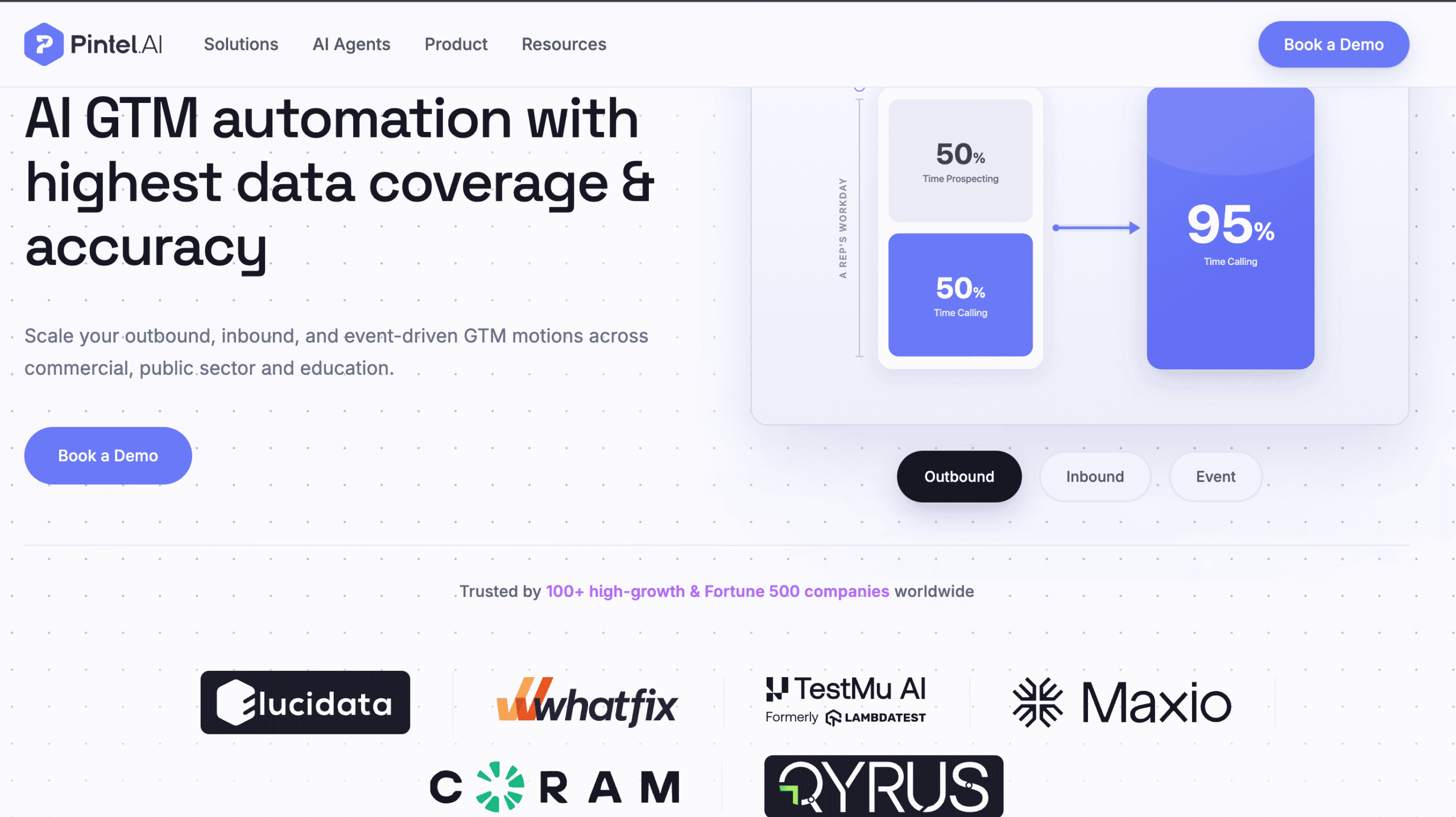
Best for: AI-powered B2B sales intelligence and workflow automation for SMBs to enterprises
Pintel.ai is an AI-powered sales intelligence platform built for B2B sales teams that want to move beyond static prospect lists. It combines account research, strict ICP filtering, enrichment, buying signals, scoring, and contact intelligence to help sales teams identify the right accounts, understand them, and prioritize who to engage.
What separates Pintel.ai from other AI sales tools is its account intelligence layer. Instead of relying only on fixed filters or one-time lists, Pintel.ai combines account data, ICP fit, and buying signals to help reps identify accounts that are worth pursuing and understand why they should act.
Key capabilities:
- Strict ICP filtering: Apply detailed company and business criteria to build highly targeted account lists that closely match your ICP.
- AI account research: Research companies, technologies, business context, and other account-level information to understand target accounts faster.
- Company and contact enrichment: Enrich account and stakeholder data through a multi-source enrichment waterfall.
- Buying signal identification: Surface hiring activity, technology changes, company events, acquisitions, funding, and other signals that indicate potential buying activity.
- ICP fit and account scoring: Score and rank accounts based on ICP fit, buying signals, and qualification criteria.
- Persona cohorts and role prioritization: Define the number of contacts needed from each target account and set role priorities such as P0: Senior SDR Manager, P1: SDR, P2: Junior SDR. Pintel.ai works through these priorities to find the required contacts in order.
- Account prioritization: Combine account fit and buying signals to identify which accounts deserve attention first.
- Decision-maker identification: Find relevant stakeholders within high-priority accounts for targeted outreach.
- Continuous signal monitoring: Keep account priorities updated as new company and buying signals emerge.
AI Capabilities: Pintel.ai uses AI to research accounts, assess ICP fit, identify buying signals, enrich company and contact data, score accounts, and prioritize sales opportunities based on fit and timing.
Limitations:
- Newer market entrant, with a smaller third-party review base than established vendors.
Compliance: ISO 27001 certified, SOC 2 (AICPA), GDPR compliant, HIPAA compliant, CCPA compliant, and VAPT certified.
Pricing: Self-serve and enterprise tiers available. Contact Pintel.ai for current pricing.
2. Gong
Best for: Conversation intelligence and pipeline visibility
Gong records, transcribes, and analyzes sales calls, emails, and meetings. Its AI surfaces patterns across interactions to identify which behaviors correlate with closed deals, which deal risks go unaddressed, and where coaching has the highest return. Managers get a structured view of pipeline health without relying on rep self-reporting, and reps receive feedback tied to specific conversations rather than general guidance.
Key capabilities:
- Call and meeting transcription with automated deal risk analysis
- Coaching insights derived from conversation patterns across the team
- Pipeline inspection dashboards for forecast review without manual rep input
Limitations:
- Enterprise contract pricing can reach six figures annually; covers only conversation and pipeline intelligence with no prospecting or data capability.
Pricing: Contact Gong for current pricing; enterprise-tier positioning with custom quotes.
3. Apollo.io
Best for: All-in-one prospecting and outreach for mid-market teams
Apollo.io combines a contact database with sequence automation, a built-in dialer, and AI-powered lead scoring. It is a practical entry point for teams that need prospecting data and engagement tools without managing two separate platforms. The AI layer scores leads based on engagement signals and recommends next steps based on prospect behavior patterns.
Key capabilities:
- Prospecting database with email verification and contact enrichment
- Sequence automation with AI-based send timing and step recommendations
- Integrated dialer and LinkedIn workflow within a single platform
Limitations:
- Data accuracy issues are widely reported, particularly for mobile numbers and international contacts; the platform also lacks signal-based account prioritization.
Pricing: Free tier available; paid plans start at $49 per user per month.
4. Outreach
Best for: Enterprise sales engagement and pipeline management
Outreach is a sales engagement platform with an AI layer that optimizes sequence performance, analyzes email sentiment, and surfaces deal risks. It is built for teams that run complex, multi-touch outreach across email, phone, and LinkedIn. Its forecasting features give revenue leaders a structured view of deal progression without requiring reps to manually update pipeline data.
Key capabilities:
- Multi-touch sequence automation across email, phone, and LinkedIn
- AI meeting assistant for call notes, action items, and next-step capture
- Pipeline inspection with deal health scoring and forecast rollups
Limitations:
- Full implementation requires a dedicated RevOps resource and a months-long rollout; under-resourced teams frequently end up with partial, underperforming deployments.
Pricing: Contact Outreach for current pricing; enterprise-focused with custom quotes.
5. Salesloft
Best for: Signal-based sales workflows and rep coaching
Salesloft aggregates intent signals, CRM data, and engagement history, then recommends the next action for each account. It turns a rep’s daily workflow into a prioritized action list rather than a manually sorted queue. The platform also includes conversation intelligence and coaching tools for managers reviewing rep performance.
Key capabilities:
- AI signal aggregation that generates a prioritized daily action list per rep
- Conversation intelligence with automated coaching insights after each call
- Deal inspection and pipeline analytics integrated directly with CRM data
Limitations:
- Enterprise pricing and multi-year contract structures make it inaccessible for most teams below 30 to 40 reps.
Pricing: Contact Salesloft for current pricing; enterprise tiers with modular packaging.
6. Clay
Best for: AI-powered data enrichment and outbound workflow automation
Clay aggregates data providers into a single enrichment waterfall. Teams use it to build prospect lists, run custom AI research tasks, and push personalized outreach at scale without engineering resources. It is especially common with revenue operations teams and growth-stage companies that need flexible workflow automation without writing code.
Key capabilities:
- Multi-provider data enrichment waterfall for contact and account data
- AI agent for custom prospect research and personalized messaging at scale
- No-code workflow builder for automating lead sourcing and outreach triggers
Limitations:
- Steep learning curve; most teams require several weeks of ramp before building reliable workflows, and credit costs escalate sharply at high enrichment volumes.
Pricing: Free tier available; paid plans scale by credit usage starting around $149 per month.
7. 6sense
Best for: Intent data and account-based marketing for enterprise B2B
6sense identifies anonymous buyers researching solutions in your category, predicts where accounts are in the buying journey, and recommends the appropriate engagement strategy. Its Revenue AI layer aggregates first-party, third-party, and behavioral intent data to surface accounts that are actively in-market before they respond to outreach. For how buyer intent data fits into a broader prospecting workflow, see the best buyer intent tools for B2B sales.
Key capabilities:
- Anonymous buyer identification across B2B web activity
- AI-predicted buying stage for target accounts, updated continuously
- Native integrations with major CRM and sales engagement platforms
Limitations:
- Enterprise-only contracts with high minimum commitments place it beyond reach for most teams below 50 reps; intent scores are probabilistic and produce false positives in niche or international markets.
Pricing: Contact 6sense for current pricing; enterprise contracts typically required.
8. Clari
Best for: Revenue intelligence and AI-powered forecasting
Clari captures activity data from email, calendar, and CRM, then uses AI to assess deal health, flag at-risk opportunities, and generate forecast predictions. It removes reliance on rep-reported pipeline updates by pulling signals directly from communication patterns. Revenue leaders use it to run more accurate quarterly planning and intervene on slipping deals before the quarter closes.
Key capabilities:
- AI deal scoring based on engagement patterns and historical win rates
- Automated activity capture to reduce manual CRM logging
- Forecast rollups across teams and regions with variance analysis
Limitations:
- Forecast accuracy degrades significantly when CRM data is incomplete or inconsistently entered; the platform covers only forecasting with no value for prospecting or outreach.
Pricing: Contact Clari for current pricing; enterprise-tier with modular product packaging.
9. Lavender
Best for: AI email coaching for outbound sales reps
Lavender is a browser extension that scores cold emails in real time and suggests specific improvements to increase reply rates. It draws on data from millions of sent emails to surface what drives responses: subject line length, word choice, personalization depth, and email structure. SDRs and account executives use it to self-edit before sending without waiting for a manager review cycle.
Key capabilities:
- Real-time email scoring with specific improvement recommendations as the rep writes
- Personalization prompts based on recent prospect activity and signals
- Integrations with major email clients and engagement platforms
Limitations:
- Single-purpose tool with no value outside of email writing; rep-dependent adoption means teams without enforcement rarely see meaningful return.
Pricing: Free tier available; paid plans start at $29 per user per month.
10. Instantly
Best for: High-volume cold email outreach and deliverability management
Instantly is built for teams that send significant volumes of cold email and need infrastructure to maintain deliverability at scale. It supports unlimited email account connections with automated inbox rotation, AI-personalized email variants, and campaign analytics. It is a common choice for agencies and outbound-heavy teams running campaigns across multiple domains and sender identities.
Key capabilities:
- Email account rotation and inbox warm-up for deliverability management
- AI-generated email variants and personalization at volume
- Campaign analytics covering replies, bounces, and deliverability
Limitations:
- No contact database; requires pre-sourced lists from a separate tool, and high-volume campaigns carry domain reputation risk that demands active monitoring.
Pricing: Plans start at $37 per month; scales based on active leads and sending volume.
11. ZoomInfo
Best for: Enterprise B2B data and intent signal coverage
ZoomInfo is a B2B data platform with an extensive professional database, intent data aggregated through third-party publisher networks, and signal-based workflow automation. Enterprise teams use it as a primary source for account research, contact identification, and intent-based account prioritization. For teams building out AI-driven account research workflows, see AI account research and contact identification.
Key capabilities:
- Extensive B2B contact and company database with email and direct-dial coverage
- Intent data sourced from third-party publisher networks
- Workflow automation triggered by signal thresholds
Limitations:
- Annual contract minimums and high per-seat pricing make it one of the most expensive options in the category; data accuracy is inconsistent for international contacts and smaller-company segments.
Pricing: Contact ZoomInfo for current pricing; annual contracts; pricing varies by seat count and data access tier.
12. HubSpot Sales Hub
Best for: SMB to mid-market teams wanting an AI-enhanced CRM without Salesforce complexity
HubSpot Sales Hub includes an AI layer that powers predictive lead scoring, email and meeting scheduling assists, call summarization, and sequence personalization recommendations. It is accessible for teams without a dedicated CRM administrator, covering contact management, deal tracking, and sequence automation in one interface.
Key capabilities:
- Predictive lead scoring, email assist, and AI-generated call summaries
- Sequence automation with AI-recommended send timing and messaging suggestions
- Native integration with HubSpot Marketing Hub for full-funnel visibility
Limitations:
- AI capabilities lag behind purpose-built platforms for prospecting intelligence, deal risk detection, and signal-based account prioritization.
Pricing: Free CRM available; Sales Hub Professional starts at $90 per seat per month.
13. Fireflies.ai
Best for: AI meeting intelligence and automatic CRM note capture
Fireflies.ai joins meetings as a bot, transcribes the conversation, generates structured summaries with action items, and pushes notes directly to your CRM. It reduces the post-call logging burden for reps and ensures call outcomes are documented consistently rather than relying on rep memory. The platform integrates with over 50 video conferencing, calendar, and CRM tools.
Key capabilities:
- Automatic meeting transcription with speaker identification
- AI-generated summaries with action items and next steps organized by topic
- CRM sync for call notes with integrations across major platforms
Limitations:
- Summary quality varies with audio clarity and meeting structure; single-purpose tool with no deal intelligence or outbound capability.
Pricing: Free tier available; paid plans start at $10 per user per month.
14. Reply.io
Best for: Multi-channel AI outreach with an automated SDR agent
Reply.io is a multi-channel sales engagement platform with an AI SDR agent that handles prospect research, message personalization, and sequence execution across email, LinkedIn, calls, and SMS. Teams use it to run automated outreach workflows with human review at key touchpoints rather than manual rep involvement throughout every step.
Key capabilities:
- AI SDR agent for automated prospect research, message writing, and sequence execution
- Multi-channel automation across email, LinkedIn, phone, and SMS
- AI reply classification to route inbound responses by intent without manual triage
Limitations:
- AI-generated outreach is generic at default settings; genuine personalization requires significant configuration effort, and deliverability has been flagged as inconsistent at high volumes.
Pricing: Starts at $49 per user per month; AI SDR features available on higher tiers.
15. Salesforce Einstein
Best for: Enterprise sales teams running on the Salesforce platform
Salesforce Einstein is the AI layer embedded across the Salesforce platform. It includes predictive lead and opportunity scoring, automated activity capture to reduce manual CRM logging, deal insights that surface engagement risks, and a generative AI assistant that answers pipeline questions and drafts emails within the CRM interface. For Salesforce-native organizations, it is the most integrated option for adding AI capabilities without a third-party tool.
Key capabilities:
- Predictive lead and opportunity scoring based on historical CRM conversion data
- Generative AI assistant for pipeline queries and email drafting within the CRM
- Automated activity capture from email and calendar with CRM field updates
Limitations:
- All AI features depend on CRM data completeness; advanced AI capabilities require paid add-ons layered on top of already expensive Salesforce licensing.
Pricing: Included with select Salesforce editions; advanced AI features require additional licensing. Contact Salesforce for current pricing.
Building Your AI Sales Stack
The best AI sales tools for your team are the ones that map to a specific workflow gap. A platform that transforms enterprise forecasting will not necessarily help a three-person outbound team. Start by identifying one category where manual work is slowing your pipeline: account research, outreach, meeting follow-up, or forecasting. Add one tool, measure the impact, and expand from there. Stacking platforms before any single one is embedded in the workflow tends to create noise rather than results.
FAQ’s
What are AI sales tools?
AI sales tools use artificial intelligence to automate, analyze, or improve sales activities such as prospecting, account research, outreach, conversation analysis, and forecasting.
What can AI sales tools automate?
Depending on the platform, AI sales tools can automate tasks such as account research, prospect identification, lead scoring, outreach assistance, meeting summaries, pipeline analysis, and sales forecasting.
How do I choose the right AI sales tool for my team?
Start with the sales workflow you want to improve, then evaluate data quality, AI capabilities, CRM integrations, ease of use, pricing, and how well the tool fits your existing sales process.
Can AI sales tools replace SDRs?
AI sales tools are primarily designed to reduce repetitive sales work and help reps research, prioritize, and engage prospects more efficiently. Human reps are still needed for relationship building, qualification, complex conversations, and closing.
What is the best AI sales tool for B2B prospecting?
The best option depends on your workflow. Teams focused on finding and prioritizing B2B accounts should look for AI capabilities around ICP matching, account research, buying signals, contact intelligence, and prospect prioritization.
Should I use one AI sales tool or multiple tools?
Start with the workflow creating the biggest bottleneck. Using one tool effectively is often better than adding several overlapping platforms that create duplicate data, disconnected workflows, and higher costs.
How much do AI sales tools cost?
Pricing varies significantly by platform, data volume, users, features, and contract structure. Some offer free or self-serve plans, while enterprise platforms typically use custom pricing.