Most buyer intent tools sell you a list of companies that visited your website last week. That is web analytics repackaged as intent data.
Real buying intent shows up months earlier: a new CRO joined an account, the company raised a Series B, a major tech stack contract is up for renewal. According to Gartner, B2B buyers complete more than 57% of their evaluation process before contacting a vendor. The best buyer intent tools reach you before the prospect even starts searching for your category.
TL;DR
- Buyer intent tools identify accounts in an active buying window by tracking signals across behavior, research activity, and structural account changes.
- Most teams only buy behavioral intent tools (website visitor tracking). The accounts most likely to close are showing structural signals: funding rounds, leadership changes, tech stack migrations.
- The top buyer intent tools for B2B teams are Pintel.ai, 6sense, and Bombora, depending on your go-to-market motion and target market.
- Use the Intent Signal Stack framework to evaluate tools by the depth of signal they capture, not just the volume of accounts they flag.
- See the full comparison table and per-tool breakdown below.
Here are the 10 best buyer intent tools for B2B sales teams in 2026, ranked by signal depth and go-to-market fit.
Quick Comparison: 10 Best Buyer Intent Tools at a Glance
Each tool captures a different layer of buying intent data. Use this table to shortlist by signal type and use case before reviewing individual tools in depth.
| Tool | Signal Type | Best For | Pricing |
|---|---|---|---|
| Pintel.ai | Structural + contextual + behavioral | Signal-driven outbound, global ICP, niche sectors | Contact for pricing |
| 6sense | Predictive + behavioral + contextual | Enterprise ABM teams | Contact for pricing |
| Bombora | Contextual (topic research) | Third-party intent enrichment | Contact for pricing |
| Demandbase | Predictive + behavioral | Marketing-led ABM programs | Contact for pricing |
| G2 Buyer Intent | Behavioral (review site activity) | Software vendors with a G2 presence | Add-on to G2 subscription |
| TechTarget Priority Engine | Contextual (publisher research) | Enterprise tech vendors | Contact for pricing |
| ZoomInfo Intent | Contextual (topic research) | Teams already on ZoomInfo | Add-on to ZoomInfo plan |
| Dealfront | Behavioral (website visitor ID) | Inbound-led teams in EU/DACH | From ~$99/month |
| Cognism | Contextual (Bombora-powered) | EMEA-focused outbound teams | Contact for pricing |
| Apollo.io | Behavioral (job postings + tech) | SMB teams, all-in-one outreach | From $49/month |
What Are Buyer Intent Tools?
Buyer intent tools are platforms that track signals indicating when a company is actively moving toward a purchase decision. They connect those signals to named accounts in your CRM or target list, so your sales team reaches out at the moment an account is most likely to buy.
The term “intent” covers three very different types of signals. Some tools track website behavior (who visited your pricing page). Others track research activity (which topics a company is reading about across publisher networks). A third category tracks structural changes inside accounts (funding rounds, leadership hires, tech stack changes) that predict a buying window before the prospect starts researching at all.
Most tools cover one layer. The gap between what most teams buy and what actually drives pipeline is almost always in the signal layer they are not tracking.
Top10 Buyer Intent Tools
Pintel.ai
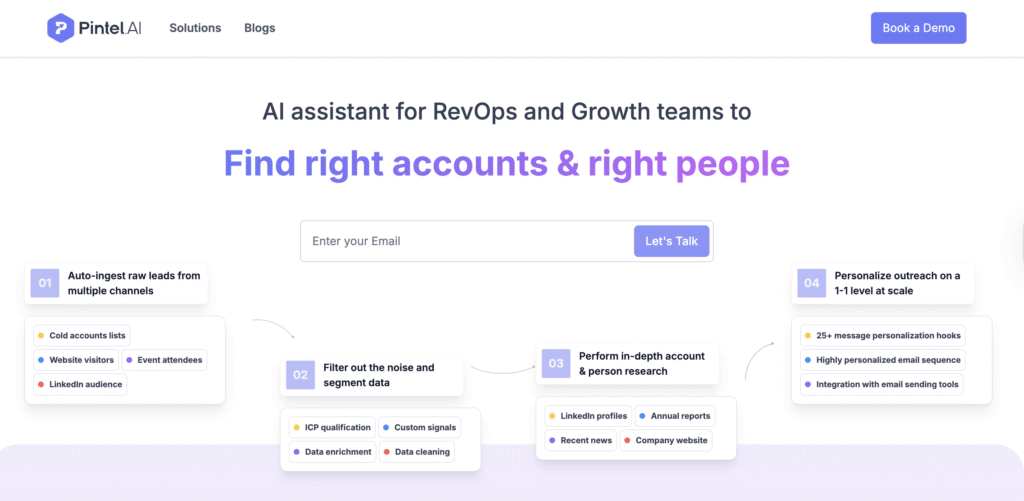
Pintel.ai is a signal-driven prospecting platform that tracks three types of buying signals:
Structural signals are company-level changes that happen before a prospect starts searching: funding rounds, leadership hires, hiring spikes in key roles, tech stack migrations, etc. These appear three to twelve months before a formal evaluation.
Contextual signals are third-party topic research data: which categories a company is actively reading about across publisher networks and intent data providers. These are two to six weeks ahead of evaluation.
Behavioral signals are first-party activity: website visits, content downloads, and review site engagement. These are late-stage, but useful for confirmation.
Most intent tools only flag accounts at the behavioral stage. Signal-driven teams reach accounts months before competitors who rely on website visitor data.
Strengths:
- Tracks structural buying signals (funding rounds, leadership hires, tech stack changes, hiring spikes, etc.) that most intent tools do not capture at all
- For teams targeting niche sectors (education, government, healthcare, manufacturing) and global markets: reaches non-indexed proprietary sources like government procurement records, board minutes, school directories, and local business data that no standard intent tool covers
- Multi-signal triangulation: surfaces accounts showing three or more simultaneous signals, separating active buying windows from noise
- Applies plain-English ICP filtering at scale to remove false positives before signals reach the sales team
- Global coverage with no regional limitations, including multi-language support for non-English prospect profiles across EMEA, APAC, and beyond
Limitations:
- Less market visibility compared to 10-year-old intent data vendors, which is common for fast-growing platforms
Pricing: Contact for pricing
Best for: Signal-driven outbound teams globally, niche industries (education, government, healthcare, manufacturing, and more), and GTM teams across US, EMEA, and APAC that need multi-region intent coverage beyond basic behavioral data
For teams running structured outbound workflows, Pintel.ai’s buying signal data integrates directly into account prioritization so reps work the highest-readiness accounts first.
2. 6sense
6sense is a predictive ABM platform that identifies anonymous website visitors, layers in third-party intent signals, and scores accounts for sales readiness, but its enterprise pricing and setup complexity put it out of reach for most teams below 50 sales reps.
Strengths:
- Identifies companies behind anonymous website traffic at account level with strong match rates
- Predictive scoring combining multiple behavioral and contextual signals into a single account readiness score
- Deep integrations with Salesforce, HubSpot, and major marketing automation platforms
Limitations:
- Enterprise pricing puts it out of reach for most teams below 50-person sales organizations
- Less effective for niche industries and non-tech verticals where web-based behavioral signals are sparse
Pricing: Contact for pricing (enterprise tier)
Best for: Enterprise ABM teams with mature marketing operations and dedicated RevOps support

3. Bombora
Bombora tracks content consumption across a network of B2B publisher sites to identify companies surging in research around specific topics, but it covers contextual intent only and cannot capture structural signals or identify individual decision-makers within an account.
Strengths:
- Wide topic coverage across B2B categories, with integrations into most major CRMs and marketing automation platforms
- Useful for enriching existing account lists with early-stage research intent signals
- Available through multiple platforms (ZoomInfo, Cognism, Demandbase) as a data layer
Limitations:
- Topic-level only: no structural signals, no individual prospect behavior, no intent from non-web sources
- Signal lag of one to two weeks, which matters for fast-moving buying windows
Pricing: Contact for pricing (typically sold as a data partnership or through platform resellers)
Best for: Teams enriching existing account lists with third-party topic research intent, particularly those in mainstream tech categories
4. Demandbase
Demandbase incorporates intent signals into advertising targeting and account-level scoring for ABM programs, but it requires dedicated RevOps support to set up and only delivers value when marketing and sales are fully aligned on the same account list.
Strengths:
- Combines intent data with programmatic advertising for coordinated account targeting across ads and outbound sequences
- Strong account-level firmographic and technographic enrichment layered with intent signals
- Well-suited for full-funnel ABM programs where marketing and sales share the same target account list
Limitations:
- Realizing full value requires a dedicated marketing operations or RevOps resource
- Platform depth only pays off when marketing and sales are tightly aligned on shared account lists
Pricing: Contact for pricing
Best for: B2B SaaS companies with 100-plus-person marketing and sales teams running coordinated ABM programs
5. G2 Buyer Intent
G2 Buyer Intent identifies companies whose employees visited your product page, competitor pages, or category pages on G2, but it only captures accounts already aware enough to compare on a review site — missing most early-stage buying activity.
Strengths:
- Confirmed in-market signal: visitors are actively comparing solutions in your category
- Shows which competitor pages each account visited, so reps know which alternatives prospects are considering
- Easy to activate for teams already using G2 for reviews and social proof
Limitations:
- Coverage limited to companies whose employees visited G2, capturing only a fraction of total buyers in a category
- Late-stage signal: accounts comparing on G2 are often 70% or more through their evaluation already
Pricing: Available as an add-on to G2 seller plans
Best for: Software companies with a strong G2 presence that want to convert active evaluators faster and identify competitive threats in real time
6. TechTarget Priority Engine
TechTarget Priority Engine captures intent signals from its owned media network of enterprise tech content, surfacing accounts and contacts actively researching your category, but it is effective for enterprise IT verticals only and has limited value for SaaS, services, or non-tech categories.
Strengths:
- Contact-level intent: identifies specific individuals researching your category, not just the account
- Covers IT, security, networking, and infrastructure functions within enterprise buying committees
- Useful for vendors selling to structured enterprise procurement cycles
Limitations:
- Effective for enterprise IT verticals only; limited for SaaS, services, or non-tech categories
- Expensive relative to coverage for mid-market teams outside core enterprise technology
Pricing: Contact for pricing
Best for: Enterprise technology vendors (cybersecurity, infrastructure, cloud) selling to large IT organizations with structured procurement cycles
7. ZoomInfo Intent
ZoomInfo Streaming Intent layers Bombora-powered topic-research signals onto the ZoomInfo contact database, but the intent data is not proprietary, signal quality outside North America is inconsistent, and it adds meaningful cost on top of an already expensive subscription.
Strengths:
- Integrates intent signals directly with ZoomInfo contact records for immediate outbound activation
- Covers a broad range of B2B topics through the Bombora data partnership
- Reduces tool switching for teams already deeply embedded in the ZoomInfo workflow
Limitations:
- Intent data is licensed from Bombora, not proprietary, limiting differentiation vs. buying Bombora through another platform
- Weaker signal coverage outside North America, where ZoomInfo’s core database is strongest
Pricing: Add-on to existing ZoomInfo subscription
Best for: Teams already locked into ZoomInfo contracts that want to layer basic intent signals without adding a separate vendor
8. Dealfront (formerly Leadfeeder)
Dealfront identifies companies visiting your website by matching IP addresses to business accounts, but it only captures accounts already aware of and actively visiting your brand — providing zero value for cold outbound or net-new pipeline generation.
Strengths:
- Simple setup: identifies anonymous website visitors with no additional data sourcing required
- GDPR-compliant data handling, making it a strong choice for EU and DACH-focused sales teams
- Shows which pages (pricing, product, case studies) each visiting company viewed for clear intent context
Limitations:
- Only captures accounts that have already found your website: zero value for cold outbound or net-new pipeline generation
- Match rate gaps from mobile traffic, VPN use, and smaller companies with dynamic IPs
Pricing: From approximately $99/month
Best for: Inbound-led teams in EU and DACH markets that want to convert anonymous website traffic into identified account leads
9. Cognism
Cognism layers Bombora-powered intent signals onto its GDPR-compliant contact database for EU and UK markets, but its intent data is not proprietary and coverage outside Europe is weaker than US or APAC-focused alternatives.
Strengths:
- Strong GDPR-compliant contact data for EU and UK markets, with verified mobile number coverage
- Intent signals layered directly onto contact records for streamlined European outbound workflows
- Good for teams that need verified phone numbers alongside intent signals for call-first outbound sequences
Limitations:
- Intent data is Bombora-powered, not proprietary: the same contextual signals are available through other platforms
- Contact and intent coverage outside EU and UK is weaker than US-focused or APAC-focused alternatives
Pricing: Contact for pricing
Best for: Outbound teams targeting European accounts where GDPR compliance and verified mobile data are both required alongside intent signals
10. Apollo.io
Apollo.io combines a contact database, email sequencing, and basic intent signals in one affordable platform, but its intent data relies on job posting patterns and technology detection rather than real-time buying signals, making it a proxy rather than true intent data.
Strengths:
- All-in-one platform: contact data, sequencing, and basic intent signals in a single affordable product
- Job posting intent and technology detection provide useful structural proxies for SMB and mid-market outbound
- Strong self-serve onboarding and fast time-to-first-sequence for smaller teams with no RevOps support
Limitations:
- Intent signals are basic: job posting detection and technology installs are proxies, not real-time buying behavior data
- Contact data quality for non-US markets is inconsistent, limiting usefulness for global go-to-market teams
Pricing: From $49/month (paid annually), with intent features on higher-tier plans
Best for: SMB and early-stage teams that need an affordable all-in-one platform and can work with basic structural intent signals
How to Choose a Buyer Intent Tool: The Intent Signal Stack
Choose a buyer intent tool based on which signal layer you need most: behavioral signals catch accounts already researching your category; contextual signals catch accounts in early evaluation mode; structural signals catch accounts entering a buying window before they start searching at all.
Most teams evaluate buyer intent tools on brand name, integration list, or account volume. That is the wrong filter. The right filter is signal depth.
There are three layers in what high-performing teams call the Intent Signal Stack:
Behavioral signals (website visits, G2 profile views, content downloads) show accounts researching right now. These are late-stage signals. The prospect is already in evaluation mode before you have their attention.
Contextual signals (third-party topic research, publisher content consumption) show accounts starting to learn about a category, giving you a two to six week window before formal evaluation begins.
Structural signals (funding rounds, leadership changes, tech stack migrations, hiring spikes in relevant roles) show which accounts are entering a buying window, often three to twelve months ahead of a formal evaluation. Most buyer intent tools do not track structural signals at all.
An account showing four simultaneous signals is in the buying window today.
Use the Intent Signal Stack to evaluate every tool: which layer does it cover? A behavioral-only tool solves a different problem than a structural-signal tool. If your team runs high-velocity outbound, structural signals are your priority. If you are running an ABM strategy, predictive scoring with behavioral overlay is more relevant. For a full breakdown of how intent data providers differ in methodology, see our detailed guide.
How to Build Your Buyer Intent Stack in 2026
Build your buyer intent stack by starting with one signal layer, not three. The most common mistake is buying multiple buyer intent tools that cover overlapping signals and ending up with data overload instead of better pipeline.
Here is a practical framework based on your go-to-market motion:
If you run signal-driven outbound: Start with a structural signal tool to identify accounts entering a buying window before your competition reaches them. Add contextual intent (Bombora or ZoomInfo Intent) as a second layer to confirm topic-level interest. This combination gives you timing plus category validation at high precision.
If you run ABM at scale: Start with 6sense or Demandbase for predictive scoring and account prioritization. Layer in G2 Buyer Intent if you have a software product with strong review site presence. Your lead scoring models should weight structural signals higher than behavioral signals for early-pipeline accounts.
If you are inbound-led: Start with Dealfront or a similar website de-anonymization tool. This solves the most immediate problem: who is already on your site. Add a contextual or structural layer only after you have activated your existing warm traffic.
One approach worth considering: instead of buying separate tools for account discovery, buying intent data, and contact enrichment, an end-to-end platform like Pintel.ai’s prospect prioritization consolidates the data layer into a single workflow. This avoids the signal fragmentation from stitching five tools together, and keeps your team focused on outreach rather than reconciling conflicting signals.
The teams adding pipeline fastest use the deepest signal layer available, not the most tools.
According to Salesforce’s State of Sales, high-performing teams consistently prioritize account selection based on buying signals over static account lists. For a deeper look at how top teams build their account intelligence workflow end to end, see our guide on account research methods.
FAQ: Buyer Intent Tools
What are buyer intent tools?
Buyer intent tools are software platforms that track signals indicating when a business is actively evaluating or moving toward a purchase decision. These signals include website visits, third-party topic research, review site activity, funding events, leadership changes, and technology migrations. The best buyer intent tools combine multiple signal types to identify accounts in a buying window before those accounts contact vendors directly.
How do buyer intent tools work?
Buyer intent tools collect data from multiple sources: first-party behavioral signals (website visits, content downloads), third-party contextual signals from B2B publisher networks tracking research activity, and structural signals (funding events, hiring patterns, leadership changes). They match this data to account records in your CRM or target account list, then surface accounts showing elevated buying activity so sales teams can prioritize outreach at the right moment.
What is the difference between first-party and third-party intent data?
First-party intent data comes from your own digital properties: who visited your website, which pages they viewed, how often they returned. Third-party intent data comes from external networks tracking content consumption, review site activity, and research behavior across many publisher sites. First-party data is higher quality but narrow in scope. Third-party data provides broader market coverage but is shared with every team subscribing to the same provider.
What is the best buyer intent tool for small B2B teams?
For small B2B teams (under 20 reps), Apollo.io provides the best entry-level option: basic intent signals, a contact database, and sequencing in a single affordable platform. For outbound-focused teams, a structural signal tool like Pintel.ai identifies accounts entering a buying window earlier and with less noise than behavioral-only tools. The right choice depends on whether you are primarily inbound-led or outbound-led in your go-to-market motion.
How much do buyer intent tools cost?
Buyer intent tools range from approximately $49/month (Apollo.io, basic tier) to six-figure annual contracts (6sense, Demandbase, TechTarget Priority Engine). Mid-range tools like Dealfront start from around $99/month. Enterprise platforms like Bombora and ZoomInfo Intent are priced as add-ons or annual data partnerships. Total cost depends on coverage requirements, number of seats, and signal depth needed for your target market.
How do buyer intent tools integrate with CRMs?
Most buyer intent tools integrate directly with Salesforce and HubSpot through native connectors or Zapier workflows. The integration pushes intent signals as account fields, activity records, or lead scores into the CRM. Teams using multiple intent sources typically route signals through a data enrichment layer first to deduplicate before they reach the CRM.
What signals should I track with buyer intent tools?
Track signals in order of depth. Start with structural signals: funding rounds, VP-level hires in relevant functions, major tech stack changes, and hiring spikes. These predict buying windows three to twelve months out. Add contextual signals: third-party topic research through Bombora or similar networks. Behavioral signals (website visits, G2 page views) confirm late-stage interest but should not be the primary signal for early outbound pipeline.
How is Pintel.ai different from traditional buyer intent tools?
Traditional buyer intent tools track behavioral and contextual signals from public web sources. Pintel.ai adds a structural signal layer that most intent tools do not have: funding events, leadership changes, hiring spikes, and tech stack migrations. It also reaches non-public data sources (government procurement records, board minutes, proprietary industry directories) that no public web crawler can access. The result is buying signals that surface accounts three to twelve months earlier, with global coverage and no regional limitations.
For the broader strategy on identifying in-market accounts, see our guide on how to identify in-market B2B accounts before your competition does. To build a complete outbound stack around your buyer intent tools, see our breakdown of the best sales prospecting tools in 2026.