Finding reliable data on private companies is much harder than it looks. Many B2B databases perform well for public companies and VC-backed startups but struggle with privately held businesses, leaving sales teams with incomplete company records, missing decision-makers, outdated contact details, and limited buying signals.
Choosing the right private company data provider is equally challenging. Some platforms specialize in company intelligence, others focus on contact data, while a few combine verified contacts, firmographic data, and buying signals in a single platform. The best choice depends on the type of private companies you target and the data your sales team actually needs.
This guide compares the 8 best private company data providers based on company coverage, contact accuracy, firmographic depth, buying signals, regional reach, and non-traditional data sources, helping you choose the right platform for your outbound strategy.
What Are Private Company Data Providers?
A private company data provider helps B2B sales teams discover private companies, find decision-maker contacts, access company information, and track buying signals for businesses that are not publicly traded.
Why Is Private Company Data Harder to Source?
Revenue figures are modeled, not disclosed
Private companies file no SEC reports or board minutes, so revenue figures in most databases are estimates built from proxy signals like employee headcount and job posting volume. Two databases can show the same company at $15M and $40M revenue, and neither is verifiably wrong.
Decision-makers have thin digital footprints
Many decision-makers at traditional private companies do not maintain active LinkedIn profiles. Tools built on LinkedIn scraping return incomplete records for contacts at manufacturing firms, local service businesses, and government-adjacent organizations. A funded startup has a Crunchbase profile. A manufacturing company with 200 employees and no institutional investors is effectively invisible to most prospecting tools.
No disclosure events to trigger updates
Private companies change leadership and restructure without press releases. A contact accurate three months ago has a higher probability of being stale at a private company than at a public one, because there are no filing events to prompt database updates.
What Is the Private Company Data Stack?
Sales teams that build reliable outbound pipelines on private company accounts use three layers. The right private company data provider depends on which layer is missing.
Tier 1: Company identity and firmographics
Confirms the company exists, its size, industry, location, and estimated revenue. Government registries such as Companies House, India MCA, and US state business registries are the primary sourcing model, alongside trade directories and D-U-N-S numbers.
Tier 2: Private company contact data
Surfaces decision-makers: verified email addresses, direct dial numbers, and job titles. Tools vary sharply in how they source this. Web scraping, community contributions, and proprietary registry enrichment produce different accuracy levels, especially for companies with low digital footprints.
Tier 3: Signals and timing
Shows when a private company is in a buying window: hiring spikes, leadership changes, tech stack migrations, and facility expansions. Without this layer, teams reach the right contact at the wrong moment.
How 8 Private Company Data Providers Compare at a Glance
The table below maps each tool across the dimensions that determine whether a platform covers your actual private company ICP or returns gaps.
| Provider | Company Coverage | Contact Data | Signal Layer | Non-Web Sourcing | Best For |
|---|---|---|---|---|---|
| Pintel.ai | Global: proprietary registries + 30-plus providers | Verified email, direct dial, waterfall enrichment | Structural, contextual, behavioral | Government registries, trade directories, local business data | Full private company stack, all regions |
| ZoomInfo | US mid-market and enterprise | Email and phone, community-sourced | Job posting signals, intent data | Web and community only | US enterprise private company outbound |
| D&B Hoovers | 500M-plus via D-U-N-S registry | Thin; firmographics-first tool | Financial and ownership signals | D-U-N-S registry, proprietary data | Firmographic verification, ownership research |
| Crunchbase | VC and PE-backed companies | Executive names and LinkedIn links only | Funding events | Investor disclosures, startup web data | Funded startup targeting by investment event |
| Apollo.io | US and English-market SMB | Email and phone, web-sourced | Job change and hiring signals | Web scraping only | US SMB outbound with built-in sequencing |
| Cognism | European private companies | GDPR-compliant, Diamond Verified mobile | Limited signal layer | European registry feeds | UK and DACH private company contacts |
| Clearbit | Web-active private companies | Inbound enrichment only | Website visit and IP signals | Web and IP signals | Inbound lead enrichment for private companies |
| PrivCo | US private company financials | No contact data | M&A and financial events | Proprietary financial research | Private company financial intelligence |
This comparison is based on first-hand platform knowledge, publicly available product information, and commonly reported user experiences. Contact each vendor directly for the latest pricing and product details.
The table shows a clear split between tools built for contact prospecting and tools built for financial research. Selecting the right category before comparing features saves most evaluation effort.
How We Evaluated These Providers
Each provider was evaluated against a shared sample of private company accounts across US, EMEA, and APAC, using live product documentation and published pricing current as of July 2026. Evaluation focused on five criteria specific to private company data needs:
- Coverage depth for non-public companies, not just funded startups
- Contact accuracy: email deliverability and mobile number verification method
- Signal breadth: types of buying signals tracked for private companies
- Non-digital sourcing: government registries, trade directories, offline sources
- Regional breadth: US, EMEA, APAC, and emerging market coverage
8 Best Private Company Data Providers for B2B Sales Teams
Here’s a closer look at how each provider performs, where it excels, and the teams it’s best suited for.
1. Pintel.ai: Verified Contacts, Proprietary Registries, and Buying Signals for Private Companies Globally
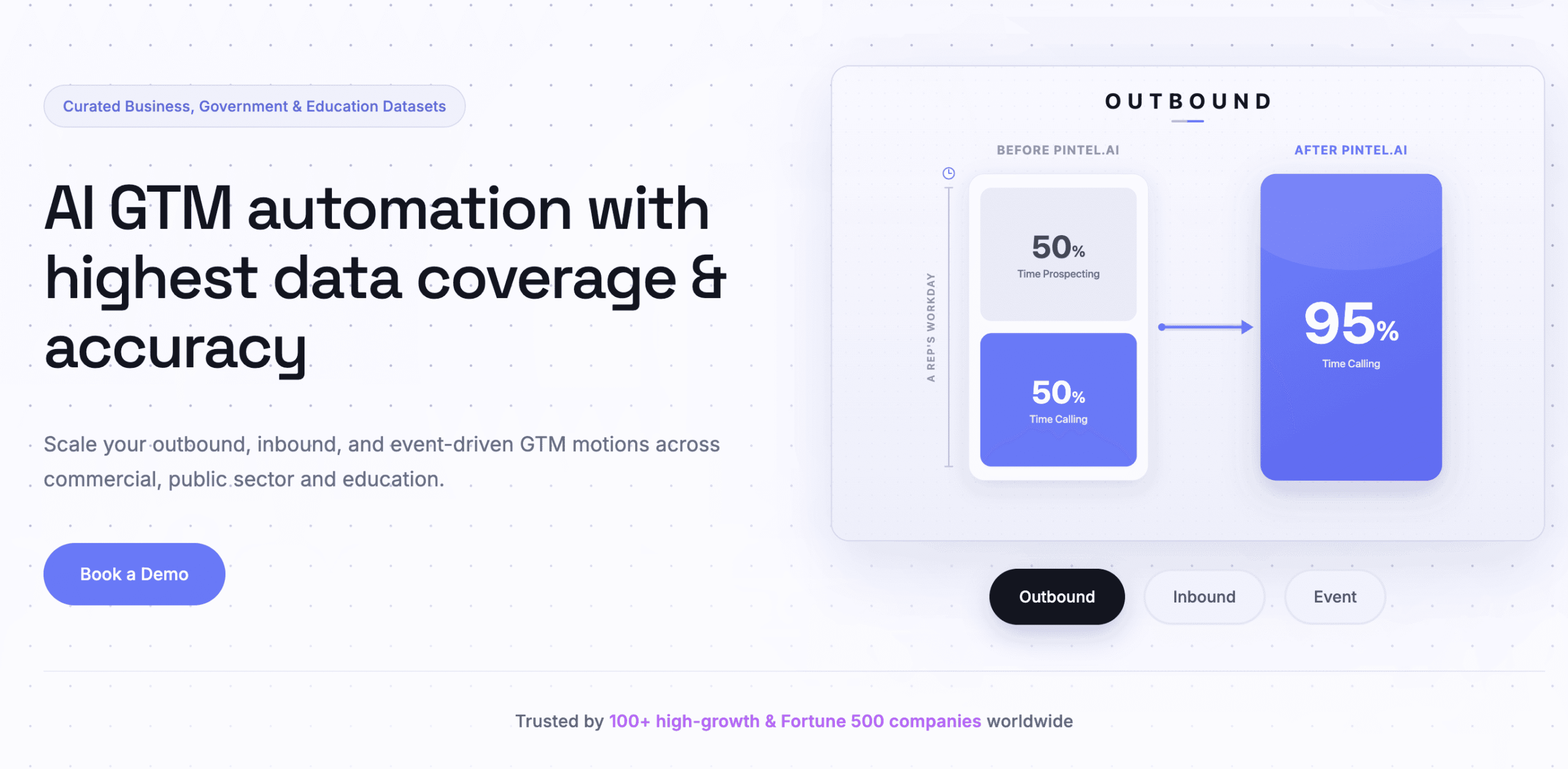
- Pintel.ai discovers private companies across the US, EMEA, APAC, GCC, and emerging markets using proprietary registries, trade directories, government records, and local business databases.
- It identifies the right decision-makers based on their role, responsibilities, and company context instead of relying only on exact job title matches.
- Pintel.ai enriches company and contact records with verified business emails, direct dials, mobile numbers, firmographic data, and company intelligence.
- Its waterfall enrichment queries 30+ vetted providers to improve contact coverage and reduce missing or outdated records.
- Pintel.ai tracks buying signals such as leadership changes, hiring activity, technology adoption, funding events, and facility expansions to help sales teams prioritize outreach.
- It automatically syncs enriched company and contact data to Salesforce, HubSpot, and other CRM platforms, reducing manual updates and keeping records current.
- Pintel.ai supports prospecting across manufacturing, healthcare, education, government, logistics, and other industries where traditional databases often have limited coverage.
- It maintains enterprise-grade security with ISO 27001, SOC 2, GDPR, HIPAA, CCPA, and VAPT compliance.
- Strong for: Global private company discovery, verified decision-maker contacts, buying signals, and CRM-ready data.
- Falls short for: Teams looking only for financial intelligence or private market investment data.
- Best for: Global B2B sales teams targeting private companies.
2. ZoomInfo: Strong for US Private Enterprise Companies, Weak for Small Private Companies and Non-US Markets
ZoomInfo sources private company data through community contributions, job posting signals, and third-party feeds. This produces solid coverage for US mid-market and enterprise private companies where employees maintain LinkedIn profiles. Two gaps appear: below 50 employees, US records thin out, and outside North America, coverage degrades significantly because the community-contribution model depends on a US-concentrated user base. ZoomInfo has no proprietary government registry sourcing.
- Strong for: US mid-market and enterprise private company contacts, broad CRM integrations, LinkedIn-active companies
- Falls short for: Small private companies under 50 employees, non-US markets, offline or registry-based sourcing
- Best for: US-focused teams targeting mid-market and enterprise private companies
3. D&B Hoovers: Strong for Private Company Firmographics and Ownership Data, Weak for Contact Prospecting
Dun & Bradstreet’s D-U-N-S number system covers over 500 million businesses globally, including private companies that appear nowhere else. This makes D&B Hoovers the strongest option for verifying company existence, understanding corporate hierarchy, and identifying whether a private company is PE-backed, family-owned, or a subsidiary. The weakness is contact depth: D&B Hoovers is a firmographic intelligence tool first, and email or phone fill rates are thinner than what sales-focused platforms provide.
- Strong for: D-U-N-S coverage across 500M-plus companies, corporate hierarchy and ownership structure, firmographic verification
- Falls short for: Email and direct dial contact depth, signal layer for timing outreach
- Best for: Teams that need to verify private company identity or understand ownership chains before prospecting
4. Crunchbase: Strong for Funded Private Companies, Weak for Non-Startup Private Markets
Crunchbase tracks private companies that have intersected with VC and PE: funded startups, PE-acquired companies, and growth-stage businesses with disclosed investor rounds. Outside the funded startup ecosystem, Crunchbase is sparse. A manufacturing company with 300 employees and no VC investors often returns no record. Crunchbase also does not provide outbound-grade contact data: it surfaces executive names and LinkedIn links, not verified emails or direct dial numbers.
- Strong for: Funding history for VC and PE-backed companies, investment events as buying signals, tech startup targeting
- Falls short for: Non-funded traditional private companies, direct email and mobile numbers for outbound
- Best for: Sales teams targeting VC-backed and PE-backed private companies using funding events as a prospecting trigger
5. Apollo.io: Strong for SMB Private Company Contacts in English-Language Markets, Weak for Non-Web-Active Companies
Apollo.io covers a broad range of private companies through web scraping, LinkedIn profile data, and community contributions. For outbound teams targeting small and mid-sized private companies in the US, UK, Australia, and other English-language markets, Apollo returns contact data at a competitive price point with native sequencing built in.
Its limitation is source dependency: Apollo’s private company coverage reflects what is findable on the open web. Private companies with minimal digital footprint, particularly in manufacturing and local services, often return thin or missing records.
- Strong for: US and English-market private company contacts, native sequencing, accessible pricing
- Falls short for: Companies with thin web presence, non-English markets, offline private businesses
- Best for: US-focused SMB outbound teams wanting private company contacts and sequencing in one tool
6. Cognism: Strong for European Private Company Contact Data, Weak for Global Coverage
Cognism focuses on GDPR-compliant private company contact data across Europe. Its Diamond Verified phone data gives European private company mobile numbers confirmed via human verification, not just database matching. For teams selling into UK, DACH, France, Benelux, and the Nordics, Cognism’s contact fill rates outperform US-built tools in those regions.
Outside Europe, private company coverage thins. APAC and emerging market coverage is limited, making Cognism most useful as the European layer in a broader data setup.
- Strong for: GDPR-compliant European private company contacts, Diamond Verified mobile numbers, UK and DACH coverage
- Falls short for: Non-European private companies, global teams needing APAC and US in the same platform
- Best for: Sales teams targeting private companies in UK, Germany, France, Benelux, and the Nordics
7. Clearbit (HubSpot Breeze Intelligence): Strong for Inbound Enrichment of Private Companies, Weak for Outbound Prospecting
Clearbit, now operating as HubSpot Breeze Intelligence, excels at identifying private companies from web visitor signals. When a company visits your website without completing a form, Clearbit can identify the company, append firmographic data, and route it into CRM workflows.
For outbound, Clearbit is weaker: its sourcing depends on web and IP signals, so it covers web-active private companies but misses companies with no digital engagement. There is no outbound contact discovery for finding decision-makers at unknown private company accounts.
- Strong for: Website visitor identification for private companies, firmographic enrichment of inbound records, deep HubSpot integration
- Falls short for: Cold outbound prospecting, private companies with no web presence, direct email and mobile for cold contact
- Best for: RevOps teams enriching inbound leads and qualifying private company website visitors
8. PrivCo: Strong for Private Company Financial Intelligence, Not Built for Sales Outbound
PrivCo provides financial and ownership intelligence for private companies: estimated revenues, EBITDA figures, ownership structure, M&A activity, and PE-backed status. For B2B sales teams focused on outbound prospecting, PrivCo is the wrong category of tool. It does not provide verified email addresses or direct phone numbers for individual decision-makers.
Teams that need financial context on a private company before first contact typically pair PrivCo with a separate contact data platform rather than using it as a standalone outbound tool.
- Strong for: Private company financial estimates, M&A and ownership tracking, PE-backed status, pre-call account context
- Falls short for: Contact data for outbound, signal data for timing, direct prospecting
- Best for: Investment, BD, and enterprise sales teams needing financial intelligence on private companies before the first call
How Do You Choose the Right Private Company Data Provider?
The right tool depends on which tier of the private company data stack your team is missing.
Gap is contacts inside a known company (Tier 2)
If your team can identify the right private companies but cannot find contacts inside them, tools with strong direct dial coverage and email verification are the priority. Pintel.ai’s account discovery and Cognism’s Diamond Verified model have the strongest case for different regions.
Gap is knowing when to reach out (Tier 3)
If your team knows who to target but cannot tell when they are ready to buy, the gap is signals. A private company showing new leadership, a hiring spike, or a facility expansion is a different outreach conversation than one showing no activity. Most standard databases do not track these signals for private companies below the funded startup level.
Gap is building the list from scratch (Tier 1)
If your team is building a list from scratch, the gap is account discovery. Company data enrichment at the account level, including firmographic data from government registries and trade directories, is where to start. Before buying, pull 50 private company accounts from your real target list and run them through the vendor’s trial. The fill rate on your actual ICP is the number that matters, not a vendor’s headline database size. The B2B contact data accuracy guide covers the full evaluation framework in detail.
Final Takeaway
Private company prospecting does not fail at the sequence or the messaging. It fails before the first email is sent, when the contact list is built on data that was never designed for private companies.
Government registries, trade directories, and multi-source waterfall enrichment are not just features to compare on a vendor checklist. They are the sourcing model that determines whether a contact list is usable or not. The teams closing consistently in private company verticals are not better at cold email. They are working from better data.
If your team is seeing bounce rates above 5% or contact fill below 70% on private company accounts, the data layer is the first fix. Not the sequence, not the cadence. The B2B database providers guide, the company data quality guide, and the B2B data providers comparison cover the sourcing mechanics in more detail. According to the US Small Business Administration, small businesses account for over 99% of all US companies — making private company data quality the core data challenge for most outbound teams, not a niche concern.
Frequently Asked Questions
What are private company data providers?
Private company data providers supply firmographic information, verified contacts, and buying signals for companies that do not trade publicly. For B2B sales teams, this means finding decision-makers at companies that file no public financial disclosures, covering over 99% of US businesses.
What makes private company data harder to source than public company data?
Private companies file no SEC reports or public financial disclosures. Revenue figures are modeled estimates. Decision-makers at traditional private companies often have thin LinkedIn profiles, so tools built on web and social data miss a significant share of contacts.
Is Pintel.ai a private company data provider?
Yes. Pintel.ai covers private company data across US, EMEA, APAC, and emerging markets using proprietary government registries, trade directories, and local business databases, plus waterfall enrichment across 30-plus providers. It also tracks buying signals such as leadership changes and hiring spikes.
Which private company data provider is best for European companies?
Cognism leads for GDPR-compliant European private company contacts, particularly mobile numbers in UK, DACH, France, and the Nordics. Pintel.ai covers European private companies through proprietary registries and adds a buying signal layer that Cognism does not include.
What is the difference between private company data and private market data?
Private company data means firmographic, contact, and signal data for B2B sales outreach at non-publicly-traded companies. Private market data means investment intelligence such as deal flow, cap tables, and VC or PE portfolio tracking. PrivCo and PitchBook serve investors. Pintel.ai, ZoomInfo, and Apollo serve B2B sales teams.
How often does private company data go stale?
Private company data decays faster than public company data because there are no mandatory disclosure events to trigger updates. Leadership changes happen without press releases. Teams should expect meaningful data decay every 3 to 6 months without a regular enrichment pass.