California has millions of registered business entities. Most B2B data platforms cover the full US market, with the strongest coverage concentrated in Bay Area SaaS. The gap shows up when you move to different company sizes, industries, or regions across the state, and it usually surfaces after your first sequence has already gone out.
This guide compares 10 California company database providers on verified contact coverage, ICP filtering depth, buying signals, and how data quality holds up across different California market segments. It includes a comparison table, a three-segment coverage test you can run before committing to any platform, and a breakdown of which provider fits which prospecting motion.
What Is a California Company Database?
A California company database is a structured dataset of businesses registered or operating in California, including firmographic attributes such as industry, headcount, revenue range, and location. For B2B outreach, the most useful California company databases also include verified decision-maker contacts, technographic data, and buying signal enrichment to identify accounts in an active buying window.
Which California Company Database Is Best for B2B Outreach?
The right platform depends on your ICP. Pintel.ai uses waterfall enrichment across 30+ sources to deliver high fill rates and verified contacts across California accounts. ZoomInfo fits enterprise technology accounts, Apollo.io fits early-stage SaaS teams, Crunchbase fits funding-triggered outreach, and the free California Secretary of State search verifies entity registration status for compliance and base list building.
The sections below cover what each platform actually contains, how the coverage holds up across California’s distinct market segments, and what to test before committing.
What Does a California Company Database Contain?
California has more registered business entities than any other US state. A commercial platform draws from the California Secretary of State registry and combines it with additional sourcing to produce enriched records. Each record typically contains:
- Company name, entity type, and registration status (LLC, corporation, active or inactive)
- Industry and sub-industry classification (SIC/NAICS codes, and in stronger platforms, granular sub-industry tagging beyond standard codes)
- Headcount and revenue range (estimated from LinkedIn, job postings, and commercial databases)
- Headquarters location (state, city, zip, and in better platforms, regional cluster classification)
- Technology stack (software and tools the company uses, sourced from job postings and web tracking)
- Funding history (for VC-backed companies: round details, investors, total raised)
- Verified contact data (decision-maker name, title, professional email, direct dial, LinkedIn URL)
- Buying signals (recent funding, leadership hires, tech stack changes, procurement activity)
Coverage of these fields varies significantly across platforms. Most standard databases cover Bay Area technology companies well. Coverage falls apart depending on company size, industry, and how the platform sources its data. Most teams discover this gap only after their sequences have already fired.
California Company Database Providers Compared
| Provider | CA Private Company Coverage | Contact Verification | Buying Signals | Non-Tech Vertical Coverage | Limitations |
|---|---|---|---|---|---|
| Pintel.ai | 90%+ via waterfall (30+ sources) | 95%+ match rate, dual-agent QA validation | Yes: funding, hiring, tech stack, procurement | Yes: waterfall across 30+ sources including registry data | No built-in email sequencer |
| ZoomInfo | Enterprise tech focus; gaps in private and non-tech | Continuous database refresh | Yes: third-party intent signals | Partial: gaps in healthcare, manufacturing, government | Stale data outside enterprise tech; intent signals sold separately; annual lock-in |
| Apollo.io | CA tech/SaaS focus; limited non-tech coverage | Moderate; user-contributed corrections | Limited | Limited outside tech | Crowdsourced data errors; high bounce rates outside tech |
| Crunchbase | VC-backed and funded companies only | Limited: no email or phone data | Yes: funding rounds, leadership changes | Weak: focused on funded companies | No emails or direct dials; signal layer only |
| D&B Hoovers | Established businesses via official registries | Sourced from public registries | No | Manufacturing, public sector, professional services | Contact data often outdated; no buying signals |
| Lusha | LinkedIn-indexed accounts only | Contact-focused (direct dials) | No | Weak | LinkedIn-only; mobile numbers often stale; no bulk enrichment |
| Seamless.ai | Volume-focused; variable accuracy | Real-time sourcing; inconsistent | No | Partial | High bounce rates at scale; no re-verification |
| UpLead | Moderate; smaller database | 95% verified at export | No | Weak | Smaller database; thin results for niche segments |
| LinkedIn Sales Navigator | LinkedIn-indexed accounts only | Real-time LinkedIn data | LinkedIn activity only | Weak | No email data; limited contact export; CRM sync covers activity and account records, not contact enrichment |
| CA Secretary of State | All registered entities (free) | None: no contacts | None | Full: all registered California businesses | No contacts; no signals; manual lookup only |
Note: This comparison is based on firsthand experience and publicly available reviews and information. For the latest and most accurate details, please contact the respective vendor directly.
What to Consider When Choosing the Right California Company Database for Your ICP
Price and database size alone rarely tell you whether a platform will cover your ICP. These are the criteria that do.
Fill Rate on Your Actual ICP Segment
Ask the vendor to run your target account list before you commit. California private companies in manufacturing, healthcare, and government frequently return far fewer usable contacts than vendor-quoted global coverage figures suggest. This fill-rate test is a standard step in any solid B2B outbound playbook.
Contact Data Included or Sold Separately
Some platforms provide firmographic records only. Adding verified emails and direct dials means a second vendor contract and another point where data quality drops. Teams prospecting across California and the US can compare coverage in this breakdown of US business email providers.
How Often the Database Is Refreshed
B2B contact data decays steadily each year. California tech and startup sectors run faster than most due to above-average turnover. Ask for the vendor’s re-enrichment cadence and whether contacts are validated before they reach your CRM, the same questions any BDR prospecting workflow includes before a platform switch.
CCPA Compliance
Any data vendor you use for California outreach should be CCPA-compliant at the vendor level, with documented data sourcing and opt-out handling. Non-compliant sourcing creates legal exposure for your team, not just the vendor.
Data Verification Method
Real-time scraping and crowdsourced databases shift cleanup to your team. A QA layer that validates output before it reaches your CRM is what separates clean pipelines from ones that fail at sequence. Teams on single-source enrichment with no QA carry a 37 percent bad data rate on average.
Buying Signals vs. a Static Account List
A static list tells you who exists. Buying signals tell you who is in a buying window right now. Platforms that layer funding rounds, hiring, tech stack changes, and procurement signals let you prioritise the accounts most likely to convert this quarter. How to evaluate signal quality is covered across the top intent data providers in this comparison.
ICP Filtering Depth
Firmographic filters return a broad segment, not a precise ICP. Profile-level filtering narrows thousands of accounts down to the ones that match your actual buying profile, without manual cross-referencing across systems.
Non-Indexed Source Coverage
California manufacturing, healthcare, and government accounts are underrepresented on LinkedIn. Platforms pulling from state registries, procurement records, and industry directories cover segments where standard databases fall short.
Global Coverage if California Is One Region
A California-only tool forces a split-stack if your ICP extends beyond the state to other US regions or markets like APAC and EMEA. One enrichment layer covering US company data and global accounts avoids doubled vendor cost and data consistency issues across regions.
The 3-Segment California Coverage Test
Before committing to any data platform for California outreach, test coverage across three segments. Each one reveals a different failure mode that vendor marketing numbers conceal.
Segment 1: Bay Area Technology (Baseline)
Pull 100 California SaaS or tech companies with 50 or more employees in the Bay Area. Every platform on this list covers this segment at a usable level: expect 80 percent or higher fill rate here from any credible provider. If a platform underperforms on this segment, remove it from consideration without running the other two.
Segment 2: Non-Tech Middle Market (Where Coverage Drops)
Pull 100 California manufacturing, healthcare, or logistics companies with 100 to 500 employees. This is where most platforms show significant coverage gaps compared to their tech-segment fill rates. Our recommended threshold: a platform returning fewer than 70 usable contacts from this list likely has a coverage gap your ICP will expose in production.
Segment 3: Non-Indexed SMB (Where Most Platforms Stop)
Pull 50 California companies with fewer than 50 employees outside the technology sector. Coverage in this segment is typically the lowest of the three for most platforms. Only platforms with non-indexed source coverage, including state registries, industry directories, and procurement records, return usable results here. As a practical threshold: if fill rate on your weakest segment falls below 70 percent, continue evaluating before committing.
The 10 Best California Company Database Providers for B2B Outreach in 2026
Each provider below is reviewed on what it actually covers for California prospecting, where its data falls short, and which teams it best serves.
1. Pintel.ai: Strong for California Company Database Coverage and Verified Contacts, Newer Brand Than Legacy Players
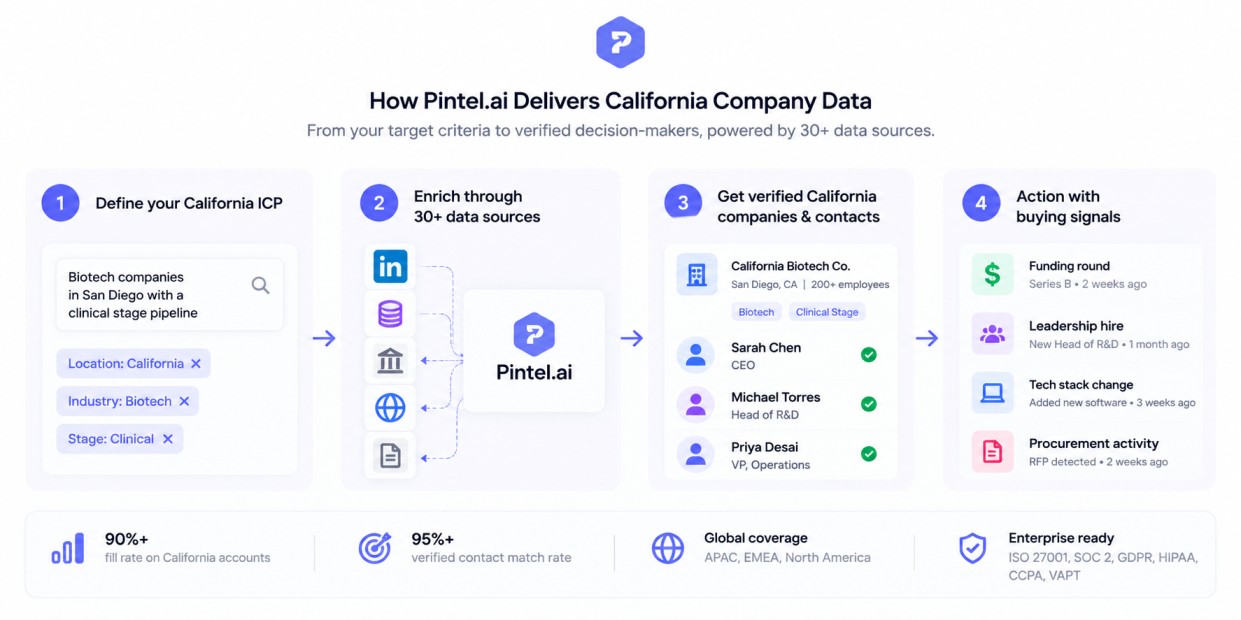
Pintel.ai has an accurate California and US company database that refreshes continuously through waterfall enrichment. The 30+ data providers in the enrichment stack are handpicked by the Pintel.ai team, with a focus on regional sources that cover the California market segments most platforms miss.
What Pintel.ai delivers for California company data:
- 90%+ fill rate on California accounts through waterfall enrichment across 30+ sources, reaching segments and company sizes that single-source platforms miss entirely.
- Multi-source coverage: Pintel.ai queries more than 30 data sources in priority order, including sources that go beyond standard commercial databases. This broadens the addressable California company dataset without requiring a separate data vendor for each segment.
- Verified decision-maker contacts for your ICP companies: Pintel.ai delivers contacts for the exact decision-makers at your target California accounts, verified at 95%+ match rate before reaching your CRM.
- Profile-level ICP filtering: Define your California ICP in natural language and Pintel.ai reads full company and contact profiles to return matching accounts. “Biotech companies in San Diego with a clinical stage pipeline” or “SaaS companies in LA that serve the media industry” return targeted lists without manual cross-referencing.
- Buying signals specific to California: Funding round alerts, leadership hires tracking across all California regions, tech stack change detection, and procurement activity layered into Pintel.ai’s enrichment layer to time outreach to accounts in a buying window.
- Global coverage alongside California: Teams whose ICP extends beyond California do not need a separate regional vendor. Pintel.ai covers APAC, EMEA, and North America from a single enrichment layer with the same data quality standards.
- Security and compliance: ISO 27001 certified, SOC 2 (AICPA), GDPR compliant, HIPAA compliant, CCPA compliant, and VAPT certified.
Pintel.ai has less brand name recognition than incumbents like ZoomInfo or Apollo. Teams that run a direct data test before committing tend to find higher fill rates on complex California ICPs, particularly when the ICP spans multiple industries or company sizes.
In practice: Fill rate across a mixed California company list was higher than other platforms in this evaluation, particularly where the ICP included company types that standard databases cover unevenly.
Pintel.ai is an enrichment and data layer, not a sending tool. Sequences run through your existing CRM, and access is via demo rather than self-serve trial.
Best for: Revenue teams that need accurate California company data with buying signals, ICP filtering, and global coverage built into a single platform.
ZoomInfo: Enterprise Tech Data, Weak on SMB and Mid-Market California
ZoomInfo is one of the most established US B2B databases, with strong coverage of enterprise and mid-market technology companies and deep CRM integrations. For California technology accounts above 500 employees in the Bay Area and LA, it delivers reliable firmographic and contact data.
What it covers for California prospecting:
- Broad coverage of California enterprise tech with regular database refresh cycles
- Third-party intent signal layer for identifying in-market California accounts
- Org chart data and buying committee mapping for named enterprise accounts
- Salesforce, HubSpot, and major CRM integrations with pre-built sync workflows
Limitations:
- Coverage drops noticeably outside enterprise technology, including healthcare, manufacturing, and government accounts in California where fill rates fall well short of the platform’s quoted averages
- ICP filtering is limited to standard firmographic fields with no profile-level qualification
- Annual enterprise contracts make it a poor fit for teams testing new California verticals
In practice: Named Bay Area enterprise accounts were well-covered and accurate. California private company and SMB coverage produced meaningful bounce rates. Intent signals cost extra on top of the base contract, and the annual lock-in means coverage gaps surface after signing.
Best for: Enterprise sales teams targeting California technology companies with established CRM infrastructure and predictable annual data spend.
Apollo.io: SaaS and Tech Contacts, Weak on Non-Tech California Segments
Apollo.io combines a contact database, email sequencing, and basic enrichment in a single platform. For early-stage teams building their first California outbound motion in the technology segment, its accessible pricing and all-in-one model reduces toolstack overhead.
What it covers for California prospecting:
- Solid coverage of California tech and SaaS companies across the Bay Area, LA, and San Diego markets
- Built-in email sequencing that removes the need for a separate outreach tool
- Basic intent data layer for in-market signal detection
- No multi-year commitment, accessible pricing for early-stage teams
Limitations:
- Coverage falls off significantly outside North American tech companies
- California ICPs covering manufacturing, logistics, or government will see low fill rates
- User-contributed data corrections mean accuracy varies by segment
In practice: Fast list-building for California SaaS and tech, with reasonable accuracy for that segment. A California healthcare list had a meaningful share of contacts who had changed roles. The further from tech, the more manual cleaning the data requires before sequences fire.
Best for: Early-stage teams building an initial California outbound motion in the technology or SaaS segment.
Crunchbase: Startup Funding Intelligence, Weak on Contact Data
Crunchbase is one of the most thorough sources of startup and funding data available, and California is its strongest geography. It tracks funding rounds, investors, leadership changes, and company milestones for hundreds of thousands of California-based companies, making it a strong signal layer for teams whose trigger is a recent fundraise.
What it covers for California prospecting:
- Funding history and round details for California startups, updated close to real time
- Investor relationship mapping to identify portfolio companies within a specific VC’s network
- Leadership and board change tracking that signals new budget authority
- Strong coverage of pre-Series A companies not yet in standard B2B databases
Limitations:
- No verified emails or direct dials: contact enrichment requires a separate platform
- Coverage is concentrated in VC-backed companies, weak for bootstrapped or privately held businesses outside the funding ecosystem
In practice: Catches California funding rounds earlier than most commercial platforms, including early-stage rounds that other databases miss. The funding event is the deliverable: a second enrichment step is still required to reach a verified email or phone number.
Best for: Teams using recent funding events as the primary trigger for California outreach, as a signal and account discovery layer rather than a standalone prospecting tool.
D&B Hoovers: Traditional Industries and Registry Data, Weak on Buying Signals
D&B Hoovers is Dun and Bradstreet’s business intelligence platform and draws from the most comprehensive publicly sourced business registry data in the US, including California Secretary of State filings, industry directories, and public procurement records.
What it covers for California prospecting:
- Coverage of California manufacturing, logistics, agriculture, and professional services that standard B2B databases underserve
- DUNS number linkage for matching California companies across public and private data sources
- Subsidiary and parent-company relationship mapping for identifying California subsidiaries of national enterprises
- Public procurement and contract data for California government and public sector accounts
Limitations:
- Contact data quality is weaker than specialised B2B prospecting platforms, particularly for direct dials
- No buying signal enrichment layer for identifying in-market California accounts
- Platform interface is dated compared to modern prospecting tools
In practice: California manufacturers and professional services companies were well-represented, including sectors that LinkedIn-based tools do not index. Decision-maker records for Inland Empire manufacturing required manual verification of a significant share. No timestamps indicate when records were last confirmed.
Best for: Teams targeting established California businesses in traditional industries and public sector procurement where official registry data is the most reliable source.
Lusha: Individual Contact Lookups, Weak on Bulk Enrichment
Lusha’s browser extension lets individual SDRs enrich contacts on the fly while browsing LinkedIn or company websites. For California accounts with a strong LinkedIn presence, it delivers fast email and phone lookups without platform-level setup.
What it covers for California prospecting:
- Fast individual contact enrichment from LinkedIn profiles of California decision-makers
- Direct dial accuracy consistently rated above average for California tech contacts
- Works inside LinkedIn, Salesforce, and most CRM interfaces via browser extension
Limitations:
- Not built for bulk enrichment or ICP-based list building at scale
- Coverage for California companies outside the LinkedIn-indexed universe is limited
- No buying signal or ICP qualification layer
In practice: Direct dials held up well on California tech contacts with current LinkedIn activity. Switched to a California logistics list and coverage dropped sharply. Low LinkedIn presence in a segment maps directly to low Lusha coverage.
Best for: Individual SDRs and small teams that need on-demand California contact lookups while working named accounts.
Seamless.ai: High-Volume Fill Rate, Weak on Accuracy at Scale
Seamless.ai positions itself on real-time data sourcing and aggressive pricing. Its fill rates are high, which makes it useful for teams that need volume quickly. Accuracy is the consistent trade-off at scale.
What it covers for California prospecting:
- High fill rates on California contact requests, including email and phone data
- Real-time sourcing model that assembles records at query time
- Integrations with Salesforce, HubSpot, Salesloft, and Outreach
Limitations:
- Accuracy concerns are consistent at scale: real-time sourcing produces variable verification quality with no systematic re-verification cadence
- The accounts that cost the most to outreach are the ones where the contact data was wrong before the first email went out. For California ICPs where sender domain health matters, accuracy should outrank fill rate in the evaluation criteria.
In practice: Fast for building volume on California tech lists. A sequence had to be paused after the first few hundred sends to address bounce issues. Without a separate verification step before sending, bounce rates compound and affect sender domain reputation.
Best for: Teams that need high-volume California contact data quickly and run a separate verification step before sequences fire.
UpLead: Verified Email Accuracy, Weak on Database Depth
UpLead guarantees 95 percent email verification at the point of export, making it a strong choice for teams where deliverability is the primary constraint on California outreach performance.
What it covers for California prospecting:
- 95 percent email verification guarantee at export, validated at the time of download rather than enrichment
- Technology stack data for California companies, useful for tech-targeted ICPs
- Transparent credit pricing with no long-term commitment required
Limitations:
- Database is smaller than ZoomInfo or Apollo, limiting coverage for less-indexed California segments
- No buying signal layer or ICP filtering beyond standard firmographics
- Works best as a verification layer within a broader California data stack, not as a standalone platform
In practice: Export-time email verification catches invalid addresses before they reach sequences. Niche California segments including local government and construction returned thin results, with insufficient depth to build a workable list even after adjusting filters.
Best for: Teams where verified email accuracy is the primary bottleneck and bounce rate is directly affecting California campaign performance.
LinkedIn Sales Navigator: Social Signals and Relationship Mapping, Weak on Contact Export
LinkedIn Sales Navigator offers highly accurate job title and company filtering for California accounts with a strong LinkedIn presence, drawing directly from LinkedIn’s live data. For social selling, executive relationship mapping, or tracking leadership changes at named accounts, it provides real-time signals no third-party database can match for speed.
What it covers for California prospecting:
- Real-time job change alerts and LinkedIn activity signals for California decision-makers
- TeamLink relationship mapping to find warm paths into California accounts
- Accurate company headcount and growth data sourced directly from LinkedIn
- Account lists that sync with Salesforce and HubSpot
Limitations:
- Not a conventional outreach database: no bulk export, no API access for CRM enrichment, no verified email or direct dial data
- Coverage for California companies with low LinkedIn presence is poor
- Requires a separate enrichment platform to move data into an outreach workflow at scale
In practice: Accurate for confirming who the actual decision-maker is at a California company. Title filtering plus recent activity signals is effective for contact identification. No email addresses or bulk export, so a second tool is required to reach contacts identified here.
Best for: Account-based selling into California named accounts where social signals and warm relationship paths are part of the outreach strategy.
California Secretary of State Business Search: Entity Registration Records, Weak on Outreach Readiness
The California Secretary of State Business Search is a free public database of every LLC, corporation, and registered business entity in the state. It is the most comprehensive and authoritative source of registered California business data available at no cost.
What it covers for California prospecting:
- Every registered LLC, corporation, and partnership in California, including those not indexed by commercial B2B platforms
- Legal entity name, registration date, agent of service, and registered address
- Active versus inactive status for verifying whether a California company is still operating
- Useful for building county-level base lists before enriching with a commercial platform
Limitations:
- No contact data, emails, phone numbers, technographics, or buying signals
- Requires a commercial enrichment platform layered on top for any outbound use case
In practice: Useful for confirming a company is legitimately incorporated in California and cross-checking entity names before enrichment. No contacts, no bulk export, every lookup is manual.
Best for: Teams that need to verify California entity registration status, build exhaustive base lists, or cross-reference commercial data against official state records.
Final Takeaway for B2B Outreach Teams Targeting California
The California company database you choose determines what proportion of your addressable California market you can actually reach, how accurate your outreach is when it fires, and how much manual research work your team still has to do after the data lands.
Test any platform against your actual California target accounts before committing. The fill rate difference between providers on your specific ICP segment is almost always wider than their marketing materials suggest. Run the 3-Segment California Coverage Test before signing: Bay Area tech as the baseline, non-tech mid-market as the real test, and non-indexed SMB as the ceiling check. As a practical guide: if fill rate falls below 70 percent on your weakest segment, keep evaluating.
Teams getting the strongest results from California outbound are not the ones with the biggest list. They are the ones with the most precise list, timed to when accounts are in a buying window.
Frequently Asked Questions About California Company Databases
What is a California company database?
A California company database is a structured dataset of businesses registered or operating in California, with firmographic attributes including industry, headcount, revenue range, and location. For B2B outreach, the most useful California company databases also include verified decision-maker contacts, technographic data, and buying signal enrichment.
Which platform provides a direct API for California or US B2B data?
Pintel.ai provides a direct API for B2B data covering California and US accounts. The API delivers firmographic, contact, and enrichment data programmatically into your CRM or data pipeline. A comparison of B2B enrichment APIs covers integration options across platforms.
Is the California Secretary of State database useful for B2B sales?
The California Secretary of State database lists all registered LLCs and corporations in the state but contains no contact data, technographics, or buying signals. It is useful as a base list layer or for compliance verification, not as a standalone outreach tool.
What does B2B database access cost for California prospecting?
Pricing varies by platform and data volume. Apollo.io offers plans from around $49 per user per month. ZoomInfo and Pintel.ai use custom pricing based on ICP scope and enrichment volume. Book a demo at pintel.ai to get current pricing for your use case.
Where can I find a California email database?
Explore California email database providers to compare options for finding business email addresses for B2B outreach.
What firmographic data is available for California B2B accounts?
Standard firmographic data includes industry, headcount, revenue range, founded year, and location. Profile-level enrichment adds sub-industry context and company type classification that basic filters miss. A comparison of firmographic data providers covers what each attribute tier includes.
Which California B2B database includes technographic data?
Pintel.ai, ZoomInfo, and Apollo.io all include technographic data for California accounts. Technographic filters identify companies by their tech stack, which is useful for SaaS teams prospecting California’s technology corridors. A breakdown of technographic data in B2B covers how to apply these filters in a prospecting workflow.
How do buying signals improve California B2B outreach?
Buying signals flag accounts in an active purchasing window. Funding rounds, leadership changes, tech stack updates, and hiring patterns signal timing. Teams layering multiple signals reach accounts that are ready to buy, not just ICP matches. A comparison of the top intent data providers covers how each handles signal layering.
What is the best free California business database for sales teams?
The California Secretary of State Business Search is the most comprehensive free source for registered California businesses. For verified contacts and buying signals, paid platforms are required. LinkedIn allows free search but does not export contacts in bulk.
How often does California company data go out of date?
B2B contact data decays steadily each year, and California tech and startup sectors move faster than most due to above-average employee turnover. Re-enrichment on a 90-day cycle is the standard practice for teams running active outbound into California accounts