Finding a reliable Germany company database is one of the biggest challenges for B2B sales teams expanding into the German market. While many providers claim broad company coverage, the quality of company data, decision-maker contacts, buying signals, and CRM readiness can vary significantly.
The best Germany company database should do more than list registered businesses. It should help sales teams identify companies that match their ideal customer profile (ICP), connect with verified decision-makers, and prioritize the right prospects for outreach.
This guide compares the 10 best Germany company database providers based on company data coverage, contact accuracy, buying signals, GDPR compliance, pricing, and overall value for B2B sales. Whether you’re building prospect lists, enriching CRM records, or expanding into the German market, this comparison will help you choose the right provider for your business.
What Is the Best Germany Company Database for B2B Sales Teams?
The best Germany company database depends on whether your team needs accurate company data, verified decision-maker contacts, and buying signals. Pintel.ai combines Germany company data, verified decision-maker contacts, buying signals, and CRM-ready enrichment to help sales teams identify, prioritize, and engage the right companies.
Quick Comparison: German Company Database Providers
| Provider | Data Sourcing Model | Germany Coverage Depth | Verified Contact Data | Buying Signals | Starting Price |
|---|---|---|---|---|---|
| Pintel.ai | German Company and Decision-Maker Contact Data | Deep, covers major hubs and non-metro German companies alike | Yes, verified emails and direct dials | Yes, structural and behavioral signals | Custom |
| ZoomInfo | Community-contributed data, concentrated in the US and Western Europe | Deep for large German enterprises, thinner for SMEs | Yes, for enterprise-heavy accounts | Limited outside core markets | Custom |
| Apollo | Global scraping and crowd-contributed database | Inherited coverage, major-city weighted | Partial, frequently outdated outside major cities | Basic | From $49/mo |
| Cognism | GDPR-compliant sourcing built around European markets | Deep for major German business hubs, thinner elsewhere | Yes, direct dial coverage | Limited | Custom |
| Lusha | Browser extension and crowd-contributed network | Inconsistent, depends on individual contributor data | Partial | No | From $29/mo |
| Kompass Germany | Structured German business directory by industry and trade activity | Deep for registered trade and manufacturing companies | No, directory listings only | No | Custom |
| Creditreform | Germany’s largest business credit reporting network | Complete for credit and risk profiles of German companies | No, credit and risk data only | No | Custom |
| North Data | Aggregated Handelsregister filings and shareholder networks | Complete for registered company and ownership structure data | No, no contact-level data | No | From EUR 29/mo |
| Handelsregister | Official German government company register | Complete for all registered German companies | No, filings only, not contact data | No | Public (free registry) |
| Dun and Bradstreet | D-U-N-S numbering and global credit risk network | Broad firmographic and financial coverage | Partial, secondary to its credit and risk focus | No | Custom |
This comparison is based on first-hand platform knowledge, publicly available product information, and commonly reported user experiences. Contact each vendor directly for the latest pricing and product details.
How We Evaluated These German Company Database Providers
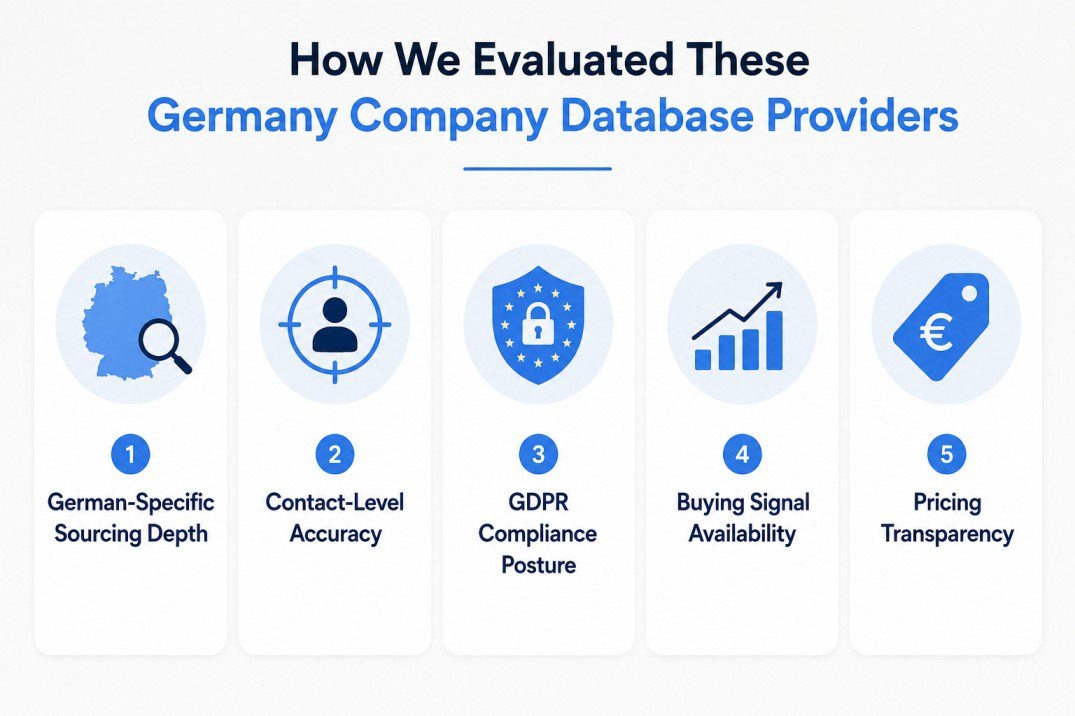
German-Specific Sourcing Depth
Whether the provider sources German company data directly, cross-referenced against Handelsregister filings, or whether German coverage is a byproduct of broader global scraping.
Contact-Level Accuracy
Whether verified emails and direct phone numbers are available for named decision makers, not just company-level firmographic or credit records.
GDPR Compliance Posture
Whether the provider documents a lawful basis for processing German contact data, the same standard covered in GDPR compliant data providers for B2B sales, which matters as much for outreach here as raw accuracy.
Buying Signal Availability
Whether the provider tracks structural signals like funding, hiring, and leadership changes for German companies, or only lists static company records.
Pricing Transparency
Whether pricing is published or requires a custom quote, and whether the entry price is realistic for the team size evaluating it.
With those five criteria set, here is how each of the 10 providers actually performs.
Why Germany Company Database Providers Can Be Difficult to Compare
Not every Germany company database serves the same purpose. Some providers focus on official company records, others specialize in business credit data, while sales intelligence platforms help GTM teams find verified decision-makers and buying signals. Comparing them side by side without understanding these differences can make it difficult to choose the right solution.
- Official registries verify company registration and legal records.
- Business credit providers focus on financial risk and payment history.
- Sales intelligence platforms provide company data, verified contacts, and sales insights for prospecting.
The providers below span all three categories, so understanding what each one is built for makes the comparison more meaningful.
The 10 Germany Company Databases Compared in Detail
With the category distinctions and evaluation criteria established, here is how each of the 10 providers actually holds up against them.1. Pintel.ai: Germany Company Database with Verified Decision-Maker Contacts
Pintel.ai: Germany Company Database with Verified Decision-Maker Contacts
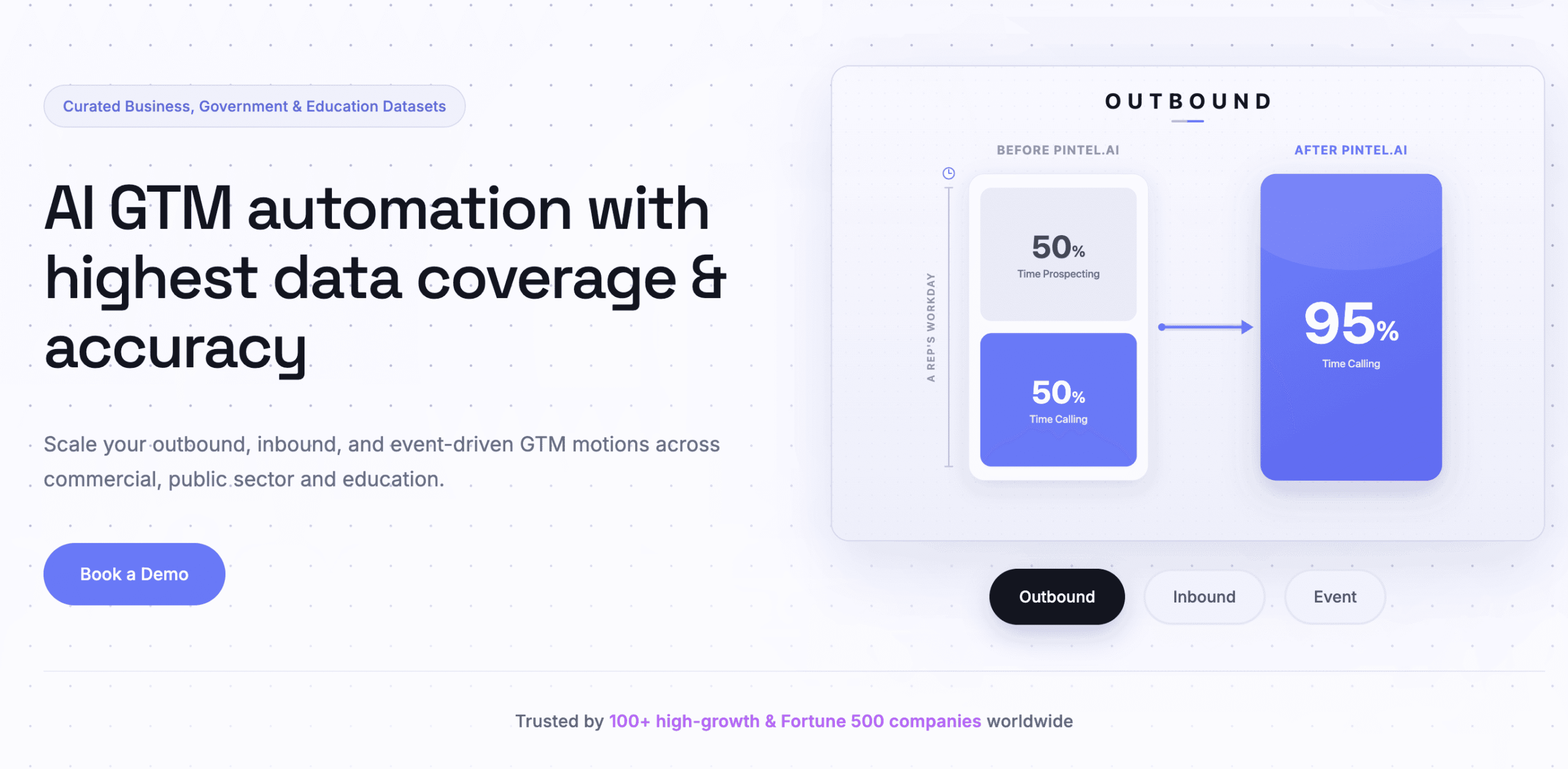
Pintel.ai is a B2B company and contact data platform that helps sales teams identify German companies, find verified decision-maker contacts, discover buying signals, and sync enriched data directly to their CRM.
Company & Contact Data
- Pintel.ai provides a Germany company database with verified company and decision-maker contact data, helping sales teams identify high-fit German companies and reach the right buyers.
- Covers companies across Germany, including large enterprises, mid-sized businesses, SMEs, and fast-growing startups.
- Company data includes industry, employee size, annual revenue, location, company type, website, and technologies used.
- Contact data includes verified business emails, direct dials, job titles, departments, and seniority.
Data Coverage
- Coverage across major German business hubs as well as smaller cities and regional markets.
- Supports prospecting across manufacturing, automotive, SaaS, technology, financial services, healthcare, retail, logistics, education, real estate, telecommunications, energy, and many other industries.
Data Accuracy
- Multi-source verification to improve company and contact accuracy.
- Waterfall enrichment across 30+ data providers for higher contact coverage.
- Regular data updates to reduce outdated company and contact records.
Buying Signals
- Identifies companies showing buying intent through signals such as funding, hiring, leadership changes, company expansion, and technology adoption.
Security & Compliance
- GDPR compliant.
- ISO 27001 certified.
- SOC 2 (AICPA).
- HIPAA compliant.
- CCPA compliant.
- VAPT certified.
Customer Support
- Dedicated onboarding and implementation support.
- Responsive customer success team.
- Ongoing product and data support.
Best for: Sales teams looking for an accurate Germany company database with verified contacts, buying signals, and broad coverage across the German market.
2. ZoomInfo: Enterprise German Accounts, Thinner SME Depth
ZoomInfo builds its contact database mainly through community data contribution concentrated among US and large Western European enterprises, so German small and mid-size company records depend more on secondary enrichment than direct Handelsregister cross-referencing. Coverage is noticeably deeper for large, well-known German enterprises than for SMEs.
- Deep coverage for large German enterprise accounts
- Established CRM and sales engagement integrations
- Limitations: German SME and non-metro coverage relies on secondary enrichment, and update frequency lags for smaller companies
3. Apollo: Self-Serve SMB Outreach, Limited German Compliance Depth
Apollo offers a large self-serve contact database built for SMB and mid-market teams, but its German data is inherited from broader global scraping rather than dedicated Handelsregister cross-referencing, so job titles and company details outside major German cities are frequently out of date.
- Native sequencing built into the same platform as the contact database
- Lower entry pricing for small teams
- Limitations: German contact data is not independently verified against Handelsregister filings, and documentation of GDPR lawful basis is thinner than German-native providers
4. Cognism: GDPR-First European Sourcing, Thinner Non-Metro Depth
Cognism built its core data engine around GDPR-compliant sourcing with a well-established European base, giving it genuinely deep coverage for major German business hubs, but SME and micro-business coverage outside those hubs is thinner because those companies file less public data for any provider to draw from.
- Established compliance documentation for German and wider European outreach
- Direct dial coverage for major German metro contacts
- Limitations: coverage thins out for small companies outside major German cities
5. Lusha: Fast Individual Lookups, Inconsistent German Sourcing
Lusha sources contact data through a browser extension and crowd-contributed network concentrated in North America and parts of APAC, so German company profiles depend on whatever individual contributors happen to have entered, producing inconsistent coverage across sectors.
- Fast individual contact lookups through its browser extension
- Straightforward per-seat pricing for small teams
- Limitations: German coverage is not systematically sourced, so accuracy varies widely by industry and company size
6. Kompass Germany: Trade Directory Listings, No Contact Enrichment
Kompass Germany operates as a structured business directory, listing verified company profiles by industry and trade activity, but it is organized as a directory rather than a sales enrichment tool, so it lacks buying signals, contact-level enrichment, and CRM integration.
- Deep listings for registered trade, manufacturing, and distribution companies
- Organized by industry classification, useful for market mapping
- Limitations: no verified contact-level data, no buying signals, and no native CRM sync
7. Creditreform: Business Credit and Risk Data, No Sales Contact Layer
Creditreform is Germany’s largest business credit reporting network, aggregating company registration, credit risk, and payment history data directly from Handelsregister filings and its own member network, but its core product is credit risk assessment, not contact-level sales data, so named decision-maker contacts are not part of its standard offering.
- Deep, authoritative credit and payment risk profiles for German companies
- Direct sourcing from Handelsregister and member reporting networks
- Limitations: no contact-level data, and reports are priced around credit and risk use cases, not outbound prospecting
8. North Data: Company and Ownership Structure Search, No Contact Data
North Data aggregates Handelsregister filings, shareholder structures, and company network relationships into a searchable, modern interface, but like the registry it draws from, it provides no contact-level data such as verified emails or phone numbers.
- Clear visualization of company ownership and network relationships
- Modern search interface built directly on official filing data
- Limitations: no contact data, and no buying signal or prioritization layer
9. Handelsregister: Official Company Records, No Contact Data
Handelsregister is Germany’s official company register, giving free public access to incorporation records, registered representatives, and filing history for every registered German company, but it provides no email addresses, phone numbers, or buying signals, so it functions as a verification source rather than a prospecting tool.
- Complete and authoritative for company incorporation status and registered representatives
- Free public access to filing history for any German company
- Limitations: no contact data of any kind, and no signal or prioritization layer
10. Dun and Bradstreet: Global Firmographic and Credit Data, Secondary Contact Layer
Dun and Bradstreet aggregates German company data through its D-U-N-S numbering system and global credit risk network, giving broad firmographic and financial coverage, but contact-level data for individual decision makers is a secondary feature layered onto a credit and risk platform built for a different primary use case.
- Broad global firmographic and credit data coverage, including Germany
- Established D-U-N-S numbering used across procurement and compliance workflows
- Limitations: contact data is secondary to its credit and risk focus, and depth varies by company size
Reading through all ten, the pattern holds across every provider: global databases inherit German coverage as a byproduct of broader sourcing, German-native registries and credit agencies are authoritative but contact-free, and only a smaller subset combine direct German sourcing with verified, signal-tracked contact data. That distinction is exactly what the next section addresses.
How to Choose a Germany Company Database for Your Team
1. Does the provider cover the German companies you want to target?
Look for broad coverage across enterprises, mid-sized businesses, SMEs, and startups, along with detailed company information such as industry, employee size, revenue, location, and technologies used.
2. Does it provide verified decision-maker contacts?
A company database is more valuable when it includes verified business emails, direct dials, job titles, and seniority information for the people involved in buying decisions.
3. Does it include buying signals?
Buying signals such as hiring activity, funding, leadership changes, and technology adoption help sales teams prioritize companies that are more likely to be evaluating new solutions.
4. Is the data GDPR compliant and CRM ready?
Choose a provider that supports GDPR compliance, regularly updates its data, and allows enriched company and contact records to sync directly with your CRM.
5. Which Germany Company Database Should You Choose?
Pintel.ai is the best Germany company database for B2B sales teams looking to identify high-fit companies, find verified decision-maker contacts, prioritize accounts with buying signals, and sync enriched data directly to their CRM. It combines Germany company data, contact enrichment, and sales intelligence in a single platform, helping teams prospect faster and build higher-quality pipelines.
Final Takeaway
Germany company data fails in a predictable way: the registry confirms the company exists, the credit agency confirms it pays its bills, but neither tells a sales team who to call. A germany business database built specifically for sales contact enrichment, layered on top of official registry accuracy, is where a genuinely useful data stack for German outbound starts.
Frequently Asked Questions
What is the best Germany company database for B2B sales teams?
The best choice depends on whether a team needs official registry accuracy, credit and risk context, or sales-ready contact data. These are three different categories of tool, and most teams only need one of them at a time.
What is the difference between Handelsregister and a company database for sales?
Handelsregister confirms a company is legally registered and lists its representatives. A sales-focused company database adds verified contact details, firmographic scoring, and buying signals that Handelsregister does not track.
Is Handelsregister data enough for B2B prospecting?
No. Handelsregister confirms a company is active and lists registered representatives, but it provides no email addresses, phone numbers, or buying signals, so it works as a verification source rather than a standalone prospecting tool.
What is the difference between Creditreform and a sales contact database?
Creditreform assesses financial risk and payment history for German companies. A sales contact database identifies and verifies the actual decision maker to reach out to, which is a different data category entirely.
Do Germany company databases need to be GDPR compliant?
Yes. Any germany business database used for outreach needs a documented lawful basis for processing personal data under GDPR, which is a compliance requirement separate from raw contact accuracy.
How much does a Germany company database cost?
Pricing ranges from about $29 to $49 a month for self-serve global tools with inherited German coverage, up to custom pricing for German-native providers with verified contacts and GDPR documentation.
Do I need a separate German-focused provider if I already use ZoomInfo or Apollo?
If Germany is more than an occasional target, yes. Layering a German-native, GDPR-documented data source on top of an existing global tool typically improves contact accuracy and compliance posture for that market specifically