By the Pintel.ai GTM Research Team, B2B Sales Data and RevOps Analysts. Last updated: July 22, 2026.
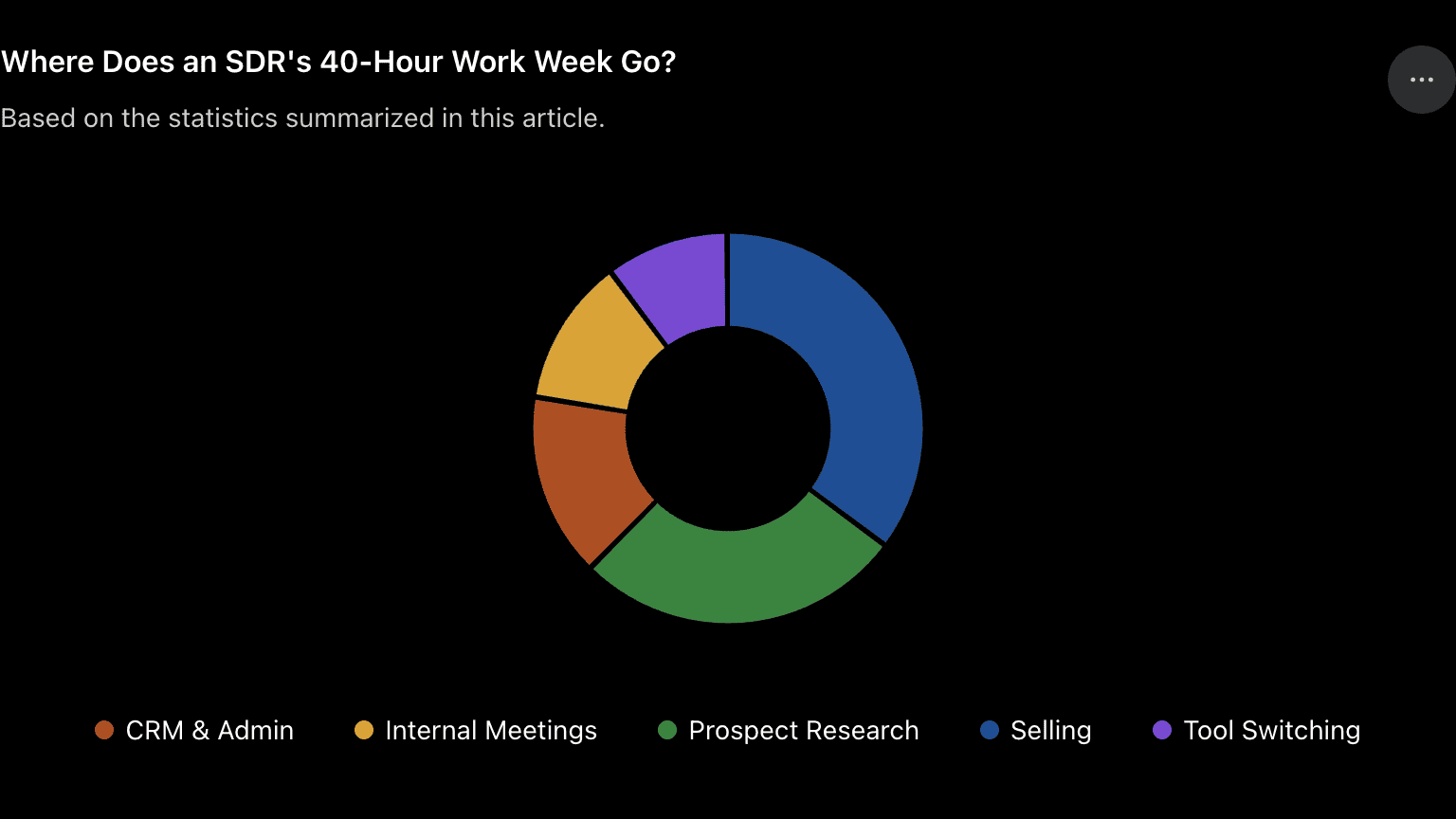
An SDR who works 40 hours a week spends about 14 of those 40 hours selling. The remaining 26 hours go to research, CRM entry, meetings, and switching between tools.
That 14-hour selling total is for one SDR. Most teams have five, ten, or twenty SDRs losing the same 26 hours a week, every single week. Multiply the lost hours by your team size, and the loss stops being a percentage. It turns into real hours, real weeks, and real cost.
This page covers 12 statistics on how sales reps actually spend their time. Every statistic names the exact role it is about, explains why the number happens, and shows the math worked out for a team of 5 SDRs, so each point makes sense fully on its own, even without reading the rest of the page.
Key Takeaways
- Sales reps spend only 34–40% of their workweek selling. The remaining time goes to prospect research, CRM updates, meetings, and switching between tools.
- A team of 5 SDRs loses around 130 hours every week to non-selling activities, leaving just 70 hours for customer conversations.
- Prospect research alone takes about 11 hours per SDR each week, adding up to 220 hours a month for a 5-person team.
- Manual CRM work consumes another 5–6 hours per rep every week, reducing the time available for revenue-generating activities.
- Most SDRs stop prospecting too early. While it takes nearly 5 touches to get a reply, the average rep makes only 1.3 attempts before giving up.
- These hidden productivity losses directly affect quota attainment, pipeline growth, and team capacity, making automation and better data quality critical for improving sales performance.
How Much Time Do Sales Reps Actually Spend Selling?
SDRs and BDRs sell for about 34 to 40 percent of their working time. Out of a 40-hour week, that is roughly 14 to 16 hours of actual selling. The remaining 24 to 26 hours go to prospect research, CRM work, internal meetings, and switching between tools.
12 Statistics on Sales Rep Time, With the Math Worked Out
SDRs sell for only 34 to 40 percent of their week
An SDR who works a 40 hour week spends 14 to 16 of those 40 hours selling. The remaining 24 to 26 hours split into four specific tasks: about 17 percent of the week on prospect research, 21 percent on CRM and admin work, 12 percent in internal meetings, and 10 percent switching between different sales tools.
Do the math: A team of 5 SDRs is paid for 200 hours a week combined (5 SDRs x 40 hours). At 35 percent selling time, only 70 of those 200 hours go toward talking to buyers (200 x 0.35 = 70). The remaining 130 hours go to the four tasks above: prospect research, CRM and admin entry, internal meetings, and switching between tools.
B2B account executives sell even less than B2C reps
B2B account executives sell for about 33 percent of their time. B2C and hybrid sales reps sell for about 49 percent of their time. This 16-point gap exists for a specific reason: a B2B account executive has to research each company individually, sell to several stakeholders inside one account, and update more CRM fields per deal, because a B2B sale involves more people and more steps than a typical B2C sale.
Do the math: A B2B account executive works 40 hours a week and sells for about 13 hours of that week (40 x 0.33 = 13.2). A B2C rep works the same 40 hours and sells for about 20 hours of their week (40 x 0.49 = 19.6). The gap between those two numbers is roughly 6.4 more hours of actual selling every week for the B2C rep, caused entirely by the extra per-account research and CRM work a B2B deal requires. Over a 48 week work year, that 6.4-hour weekly gap adds up to about 307 hours, nearly 8 extra 40 hour work weeks of selling time the B2B account executive never gets.
SDRs spend about 11 hours a week on prospect research alone
Before an SDR sends a single message, they spend around 11 hours a week, about 2.2 hours a day, researching prospects: looking up contact details, checking whether a company still matches the target list, and verifying phone numbers and email addresses that are often outdated.
Do the math: A team of 5 SDRs spends 55 hours a week on prospect research combined (11 hours x 5 SDRs). Over a 4 week month, that prospect research alone costs the team 220 hours (55 x 4). A single full-time employee works about 160 hours a month (40 x 4). This team of 5 SDRs spends more hours on prospect research alone every month than a sixth full-time SDR would work in total, and none of those 220 research hours involve talking to a buyer.
Manual CRM data entry costs 5 to 6 hours a week per rep
The average B2B sales rep spends 5 to 6 hours a week manually entering data into the CRM: logging calls, updating deal stages, and fixing missing or duplicate fields by hand. This CRM data entry time is separate from the prospect research time described in statistic 3.
Do the math: A team of 5 SDRs spends 25 to 30 hours a week on manual CRM data entry combined (5 to 6 hours x 5 SDRs). Over a 48 week work year, that CRM data entry time adds up to 1,200 to 1,440 hours (25 to 30 x 48). A single full-time employee works about 1,920 hours a year (40 x 48). So this team of 5 SDRs spends 62 to 75 percent of a full extra SDR’s entire year just typing data into the CRM (1,200 divided by 1,920 = 62 percent, 1,440 divided by 1,920 = 75 percent).
About one in four reps spends a full workday a week just on CRM entry
Sixty five percent of sales reps spend 5 or more hours a week on manual CRM entry. Nineteen percent spend 8 to 10 hours a week on manual CRM entry. Twenty four percent, about one in four reps, spend 11 hours or more on manual CRM entry every single week, more than a full workday.
Do the math: On a team of 5 SDRs, if that same 24 percent share holds, roughly 1 of the 5 SDRs is losing 11 or more hours a week to CRM entry alone. Over a 48 week year, that CRM entry time adds up to at least 528 hours (11 x 48) for that one SDR, more than 3 months of their total working hours (528 divided by 160 hours a month is about 3.3 months) spent typing data instead of selling.
A prospecting platform gives SDRs back 5 to 6 hours a week
SDRs who use a dedicated prospecting platform instead of building lists by hand save 5 to 6 hours a week, the exact time that would otherwise go into the manual prospect research described in statistic 3.
Do the math: A team of 5 SDRs gets back 25 to 30 hours a week combined when the whole team uses a prospecting platform (5 to 6 hours x 5 SDRs). Against a 40 hour work week, those 25 to 30 recovered hours equal 63 to 75 percent of one additional SDR’s full week (25 divided by 40 = 63 percent, 30 divided by 40 = 75 percent), recovered every single week without hiring anyone new.
It takes about 5 touches to get one reply
On average, it takes 4.81 touches, close to 5, for an SDR to get one reply from a prospect across phone, email, and LinkedIn combined. This holds true whether the lead is warm or cold.
Do the math: If an SDR sends 2 touches to a prospect and then stops, they have covered less than half the distance, 2 out of roughly 5 touches, to the point where most replies actually happen.
Most SDRs stop after 1.3 attempts, not 6
The average SDR makes just 1.3 attempts to reach a prospect before giving up. But 95 percent of prospects who eventually convert are only reached by an SDR’s sixth attempt.
Do the math: Take an SDR working 50 leads a week, a typical weekly load for the role. Stopping at attempt 1.3 instead of attempt 6 means the SDR never reaches most of those 50 leads at the point, attempt 6, where 95 percent of eventual converters are actually found. Most of the 50 leads get dropped before the attempts that would have worked.
60 percent of buyers say no four times before saying yes
Six out of ten prospects who eventually buy say no to an SDR on four separate occasions first. Ninety two percent of SDRs give up after that fourth unanswered call.
Do the math: On a team of 5 SDRs each working 50 leads a week, that is 250 leads a week for the team (5 SDRs x 50 leads). If most of those SDRs quit at call four, the team is stopping right before the exact point where 6 out of 10, or about 150 of those 250 leads, were statistically about to say yes.
Median SDR quota attainment is 68 percent
Half to two thirds of SDRs hit quota in a typical month. Just over 61 percent of SDR teams, measured as a whole team, fall below 70 percent quota attainment.
Do the math: On a team of 5 SDRs, a 68 percent median attainment rate means roughly 1.6 of the 5 SDRs are missing quota in an average month (5 SDRs x 32 percent, the share missing quota, = 1.6). That quota gap traces directly back to statistics 1 through 6: SDRs who lose 24 to 26 hours a week to prospect research and CRM entry have fewer selling hours left to hit their quota.
New SDRs take 3 to 4 months to ramp up
The median time for a new SDR to reach full productivity is 3 to 4 months. During that ramp-up window, the new SDR is not yet selling at full capacity, by definition.
Do the math: If a team of 5 SDRs replaces just 1 SDR this year, that same team effectively runs as 4 full SDRs, not 5, for the 3 to 4 months the new hire spends ramping up (4 out of 5 seats selling at full output). For that 3 to 4 month stretch, the team is short one fifth of its total selling capacity.
SDRs quit at almost double the rate of account executives
SDRs leave their jobs at about 45 percent a year, the highest turnover of any sales role. Account executives leave at about 30 percent a year. Average SDR tenure is just 14 to 18 months.
Do the math: On a team of 5 SDRs, a 45 percent annual churn rate means about 2.25 SDRs leave every year (5 SDRs x 0.45). Using the 3 to 4 month ramp time from statistic 11, replacing those 2.25 SDRs can cost the team 7 to 9 months a year (2.25 replacements x 3 to 4 months each) with at least one seat not selling at full capacity, close to two thirds of the year.
What Sales Rep Time Selling Statistics Mean for Your Team
None of the numbers above are about SDRs working harder. Every statistic points to the same place: time that should go to selling gets eaten first by prospect research, then by CRM entry, then by switching tools.
The fix for this is not more hours or more headcount. It is giving SDRs a list that is already accurate and ready to contact, so the hours currently lost to research and data entry go toward selling instead.
Frequently Asked Questions
How much time do sales reps actually spend selling?
SDRs and BDRs sell for about 34 to 40 percent of their working time. Out of a 40-hour week, that is roughly 14 to 16 hours of real selling. The remaining 24 to 26 hours go to prospect research, CRM work, and internal meetings.
Why do B2B sales reps sell less than B2C reps?
B2B account executives sell for about 33 percent of their time versus 49 percent for B2C reps, because B2B deals need more research per company, involve more stakeholders per account, and require more CRM fields updated per deal.
How much does manual prospecting cost a team of 5 SDRs?
A team of 5 SDRs spends about 55 hours a week on prospect research alone, plus 25 to 30 hours a week on manual CRM entry. That adds up to roughly 80 to 85 hours a week, more than two full-time hires worth of time, spent on work that is not selling.
How many times should an SDR try to reach a prospect?
Ninety five percent of prospects who eventually convert are reached by an SDR’s sixth attempt. Most SDRs stop after 1.3 attempts, well short of that point.
What percent of SDRs hit quota?
Median SDR quota attainment is around 68 percent. On a team of 5 SDRs, that attainment rate means roughly 1.6 SDRs miss quota in a typical month.
How long does it take a new SDR to become fully productive?
The median ramp time for a new SDR is 3 to 4 months. During that ramp-up window, the SDR is not yet selling at full capacity, which means a team replacing one SDR runs short one fifth of its selling capacity for that stretch.
How often do SDRs quit?
SDRs leave their jobs at about 45 percent a year, the highest turnover of any sales role, versus about 30 percent for account executives. Average SDR tenure is just 14 to 18 months.
Methodology note: Per-rep figures are compiled from sales performance research and analyst studies published through 2026. Every “Do the math” line applies simple, shown arithmetic to those per-rep numbers, scaled to a team of 5 SDRs, so each statistic is understandable entirely on its own. These are worked examples of the math, not a separate claim about any specific company