You can have access to millions of company and prospect records and still end up doing manual research, checking whether companies actually fit your ICP, finding the right decision-makers, and wondering why emails are bouncing.
The problem is not always the size of the database. It is whether the data helps you build a targeted, accurate prospect list without all the extra work.
This guide compares 9 B2B prospecting databases in 2026, plus Pintel.ai, based on company research, contact coverage, search and filtering capabilities, data freshness, list building, and export workflows.
What Is a B2B Prospecting Database?
A B2B prospecting database is a collection of business and professional contact information that sales and marketing teams use to identify potential customers, find decision-makers, and build targeted prospect lists.
It typically includes company names, industry, company size, location, employee details, business email addresses, phone numbers, job titles, and other firmographic or contact data.
Example: A SaaS company targeting US-based marketing leaders can use a B2B prospecting database to find companies that match its ideal customer profile and identify relevant decision-makers for outreach.
What Can You Do With a B2B Prospecting Database?
- Find target accounts: Identify companies that match your ideal customer profile.
- Identify decision-makers: Find relevant contacts based on job titles, departments, and seniority.
- Access contact information: Find business email addresses and phone numbers.
- Build targeted prospect lists: Filter companies and contacts by industry, location, company size, and other criteria.
- Support sales outreach: Use prospect data to support cold email campaigns, calling, and account-based marketing.
How to Choose the Right B2B Prospecting Database
The best B2B prospecting database depends on who you want to reach, where your target customers are located, your budget, and how precisely you need to filter prospects against your ideal customer profile (ICP). A database with millions of contacts may still be a poor fit if it lacks the companies, decision-makers, or contact details your sales team needs.
Consider these factors before choosing a provider:
- Target market: Check whether the database covers your target industries, company sizes, and regions. A provider with strong US coverage may not offer the same depth of data for India or EMEA.
- Budget and pricing model: Compare subscription plans, credit-based pricing, and pay-as-you-go options based on your expected prospecting volume and actual usage.
- ICP filtering depth: Look for filters that match your targeting strategy, such as industry, employee count, revenue, job title, seniority, technology stack, and buying signals.
- Data accuracy and freshness: Evaluate whether contacts still work at the listed companies and whether their email addresses and phone numbers are valid.
- Required data and workflow: Determine whether you need company information, verified contact details, intent signals, data enrichment, or integrations with your CRM and outreach tools.
For example: A startup targeting US-based SaaS companies with 50–200 employees may prioritize affordable pricing and job-title filters. A sales team targeting enterprise accounts across multiple regions may need deeper company intelligence, broader geographic coverage, and more advanced segmentation.
Before committing to a paid plan, test a sample of contacts that match your ICP. Compare the provider’s coverage, data accuracy, and cost for usable contacts rather than relying solely on its advertised database size.
10 Best B2B Prospecting Databases Compared
Here is how the 9 prospecting databases compare on search depth, list mechanics, data type, and where each one falls short.
| Provider | Company Research | Verified Contacts | Primary Weakness | Best For |
|---|---|---|---|---|
| Pintel.ai | AI-powered company discovery with natural language ICP search | Verified and refreshed decision-maker contacts | Newer platform | Building targeted prospect lists for B2B sales |
| Apollo.io | Company research | Verified business contacts | Data quality varies across regions | Sales prospecting |
| Crunchbase Pro | Company research | Limited contact data | Contacts require an add on | Company research |
| Vainu | Company research | No contact data | Regional coverage | Regional prospecting |
| Global Database | Company research | Business contacts | Coverage varies by industry | International prospecting |
| Kompass | Company research | Business contacts | Older workflow | Business discovery |
| LeadIQ | Basic company research | Business contacts | Depends on LinkedIn | Contact discovery |
| Seamless.AI | Company research | Business contacts | Accuracy concerns | Outbound prospecting |
| AeroLeads | Basic company research | Contact discovery | Limited company filtering | Contact discovery |
| Ocean.io | Company discovery | Limited contact data | Contacts are secondary | Account discovery |
This comparison is based on first-hand platform knowledge, publicly available product information, and commonly reported user experiences. Contact each vendor directly for the latest pricing and product details.
How We Evaluated These Prospecting Databases
Each provider was assessed against four criteria specific to what makes a prospecting database usable, not just large.
- Filter combination depth: whether a search can combine industry code, revenue, headcount, and technology stack in one pass, rather than filtering one field at a time.
- List export mechanics: whether a built list can push directly into a CRM or sequencer, or requires manual cleanup and re-formatting first.
- Refresh behavior: whether an exported list stays current after export, or is certified once and left to go stale.
- Data type coverage: whether the platform returns company data, contact data, or both, since several tools on this list are company-first with contacts as an afterthought.
These criteria came from publicly available product documentation, vendor websites, and commonly reported user feedback rather than a formal lab test, and they are the same lens applied consistently across all 10 entries below.
9 B2B Prospecting Databases Reviewed in Detail
The comparison above highlights the main differences between the 9 databases. The detailed reviews below explain how each one performs when building, exporting, and maintaining a prospecting list.
Pintel.ai: AI-Powered B2B Prospecting Database for Building Targeted Prospect Lists
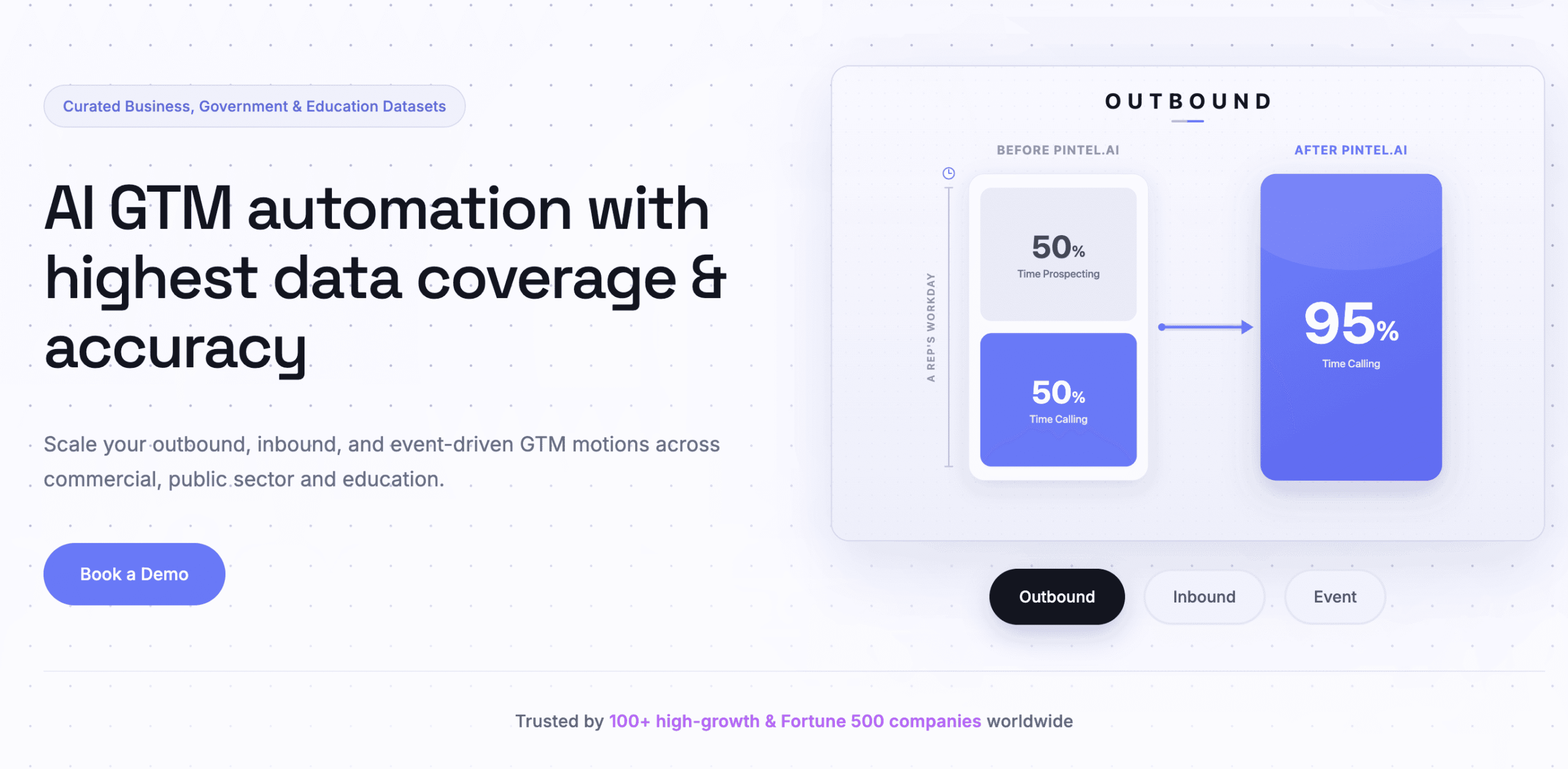
Pintel.ai helps B2B sales teams discover companies that match their ideal customer profile and enrich them with verified decision-maker contacts. Teams can search using natural language or advanced filters, build targeted prospect lists, and keep company and contact data updated through continuous refresh.
What you can achieve with Pintel.ai:
- Access accurate, regularly refreshed company data with Pintel.ai. The database is refreshed every three months to keep company and contact information current, so sales teams can build prospect lists using fresher, more reliable data.
- Find target companies that match your ideal customer profile using natural language search or advanced filters for faster B2B company research.
- Score companies based on your ICP to prioritize the accounts that best match your target customers.
- Get verified decision maker contacts with business emails and phone numbers to build accurate B2B prospect lists.
- Find everyone involved in the buying decision, not just a single contact at a company.
- Keep your prospect database up to date with continuously refreshed company and contact data.
- Create AI personalized sales messages using company and prospect information.
- Export enriched prospect lists or sync verified company and contact data with your CRM and sales engagement tools.
- Build targeted B2B prospect lists and research companies across the US, EMEA, APAC, and GCC/MENA from a single B2B prospecting database.
Con: Newer platform than long established providers.
Security and compliance: ISO 27001 certified, SOC 2 (AICPA), GDPR compliant, HIPAA compliant, CCPA compliant, and VAPT certified.
Pricing: Custom pricing.
Best for: Sales teams looking to build targeted B2B prospect lists from company discovery to AI personalized outreach.
Apollo.io: Sales Intelligence Platform, Regional Data Limitations
Apollo.io is a sales engagement platform whose prospecting database lets a team filter, assemble a prospect list, and push straight into a sequence without switching tools. That bundled workflow is the main reason teams choose it over a standalone database.
Con: Filter depth and data accuracy both decline for non-US and non-tech accounts, so an international or non-tech list built here needs more manual review before it is trustworthy.
Pricing: From $99/month (enrichment credits bundled into plan).
Best for: Teams that want prospecting, list building, and outreach sequencing in a single platform.
Crunchbase Pro: Business Intelligence Platform, Limited Contact Data
Crunchbase Pro functions as a prospecting database built around funding events, growth signals, and company-level attributes rather than static firmographic fields alone. That focus makes it a strong fit for prospecting around funding-stage triggers specifically.
Con: Lower pricing tiers cap monthly export rows at 2,000, and individual contact data sits behind a separate paid add-on rather than being included in the core plan.
Pricing: From $49/month (Pro, annual); Business tier from $199/month.
Best for: Teams prospecting specifically around funding rounds and company growth signals.
Vainu: Government-Sourced Nordic Company Data, Weak on Contact-Level Coverage
Vainu is a prospecting database sourced directly from official business registries across Finland, Sweden, Norway, and Denmark, rather than scraped or estimated data. That registry-based sourcing means its data lineage differs from most other providers on this list, which rely on scraping or self-reported records.
Con: The platform provides company-level data only, with no individual contact records, and coverage thins out noticeably for accounts outside the Nordic region.
Pricing: From roughly €3,500/year (Prospecting plan), plus onboarding fees.
Best for: Teams prospecting specifically into Nordic markets who need registry-grade company data.
Global Database: Global Company Coverage, Industry Coverage Varies
Global Database is a prospecting database offering more than 100 filters, including SIC code, revenue, seniority, and company size, across business profiles in 195 countries. That filter breadth covers more countries than most regional-only databases.
Con: Coverage is reported as thinner for niche or specialized industries, and pricing is not published, requiring a custom quote before a team knows the real cost.
Pricing: Custom, reported range roughly $5,000 to $25,000/year.
Best for: Teams needing broad geographic and filter coverage across many countries in one platform.
Kompass: Classification-Driven Directory Search, Weak on Modern List Automation
Kompass is a long-established global B2B directory and prospecting database that organizes its 57-million-company records around industry classification and geography, built originally for supplier research and company discovery. Its EasyList feature generates on-demand company lists from that directory.
Con: The platform’s directory-first design means list automation and modern CRM workflows are less native than in newer prospecting-first tools, and published 2026 pricing is not available.
One counterintuitive strength: because Kompass predates most prospecting-first tools, its classification data goes deeper into supplier and distributor relationships than platforms built around outbound search alone, which is useful for teams mapping a supply chain, not just a target account list.
Pricing: Custom, not publicly disclosed.
Best for: Teams doing supplier research or classification-driven prospecting rather than fast-moving outbound list building.
LeadIQ: One-Click Lists From LinkedIn Search, Weak on Filtering Beyond LinkedIn
LeadIQ is a prospecting tool built around capturing contacts directly from LinkedIn and Sales Navigator search results into a prospect list or CRM in one click. That LinkedIn-native workflow is its core strength for reps already searching there.
Con: Filtering is built around what LinkedIn’s own search already returns, so a team needing filter criteria LinkedIn does not support has no independent search layer to fall back on.
Pricing: Custom, credit-based plans.
Best for: Teams building lists directly from LinkedIn and Sales Navigator search results.
Seamless.AI: Real-Time Bulk List Building, Weak on Accuracy at Scale
Seamless.AI is a real-time prospecting database that lets a team assemble bulk prospect lists and sync them directly to a CRM. The real-time search returns results quickly compared to platforms that only refresh on a fixed schedule.
Con: The underlying data is built from web-scraped sources rather than verified primary records, and accuracy inconsistency at scale raises bounce rates on larger exported lists.
Pricing: From $65/month.
Best for: Teams wanting fast, real-time list building at accessible pricing who can tolerate some accuracy variance.
AeroLeads: LinkedIn-Sourced Lists With Guaranteed Phones, Weak on Company-Level Filtering
AeroLeads is a prospecting database that searches a 650-million-profile pool sourced largely from LinkedIn, building lists that include a guaranteed number of phone numbers per pricing tier. That phone guarantee is a specific, unusual commitment among LinkedIn-sourced tools.
Con: Company-level filtering is thinner than platforms built around firmographic search first, since the tool’s core strength is individual profile discovery rather than company-list building.
Pricing: From $49/month (2,000 credits, 80 guaranteed phone numbers).
Best for: Teams needing guaranteed phone numbers alongside LinkedIn-sourced contact lists.
Ocean.io: Lookalike Account Search, Weak on Individual Contact Depth
Ocean.io is a prospecting database that lets a team search by more than 300 parameters or find companies that look like an existing best-fit account, rather than filtering on static criteria alone. That lookalike search model is a different starting point for building a list than a standard filter form.
Con: The platform is built company-first, with individual contact data available as an add-on layer rather than a core part of the search experience.
A practical use for the lookalike model: feeding it a list of closed-won accounts, rather than a generic ICP description, often surfaces prospects a standard filter search would miss entirely.
Pricing: From $79/month (Premium); Professional from $129/month.
Best for: Teams that want to prospect by account similarity rather than building filters from scratch each time.
How to Choose a B2B Prospecting Database
The best B2B prospecting database depends on how your sales team builds prospect lists. Instead of comparing company counts, focus on the part of your prospecting process that takes the most time or creates the biggest bottleneck.
If you need targeted prospect lists that stay accurate over time:
Pintel.ai is a strong choice for teams that want AI-powered company research, verified decision maker contacts, ICP scoring, and continuous data refresh in a single platform. If your team only needs basic company and contact data, Apollo.io is another option, although data quality may vary across regions.
If you mainly need company research:
Pintel.ai combines company discovery with verified contacts, buying signals, and AI personalization. Crunchbase Pro and Global Database also provide company information, but contact data is either limited or requires an additional purchase.
If your sales team relies on LinkedIn for prospecting:
Pintel.ai helps you build prospect lists without depending solely on LinkedIn searches. LeadIQ and AeroLeads integrate closely with LinkedIn, but their prospecting workflows are tied more closely to the platform.
If you prospect across multiple countries:
Pintel.ai supports company research and prospecting across the US, EMEA, APAC, and GCC/MENA from a single platform. Other providers may have stronger coverage in specific regions, but several focus primarily on regional datasets or have varying coverage across industries.
If you want more than a prospecting database:
Pintel.ai combines company discovery, verified contact enrichment, ICP scoring, buying signals, AI personalized outreach, and CRM sync in one workflow. Many other platforms focus on only one or two parts of the prospecting process, which may require additional tools as your sales workflow grows.
Ultimately, the right B2B prospecting database should help your team find the right companies, reach verified decision makers, and build targeted prospect lists with less manual research. The detailed reviews above highlight where each platform performs well and where its limitations should be considered before making a decision.
FAQs: B2B Prospecting Databases
What Are the Best B2B Prospecting Databases?
The best B2B prospecting databases for 2026 are Pintel.ai, Apollo.io, Crunchbase Pro, Vainu, Global Database, Kompass, LeadIQ, Seamless.AI, AeroLeads, and Ocean.io. Search depth, list-building mechanics, and contact-level coverage vary sharply across this list, more than the shared “database” label suggests.
What is a B2B prospecting database?
A B2B prospecting database is a searchable, filterable collection of company and contact records a team uses to build its own outbound list from scratch, based on criteria it defines itself, before any qualification or scoring step happens.
What is the difference between a prospecting database and a lead database?
A prospecting database is the raw search layer: filter and export a list. A lead database goes further by pre-qualifying those records against fit and intent signals before a rep sees them, so a lead database sits one step downstream of a prospecting database.
How many search filters does a good prospecting database need?
Enough to combine industry code, revenue, headcount, technology stack, and location in a single search. A database that only filters one criterion at a time forces manual cross-referencing that a combined filter would handle automatically.
Do prospecting databases include contact-level data or just company data?
It varies by platform. Vainu and Ocean.io are company-first with contacts as an add-on or absent, while Apollo.io, Global Database, and Kompass combine company and contact data in the same search.
How often should a prospecting list be refreshed after export?
Ideally continuously, triggered by account-level changes rather than a fixed calendar. Most databases only certify data once at export, so a list pulled quarterly needs manual re-verification unless the platform refreshes automatically.
Are free B2B prospecting databases worth using?
Free tiers work for testing a platform’s filter depth and coverage on a small sample, but most cap export volume and contact reveals too low for an active outbound program, making a paid plan necessary for real usage.
Which B2B prospecting database works best for global outbound?
Pintel.ai covers US, EMEA, APAC, and GCC/MENA markets in one search. Most other providers on this list are strongest in a single region, such as Vainu for the Nordics or Kompass for European directory coverage.