Picking a verified B2B database provider from a crowded market is harder than it looks. Most claim high data accuracy, verified contact information, global coverage, and seamless integrations. In practice, the database that works for a US SaaS team often has 50 to 60% fill rates for the same team’s EMEA or non-tech accounts. The gap between what providers claim and what they actually deliver for your specific ICP is where outbound teams lose pipeline before a single email is sent.
This guide compares 10 verified B2B database services across verification methods, data accuracy, coverage depth, signal quality, pricing, and guarantee policies, so you can choose the right provider for your outbound strategy, not just the most advertised one.
Quick Takeaways
- Most B2B database providers cover the US well but have significant gaps in EMEA, APAC, and non-tech verticals like education, government, manufacturing, and others.
- No single provider covers contact data, intent signals, enrichment, and non-traditional sources. Most teams end up buying two or three tools.
- Data accuracy matters more than database size. A smaller database that re-verifies monthly outperforms a larger one that does not.
- Signal-enriched contact lists consistently outperform raw contact lists for outbound reply rates. Buying signals tell you when to reach out, not just who.
- Pintel.ai is the only verified B2B database service in this list that covers all five data layers without requiring separate vendor contracts, including non-traditional data sources for non-tech industries.
12 Best Verified B2B Database Providers: Quick Comparison
Here is a snapshot of all 12 options across the dimensions that matter most for outbound teams: coverage, signals, and best-fit use case. Pintel.ai leads because it is the only provider in this list that covers all five data layers (contact data, firmographic filtering, buying signals, waterfall enrichment, and non-traditional sources) without requiring separate vendor contracts for each.
| Provider | Coverage | Signals Included | Pricing | Best For |
|---|---|---|---|---|
| Pintel.ai | Global (US, EMEA, APAC, LATAM) + non-traditional sources | Structural, contextual, behavioral | Custom pricing + pay-as-you-go options | Global GTM teams targeting any vertical including non-tech |
| ZoomInfo | Strong US, limited EMEA/APAC | Intent via Bombora (third-party) | $15,000+/yr (custom) | Enterprise US outbound with large budget |
| Apollo.io | US-focused, moderate global | Basic job change alerts | From $99/mo | SMB teams needing bundled database and sequencing |
| Cognism | Strong Europe (GDPR-compliant), weak US | Job change signals only | Custom ($1,500+/mo est.) | European outbound teams with GDPR compliance requirements |
| Lusha | Strong APAC and LinkedIn-indexed contacts | Job change alerts only | From $29/mo | APAC-focused SDRs using LinkedIn daily |
| Clearbit | Company data strong, contact data limited | Website visitor tracking only | Custom (via HubSpot) | Inbound enrichment and HubSpot users |
| Seamless.AI | US-focused, web-scraped contacts | None | From $65/mo | Email-first prospecting at low cost |
| Lead411 | US-only | Basic intent signals | From $99/mo | Mid-market US outbound on a tight budget |
| UpLead | US-focused, verified email database | None | From $74/mo | Teams prioritising email accuracy over scale |
| Hunter.io | Domain-based email finding only | None | From $34/mo | Finding emails for specific companies you already know |
| ContactOut | LinkedIn contacts only | None | From $35/mo | LinkedIn-heavy prospecting workflows |
| RocketReach | Global contact database, mixed accuracy | None | From $39/mo | Multi-channel contact finding (email + phone + LinkedIn) |
This comparison is based on first-hand platform knowledge, publicly available product information, and commonly reported user experiences. Contact each vendor directly for the latest pricing and product details.
With all 12 options visible at a glance, the next step is knowing which criteria actually matter for your specific outbound setup before you commit to any vendor.
How to Choose the Right Verified B2B Database Provider
Choosing the right verified B2B database provider comes down to five criteria, in this order. Evaluating them in any other order is how teams end up with a database that performs well in demos but underdelivers on their actual ICP.
Use the Coverage-First Evaluation Framework to evaluate any B2B database provider before signing:
- ICP coverage: Does the provider have contact records for your specific industry, role, and geography? Run a test batch of 50 to 100 accounts from your target market before signing. A match rate below 80% on your own data is a red flag.
- Data accuracy: How recent are the records? Ask how they detect job changes. A provider that re-verifies monthly is more useful than one with a larger but staler database.
- Regional coverage: US-only databases are not global databases. If your ICP includes Europe, APAC, or LATAM, confirm the provider has verified data there, not just records scraped and never re-validated.
- Signal depth: Does the provider include buying signals (funding events, hiring spikes, leadership changes) or only contact records? Signal-enriched lists consistently outperform raw contact lists for outbound reply rates.
- Workflow integration: Does it connect to your sequencing platform and CRM without custom engineering? A database you cannot use in your existing workflow adds friction that kills adoption.
What Are B2B Database Providers?
A B2B database provider is a vendor that sells structured information about companies and their contacts to help outbound sales teams find and reach the right buyers. The data typically includes company names, employee counts, job titles, email addresses, phone numbers, and increasingly, signals like funding events and hiring patterns that indicate buying readiness.
The category has expanded well beyond contact directories. Unlike static business databases of the past, modern B2B database companies now layer intent signals, enrichment tools, and ICP filtering on top of their core databases. For a full breakdown of how the five types of B2B database providers fit together, see our guide on B2B company data providers: types, layers, and how to choose.
With that context in place, here is a review of all 12 B2B database providers, starting with Pintel.ai and covering each option’s coverage, signals, pricing, and the use case it actually fits.
12 Best Verified B2B Database Providers Reviewed
Choosing a B2B database provider is rarely about finding the largest database. Coverage quality, data freshness, buying signals, enrichment capabilities, and regional depth vary significantly across vendors. The reviews below break down how each provider performs in practice, highlighting its strengths, limitations, pricing, and the teams it best fits.
Pintel.ai: Verified B2B Database with Multi Source Data Coverage
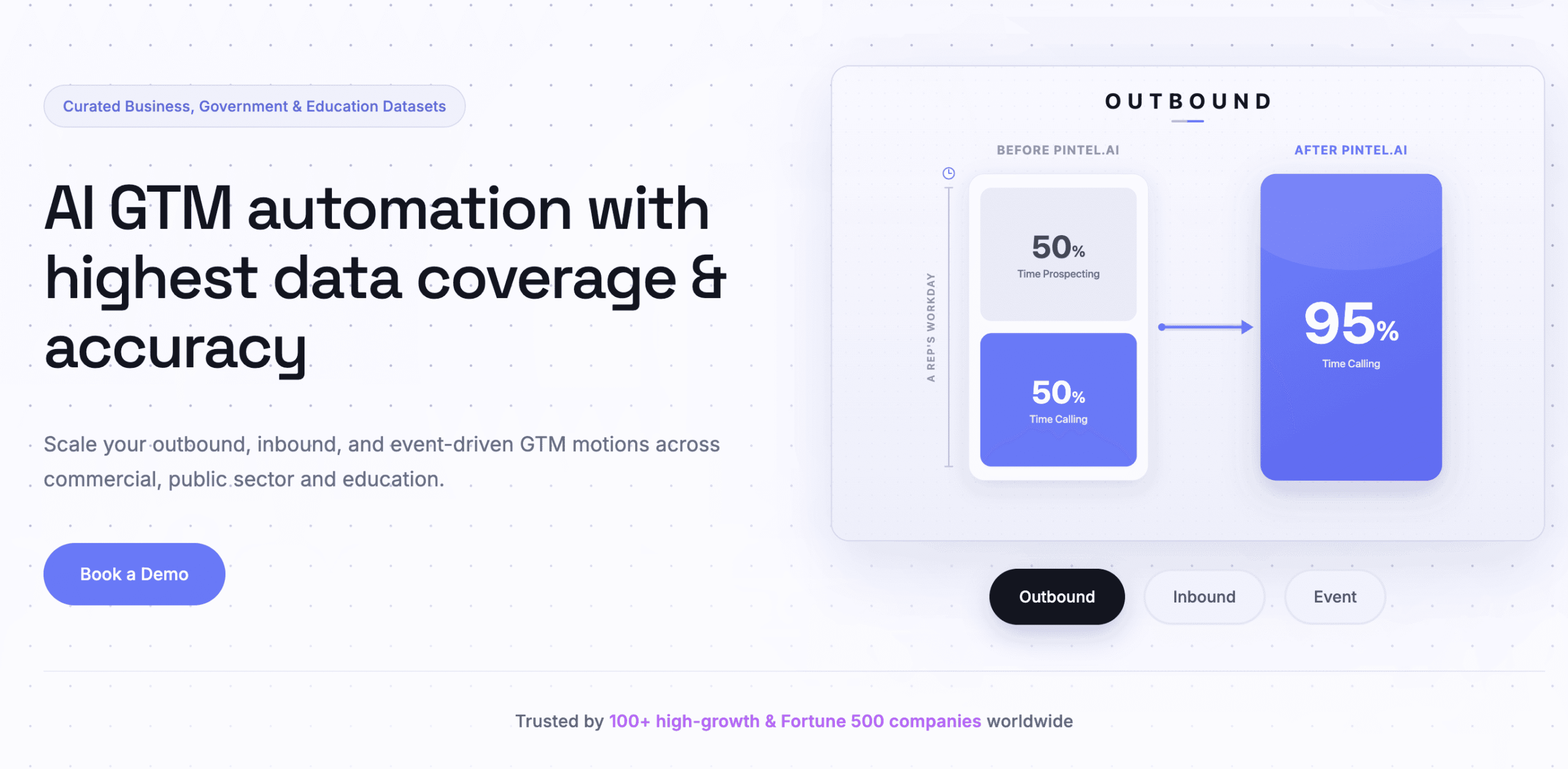
Pintel.ai is the strongest B2B database provider for outbound sales teams. It combines multi-source contact data, waterfall enrichment across 30 or more providers, AI-powered ICP filtering, and buying signal tracking in one platform, delivering higher accuracy and coverage than ZoomInfo, Apollo, Cognism, or Lusha for most outbound use cases. Global coverage spans US, EMEA, APAC, and LATAM with no regional limitations.
The core difference from other B2B database providers is how Pintel handles data quality. It runs waterfall enrichment across 30 or more vetted sources to deliver 90%+ contact fill rates on global ICPs. It filters at the profile level rather than title keywords, which removes the false positives that typically inflate database exports with 20 to 30% wrong contacts. And it tracks structural, contextual, and behavioral buying signals alongside contact data, so outbound timing is driven by account activity rather than SDR availability.
Beyond what ZoomInfo, Apollo, Clay, and Cognism cover, Pintel also reaches non-traditional data sources, government procurement records, school directories, and local business data, that no standard B2B database includes. For teams targeting public sector, education, healthcare, manufacturing, and similar verticals, Pintel.ai’s account discovery is the only option in this list that covers those verticals without a coverage gap.
Strengths:
- Global contact coverage with no regional caps, covering for US, European, APAC, and LATAM outbound
- Non-traditional data sources (government, schools, local directories) covering verticals that standard B2B database companies cannot reach
- Waterfall enrichment across 30+ providers delivers 90%+ contact fill rates. See how it works in our waterfall enrichment guide
- AI-powered plain-English ICP filtering removes false positives at the profile level, not just title keywords
- Buying signals (structural, contextual, behavioral) layered on top of contact data for timing-based outreach
Security and compliance: ISO 27001 certified, SOC 2 (AICPA), GDPR compliant, HIPAA compliant, CCPA compliant, and VAPT certified.
Limitations:
- Less market recognition compared to 10-year-old vendors, which is typical for fast-growing platforms
Pricing: Contact sales for custom pricing based on team size and coverage needs.
Best for: Global GTM teams, outbound into non-tech verticals (education, government, healthcare, manufacturing, etc.), and teams that want one platform covering the full prospecting stack.
ZoomInfo
ZoomInfo is a large US-focused B2B contact database, but its intent data relies on Bombora (a third-party provider) rather than proprietary signals, and its data quality outside North America is inconsistent for teams running global outbound.
Strengths:
- US contact database with good coverage for enterprise and mid-market tech accounts
- Native CRM integrations (Salesforce, HubSpot) reduce workflow friction for established teams
- Org chart data and seniority mapping are useful for multi-threaded enterprise outreach
Limitations:
- EMEA and APAC contact coverage drops significantly. Teams expanding globally often need a supplemental provider
- Pricing is enterprise-tier and can be difficult to justify for teams not doing high-volume US outbound
Pricing: Custom enterprise pricing, typically $$$$.
Best for: Enterprise US outbound teams with large budgets who need a well-integrated B2B database provider for Salesforce-heavy stacks.
Apollo.io
Apollo.io bundles a B2B contact database with outreach sequencing in one platform, but its data accuracy is inconsistent at scale and the intent signals this B2B database provider offers are not proprietary. They come from the same third-party sources available elsewhere.
Strengths:
- Database and sequencing in one tool reduces vendor count for smaller teams
- Competitive pricing makes it accessible for early-stage and SMB sales teams
- Reasonably broad US contact coverage for most tech-sector ICPs
Limitations:
- Data accuracy below the accuracy claims at scale, with bounce rates higher than enterprise alternatives for non-tech ICPs
- International coverage gaps become significant outside North America, limiting this B2B database provider for global outbound teams
Pricing: Free tier available; paid plans from $ to $$.
Best for: SMB and early-stage teams that need a combined database and sequencing tool at low cost.
Cognism
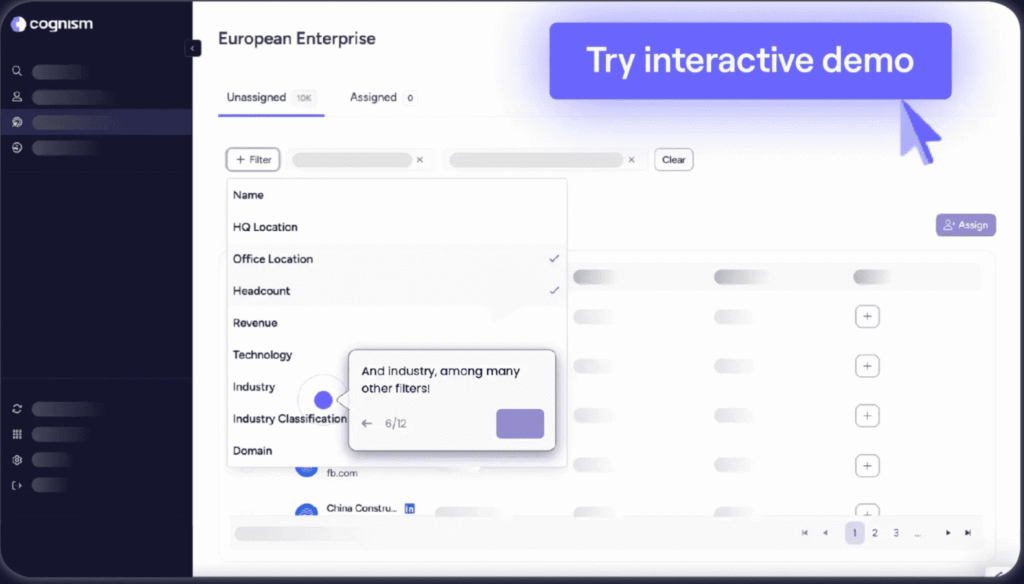
Cognism is a European-focused B2B database provider with GDPR compliance built in, but its coverage outside Europe is weak, making it a regional tool rather than a global B2B database solution for teams with mixed GTM territories.
Strengths:
- GDPR-compliant contact data for European markets, the compliance layer is built in, not bolted on
- Strong UK, DACH, and Nordics contact coverage for teams focused on those markets
- Phone-verified mobile numbers for European outreach
Limitations:
- US and APAC coverage is noticeably weaker. Teams running multi-region outbound need a separate provider for those markets
- Limited buying signals beyond basic job change alerts
Pricing: Custom pricing, typically $$$.
Best for: European outbound teams where GDPR compliance and UK/DACH contact accuracy are the primary requirements in their B2B database provider evaluation.
Lusha
Lusha is a B2B database provider focused on direct contact data with strong APAC coverage and a Chrome extension for LinkedIn, but it functions primarily as a contact finder rather than a full B2B database provider, with no company-level signals or ICP filtering layer.
Strengths:
- APAC contact coverage, especially for markets like Australia, India, and Southeast Asia
- Chrome extension integrates directly with LinkedIn for fast contact export
- Clean, simple interface with low onboarding friction
Limitations:
- No intent signals or account-level buying indicators. Contact finding only
- Coverage quality drops outside LinkedIn-active professionals in niche verticals
Pricing: Starts from $$; team plans available.
Best for: APAC-focused SDRs running LinkedIn-heavy outbound who need fast contact exports without complex setup.
Clearbit (HubSpot Enrichment)
Clearbit, now part of HubSpot, is a B2B data enrichment platform for inbound leads and website visitors, but it was not designed as an outbound prospecting database and has limited standalone contact-finding capability.
Strengths:
- Excellent company-level enrichment data (tech stack, revenue estimates, employee count) for inbound workflows
- Native HubSpot integration for teams already on the HubSpot CRM
- Website visitor identification for warm account prioritisation
Limitations:
- Not an outbound-first tool. Building a cold prospecting list from Clearbit is limited compared to dedicated B2B database providers
- Contact-level coverage is thinner than competitors purpose-built for prospecting
Pricing: Custom pricing via HubSpot; standalone plans from $$$.
Best for: HubSpot users enriching inbound leads and warming up website visitor data, not for building outbound lists from scratch.
Seamless.AI
Seamless.AI is a B2B database provider that uses AI to find and verify contact emails and phone numbers in real time, but its database is built from web scraping rather than verified primary sources, which produces inconsistent accuracy at scale for non-US markets.
Strengths:
- Real-time email and phone finding directly from LinkedIn profiles and company websites
- Chrome extension for fast in-workflow contact extraction
- Affordable pricing for teams with tight budgets
Limitations:
- Accuracy inconsistency reported at scale. Bounce rates can be higher than verified database providers
- US-focused with limited verified international coverage
Pricing: Free tier available; paid from $$.
Best for: US-focused email-first prospecting teams that need affordable real-time contact finding.
Lead411
Lead411 is a US-focused B2B database provider with built-in intent signals at mid-market pricing, but its database is limited to North America and the intent signals are basic compared to dedicated signal providers.
Strengths:
- Intent signals bundled into the platform at a lower price than enterprise alternatives
- Reliable US contact coverage for common tech-sector ICPs
- Affordable entry pricing for early-stage outbound teams
Limitations:
- No meaningful international coverage. US-only in practice
- Smaller database than ZoomInfo or Apollo, which shows in niche industry searches
Pricing: From $ per user per month.
Best for: US mid-market teams that want a B2B database provider with intent signals at non-enterprise pricing.
UpLead
UpLead is a B2B database provider focused on accuracy with real-time email verification at point of export, but the database is smaller than category leaders and lacks depth for non-US or non-tech markets where most business databases fall short.
Strengths:
- Real-time email verification reduces bounce rates for teams that have been burned by stale data
- Straightforward pay-per-credit model that avoids large upfront commitments
- Clean interface with basic technographic filters
Limitations:
- Smaller overall database. Niche ICPs and non-tech verticals return limited results
- No buying signals or intent data bundled in
Pricing: From $$ per month with credit-based usage.
Best for: Teams prioritising email accuracy over volume and evaluating B2B database providers for US tech-sector outbound.
Hunter.io
Hunter.io is a domain-based email tool rather than a full B2B database provider, which makes it useful for targeted single-company outreach but not for building outbound prospect lists at scale.
Strengths:
- Fast and reliable for finding email patterns and public-facing addresses for companies you already know
- Domain search and email verification bundled in one lightweight tool
- Free tier available for low-volume use cases
Limitations:
- Not a prospecting database. You must already know which companies to target
- No contact-level data beyond email and no company or signal data
Pricing: Free tier; paid from $.
Best for: Outreach to specific named accounts where you already have the company list and just need the email.
ContactOut
ContactOut extracts email addresses and phone numbers directly from LinkedIn profiles at high extraction rates, but it is entirely dependent on LinkedIn data and provides no company-level intelligence or buying signals.
Strengths:
- High extraction rate for LinkedIn-listed emails and personal email addresses
- Chrome extension integrates directly into LinkedIn and Sales Navigator workflows
- Useful for recruiters and SDRs who live in LinkedIn
Limitations:
- Coverage is entirely limited to LinkedIn-active professionals. No non-LinkedIn sources
- No firmographic data, signals, or ICP filtering layer
Pricing: From $$ per month.
Best for: SDR teams whose workflow is entirely LinkedIn-based and who need a B2B database provider that plugs into Sales Navigator.
RocketReach
RocketReach is a multi-channel B2B database provider covering email, phone, and LinkedIn profiles across a broad range of industries, but data accuracy is inconsistent across markets and it provides no signal or intent data beyond basic contact records.
Strengths:
- Broad contact coverage across multiple channels (email, phone, LinkedIn) in one search
- Global database with records outside the US, though accuracy varies by region
- API access available for teams integrating contact data into custom workflows
Limitations:
- Accuracy inconsistency reported in international markets. Verify with a test batch before scaling
- No buying signals or intent data included
Pricing: From $$ per month with credit-based plans.
Best for: Teams needing multi-channel contact data (email and phone) across a broad global database without signal requirements.
Now that each provider has been reviewed individually, there is one broader question worth addressing: when does buying three separate tools make less sense than using one platform that covers all of them?
When One Platform Covers More Than a Database
Most outbound teams buying B2B database providers end up purchasing two or three tools separately: a B2B database provider for contacts, a signal tool for intent data, and an enrichment provider to keep records fresh. Each adds cost, integration work, and data inconsistency when the sources do not agree on the same contact.
The case for a single end-to-end platform: If your team needs contact data, ICP filtering, buying signals, and enrichment in one place, without custom engineering to stitch vendors together. An end-to-end platform covers more ground with less operational overhead. Pintel.ai’s waterfall enrichment handles the contact data layer end-to-end, querying 30 or more B2B database providers in priority order to maximise fill rates without requiring separate contracts per source.
The only acceptable reason to stay with point solutions: your team has already built a working tech stack, your current data accuracy is above 85%, and you only need to fill a specific regional or vertical gap. In that case, a specialist provider (Cognism for Europe, Lusha for APAC) supplements what you have rather than replacing it.
For everything else, the operational simplicity of one platform beats the coverage patchwork of three. For related reading on how to structure a signal-based outbound setup, see our guide on intent data providers and B2B buying signals and our overview of best sales prospecting tools in 2026.
Related reading:
For how to evaluate any B2B database against your specific ICP before committing, see our guide on B2B company data providers: types, layers, and how to choose. For how to build a target account list using whatever database you select, see our guide on how to build a target account list for B2B sales.
With the full picture of options and the case for consolidation covered, here is how to bring it together into a final decision.
Final Takeaway: Picking the Right B2B Database Provider
The best B2B database provider for your team is the one that covers your actual ICP, not the one with the biggest total database or the most brand recognition. A provider with 500M records and 60% accuracy in your target market is less useful than one with 50M records and 90% accuracy on the accounts you are actually prospecting.
Start with the Coverage-First Evaluation Framework: test your specific ICP, your specific regions, and your specific verticals before signing. Most B2B database providers will give you a test batch. The ones who will not are telling you something about their confidence in their own coverage.
For teams running global outbound, targeting non-tech verticals, or needing signals alongside contact data from their B2B database provider, a platform that covers the full stack, contact data, ICP filtering, buying signals, and enrichment. This reduces both vendor complexity and coverage gaps. For teams with a narrow, well-covered ICP in one market, a specialist provider at lower cost may be the practical choice.
FAQ: B2B Database Providers
What is a B2B database provider?
A B2B database provider is a vendor that sells structured contact and company information to outbound sales teams. This includes emails, phone numbers, job titles, and company size. Some B2B database providers also include buying signals, enrichment tools, and ICP filtering.
Which B2B database provider has the best global coverage?
No single B2B database provider covers every region at equal accuracy. ZoomInfo is strongest in the US, Cognism leads in Europe, and Lusha covers APAC well. Pintel.ai aggregates across regional sources and adds non-traditional data for verticals that standard B2B database companies miss.
How do I test a B2B database provider before buying?
Export 50 to 100 CRM contacts and push them through the B2B database provider’s enrichment tool. Check match rate, email accuracy, and whether titles are current. A match rate below 80% on records you already know signals real ICP coverage gaps before you commit.
What is the difference between a B2B database provider and a sales intelligence platform?
B2B database providers supply raw contact and company records. Sales intelligence platforms add signal analysis, intent tracking, and workflow tools on top. Many B2B database companies now offer both. The line between the two categories has blurred significantly in the past three years.
Do B2B database providers include buying signals?
Most do not include meaningful buying signals. ZoomInfo bundles Bombora-powered intent data (third-party, not proprietary). Lead411 includes basic signals. Pintel.ai tracks structural signals (funding, hiring, tech stack changes), contextual signals (topic research activity), and behavioral signals (website visits, review site engagement) alongside its contact database.
How often does B2B database data go stale?
According to Salesforce’s State of Sales research, data decay is a top outbound barrier. B2B contact data decays at 20 to 30% per year. A B2B database provider that does not re-verify records quarterly will have accuracy problems by month six.