Most B2B teams are running outbound on CRM data that is 20 to 30% wrong. Contacts have changed jobs. Emails are inactive. Company details are outdated. Data enrichment tools fix this, but they work in very different ways, at very different fill rates, and with very different coverage for teams outside North America. Picking the wrong data enrichment tool means paying to maintain a database that is still failing your sequences.
This guide compares 12 data enrichment tools on the metrics that matter for outbound teams: match rate, regional coverage, CRM integration depth, and pricing, so you can choose the one that actually keeps your contact data accurate.
Quick Takeaways
- Single-source data enrichment tools typically hit 60 to 80% match rates on global contact lists. Waterfall enrichment across multiple providers consistently delivers above 90%.
- Match rate on your own CRM data, not the vendor’s claimed database size, is the only metric that matters. Always run a test batch before committing.
- Most data enrichment tools are built for US or European ICPs. Global teams needing coverage across EMEA, APAC, and LATAM need a provider with multi-source enrichment or a waterfall approach.
- CRM integration depth varies significantly. Some tools sync automatically on job change signals. Others require manual exports. The automation gap directly affects how stale data gets before it is caught.
- Pintel.ai runs waterfall enrichment across 30 or more vetted data sources, delivering the highest contact fill rates in this list for global outbound teams.
12 Best Data Enrichment Tools: Quick Comparison
Here is a snapshot of all 12 data enrichment tools compared across the dimensions that matter most for B2B sales and RevOps teams. Pintel.ai leads because its waterfall enrichment approach (querying multiple sources in priority order) that consistently delivers higher match rates than single-source alternatives, particularly for global ICPs.
| Tool | Enrichment Type | Coverage | Pricing |
|---|---|---|---|
| Pintel.ai | Company and contact enrichment, buying signals, enrichment API | Global (US, EMEA, APAC, LATAM) | Contact sales |
| Clearbit (HubSpot Enrichment) | Company and contact enrichment | US-strong, limited global | Custom (via HubSpot) |
| Clay | Workflow-based multi-source enrichment | Depends on connected sources | From $149/mo |
| ZoomInfo Enrich | Real-time CRM data enrichment | Strong US, limited EMEA/APAC | Custom (via ZoomInfo) |
| Cognism | GDPR-compliant contact enrichment | Strong Europe, limited US | Custom ($1,500+/mo est.) |
| Apollo.io | Contact enrichment with database access | US-focused, moderate global | From $99/mo |
| Lusha | LinkedIn-based contact enrichment | Strong APAC and LinkedIn-indexed | From $29/mo |
| FullContact | Identity resolution and contact enrichment | US-focused | From $99/mo |
| Diffbot | AI-powered company enrichment from web | Global company data, limited contact | From $299/mo |
| Surfe | LinkedIn-to-CRM contact enrichment | LinkedIn-indexed contacts only | From $23/user/mo |
| People.ai | Automatic CRM activity data enrichment | Activity data (not contact enrichment) | Custom (enterprise) |
| Seamless.AI | Real-time contact email and phone finding | US-focused, web-scraped | From $65/mo |
This comparison is based on first-hand platform knowledge, publicly available product information, and commonly reported user experiences. Contact each vendor directly for the latest pricing and product details.
Looking for a done-for-you solution instead of software? Explore our guide to the best managed B2B data enrichment services to compare providers that build and enrich your B2B data for you.
With all 12 tools visible at a glance, the next step is knowing which evaluation criteria actually separate a tool that works for your ICP from one that looks good in demos.
What Are Data Enrichment Tools?
A data enrichment tool is software that fills in missing or outdated information in existing contact and company records by matching them against one or more external data sources. In B2B sales, this means updating emails, phone numbers, job titles, company details, and firmographic data in the CRM automatically rather than relying on manual research.
Data enrichment is distinct from data prospecting. Prospecting tools find new contacts from scratch. Enrichment tools update and complete records you already have, including correcting stale data when a contact changes jobs or a company changes structure. For a breakdown of how enrichment fits into the broader B2B company data provider landscape, including how firmographic data layers alongside enrichment, including the five types of data providers and when each is appropriate, that guide covers the full picture.
What to Look for in Data Enrichment Tools
The Enrichment Match Rate Framework narrows the field of data enrichment tools to the ones that actually deliver for your specific ICP. Evaluate in this order before committing to any vendor:
- Match rate on your own data: Run a test batch of 50 to 100 existing CRM contacts through the tool. A match rate below 80% on data you already have signals the provider has coverage gaps in your specific ICP, not just the broad market.
- Data freshness and re-verification cadence: Ask how the tool detects when a contact changes jobs. Tools that trigger re-enrichment automatically on job change signals catch data decay before it reaches sequences. Tools that only enrich at export time let data go stale within months.
- Regional coverage for your ICP: US-focused enrichment tools frequently drop to 50 to 60% fill rates for European or APAC contacts. If your ICP spans multiple regions, confirm the tool has verified records for those specific markets, not just global claims.
- CRM integration depth: Does the tool push enriched data into Salesforce or HubSpot automatically, or does it require manual import? Automatic sync preserves data freshness. Manual workflows create gaps between enrichment and outreach.
- Source diversity: Single-source data enrichment tools are limited by one provider’s database coverage. Multi-source or waterfall tools query additional sources when the primary source returns no match, delivering higher overall fill rates.
12 Best Data Enrichment Tools: Deep Dive
1. Pintel.ai
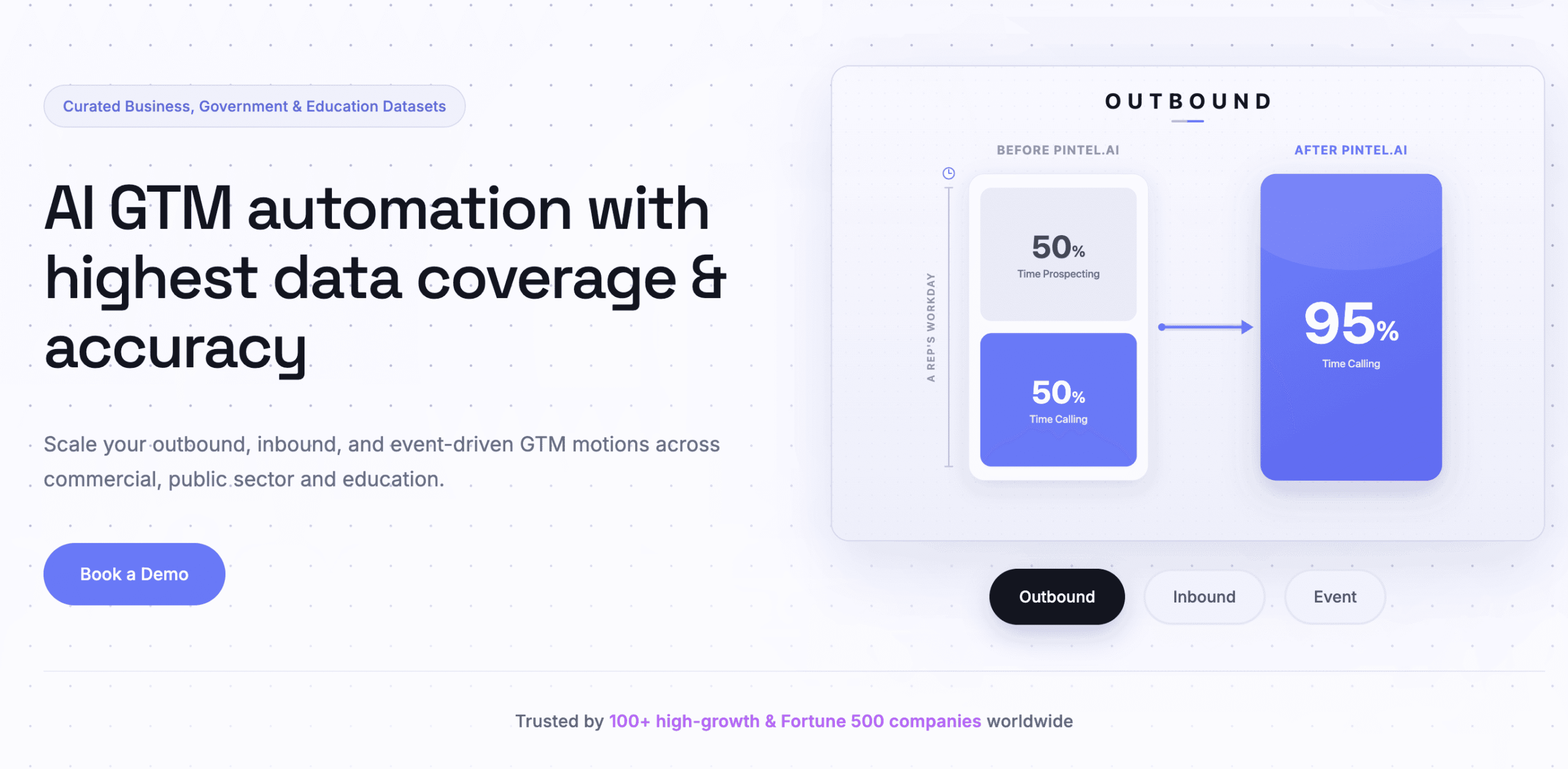
Pintel.ai is built for GTM, sales, outbound, and RevOps teams that need accurate global B2B data enrichment at scale. Unlike traditional enrichment tools that rely on a single database, Pintel runs waterfall enrichment across 30+ vetted providers to improve contact match rates across emails, phone numbers, firmographics, and company data.
The platform supports global enrichment coverage across US, EMEA, APAC, and LATAM markets, making it suitable for teams prospecting beyond North America. Pintel also helps teams track buying signals such as hiring activity, job changes, funding events, company expansion, technology adoption, and other intent signals that help prioritize high-fit accounts.
Teams can use Pintel through API-first enrichment workflows, CRM integrations, and profile-level filtering to enrich and qualify records automatically inside their outbound workflows.
Why teams choose Pintel.ai
- Coverage across EMEA, APAC, LATAM, and North America
- Waterfall enrichment across 30+ providers
- Higher contact match rates across global B2B data
- Email, phone, firmographic, and company enrichment
- Buying signal and intent tracking
- Automatic data refresh workflows
- API-first enrichment infrastructure
- CRM sync and profile-level filtering
Strengths:
- Waterfall enrichment across 30+ sources delivers 90%+ fill rates on global ICPs (US, EMEA, APAC, LATAM)
- Automatic re-enrichment triggers on job change signals, catching data decay before it reaches outbound sequences
- Profile-level ICP filtering removes false positives from enriched contact lists before they enter sequences
- Covers non-traditional sources (government records, school directories, local business data) for teams targeting public sector, education, manufacturing, healthcare, and similar verticals
Security and compliance: ISO 27001 certified, SOC 2 (AICPA), GDPR compliant, HIPAA compliant, CCPA compliant, and VAPT certified.
Limitations:
- Less market recognition compared to tools with 10+ years of market presence, which is common for fast-growing platforms
Pricing: Contact sales for custom pricing.
Best for: Global GTM and RevOps teams who need the highest contact fill rates on diverse ICPs, including non-tech verticals (public sector, education, healthcare, manufacturing, etc.).
The remaining 11 tools each cover a specific enrichment use case or regional need. Knowing where each one excels and where it falls short, helps you layer the right tool into your existing setup or evaluate whether a single multi-source platform covers more ground.
2. Clearbit (HubSpot Enrichment)
Clearbit, now integrated into HubSpot as HubSpot Enrichment, is a data enrichment tool built primarily for inbound workflows, but its outbound enrichment coverage is weaker than dedicated contact enrichment providers and does not include job change detection triggers.
Strengths:
- Company-level enrichment (tech stack, employee count, revenue band) is strong for US-based companies
- Native HubSpot integration enriches inbound leads and web visitor data automatically
- Reveal feature identifies anonymous website visitors for inbound pipeline enrichment
Limitations:
- Contact-level enrichment depth is thinner than dedicated enrichment tools for outbound use cases
- Not built for global ICPs. European and APAC coverage drops noticeably outside US-headquartered companies
Pricing: Custom (via HubSpot).
Best for: HubSpot users enriching inbound leads, web visitor data, and CRM company records at the account level.
3. Clay
Clay is a workflow-based data enrichment tool that connects to multiple data sources through a recipe builder, but it requires significant RevOps configuration to set up and maintain. Teams without dedicated workflow-building capacity get less value than advertised.
Strengths:
- Connects to dozens of data providers through a visual workflow, enabling multi-source enrichment without custom code
- Highly customisable enrichment sequences for teams with specific data requirements per field
- Strong in the modern outbound community with a wide library of community-built templates
Limitations:
- Coverage quality depends entirely on which sources you connect. Clay does not have its own proprietary database
- Setup complexity is significant. Teams without a dedicated RevOps resource often underutilise the platform
Pricing: From $149/mo; credits consumed per enrichment lookup.
Best for: RevOps teams with workflow-building capacity who want full control over their enrichment source stack. For teams that want the multi-source approach without building it themselves, a pre-built waterfall enrichment setup delivers comparable fill rates with less configuration.
4. ZoomInfo Enrich
ZoomInfo Enrich is a real-time data enrichment tool for teams already on the ZoomInfo platform, but its enrichment quality outside North America is inconsistent and the bundled pricing model means standalone enrichment buyers pay for capabilities they may not use.
Strengths:
- Native Salesforce and HubSpot integration enables automated enrichment when records are created or updated
- Real-time enrichment triggered by CRM activity keeps US contact data current without manual exports
- Strong org chart and hierarchy data for enterprise account mapping
Limitations:
- EMEA and APAC contact enrichment quality drops significantly compared to US records
- Pricing is bundled with ZoomInfo’s broader platform. Standalone enrichment buyers often overpay
Pricing: Custom (via ZoomInfo).
Best for: Enterprise teams already paying for ZoomInfo who want enrichment activated natively inside their Salesforce or HubSpot CRM.
5. Cognism
Cognism is a GDPR-compliant data enrichment tool with strong European contact coverage, but its US database coverage is noticeably weaker, making it a regional enrichment tool rather than a global one for teams with mixed GTM territories.
Strengths:
- GDPR compliance is built into the data sourcing and consent verification process, not added as an afterthought
- Phone-verified mobile numbers for UK, DACH, and Nordics markets where email reply rates are low
- Job change alerts for European contacts help catch data decay earlier than most EU-focused providers
Limitations:
- US contact enrichment coverage is thinner. Teams running mixed US and European outbound often need a supplemental tool
- APAC coverage is limited
Pricing: Custom ($1,500+/mo est.).
Best for: European outbound teams where GDPR compliance and UK/DACH contact accuracy are the primary enrichment requirements.
6. Apollo.io
Apollo.io is a data enrichment tool that bundles contact enrichment alongside its prospecting database and sequencing tools, but the enrichment accuracy is inconsistent at scale for non-tech ICPs and the international coverage gaps become significant for teams expanding beyond North America.
Strengths:
- Enrichment credits bundled into prospecting and sequencing plans reduce the number of separate vendor contracts
- Solid US tech-sector contact coverage for common SDR personas
- Reasonably priced enrichment for SMB teams not yet ready for enterprise enrichment tools
Limitations:
- Bounce rates from enriched contacts are higher than enterprise alternatives, particularly for non-tech and non-US ICPs
- No waterfall fallback. If Apollo’s database misses a record, the field stays blank
Pricing: From $99/mo (enrichment credits bundled into plan).
Best for: SMB teams that want enrichment as part of a bundled prospecting and sequencing platform at accessible pricing.
7. Lusha
Lusha is a data enrichment tool that extracts contact data from LinkedIn profiles through its Chrome extension, but its enrichment coverage is entirely dependent on LinkedIn-indexed data and provides no enrichment for contacts who are not active on LinkedIn.
Strengths:
- Strong APAC contact enrichment for LinkedIn-active professionals
- Chrome extension enables direct enrichment from LinkedIn profiles into the CRM without a separate export step
- Lower per-seat pricing than enterprise enrichment alternatives
Limitations:
- Coverage gaps are significant for non-LinkedIn-active industries (manufacturing, government, education, etc.)
- No company-level enrichment or signal tracking beyond basic contact fields
Pricing: From $29/mo.
Best for: APAC-focused SDRs running LinkedIn-heavy workflows who need fast contact enrichment without complex setup.
8. FullContact
FullContact is an identity resolution data enrichment tool that matches fragmented contact records across sources to build unified profiles, but its US-centric database makes it a weak choice for teams with global or non-tech ICPs.
Strengths:
- Identity resolution links multiple partial records (email, phone, social) into a single unified contact profile
- Good for cleaning and deduplicating messy CRM data before enrichment runs
- Direct API access for teams building custom enrichment pipelines
Limitations:
- US contact depth is the main strength. International coverage is limited
- Less suited to active outbound enrichment workflows than to CRM hygiene and identity matching use cases
Pricing: From $99/mo; API pricing scales with volume.
Best for: Teams doing CRM data cleaning and identity resolution on US contact databases before outbound campaigns.
9. Diffbot
Diffbot is a data enrichment tool that uses AI to extract company data from public web sources, providing company-level enrichment from any publicly available business information, but contact-level data (emails, phone numbers) is limited compared to dedicated contact enrichment providers.
Strengths:
- Company enrichment covers a broad range of organisations including those not in standard B2B databases
- Knowledge graph approach provides structured data on company relationships, products, and leadership
- Global company coverage pulls from international web sources, useful for non-US company research
Limitations:
- Contact-level enrichment (verified emails, phone numbers) is weak compared to dedicated contact providers
- Pricing is higher than contact-focused tools for teams that primarily need email and phone enrichment
Pricing: From $299/mo.
Best for: Teams needing company-level intelligence enrichment (structure, products, leadership) from public web sources rather than contact data.
10. Surfe
Surfe is a data enrichment tool that pushes LinkedIn contact data into CRM fields via a Chrome extension, making it useful for individual SDRs working from LinkedIn, but it provides no enrichment for contacts discovered outside the LinkedIn ecosystem and no company-level data beyond what LinkedIn provides.
Strengths:
- Fastest path from LinkedIn profile to CRM record without manual copy-paste
- Works directly inside LinkedIn and Sales Navigator without a separate tool window
- Low per-user pricing makes it accessible for individual SDRs
Limitations:
- Coverage limited entirely to LinkedIn-indexed contacts
- No batch enrichment capability for existing CRM records. Contact-by-contact only from LinkedIn
Pricing: From $23/user/mo.
Best for: Individual SDRs who want to push LinkedIn contact data into Salesforce or HubSpot without manual data entry.
11. People.ai
People.ai is a data enrichment tool for activity data that automatically captures sales calls, emails, and meetings and maps them to CRM account and contact records, but this is activity enrichment, not contact data enrichment, and it does not fill missing emails, phone numbers, or firmographic data.
Strengths:
- Eliminates the need for reps to manually log calls and meetings in Salesforce
- Activity data enrichment gives RevOps a true picture of account engagement without rep-entered data
- Connects outreach activity patterns to pipeline outcomes for coaching analytics
Limitations:
- Does not enrich missing contact fields (email, phone, title). It captures activity, not contact data
- Enterprise pricing and implementation complexity make it unsuitable for teams under 50 reps
Pricing: Custom (enterprise).
Best for: Enterprise RevOps teams using Salesforce who need automatic activity capture, not teams looking to fill gaps in contact or company data.
12. Seamless.AI
Seamless.AI is a data enrichment tool that finds email addresses and phone numbers in real time from web sources, but its database is built from web scraping rather than verified primary sources, producing accuracy inconsistency that can raise bounce rates at scale.
Strengths:
- Fast email and phone finding directly from LinkedIn profiles and company websites
- Lower pricing than enterprise alternatives for teams with tight budgets
- Chrome extension provides quick lookup without leaving the browser
Limitations:
- Accuracy inconsistency at scale. Bounce rates are higher than verified database providers
- US-focused with limited coverage outside North America
Pricing: From $65/mo.
Best for: Small teams doing US-focused email finding at low cost where some accuracy variance is acceptable.
Why Waterfall Enrichment Outperforms Single-Source Tools
Every data enrichment tool in this list has a coverage ceiling, the point at which its database has no record for a contact and returns a blank. For US tech-sector ICPs, that ceiling sits around 70 to 80% for most tools. For global ICPs or non-tech verticals, it is often much lower.
Waterfall enrichment solves this by querying multiple sources in a defined priority order. If the highest-accuracy source returns no match, the enrichment falls back to the next source, and so on, until a match is found or all sources are exhausted. Applied across 30 or more vetted providers, this approach delivers fill rates above 90% on the same contact lists where single-source tools return 60 to 70%. The waterfall enrichment guide covers how to structure a waterfall sequence, which source types to prioritise, and how to cache results to avoid paying for duplicate lookups.
Teams looking for a data enrichment tool with waterfall capability built in use Pintel.ai’s waterfall contact enrichment, which runs the full multi-source sequence automatically and triggers re-enrichment on job change signals.
Final Takeaway: Choosing the Right Data Enrichment Tool
The right data enrichment tool is the one that delivers the match rate your ICP actually needs, not the one with the biggest claimed database. A tool that enriches 90% of your US tech contacts but returns blanks for 40% of your European or APAC records is not a global enrichment solution, regardless of what the vendor claims.
Start with a test batch on your own CRM data. Measure match rate, accuracy of returned fields, and freshness of job titles. That test tells you more about the tool’s fit for your ICP than any demo or marketing page.
For teams with diverse global ICPs or those expanding beyond a single region, a waterfall enrichment approach across multiple sources consistently outperforms any single-source tool. For teams with narrow, well-covered US tech ICPs, a specialist tool at lower cost may be the practical choice. Either way, the enrichment cadence (triggered automatically on job change, not just at list-build time) is what separates teams with clean pipelines from teams constantly dealing with bounces. For how enrichment fits into the full lead qualification framework, that guide covers how enriched data feeds directly into scoring and routing.
FAQ: Data Enrichment Tools
Which data enrichment tools are best for global B2B teams?
The best data enrichment tools for global B2B teams are platforms that support multi-source or waterfall enrichment across US, EMEA, APAC, and LATAM datasets. Single-source enrichment tools often struggle with non-US coverage and lower match rates.
Are data enrichment tools worth it for outbound sales teams?
Yes. Data enrichment tools help outbound teams reduce bounce rates, improve CRM accuracy, identify job changes faster, and maintain fresher contact records for prospecting and sequencing workflows.
What are the most important features in data enrichment tools?
The most important features in data enrichment tools include high match rates, waterfall enrichment, CRM integrations, job change detection, global coverage, API access, and automated re-enrichment workflows.
Do data enrichment tools improve email deliverability?
Yes. Data enrichment tools improve deliverability by replacing outdated or invalid contact records with fresher verified data, reducing email bounce rates and improving sender reputation over time.
What is the difference between single-source and multi-source data enrichment tools?
Single-source data enrichment tools rely on one database for enrichment. Multi-source or waterfall data enrichment tools query multiple providers sequentially, improving coverage and fill rates significantly.
Which data enrichment tools support API integrations?
Most modern data enrichment tools provide API access for CRM syncing, outbound automation, and enrichment workflows. However, API coverage depth and refresh frequency vary significantly between providers.
Can data enrichment tools detect job changes automatically?
Some advanced data enrichment tools track job change signals and automatically refresh outdated records before they impact outbound sequences or CRM accuracy.
How accurate are data enrichment tools?
Accuracy varies by provider, region, and ICP. US-focused data enrichment tools may perform well for North American contacts but struggle with EMEA or APAC datasets. Waterfall enrichment generally delivers higher accuracy and fill rates.
Are data enrichment tools GDPR compliant?
Some data enrichment tools are GDPR compliant and maintain consent-aware enrichment processes, especially providers focused on European markets. Compliance standards vary by vendor and region.
How do waterfall data enrichment tools work?
Waterfall data enrichment tools query multiple providers in sequence until a verified match is found. This approach improves match rates compared to single-source enrichment systems that return blank records when no match exists.