A sales operations lead pulls a “company database” that turns out to be a small business directory built from self-submitted listings. A researcher trying to verify a private company’s revenue pulls up a public filings database that only covers companies that sell stock on an exchange. Both found a US company database. Neither found the record type they actually needed.
US company database is not one product category. Some are official government registries. Some are crowdsourced directories. Some are credit-risk platforms repurposed for sales research. A few are raw data feeds meant for developers, not sales reps. The label “database” covers all of them, which is why picking the wrong one wastes hours before a single prospect is contacted.
This guide compares 12 US company database providers on how they source records, how those records are verified, who they actually cover, and what access costs, so RevOps (Revenue Operations) and sales leaders can match the database to the record type they need instead of the marketing page.
What Are the Best US Company Database Providers?
The best US company database provider depends on what you need the data to do. If you need sales-ready company and contact data, enrichment, and buying signals in one workflow, Pintel.ai is the strongest fit for B2B sales teams. If you only need public filings, government registrations, private company intelligence, or industry-specific directories, specialized databases may be more appropriate.
For most RevOps and sales teams, the important question is not simply which database has the most companies, but which one gives you the company records, data quality, coverage, and workflow access you actually need. The 12 providers below cover these different use cases, with Pintel.ai focused on turning company data into actionable sales opportunities.
Quick Comparison: 12 US Company Database Providers at a Glance
Here is how the top US company database providers compare on what they cover and how the underlying records are sourced.
| Provider | What It Covers | Where It Falls Short | Verification |
|---|---|---|---|
| Pintel.ai | Verified company database, contact data enrichment, and buying signals | Newer than established enterprise data vendors | 95%+ match rate, profile-level review |
| D&B Hoovers | Business and company data | Higher pricing for smaller teams | DUNS-linked verification |
| Data Axle | Business and consumer data | Coverage and data depth can vary by segment | Human-verified |
| SEC EDGAR | Public company information | Covers only publicly traded companies | Primary-source government filings |
| SAM.gov | Government contractor and vendor data | Not designed for general company discovery | Government-run, self-reported |
| OpenCorporates | Company and registry data | Limited contact and company-level detail | Registry-based |
| PitchBook | Private company and investment data | Expensive for general company database needs | Analyst-reviewed |
| Cortera | Business credit and risk data | Less depth for general company research | Network-contributed |
| Owler | Company and competitive intelligence | Contact coverage is relatively limited | Community-contributed |
| ThomasNet | Supplier and business data | Narrower overall company coverage | Verified profiles and badges |
| Coresignal | Company data through APIs | Requires additional setup to turn data into usable prospect lists | Automated collection |
| Manta | Small business data | Data depth and accuracy can vary | Self-submitted |
This comparison is based on first-hand platform knowledge, publicly available product information, and commonly reported user experiences. Contact each vendor directly for the latest pricing and product details.
What Is a US Company Database?
A US company database is a searchable collection of business records, such as company names, addresses, registration status, or financial data, built by a government agency, a data vendor, or a directory operator.
The term hides a real split in how trustworthy those records are. Government registries and regulatory filings are primary-source records, filed directly by the entities themselves under legal obligation. Commercial databases either license that same registry data, crowdsource it from business communities, or scrape it from public web pages, each with a different accuracy ceiling.
A team that treats a self-submitted directory record as verified fact inherits every gap the business owner never fixed. These CRM hygiene tools catch stale company records before they reach a rep, regardless of which database supplied the raw data.
How We Evaluated These US Company Database Providers
Every one of these US company database providers was scored against the same seven-criteria Database Trust Check, not brand size or search ranking, so the comparison reflects how reliable each source actually is for B2B use.
- 1. Sourcing model: Is the data a government filing, licensed registry data, crowdsourced from a community, or scraped from public web pages?
- 2. Coverage scope: Does it cover public companies, private companies, small businesses, or only federal contractors?
- 3. Verification method: How are records checked, and is there any independent review beyond self-reporting?
- 4. Access method: Is it a searchable web interface, an API for developers, or a bulk data export?
- 5. Depth beyond basics: Does it go beyond name and address into credit risk, funding, filings, or org structure?
- 6. Compliance: Is the data collected lawfully and disclosed transparently, and does it meet privacy obligations like CCPA when records include named individuals?
- 7. Pricing transparency: Is starting price published, or is it contact-sales only?
According to Forrester’s B2B research, data quality issues compound at every stage of a go-to-market motion, which is exactly why sourcing model and verification method carry as much weight in this framework as raw coverage. The Database Trust Check above is the single lens used for choosing a provider and for every review that follows.
12 Best US Company Database Providers: Detailed Reviews
We reviewed 12 US company database providers to understand what each offers, what they are best suited for, and where their data may fall short. The list covers sales platforms, government databases, private company intelligence, credit data, directories, and developer-facing data providers.
Pintel.ai: Company Database with Accurate Decision-Maker Contact Data
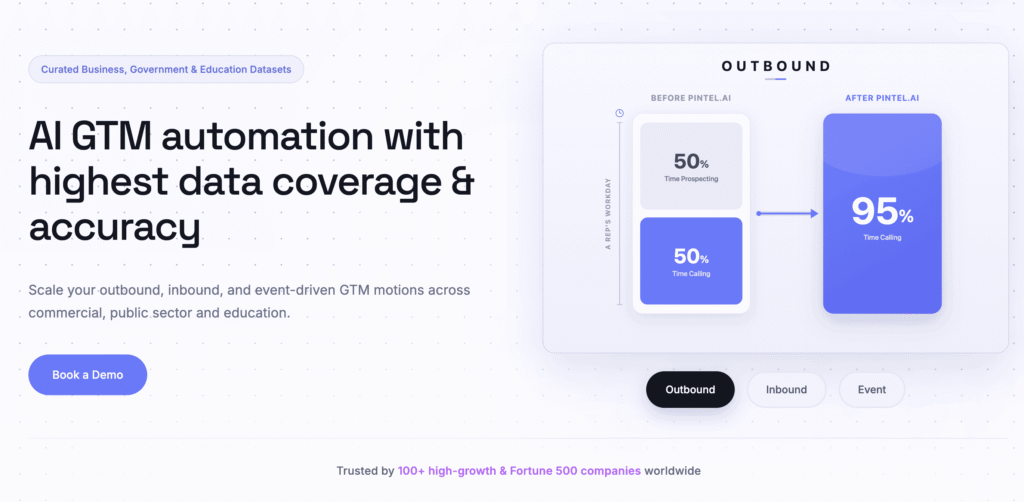
Pintel.ai combines US company data, accurate decision-maker contact data, enrichment, and buying signals in one platform. Sales and RevOps teams can use it to find US companies that match their ICP, identify the right decision-makers, enrich company and contact records, and prioritize accounts based on relevant buying signals.
Its waterfall enrichment system uses 30+ data providers along with proprietary US sources to enrich US company and contact records. This helps teams build more complete company profiles and find relevant decision-makers without relying on a single data source.
For public sector, education, and healthcare use cases, Pintel.ai also uses non-traditional US data sources such as government procurement records and school district directories to identify organizations and relevant contacts.
Key capabilities:
- US company database: Firmographic and organizational data for finding and segmenting US businesses.
- Decision-maker contact data: Accurate contact information for identifying relevant stakeholders within US companies.
- Waterfall enrichment: Sequential enrichment across 30+ providers and proprietary sources to fill missing company and contact data.
- ICP filtering: Plain-English prompts to find US companies that match specific profile and targeting criteria.
- Buying signals: Structural, contextual, and behavioral signals that help identify US accounts showing relevant activity or changes.
- Industry-specific data: Non-traditional US sources for public sector, education, healthcare, and other specialized markets.
- Global coverage: Data across the US, EMEA, APAC, and GCC.
- Security and compliance: ISO 27001, SOC 2 (AICPA), GDPR, HIPAA, CCPA, and VAPT certifications or compliance coverage.
Best for: Sales and RevOps teams looking for a US company database with accurate decision-maker contact data, enrichment, and buying signals in one workflow.
Pricing: Contact sales.
D&B Hoovers: Company and Firmographic Verification, Weak on Cost Per Contact
D&B Hoovers draws on Dun and Bradstreet’s proprietary company database to deliver verified firmographic records and org charts, but company and contact credits are billed separately, so unlocking a full profile can cost more than a single unified credit would.
- Strong at: Verified company and firmographic data backed by DUNS-linked records
- Strong at: Org chart mapping for enterprise account research
- Weak at: Contact-level freshness and a credit system where unused credits expire
Pricing: From $49/mo (Essentials tier); enterprise tier is contact sales | Best for: Teams that need a verified company database first and contact data second.
Data Axle: US Business and Consumer Data Breadth, Weak on Modern Intent Signals
Data Axle verifies its US business and consumer database through an in-house research team rather than aggregation, but the platform has no native buying-signal or intent layer, so account prioritization needs a separate tool.
- Strong at: Broad US and Canada business data with phone and email included
- Strong at: Human-verified records instead of scraped or crowdsourced data
- Weak at: No intent signals natively and no coverage outside North America
Pricing: Contact sales | Best for: US and Canada-only teams that value a verified company database over buying-signal intelligence.
SEC EDGAR: Free Public Company Filings, Weak on Private Company Coverage
SEC EDGAR is the US Securities and Exchange Commission’s own database of public company filings, including 10-Ks, 10-Qs, and 8-Ks, but its Full-Text Search only indexes filings submitted since 2001 and covers zero private companies, which make up most of the US B2B market.
- Strong at: Primary-source regulatory filings with no third-party verification needed
- Strong at: Completely free with no account required for basic search
- Weak at: No private company data at all and no natural-language search
Pricing: Free | Best for: Researching public company financials and disclosures, not sourcing private prospects.
SAM.gov: Free Federal Contractor Registry, Weak on General Business Coverage
SAM.gov is the US General Services Administration’s official registry for entities that want to do business with the federal government, but it only includes businesses that have chosen to register, leaving out the large majority of US companies that never pursue federal contracts.
- Strong at: Free, official federal contractor and award data with no registration fee
- Strong at: Direct government source, reducing the risk of stale third-party copies
- Weak at: Zero coverage of companies outside the federal contracting world
Pricing: Free. Third-party firms that charge for “registration help” are not SAM.gov itself. | Best for: Teams selling into federal and public-sector accounts, not general B2B prospecting.
OpenCorporates: Global Registry Aggregation, Weak on Business Activity Data
As one of the broadest US company database options for registry data, OpenCorporates aggregates official company registry records from 140+ jurisdictions, including all 50 US states, but registry status only confirms a company is registered, not that it is actively operating, solvent, or a real buyer.
- Strong at: Broad jurisdictional coverage sourced directly from government registries
- Strong at: Published, transparent API pricing starting at a low monthly tier
- Weak at: No signal on whether a registered company is actually active or a viable prospect
Pricing: From about £8/mo (Light API tier) | Best for: Confirming legal entity details, not evaluating whether a company is a live sales target.
PitchBook: Private Company and Deal Data, Weak on Published Pricing
PitchBook combines web-crawled data with a dedicated research team that contacts private companies directly, covering venture, private equity, and M&A activity in depth, but pricing is entirely contact-sales, so budgeting for it requires a sales conversation before any comparison.
- Strong at: Deep private company, funding, and deal data most free registries do not track
- Strong at: A dedicated research team that verifies data directly with company management
- Weak at: No public pricing and financial data for private companies remains self-reported estimates
Pricing: Contact sales | Best for: VC, PE, and M&A research teams that need deal-level detail on private companies.
Cortera: Business Credit and Risk Data, Weak on Sales Prospecting Fit
Cortera, now operating as a Moody’s Analytics company, combines trade payment data contributed by a business network with public records to produce credit-risk profiles, but the database is built for credit and counterparty evaluation, not for finding new sales prospects.
- Strong at: Business credit and payment-behavior data across a large company base
- Strong at: Backed by Moody’s Analytics infrastructure and oversight
- Weak at: Sparse profiles for smaller or newer companies with thin credit histories
Pricing: Contact sales | Best for: Credit and risk teams evaluating counterparties, not sales teams building a prospect list.
Owler: Crowdsourced Competitive Intelligence, Weak on Financial Accuracy
Owler, owned by Meltwater since 2021 rather than the independent startup many assume it still is, crowdsources company profiles and revenue estimates from a community of business professionals, but those financial figures are estimates, not audited numbers.
- Strong at: Fast, free lookups for competitor tracking and company news
- Strong at: Community-driven updates that can surface changes faster than static registries
- Weak at: Revenue and funding figures are crowdsourced estimates, not verified data
Pricing: Free tier; Pro from $39/user/mo billed annually | Best for: Quick competitive snapshots, not the system of record for a prospect list.
ThomasNet: Industrial Supplier Directory, Weak on Coverage Outside Manufacturing
ThomasNet, now owned by manufacturing marketplace Xometry rather than operating as an independent publisher, lists over 500,000 supplier profiles reviewed by in-house analysts, but coverage is narrow by design and tiered “Verified” badges are analyst-reviewed rather than independently audited.
- Strong at: Deep, free search across industrial and manufacturing suppliers
- Strong at: Analyst-reviewed profiles rather than fully unmoderated listings
- Weak at: Zero relevance outside manufacturing and industrial sectors
Pricing: Free to search; supplier listing packages are contact-sales | Best for: Sourcing industrial suppliers, not general B2B company research.
Coresignal: Bulk Company Data API, Weak on Manual Verification
Coresignal delivers company records at scale through an API or bulk file rather than a browsable directory, aggregating public web data from sources that include other directories, but the data is collected automatically with no manual review layer.
- Strong at: Large-scale, structured company data built for developers and data teams
- Strong at: Published, transparent API pricing with clear credit tiers
- Weak at: No manual verification, so records inherit the gaps of the public sources it scrapes
Pricing: From $49/mo (Mini API tier) | Best for: Engineering teams building a product on top of raw company data, not sales reps searching directly.
Manta: Small Business Directory, Weak on Data Verification
Manta, operated under digital marketing company Boostability since 2018, lists small business profiles that are self-submitted and self-claimed by owners, with no independent third-party check on accuracy.
- Strong at: Broad free coverage of small businesses that larger databases often skip
- Strong at: Simple, searchable listings by name, industry, and geography
- Weak at: No verification process, so unclaimed or outdated listings persist indefinitely
Pricing: Free listing; paid marketing tiers available | Best for: A first pass on small business contact details, not a verified system of record.
How to Choose the Right US Company Database
Run each of these US company database options through the Database Trust Check in three passes before relying on its records for outbound.
Step 1: Sourcing and Coverage
Confirm whether the database actually covers the company type you need (criteria 1-2). A team researching a private manufacturer gets nothing useful from SEC EDGAR, since it only covers companies that file with regulators. A team vetting a federal vendor gets nothing from a small business directory built on self-submitted listings.
Step 2: Verification and Access
Ask how records are checked, and whether the database is built for a browser search, an API, or a bulk file (criteria 3-4). Self-reported and crowdsourced records carry a real risk of stale or optimistic figures that company data enrichment would normally catch further down the pipeline.
Step 3: Depth, Compliance, and Pricing
Confirm the database goes deep enough for the decision at hand, credit risk, funding history, or org structure, whether its sourcing holds up under privacy rules like CCPA, and whether pricing is published or contact-sales only (criteria 5-7). A lead scoring framework built on thin, unverified, or non-compliant company records will misprioritize accounts no matter how well the model itself is designed.
What Makes the Best US Company Database Providers Stand Out?
Run back through the Database Trust Check across these US company database providers and the real divide is not free versus paid. It is primary-source versus self-reported. Government registries and regulatory filings are legally obligated disclosures. Crowdsourced and directory-style databases depend on someone else remembering to keep a listing current.
Buyers who confirm the sourcing model before trusting a record avoid the gap covered above. Teams weighing alternatives to a single contact-data vendor should treat that check as a first filter, since a database can be free and current, or paid and stale, in either direction.
SEC EDGAR and SAM.gov fit teams that need primary-source records for public companies or federal contractors specifically, with no ambiguity about accuracy. OpenCorporates fits teams that need broad registry status across jurisdictions. PitchBook and Cortera fit specialized private-company and credit-risk research, while Owler, ThomasNet, and Manta trade some verification rigor for free or low-cost breadth. Pintel.ai, D&B Hoovers, and Data Axle fit teams that want a maintained US company database layered directly into an actual sales workflow instead of a standalone lookup tool.
According to McKinsey’s industry research, the value of any company data asset depends less on its size than on how directly it maps to a specific business decision, which is exactly why a 500,000-supplier industrial directory and a 12-company federal contractor lookup can both be the right database for two different teams. Teams evaluating data enrichment tools separately should confirm whether the tool adds new records from a database like these or only cleans up what is already in the CRM.
Frequently Asked Questions About US Company Database Providers
What are the best US company database providers?
The best US company database providers fall into four groups: sales platforms with a company database built in, free government and public-record registries, private company and deal databases, and industry directories or developer-facing data feeds. Most providers sit in exactly one group, and the right choice depends on which group matches the record type you are missing.
What is the difference between a company database and a company data provider?
A company database is the underlying set of records, often government registries or crowdsourced listings. A company data provider is a vendor that packages, enriches, or resells that data, sometimes combined with contact information or buying signals.
Is there a free US company database?
SEC EDGAR and SAM.gov are both free and run directly by US government agencies, though EDGAR only covers public companies and SAM.gov only covers federal contractors. OpenCorporates offers free access for nonprofit and public-interest use cases.
Which US company database is best for private companies?
PitchBook offers the deepest private company and deal data, though pricing is contact-sales only. Cortera covers private company credit risk specifically, and Pintel.ai includes private company records alongside verified contacts in one platform.
How much do US company database providers cost?
Pricing ranges from free for SEC EDGAR, SAM.gov, and OpenCorporates’ nonprofit tier to $49 a month for entry-level API or database access, up to enterprise contracts for platforms like PitchBook and Cortera that require a sales conversation.
Are crowdsourced company databases reliable?
Crowdsourced databases like Owler and self-submitted directories like Manta can surface useful signals fast, but revenue, funding, and contact details are typically unaudited estimates rather than verified data, so they work best as a starting point, not a final source.
What is the best US company database for outbound sales?
Pintel.ai and D&B Hoovers both fit outbound sales teams best, since each maintains a verified company database inside a workflow built for prospecting rather than a standalone registry lookup.
How can I find a database of US companies for B2B prospecting?
You can use a US company database to find businesses by industry, location, company size, revenue, and other ICP criteria. For a broader list of US companies, see our Top US Company Database guide.
What Are the Best Fast-Growing Companies to Target for B2B Sales?
Fast-growing companies can be strong B2B targets because expansion often creates new technology, hiring, and operational needs.