B2B contact data decays at roughly 37% annually, based on Pintel.ai’s analysis of CRM records across its customer base. A single enrichment provider returns 60 to 80% fill rates on a global ICP at best, leaving the remaining records incomplete, outdated, or simply missing. A waterfall enrichment API solves this by querying multiple B2B data providers in sequence and returning only the highest-confidence match for each field.
This guide compares 12 enrichment API options on provider depth, global coverage, pricing, and integration fit. Whether your team is cleaning an existing CRM, enriching outbound lists before sequencing, or qualifying inbound leads in real time, the right tool depends on where your workflow starts and which markets you cover.
What Is a Waterfall Enrichment API?
A waterfall enrichment API queries multiple B2B data providers in a ranked sequence, stopping only when a match meets a confidence threshold for each field. The result is one clean, verified record per input, with higher fill rates than any single database can deliver, particularly for global ICPs where single-source coverage drops outside North America.
What Makes a Waterfall Enrichment API Worth Using?
Not every enrichment tool qualifies as a waterfall system. A tool qualifies as a genuine waterfall system only if it queries multiple independent data sources, scores each returned match against a confidence threshold, and cascades to the next provider when the score falls short. The Three-Factor Waterfall Test helps evaluate any tool on this list before committing to a contract.
Factor 1: How Deep Is the Provider Stack?
The number of providers in the cascade sets a practical ceiling on coverage. A tool querying five providers exhausts its sources earlier than one querying 30, particularly for roles outside North America where single-source coverage drops significantly. Provider depth is not the only factor: source overlap, matching logic, and data freshness all affect actual fill rates. But a tool reporting high fill rates on a global ICP without querying multiple independent providers is likely measuring something narrower than it implies.
Factor 2: How Are Matches Scored Before Delivery?
How the API scores and accepts matches determines data quality more than provider count alone. Tools that return any available match without a confidence check produce higher fill rates on paper but more bad data in practice. The correct behavior is a field-level confidence score that downstream systems can use to apply their own acceptance thresholds.
Factor 3: Does It Support Real-Time and Batch Workflows?
Whether the API supports real-time enrichment, batch processing, or both determines where in the GTM stack it can operate. A tool that only runs batch jobs cannot qualify inbound leads at the moment of signup. A tool without batch support cannot clean a 100,000-record CRM overnight. Some waterfall enrichment options support both real time and batch processing, while others have limitations based on their API capabilities or subscription plans. Confirm support for both workflows before choosing a provider.
The comparison below applies this framework across 12 tools so you can narrow the shortlist before requesting demos or trials.
Waterfall Enrichment API Comparison: 12 Tools at a Glance
Use this table to narrow the shortlist before reading the full profiles. Pricing shown is publicly available or estimated from third-party sources; confirm current figures with each vendor before purchasing.
| Tool | Providers in Cascade | Key Limitation | Global Coverage | Entry Pricing | Real-Time API |
|---|---|---|---|---|---|
| Pintel.ai | 20+ | No self-serve trial; sales call required | EMEA, APAC, LATAM, GCC | From $49/mo | Yes |
| Clay | 75+ | No contact database; technical setup required | NA strong, varies globally | From $167/mo | Growth plan+ |
| FullEnrich | 25+ | Weak APAC/LATAM; no Salesforce connector | NA/EU good, APAC/LATAM weaker | From $55/mo | Yes |
| Cognism | Not published | Custom pricing; API is a paid add-on | EMEA strong | Custom | Data-as-a-Service add-on |
| Apollo.io | Not published | No API on Free/Basic; weak global coverage | NA strong | From $79/mo (Professional) | Professional plan+ |
| HubSpot Breeze Intelligence | Not published | HubSpot-only; credits expire monthly | Varies | Credits from ~$45/mo | HubSpot only |
| Lusha | Not published | No API below Pro; steep plan-tier jump | NA strong | From $52.45/mo (Pro, annual) | Pro plan+ |
| Surfe | 4+ (cascade) | API on Enterprise only; monthly credit caps | NA/EMEA | From $39/mo (Essential) | Enterprise only |
| LeadMagic | Multi-provider (endpoint model) | No UI; NA-focused; no coverage guarantee | NA focused | From $49.99/mo | Yes |
| BetterContact | 20+ | No coverage guarantee; weaker mobile fill | NA good | From $15/mo | Yes |
| Dropcontact | Own database (algorithmic) | Not multi-provider; weak outside EU | EU focused | From €79/mo | Yes |
| People Data Labs | Not published | Raw data only; cascade logic not included | Global (raw data) | From $0.28/record | Yes |
This comparison is based on first-hand product experience, user reviews, and product documentation. Contact vendors directly to verify current features and pricing.
The profiles below expand on each tool’s approach, pricing structure, and where it fits in a GTM workflow.
12 Tools Compared: Features, Pricing, and Limitations
Not every tool on this list runs a managed cascade. Where the model differs, the profile notes it.
Pintel.ai: Waterfall Enrichment API With Global Coverage and B2B Buying Signal Intelligence
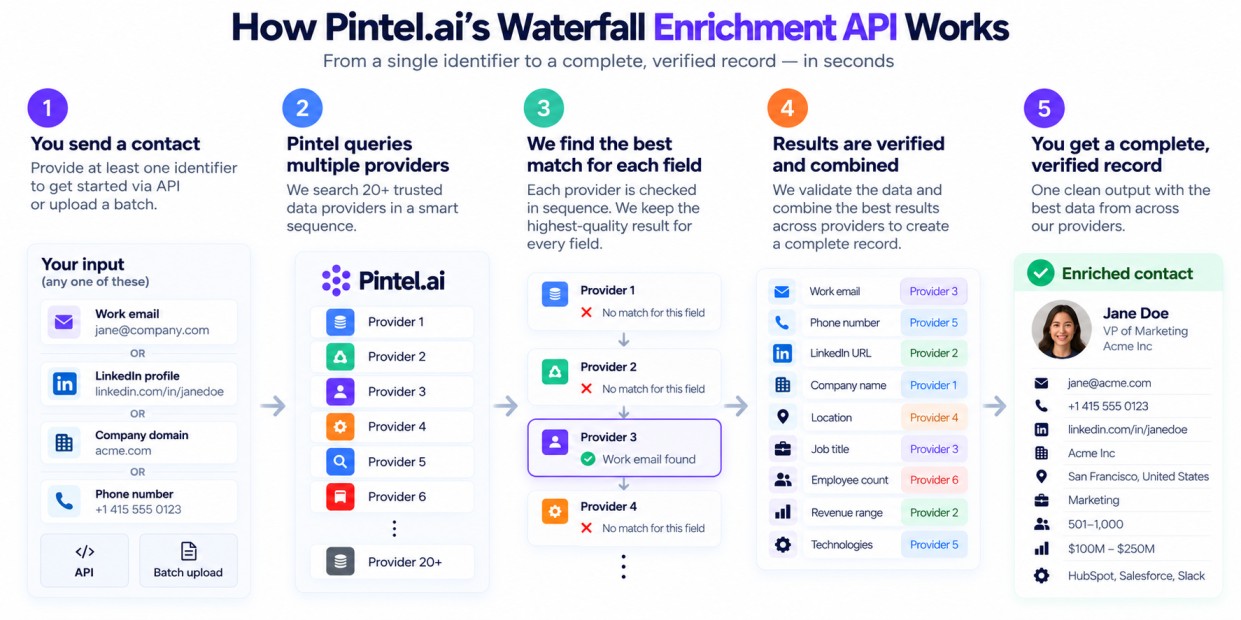
Pintel.ai is a B2B data platform built for GTM teams that operate globally. Its waterfall enrichment API queries 20+ data providers in cascade order and returns the highest-confidence match per field, with reported match rates above 95% based on internal benchmarking (verify directly with Pintel.ai before purchasing).
- Fields and signals returned: Work email, verified mobile phone, job title, seniority, LinkedIn URL, company firmographics, technographics, and B2B buying signals including funding events, hiring activity, leadership changes, and technology stack changes. Signals are returned as additional fields in the same API response alongside contact data.
- Input identifiers accepted: First name plus last name plus company domain, company domain alone, company name, LinkedIn URL, or email address.
- API modes: Real-time single-record enrichment for inbound lead qualification and PLG signup routing. Batch endpoints with asynchronous processing and webhook callbacks for CRM hygiene runs at scale.
- Email Lookup and Reverse Email Lookup: Convert personal email addresses to professional email addresses and professional email addresses to personal email addresses to help teams find alternative contact details for B2B outreach.
- Compliance: ISO 27001, SOC 2 (AICPA), GDPR, HIPAA, CCPA, and VAPT. Full certification details are available directly from Pintel.ai.
- Key limitation: No self-serve trial; a sales call is required before platform access. Teams with a purely North American ICP and no need for buying signals will find lower-cost self-serve options further down this list.
Clay: Multi-Provider Enrichment Platform for Custom GTM Workflows
Clay is a data enrichment and workflow automation platform that uses a visual table interface to build custom cascade sequences from 75 or more data providers.
- Fields returned: Depends on which providers are configured. Common fields include work email, mobile phone, job title, seniority, company firmographics, funding stage, and technographics. Claygent can also extract unstructured context from websites, LinkedIn profiles, and job postings and return it as structured fields your team defines.
- Input identifiers accepted: Name, company domain, LinkedIn URL, or email, depending on the providers in the cascade. Different providers accept different input types, so cascade design requires matching inputs to provider capability.
- Best for: Technical RevOps and growth engineering teams that want full control over the provider waterfall and can invest in initial configuration.
- Key limitation: No proprietary contact database. Data coverage and quality vary by configured providers. Setup requires significant technical effort and ongoing maintenance by a dedicated RevOps operator.
FullEnrich: Enrichment API Focused on Email and Mobile Waterfalls
FullEnrich is a credit-based enrichment platform built around a waterfall model, cascading through 25 or more providers per request and charging credits only when a valid match is returned.
- Fields returned: Work email and mobile phone number only. Job title, seniority, firmographics, technographics, and intent signals are not part of the standard response. Teams that need a full contact profile must supplement FullEnrich with a second enrichment source for role and company fields.
- Input identifiers accepted: First name plus last name plus company domain, or LinkedIn URL. LinkedIn URL typically produces higher match rates for contacts with common names.
- Credit costs: Work email costs 1 credit per match. Mobile phone costs 10 credits. Requests returning no match consume no credits.
- Key limitation: No Salesforce connector. No firmographics or intent signals in the response. Coverage is stronger for North American and European contacts; APAC and LATAM fill rates are weaker. Model mobile credit spend carefully before committing to a volume plan.
Cognism: B2B Enrichment Platform With Verified EMEA Phone Coverage
Cognism is a B2B data platform with a strong reputation for EMEA contact coverage, particularly verified mobile numbers through its Diamond Data tier, available via a Data-as-a-Service module that supports both batch delivery and API integration.
- Fields returned: Work email, mobile phone (Diamond Data tier for phone-verified EMEA numbers), direct dial, LinkedIn URL, job title, seniority, company firmographics, and technographics. Higher plans add buying signals (hiring, funding, leadership changes) and intent data from a B2B publisher network.
- Input identifiers accepted: Company domain, LinkedIn URL, email, or name-plus-company. A CRM Enrichment add-on sends existing HubSpot or Salesforce records directly into the Cognism dataset and returns updated fields in batch.
- Best for: EMEA-focused sales teams that prioritise verified mobile numbers and need buying signals alongside contact enrichment.
- Key limitation: API access is not included by default and requires a separate paid add-on. All pricing is custom, making budget planning difficult without a sales conversation. Coverage outside EMEA may require supplementary providers.
Apollo.io: Enrichment API Built on a 210 Million Contact Prospecting Database
Apollo.io is a prospecting and sales engagement platform with an enrichment API that gives programmatic access to its contact and company database of more than 210 million contacts.
- Fields returned: Work email, mobile phone, direct dial, LinkedIn URL, job title, seniority, company firmographics, technographics, and funding data. Email and phone accuracy are higher for North American contacts.
- Input identifiers accepted: Name plus company domain, LinkedIn URL, or email. Structured search filters also allow list-building and enrichment in one step.
- Best for: Teams that want a combined prospecting database and enrichment API in one subscription, particularly for North American outbound.
- Key limitation: No API access on Free or Basic plans. Enrichment data is drawn from a stored database, so record freshness depends on when each contact was last updated, which can vary. Coverage and accuracy outside North America are weaker than dedicated global providers.
HubSpot Breeze Intelligence: Enrichment Built Into HubSpot CRM
HubSpot Breeze Intelligence is the data enrichment layer inside HubSpot, formerly available as the standalone Clearbit API, and the only tool in this comparison that requires a separate CRM subscription to function.
- Fields returned: Job title, seniority, LinkedIn URL, company industry, headcount, revenue range, technographics, funding stage, and buyer intent signals for website visitor identification. All fields write directly to HubSpot records without a separate mapping step.
- How it works: Enrichment runs on existing HubSpot contact and company records. It is not a standalone REST API and cannot be called from outside a HubSpot account. One credit is charged per record enriched; credits expire every 30 days with no rollover.
- Best for: Teams already running HubSpot who want enrichment without a separate integration layer and do not need data outside that CRM.
- Key limitation: No enrichment outside HubSpot. Credits expire monthly. Total cost at scale must include both the credit cost and the HubSpot subscription tier required to access each feature.
Lusha: Enrichment API With Webhook-Based Contact Freshness
Lusha is a contact and company data platform with an enrichment API built around a search-then-enrich model, covering more than 290 million people and 29 million companies with webhook-based job-change alerts for ongoing record freshness.
- Fields returned: Work email, mobile phone, direct dial, LinkedIn URL, job title, seniority, company firmographics, and job-change event data delivered via webhook when a tracked contact updates their role or company.
- Input identifiers accepted: LinkedIn profile URL, name plus company, or email. Structured search filters also allow list-building and enrichment in a single step.
- Best for: Teams enriching North American contacts who want ongoing record freshness via job-change webhooks alongside standard email and phone enrichment.
- Key limitation: No API on Free or Starter; API evaluation requires a paid annual commitment upfront. Coverage is strongest for North American contacts; EMEA, APAC, and LATAM fill rates are weaker and not published by Lusha. The cost jump between Pro and Premium is steep for teams with variable monthly volumes.
Surfe: Cascade Enrichment for LinkedIn-First Sales Teams
Surfe is a Chrome extension and CRM sync tool for sales reps prospecting on LinkedIn and Sales Navigator, using a four-provider cascade through Apollo, Hunter, RocketReach, and Dropcontact with direct CRM push on each contact.
- Fields returned: Work email and mobile phone via a four-provider cascade (Apollo, Hunter, RocketReach, Dropcontact). Role and company data is pulled from the LinkedIn profile open in the browser at the time of enrichment. No firmographics beyond what is visible on LinkedIn, and no buying signals.
- Input identifiers accepted: LinkedIn profile page only. Not suited for bulk CSV enrichment or programmatic API lookups below Enterprise plan.
- Best for: Individual SDRs or small teams prospecting primarily on LinkedIn who want enrichment with direct CRM push without leaving the browser.
- Key limitation: Monthly credit caps exhaust quickly for high-volume teams. API access requires Enterprise. Background CRM enrichment is a separate paid add-on. Coverage outside North America and EMEA is limited on lower plans.
LeadMagic: API-First Enrichment Endpoints With Pay-Per-Result Billing
LeadMagic is an API-first enrichment platform with 15 or more independent endpoints covering email finding, mobile numbers, company data, and job-change detection. Credits are charged only when a valid result is returned. Teams typically use LeadMagic endpoints as components inside waterfalls they build in Clay or Apollo, rather than as a managed cascade.
- Fields returned: Separate endpoints return work email, mobile phone, company data, or job-change detection individually. Teams combine endpoints to build a full contact profile, paying per result per field type.
- Input identifiers accepted: Email find accepts name plus company domain. Person lookup accepts LinkedIn URL. Company data accepts company domain. Each endpoint has distinct input requirements.
- Best for: RevOps and engineering teams that need a direct API without a managed UI and want pay-per-result pricing for programmatic use.
- Key limitation: API-only with no managed UI; suited only to technical teams. Coverage is focused on North American contacts with no published international coverage guarantee. Mobile numbers cost 5 credits each, which compounds quickly at scale.
BetterContact: Low-Entry Enrichment Platform With 20-Plus Provider Waterfall
BetterContact is a waterfall enrichment platform that cascades through 20 or more vendors per contact request, with Bouncer email verification included and API access on standard plans from $15 per month.
- Fields returned: Work email and mobile phone. Bouncer email verification status is included alongside each email result. Firmographic and role fields are not part of the standard output; teams needing those fields must supplement with a second source.
- Input identifiers accepted: First name plus last name plus company domain, or LinkedIn URL. The cascade sequences through 20 or more providers and stops when a valid result is returned.
- Best for: Early-stage teams who want to test waterfall enrichment at minimal cost before committing to a higher-volume platform.
- Key limitation: No published find rate or independent coverage guarantee. Not suited for global coverage outside North America. Mobile enrichment is limited for call-heavy outbound strategies.
Dropcontact: GDPR-Native Enrichment API for European B2B Teams
Dropcontact is a European enrichment tool that uses its own proprietary algorithmic logic and EU-based servers rather than chaining third-party data providers, making it the only option in this comparison designed from the ground up for GDPR-native data provenance.
- Fields returned: Work email (algorithmically generated and verified, not retrieved from a third-party database), name, job title, LinkedIn URL, company data, and for French companies SIREN/SIRET and VAT numbers. Duplicate detection flags are included in the response. No mobile phone numbers.
- Input identifiers accepted: First name plus last name plus company name or domain. Native CRM connectors available for HubSpot, Pipedrive, and Salesforce. REST API also available for programmatic integration.
- Best for: European sales teams that need GDPR-native data provenance and CRM hygiene without relying on third-party data providers they do not control.
- Key limitation: Not a multi-provider waterfall; uses its own algorithmic database. No mobile phone numbers. Coverage and fill rates outside the EU are significantly weaker. Not suited to North America-first outbound or call-heavy strategies.
People Data Labs: Developer-First Enrichment API With Global Raw Data Coverage
People Data Labs (PDL) is a data provider offering REST API access to its person and company datasets, primarily for developers and data engineers who need raw B2B data to power internal enrichment pipelines or machine-learning models.
- Fields returned: Person records include work email, LinkedIn URL, job title, seniority, work history, skills, education, phone numbers, and location. Company records include industry, headcount, revenue, technographics, funding history, and SIC codes. All output is raw JSON with no confidence scoring or CRM-ready formatting.
- Input identifiers accepted: Email, LinkedIn URL, name plus location, or phone number. The Person Identify endpoint accepts fragmented identifiers and returns up to 20 match candidates per call.
- Best for: Engineering and data teams building internal enrichment pipelines or machine-learning models where the team controls the cascade logic and validation layer.
- Key limitation: Raw data only with no cascade logic, confidence scoring, or quality thresholds. Data coverage and quality vary across record types and geographies, and all validation is the team’s responsibility. Requires dedicated data engineering capacity to build and maintain the pipeline.
With all twelve tools profiled, the next question is which evaluation criteria matter most for a specific team’s workflow.
How to Choose the Right Waterfall Enrichment API for Your Team
The enrichment tool that generates the most pipeline is the one your team actually integrates and uses consistently. Three questions narrow the shortlist faster than feature comparisons do.
What Does Your ICP Look Like Geographically?
If your ICP is primarily North American, most tools on this list will deliver adequate fill rates. If your ICP spans EMEA, APAC, LATAM, or GCC, provider depth matters more than UI quality or price. Tools querying fewer than 20 providers with North America-first sourcing return materially lower fill rates on international records. For global teams, Pintel.ai, Cognism, and Clay are three options worth evaluating for multi-region coverage, although their approaches differ significantly.
Does Your Team Need Real-Time Enrichment, Batch Enrichment, or Both?
Inbound lead qualification and PLG signup routing require a real-time single-record API. CRM hygiene and outbound list preparation are batch jobs. Pintel.ai, FullEnrich, and BetterContact support both modes on standard plans. LeadMagic provides independent endpoints that teams wire into their own real-time workflows. Surfe, Clay, and Apollo all have limitations on real-time API access below their top tiers.
How Technical Is the Team That Will Own the Integration?
Clay delivers maximum flexibility but requires a skilled operator and weeks of configuration time before the first reliable waterfall runs. FullEnrich and LeadMagic offer cleaner REST API surfaces for teams that want to call an endpoint without building a workflow. Pintel.ai, Cognism, and BetterContact offer more managed experiences for teams that need results without deep configuration investment.
With those three factors evaluated, the final takeaway below summarizes how to apply them to the shortlist.
Final Takeaway: Match the Waterfall Enrichment API to Your Coverage Gap, Not Just Your Budget
The differences between tools on this list emerge in three places: coverage geography, confidence scoring, and what the API returns alongside contact data. A tool that delivers 80% fill rates in North America may return 50% in Germany or Japan, and a team running a global ICP will feel that gap in every sequence.
Building a waterfall in-house means negotiating three to five vendor contracts, building and maintaining cascade logic, and revisiting provider rankings as accuracy shifts. A managed enrichment cascade can simplify this process by coordinating multiple data providers through a single integration, reducing the need to build and maintain cascade logic in house. The right choice is the tool that covers your actual ICP geography, fits the technical sophistication of the team that will own it, and integrates at the right point in the workflow.
For global teams that need both enrichment and buying intelligence, contact enrichment APIs that layer signals alongside contact data are the fastest path from a raw account list to a CRM-ready, outreach-ready pipeline. Teams building a custom waterfall stack from scratch will find the best data enrichment tools guide useful for understanding which providers to layer. And for teams evaluating the broader landscape of enrichment approaches, the waterfall enrichment tools for B2B sales teams comparison covers the non-API alternatives alongside the API-first options reviewed here.
Frequently Asked Questions
What is a waterfall enrichment API?
A waterfall enrichment API queries multiple B2B data providers in sequence, stopping when a match meets a confidence threshold for each field. The result is one verified record per input, with higher fill rates than any single database can deliver, particularly for global ICPs.
How does a waterfall enrichment API improve B2B data quality?
It reduces gaps by checking multiple sources instead of depending on one database. Each field is matched and scored before delivery, so low-confidence results trigger a fallback to the next provider rather than landing as bad data in your CRM.
Which tool has the best global enrichment coverage?
Pintel.ai queries 20+ data providers with geography-aware selection and covers EMEA, APAC, LATAM, and GCC markets. Cognism is strong for EMEA mobile numbers. Clay and FullEnrich have stronger North American than international coverage.
What is the difference between a waterfall enrichment API and a single source enrichment tool?
A single-source tool queries one database and returns what it has, often leaving 20 to 40% of records incomplete. A waterfall system queries multiple providers in sequence and cascades to the next source when a match falls short, raising fill rates without manual steps.
How much does waterfall enrichment cost?
Entry pricing ranges from $15 per month (BetterContact) to $49.99 per month (LeadMagic) and $55 per month (FullEnrich) for self-serve API access. Pintel.ai plans start from $49 per month. Cognism requires a custom quote based on volume and use case. Verify current prices directly with each vendor before purchasing.
Can waterfall enrichment tools process contacts in real time?
Pintel.ai, FullEnrich, and BetterContact offer managed waterfall enrichment workflows with real-time single-record options. LeadMagic provides independent enrichment endpoints that teams can integrate into their own workflows. Clay and Surfe have limitations on real-time API access below their top tiers. Confirm plan-level API availability with each vendor.
What fields does a waterfall enrichment tool typically return?
Most waterfall enrichment responses include work email, mobile number, job title, seniority, LinkedIn URL, company name, website, industry, headcount, revenue range, and technologies in use. Field availability varies by provider and geography.
Is waterfall enrichment useful for CRM hygiene?
Yes. Batch endpoints allow teams to send existing CRM records through the waterfall and receive updated emails, phone numbers, and job titles. Pintel.ai and FullEnrich both support batch enrichment with asynchronous processing and webhook callbacks.