Building a list of companies that match your ideal customer profile (ICP) isn’t easy. Sales teams often have to use multiple tools to find companies, identify the right decision-makers, verify business emails and phone numbers, and clean the data before they can start outreach. For small teams, this can take days. Even large companies often outsource this work to save time and get better quality data.
Using multiple tools also means paying for multiple subscriptions, switching between platforms, and spending hours checking the quality of the data. Instead of doing all this in house, many businesses use managed B2B data enrichment services to receive a verified list of companies and decision makers that’s ready for sales outreach.
This guide compares the 10 best managed B2B data enrichment services for 2026 based on delivery model, turnaround time, pricing, and the type of businesses they’re best suited for. Whether you need a one-time data enrichment project or ongoing support, this guide will help you choose the right provider.
What Is a Managed B2B Data Enrichment Service?
A managed B2B data enrichment service helps businesses build and enrich lists of companies and decision makers based on their ideal customer profile (ICP) or target criteria. Instead of using multiple tools and spending hours on manual research, businesses simply share their requirements, such as industry, company size, location, job titles, or technologies used.
The service provider then builds a list of matching companies, identifies the right decision-makers, enriches each contact with verified business emails, phone numbers, company information, and other relevant data, and delivers a sales-ready list. Some providers also help generate personalized emails, LinkedIn messages, and talk tracks at scale using company and buyer signals, while others can sync the enriched data directly to your CRM or export it in your preferred format.
Pintel.ai specializes in this end-to-end workflow. Teams can define their ICP or target criteria, and Pintel.ai finds matching companies, identifies decision makers, enriches contacts with verified emails and phone numbers through waterfall enrichment, generates personalized outreach using company and buying signals, and syncs everything to your CRM or exports it for your sales workflows.
What Are the Best B2B Data Enrichment Services?
Pintel.ai is one of the best B2B data enrichment services for sales teams, helping businesses build lists of companies and decision makers, enrich CRM data, and verify business emails and phone numbers. Other providers include ZoomInfo Operations, Melissa Data, Dun & Bradstreet Data Services, Data Axle, Experian Data Quality, Acxiom, B2B Data Partners, Hitech BPO, and LeadGenius. The right choice depends on your data requirements, turnaround time, and budget.
What Makes a Data Enrichment Service Different From a Data Enrichment Tool?
A data enrichment tool is self-serve software a team logs into or connects by API, returning results automatically in seconds. A data enrichment service is a vendor relationship where a provider’s own team, process, or larger data network does some or all of the matching work, often returning results in days rather than instantly.
The practical difference shows up in three places: turnaround time (instant versus days or weeks), pricing model (subscription or credits versus custom quotes and minimum contracts), and what happens to the records a tool could not match (nothing, versus a human or a broader network taking a second pass).
The gap is real and well documented. Validity’s State of CRM Data Management research found that 76 percent of organizations report less than half of their CRM data is accurate and complete, even at companies already running enrichment tools. That gap is exactly what a managed service is built to close, not by working faster than a tool, but by working differently.
10 Managed B2B Data Enrichment Services Compared
Here is how the 10 services compare on delivery model, turnaround time, and pricing.
| Provider | Delivery Model | Typical Turnaround | Pricing | Best For |
|---|---|---|---|---|
| Pintel.ai | ICP to Sales Ready Prospect Data | Near real-time | Custom pricing | Teams that want ready-to-contact prospect lists |
| ZoomInfo Operations | Subscription plus consumption credits, waterfall across 60+ third-party vendors | Automated, but credit-gated | From ~$15,000/year entry; enterprise often six figures | Existing ZoomInfo customers who need MDM-style operations on top of their base plan |
| Melissa Data | Credit-consumption enrichment plus address validation and geolocation | Automated, batch or API | From $30/10,000 credits; anchor package around $12,300/year | Teams whose priority is address and contact validation more than firmographic depth |
| Dun & Bradstreet Data Services | Managed master data management, company and legal-entity records | Project-based, days to weeks | Custom, enterprise contract | Enterprise teams that need legal-entity and hierarchy data alongside contacts |
| Data Axle | Bulk data licensing plus custom append projects | Project-based, varies by scope | From $99/month (SMB); enterprise custom, $3,200 to $150,000+/year | Teams that need bulk firmographic or mailing data more than person-level enrichment |
| Experian Data Quality | Managed enrichment appending up to 900 data attributes, plus data correction | Project-based, days to weeks | Custom, not publicly disclosed | Enterprise teams that need deep attribute append alongside data cleansing |
| Acxiom | Identity resolution plus attribute append, historically consumer-marketing-focused | Project-based, days to weeks | Custom, not publicly disclosed | Teams whose enrichment need spans both consumer and B2B audiences |
| B2B Data Partners | Human-delivered contact and entity enrichment | Project-based, days to weeks | Custom, not publicly disclosed | Teams that need human-verified records on hard-to-match segments |
| Hitech BPO | Human research plus AI/ML for demographic, firmographic, and technographic append | Project-based, days to weeks | Custom, not publicly disclosed | Teams outsourcing a defined enrichment project rather than an ongoing subscription |
| LeadGenius | Human-in-the-loop research building custom contact lists to spec | Days to weeks; researchers verify roughly 100-200 records/day | Custom; third-party benchmarks report $18,000 to $81,000+/year | Teams needing precision on hard-to-reach segments, not speed at high volume |
This comparison is based on first-hand platform knowledge, publicly available product information, and commonly reported user experiences. Contact each vendor directly for the latest pricing and product details.
The pattern across this table is consistent: every service that adds real human research also adds real turnaround time. The one exception is worth naming directly, since it is the whole reason a team might not need to accept that tradeoff at all.
10 Managed B2B Data Enrichment Services Reviewed in Detail
Here is how each of the 10 services actually performs once you look past the table.
1. Pintel.ai: Strong for Real-Time Fill Rates, Newer Brand Than Legacy Players
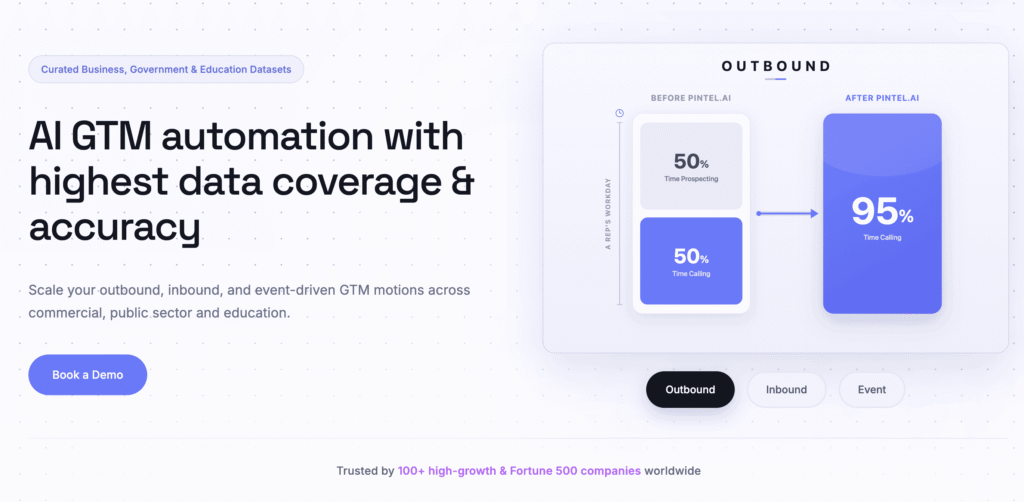
Pintel.ai helps B2B sales teams build targeted prospect lists from scratch. You define your ideal customer profile (ICP), such as industry, company size, location, revenue, or job titles, and Pintel.ai finds matching companies and the right decision-makers. It then enriches each contact with verified business emails, phone numbers, and company information, so your team gets a sales-ready prospect list instead of spending hours using multiple tools.
Yes, that’s a strong differentiator, but I’d avoid technical phrases like “native region providers” or “ingest the data.” Your audience cares about the outcome, not the architecture.
Here are simple, benefit focused points:
- Verified global data: Access verified company and contact data across the US, EMEA, APAC, and GCC/MENA using proprietary data and waterfall enrichment across 30+ trusted regional and global data providers.
- Higher data coverage: If one data source cannot verify a contact, Pintel.ai automatically checks the next trusted provider to improve coverage and reduce missing records.
- Accurate contact details: Verify business emails, phone numbers, and company information using multiple trusted data sources instead of relying on a single database.
- Built for global prospecting: Find companies and decision makers across multiple regions without managing separate data vendors for each market.
- Continuously refreshed data: Automatically refresh records when job changes or other key company updates are detected, helping keep your prospect data up to date.
- End-to-end outbound sales: Teams that need sales-ready prospect data, from account discovery to verified decision-maker contacts, with flexible pricing.
Con: Newer platform with less brand recognition than established providers like ZoomInfo and Dun & Bradstreet.
Security and compliance: ISO 27001 certified, SOC 2 (AICPA), GDPR compliant, HIPAA compliant, CCPA compliant, and VAPT certified.
Pricing: Custom pricing.
Best for: Teams that want the fill-rate depth of a managed service without committing to a days-long delivery cycle for every batch.
What Teams Underestimate About Managed Enrichment Services
The sticker price is rarely the real cost. The real cost is the calendar time between sending a list and getting it back, multiplied by how often a team needs a new batch enriched. A service that turns around a project in two weeks is a reasonable fit for a one-time list-cleaning effort and a poor fit for an active outbound motion pulling in new leads daily.
Minimum contract size is the other underestimated variable. Several of the human-in-the-loop services on this list are built around annual contracts in the five figures and up, which prices out a team that only needs a few thousand records enriched once.
2. ZoomInfo Operations: Strong for Existing ZoomInfo Customers, Weak on Cost Predictability
ZoomInfo Operations, formerly OperationsOS and including Enrich Premium, is a managed data operations add-on that runs a waterfall across 60 or more third-party vendors on top of ZoomInfo’s own database, though it is billed on consumption credits rather than a flat fee.
Con: The consumption-credit model means workflows that run without a cap can generate overage charges at premium rates well beyond the base subscription, so the actual monthly cost is harder to predict than a flat-rate service.
Pricing: Entry access around $15,000/year; enterprise contracts often run into six figures.
Best for: Existing ZoomInfo customers who need managed data operations layered on top of their base plan.
3. Melissa Data: Strong for Address Validation, Weak on Firmographic Depth
Melissa Data is an address validation and geolocation provider whose enrichment service applies that same matching process to contact records, though its coverage of B2B firmographic attributes is thinner than providers built firmographic-first.
Con: Because pricing runs on credit consumption, a team has to estimate its record volume in advance, and firmographic fields like company size, industry, or org structure get less depth than address and contact fields do.
Pricing: From $30 per 10,000 credits; anchor package around $12,300/year for 1 million records.
Best for: Teams whose priority is address and contact validation quality, not deep firmographic append.
4. Dun & Bradstreet Data Services: Strong for Legal-Entity Data, Weak on Person-Level Enrichment
Dun & Bradstreet Data Services is a managed master data management offering built on its decades-old company registry, covering legal-entity and corporate hierarchy records, though the underlying model is still built around company records more than individual contacts.
Con: Person-level contact enrichment is a secondary capability layered on top of the company-data core, so a team buying primarily for contact enrichment is paying for a company-data platform first.
Pricing: Custom, enterprise contract.
Best for: Enterprise teams that need legal-entity and company hierarchy data alongside whatever contact enrichment comes with it.
5. Data Axle: Strong for Bulk Firmographic Data, Weak on Individual Contact Depth
Data Axle, formerly Infogroup, runs custom data append projects on top of its bulk mailing and firmographic list business, though person-level contact enrichment is not the primary thing the product is built to deliver.
Con: Because the core business is bulk mailing and firmographic lists, pricing tiers swing widely, from under $100 a month for SMB access to six-figure enterprise contracts, depending on list size and scope rather than contact-level depth.
Pricing: From $99/month (SMB tiers); enterprise custom, $3,200 to $150,000 or more per year.
Best for: Teams that need bulk firmographic or mailing list data more than deep individual contact enrichment.
6. Experian Data Quality: Strong for Attribute Depth, Weak on Pricing Transparency
Experian Data Quality is a managed enrichment service that appends up to 900 data attributes per record alongside its own data correction and standardization layer, though pricing is fully custom and not disclosed anywhere publicly.
Con: A team cannot get even a ballpark cost without entering a sales process, and much of the 900-attribute depth leans on consumer and financial data rather than B2B firmographic fields specifically.
Pricing: Custom, not publicly disclosed.
Best for: Enterprise teams that need broad attribute append and are comfortable with a fully custom quoting process.
7. Acxiom: Strong for Cross-Audience Identity Resolution, Weak on B2B Focus
Acxiom runs identity resolution and attribute append for both consumer and business records, built on a data business with decades of history in consumer marketing, though B2B firmographic data is not where the platform originated.
Con: B2B enrichment is a secondary use case layered onto a platform built first for consumer audiences, so firmographic and company-hierarchy fields get less native depth than consumer attributes do.
Pricing: Custom, not publicly disclosed.
Best for: Teams whose enrichment need spans both consumer and B2B audiences under one vendor.
8. B2B Data Partners: Strong for Human-Verified Records, Weak on Throughput
B2B Data Partners is a human-delivered contact and entity enrichment service aimed at segments that automated matching tools consistently miss, though that same human-delivery model is inherently slower than any API-based tool.
Con: Throughput is capped by researcher headcount rather than server capacity, so turnaround stretches with volume, and pricing is not published anywhere, so a team cannot compare cost against other options before reaching out.
Pricing: Custom, not publicly disclosed.
Best for: Teams that need human-verified records specifically on segments where automated match rates are already known to be low.
9. Hitech BPO: Strong for Broad Attribute Append, Weak on Delivery Speed
Hitech BPO is a business process outsourcing provider that combines human research with AI and machine learning to enrich demographic, firmographic, sociographic, and technographic fields, though project timelines run on the outsourcing firm’s own queue rather than a team’s schedule.
Con: Because delivery runs on the BPO’s internal queue, a project can sit behind other clients’ work before it starts, and pricing requires a direct quote rather than a published rate card.
Pricing: Custom, not publicly disclosed.
Best for: Teams outsourcing a defined, scoped enrichment project rather than looking for an ongoing subscription.
10. LeadGenius: Strong for Precision on Hard Segments, Weak on Volume and Speed
LeadGenius pairs machine learning with human researchers who build custom contact lists to a defined ICP, though that same model caps throughput at roughly 100 to 200 verified records per researcher per day.
Con: The per-researcher cap means a large list takes proportionally longer no matter the budget, so the service fits precision work on a defined segment better than fast, high-volume enrichment.
Pricing: Custom; third-party benchmarks report a typical range of $18,000 to $81,000 or more per year.
Best for: Teams that need precision on hard-to-reach segments and can accept a days-to-weeks delivery cycle in exchange.
How to Choose a B2B Data Enrichment Service
Match the choice to the actual constraint driving the search, not the vendor with the most attributes listed on its homepage.
If the constraint is turnaround time: Pintel.ai is the one option on this list that delivers service-level depth through automation instead of a human research queue, which matters most for a team enriching records continuously rather than in one-time batches.
If the constraint is a specific hard-to-match segment: LeadGenius, B2B Data Partners, and Hitech BPO all lean on human researchers specifically for the records automated tools miss, at the cost of days-to-weeks turnaround and, for LeadGenius, a published throughput ceiling.
If the constraint is company and legal-entity data rather than individual contacts: Dun & Bradstreet Data Services and Data Axle are both built around company-level and firmographic records first, with person-level enrichment as a secondary capability.
If the constraint is budget rather than depth: most human-in-the-loop services on this list require an annual contract in the five figures or higher, which rules them out for a one-time, smaller batch. Credit-based options like Melissa Data scale down further, though still on a per-batch cost basis rather than a flat subscription.
Whichever direction a team goes, the underlying question is the same one that started the search for a data enrichment service in the first place: what happens to the records a self-serve tool already tried and failed to match. Our guide to contact data enrichment techniques covers the methods behind that gap in more depth, and our look at improving data quality through enrichment covers what a team should measure before and after any enrichment project, service or tool.
For teams whose gap is specifically inbound lead enrichment rather than a batch cleanup project, our comparison of inbound lead enrichment APIs and our broader look at AI data enrichment tools cover the automated, self-serve side of this decision in full.
FAQs: B2B Data Enrichment Services
What Are the Best B2B Data Enrichment Services?
The best B2B data enrichment services for 2026 are Pintel.ai, ZoomInfo Operations, Melissa Data, Dun & Bradstreet Data Services, Data Axle, Experian Data Quality, Acxiom, B2B Data Partners, Hitech BPO, and LeadGenius. Delivery model, turnaround time, and pricing transparency vary sharply across this list, more than the shared “enrichment” label suggests.
What is the difference between a data enrichment service and a data enrichment tool?
A data enrichment tool is self-serve software returning results automatically, usually in seconds. A data enrichment service involves a vendor’s own team, process, or broader data network doing some of the matching work, typically returning results in days rather than instantly.
How much does a managed B2B data enrichment service cost?
Costs range widely: credit-based services start under $50 for small batches, while human-in-the-loop services like LeadGenius run $18,000 to $81,000 or more per year. Most enterprise-only providers (Experian, Acxiom, Dun & Bradstreet) do not publish pricing at all.
How long does a managed data enrichment project take?
Human-in-the-loop services typically take days to weeks per batch, since researchers verify records individually. Automated services, including Pintel.ai’s waterfall model, return results in near real time instead of on a delivery queue.
Are data enrichment services worth it if I already use a self-serve enrichment tool?
Often yes, specifically for the records a self-serve tool could not match. A service is not a replacement for a tool, it is a second pass aimed at the gap the automated tool left behind.
Which B2B data enrichment service works best for hard-to-reach segments?
LeadGenius, B2B Data Partners, and Hitech BPO all specialize in human-verified enrichment for segments automated tools consistently miss, at the cost of slower turnaround than any API-based option.
Do data enrichment services have minimum contract requirements?
Many do. Several human-in-the-loop and enterprise providers on this list require annual contracts in the five figures or higher, which can price out a team that only needs a small one-time batch enriched.
Which B2B data enrichment service is best for global coverage?
Pintel.ai covers US, EMEA, APAC, and GCC/MENA markets through the same waterfall model. Most other providers on this list are built primarily around US or Western European data.