Most B2B teams have a data problem that shows up as a pipeline problem.
Reps are active and campaigns are running, but pipeline stays thin and conversion stays low because the data in your CRM is incomplete and outdated.
B2B data enrichment is the process of adding missing information to your leads and accounts, such as company size, industry, job titles, and contact details, so your team knows exactly who they are reaching and how to engage them. This makes targeting clearer and outreach more relevant, but data enrichment is the starting point, not the end state.
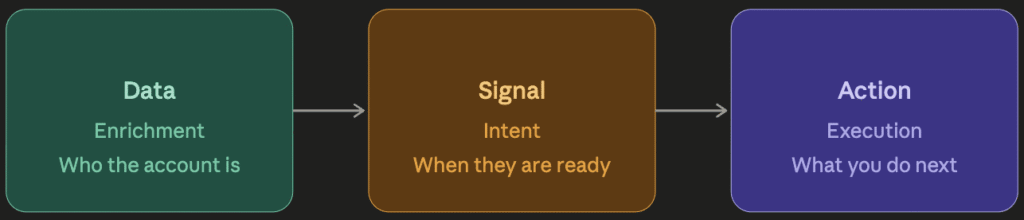
The teams that see consistent pipeline growth follow a simple model: Data tells you who. Signal tells you when. Action drives revenue.
What Is Data Enrichment?
Data enrichment is the process of adding missing or external data to existing records to improve targeting and decision-making.
In practice, it means taking an incomplete CRM record and filling in the gaps using third-party data sources, so your team always has the full context they need before reaching out.
Before vs after data enrichment
Before: A lead in your CRM with a name, email, and company name. That is it.
After: That same record now includes:
- Company size, industry, and revenue range
- Tech stack and current tools in use
- The lead’s job title, seniority, and LinkedIn profile
- A direct dial number
- A buying intent score
- Whether they recently searched for solutions like yours
The difference is significant. Enriched records transform a sparse contact into a high-precision targeting asset.
For a B2B sales or RevOps team, this means you stop guessing and start targeting. You know who the account is before your first touchpoint. That clarity changes everything from segmentation to sequencing.
Good data tells you who. That is the first step in the Data to Signal to Action model. But it is only step one.
Why B2B Data Enrichment Matters for Pipeline
When done right, enrichment makes your entire GTM motion more efficient. Here is exactly how it connects to pipeline growth.
Better targeting
Data enrichment lets you identify accounts that genuinely fit your ICP before a single rep touches them. You stop reaching out to companies that will never buy and start focusing on the ones that can.
Higher conversion rates
When your team knows the account’s industry, size, tech stack, and key contacts before reaching out, messaging becomes relevant instead of generic. Relevant messaging converts. Generic messaging does not.
Improved sales efficiency
Without enrichment, reps spend hours researching manually, looking up job titles, finding phone numbers, and piecing together basic account context. The impact is real: sales reps waste an estimated 27.3% of their time chasing bad or incomplete data. With enrichment in place, that time goes back to selling.
Smarter pipeline prioritization
Enriched records give RevOps and sales leaders the account-level context to score and rank opportunities accurately. You know which accounts deserve attention now and which ones to nurture later.
Consider what happens without it. A rep reaches out to a 10-person startup with enterprise messaging. A sequence fires at an account already locked into a competitor contract. A campaign targets IT managers when the real buyer is the CFO.
These are not rare mistakes. They happen every single day in teams operating on incomplete data. And they are expensive, not just in wasted spend, but in missed opportunities with accounts that actually could have converted.
Why Most Data Enrichment Fails
This is the section most vendors will not tell you about.
Data enrichment has become a common line item in RevOps budgets. Yet pipeline quality has not improved at the same rate. The reason is structural, and it has three distinct causes.
Problem 1: Static data goes stale fast
People change jobs every 12 to 18 months on average. A comprehensive study tracking 1,000 business contacts found that 70.8% experienced one or more changes within just 12 months, including job title shifts, company moves, and contact information updates. A substantial portion of CRM records become outdated within 12 months, even in well-maintained systems. A database that was accurate six months ago may already be significantly wrong today.
Problem 2: Data without intent signals is not enough
Knowing that an account has 500 employees and uses Salesforce tells you they could be a fit. It says nothing about whether they are actively looking, evaluating solutions, or sitting in a long-term contract. Enrichment without timing is wasted effort.
Problem 3: No execution layer
Most enrichment tools dump information into your CRM and stop there. They do not tell you what to do with it. That gap, between enriched data and a personalized outreach sequence, is where pipeline dies.
What this looks like in practice
Here is a scenario that plays out constantly. A SaaS team runs data enrichment across 15,000 accounts, scores them against ICP, and hands them to their SDR team. Three months later, the pipeline has barely moved. Why? Because they had the Data layer. They skipped the Signal layer entirely. Nobody knew which of those 15,000 accounts was actually in-market that week.
The real problem is that teams treat enrichment as an end state rather than an input. It only works when combined with intent signals and a clear execution layer. That is the Data to Signal to Action model in practice.
Types of B2B Data Enrichment
There are four core types, and each answers a different question. Together, they create a complete picture of your target accounts.
Firmographic data enrichment
Firmographic data covers the structural attributes of a company, including industry, employee count, revenue, HQ location, and funding stage. This tells you whether an account fits your ICP on paper.
Example: A SaaS company with 200 to 500 employees in fintech, Series B funded.
Technographic data enrichment
Technographic data reveals what tools and platforms a company currently uses. This matters for displacement plays, integration fit, and competitive positioning.
Example: An account running HubSpot and Segment, which is a strong signal for a data platform pitch.
Contact enrichment
Contact enrichment fills out your people records, including job titles, seniority levels, direct dials, LinkedIn URLs, and department structure. This is critical for multi-threaded outreach.
Example: Finding that the real economic buyer is the VP of Revenue Operations, not the SDR manager you have been talking to.
Intent data enrichment
Intent data is the most powerful enrichment layer. It captures behavioral signals such as what topics a company is researching, what keywords they are searching, and what competitor content they are consuming. This turns a static ICP match into an active buying signal.
Example: An account that fits your ICP is now also reading G2 reviews of your category. That is a hot signal.
Each type answers a different question. Firmographics tell you who fits. Technographics tell you how they operate. Contact enrichment tells you who to reach. Intent data tells you when to reach them. Build your stack with all four layers in mind.
Common Data Problems B2B Teams Actually Face
If any of these sound familiar, your data is the bottleneck, not your team.
Missing data: Half your CRM contacts are missing phone numbers, titles, or firmographic fields. Reps are spending time on manual research instead of selling. Enrichment fills these gaps automatically.
Duplicate data: The same company appears five times under slightly different names. The same contact sits in three lists. No one knows which record is current, so outreach gets duplicated and attribution breaks down.
Wrong ICP targeting: Your team is reaching out to companies that will never buy because nobody updated the records when the ICP was refined six months ago. Enrichment tied to ICP criteria helps you catch and correct this fast.
Outdated CRM records: A contact who moved companies 18 months ago is still in your active sequences. You are burning outreach capacity on ghosts. Regular enrichment keeps records current.
No account context for reps: Reps go into calls knowing only a name and a company. They have no idea what tools the account uses, what their priorities are, or who else is involved in the decision. Enrichment solves this before the first touchpoint.
These are not just data hygiene issues. They are revenue issues. And they compound over time if left unaddressed. Poor data quality costs U.S. businesses $3.1 trillion annually, with individual organizations losing an average of $12.9 to $15 million per year through wasted marketing spend and lost pipeline.
How B2B Data Enrichment Works: Step by Step
Effective enrichment is not a one-click fix. The best implementations follow a clear sequence that maps directly to the Data to Signal to Action model.
Step 1: Define your ICP clearly
Before enriching anything, get aligned on what a good account looks like, covering industry, size, tech stack, geography, and revenue range. Without this, you are enriching everything and prioritizing nothing.
Step 2: Run enrichment against that ICP
Use a data provider or enrichment platform to layer firmographic and technographic data onto your existing account list. This is the Data layer. Flag accounts that fit your ICP and deprioritize those that do not.
Step 3: Validate and clean the data
Enrichment surfaces new information, but it also exposes what is broken. Run deduplication, verify contact records, and remove outdated entries before anything goes to a rep.
Step 4: Map contacts within target accounts
Multi-threading is standard practice now. Use contact enrichment to identify all relevant stakeholders, including the champion, the economic buyer, and the technical evaluator, within each account.
Step 5: Layer intent signals and activate
This is where enrichment becomes pipeline. Layer intent data on top of your enriched accounts to identify the Signal layer, which accounts are actively showing buying behavior right now. Prioritize those accounts and trigger personalized sequences that reflect everything you know. This is the Action layer. Without it, the first four steps are just preparation with no output.
Data Enrichment vs Data Cleaning
These two are often confused, but they serve different purposes in your data strategy.
| Data Cleaning | Data Enrichment | |
|---|---|---|
| What it does | Removes errors and duplicates | Adds new information |
| Goal | Accuracy | Completeness |
| Input | Existing records | External data sources |
| Output | Cleaner existing data | Richer, more actionable data |
| When to do it | Before enrichment | After cleaning |
Think of cleaning as preparing the soil and enrichment as planting. You need both, in the right order. Running data enrichment on a dirty database just gives you more confident wrong answers. Clean first. Enrich second. Then activate.
Best B2B Data Enrichment Tools: What to Know Before You Buy
If you are evaluating tools for your team, this breakdown will help you choose faster. The market has grown significantly, but most teams buy the wrong tool because they evaluate on features, not on outcomes.
Here is how the landscape breaks down by category:
Data providers
Companies like ZoomInfo, Pintel.AI, Apollo, Clearbit, and Lusha maintain large databases of company and contact information. Their value is coverage and freshness at scale. Their limitation is that they cover the Data layer only. They stop there.
Enrichment APIs
These let you run enrichment programmatically at the point of capture, when a form is submitted, when a record is created, or when an account is imported. This is useful for keeping CRM data fresh automatically, but it still does not surface intent signals.
Signal-driven platforms
This is the category that closes the loop. These platforms combine enrichment with real-time intent data and activation workflows. They do not just tell you who an account is. They tell you when that account is showing buying behavior and surface what to do about it. This is the full Data to Signal to Action stack in a single platform.
How to evaluate any data enrichment tool
Use these five criteria before committing:
- Accuracy: How verified is the data? What is the typical bounce rate on contact records? Top-tier providers deliver 97%+ accuracy on verified records, while the average provider lands closer to 50% — meaning half your outreach could be misdirected before you even hit send.
- Coverage: Does it cover your target geographies and industries?
- Freshness: How often is the data updated? Weekly or closer to real-time?
- Integration: Does it connect natively to your CRM and sales engagement tools?
- Signal capability: Does it surface intent data, or does it stop at static records?
That last criterion is the most important one. Most tools fill your CRM but do not help you act on what is in it. Pipeline is not built on data. It is built on action. If your platform cannot tell you when to reach out and what to say, you are missing the Signal and Action layers entirely.
How Pintel Helps
Most enrichment platforms solve one piece of the puzzle. Pintel connects all three layers.
Here is what that looks like in practice:
Data layer: Pintel pulls firmographic, technographic, and contact data onto your target accounts automatically, giving your team a complete picture before the first touchpoint.
ICP scoring: Accounts are scored against your ICP in real time, so your team always knows where to focus without manual research.
Signal layer: Intent data is layered on top of enriched accounts, surfacing which companies are actively showing buying behavior right now, not just which ones fit on paper.
Contact mapping: Pintel identifies the right stakeholders within each target account so your outreach reaches the actual decision makers.
Action layer: Personalized outreach sequences are triggered based on what the data and signals reveal, and everything syncs back to your CRM automatically.
The result is not just a cleaner database. It is the full Data to Signal to Action motion running automatically, so your team spends less time researching and more time selling.
Best Practices for B2B Data Enrichment
Getting the most out of enrichment requires consistency beyond the initial setup. Here are the practices that separate high-performing teams from everyone else.
Keep data fresh on a schedule. B2B contact data decays at 25–30% per year, which means nearly a third of your CRM goes stale annually. Build a cadence, monthly for core accounts and quarterly for the broader CRM, to keep records current as contacts move and companies evolve.
Always anchor enrichment to your ICP. Enriching your entire database is expensive and often counterproductive. Start with accounts that fit your ICP criteria and work outward. Quality beats volume every time.
Combine enrichment with intent signals. Enrichment without intent is like knowing someone’s address but not knowing if they are home. Layer behavioral signals to find accounts that are both a fit and actively in-market. Good data tells you who. Great data tells you when.
Integrate into your existing workflows. If enrichment requires a manual export and import cycle, it will not get used consistently. Connect your enrichment layer directly to your CRM and sales engagement platform so data flows automatically and reps always have what they need.
Measure enrichment quality, not just volume. Track match rates, data decay rates, and how enriched accounts perform versus non-enriched ones. This tells you whether your investment is actually moving the needle.
Conclusion
Data enrichment is not a magic fix. It is the first layer of a three-part system.
The teams winning in B2B today are not just enriching their CRM. They are building a motion that runs on all three layers: Data to understand who the account is, Signal to know when they are ready, and Action to execute with precision.
Enrichment without timing is wasted effort. Timing without execution is a missed opportunity. Pipeline is not built on data. It is built on what you do with it.
If your pipeline is underperforming, start by asking what your enrichment process actually tells you and what it is still missing. When you are ready to close that gap, see what Pintel can do for your team.
FAQ
What is data enrichment in B2B?
Data enrichment in B2B is the process of enhancing existing company and contact records with additional verified information, such as firmographics, technographics, and intent signals, to make them more useful for sales and marketing teams.
Why is B2B data enrichment important?
Decisions made on incomplete or inaccurate data lead to wasted outreach, poor targeting, and low conversion rates. Enrichment gives your GTM team the context needed to reach the right account with the right message at the right time.
How does data enrichment improve pipeline?
It improves targeting precision, reduces wasted outreach, and enables personalized messaging. When combined with intent signals, it helps teams prioritize accounts that are actually in-market, which is where pipeline growth happens.
What are the best data enrichment tools for B2B teams?
It depends on your maturity. Early-stage teams often start with a data provider like Apollo or Clearbit. As you scale, look for signal-driven platforms that combine enrichment with intent data and activation capabilities, so you cover the full Data to Signal to Action stack.
How often should data enrichment be updated?
At minimum, quarterly for your core account list. For high-priority accounts, monthly. Intent signals should be monitored continuously, as buying behavior can emerge and fade quickly.
What is the difference between data enrichment and data cleaning?
Data cleaning removes errors and duplicates from existing records. Data enrichment adds new, external information to make those records more complete and actionable. You need both, but always clean before you enrich.