Thousands of UK companies incorporate and dissolve at Companies House every month. A contact record that was accurate in January can point to a company that no longer exists, or a director who has moved on, by the time a rep picks up the phone in July.
That turnover is exactly why “most accurate” matters more than “biggest” when choosing a UK contact database, a narrower question than the broader UK B2B data provider comparison most teams start with.
This guide compares 7 UK contact databases for B2B sales teams: how each one sources its data, how it holds up against Companies House and GDPR requirements, and where each one is genuinely accurate versus where it just looks complete.
What Is the Most Accurate UK Contact Database for B2B Sales Teams?
The most accurate UK contact database depends on whether accuracy matters more than raw volume. ZoomInfo, Apollo, and Lusha offer broad UK coverage inherited from global sourcing, Cognism and Kompass UK provide UK and European-native sourcing, and Companies House offers official but contact-free company records. Pintel.ai combines direct UK sourcing with verified contact enrichment and buying signals.
Quick Comparison: UK Contact Database Providers
| Provider | Data Sourcing Model | UK Coverage Depth | Verified Contact Data | Buying Signals | Starting Price |
|---|---|---|---|---|---|
| Pintel.ai | Direct UK sourcing plus waterfall enrichment across 30+ providers | Deep, covers London and non-metro UK companies alike | Yes, verified emails and direct dials | Yes, structural and behavioral signals | Custom |
| ZoomInfo | Community-contributed data, concentrated in the US and Western Europe | Deep for large UK enterprises, thinner for SMEs | Yes, for enterprise-heavy accounts | Limited outside core markets | Custom |
| Apollo | Global scraping and crowd-contributed database | Inherited coverage, London-weighted | Partial, frequently outdated outside major cities | Basic | From $49/mo |
| Cognism | GDPR-compliant sourcing built around European and UK markets | Deep for UK and EU, London and major metro focused | Yes, direct dial coverage | Limited | Custom |
| Lusha | Browser extension and crowd-contributed network | Inconsistent, depends on individual contributor data | Partial | No | From $29/mo |
| Kompass UK | Structured UK business directory by industry and trade activity | Deep for registered trade and manufacturing companies | No, directory listings only | No | Custom |
| Companies House | Official UK government company registry | Complete for all registered UK companies | No, filings only, not contact data | No | Public (free registry) |
This comparison is based on first-hand platform knowledge, publicly available product information, and commonly reported user experiences. Contact each vendor directly for the latest pricing and product details.
How We Evaluated These UK Contact Database Providers
Five criteria drove this comparison, chosen specifically because generic global scoring criteria understate what actually determines accuracy for a UK-focused business database.
UK-Specific Sourcing Depth
Whether the provider sources UK company and contact data directly, cross-referenced against Companies House filings, or whether UK coverage is a byproduct of broader global scraping. This is the single biggest differentiator between a generic business database uk search result and a provider actually built for the UK market.
Contact-Level Accuracy
Whether verified emails and direct UK phone numbers are available for named decision makers, not just company-level firmographic listings.
GDPR and ICO Compliance Posture
Whether the provider documents a lawful basis for processing UK contact data and follows Information Commissioner’s Office guidance, which matters more for UK outreach than for most other markets.
Buying Signal Availability
Whether the provider tracks structural signals like funding, hiring, and leadership changes for UK companies, or only lists static company records.
Pricing Transparency
Whether pricing is published or requires a custom quote, and whether the entry price is realistic for the team size evaluating it.
With those five criteria set, here is how each of the 7 providers actually performs.
Why Do UK Contact Databases Go Stale So Fast?
The UK’s company register turns over quickly. New companies incorporate, existing ones dissolve or get struck off, and directors change roles constantly, all recorded at Companies House but not always reflected in a commercial contact database on the same timeline.
Remote and hybrid work added a second decay factor after 2023. UK professionals change roles more frequently than they update their LinkedIn profile in real time, so a title that was accurate three months ago can already be wrong. A database refreshed quarterly instead of continuously will always be one step behind this pattern.
GDPR and ICO rules add a UK-specific wrinkle most global databases were not built around first. A contact record that is technically accurate but lacks a documented lawful basis for outreach is a compliance risk as much as a data quality one, which is why GDPR compliant data providers matter as much here as raw accuracy.
The 7 UK Contact Databases Compared in Detail
With the stale-data causes and evaluation criteria established, here is how each of the 7 providers actually holds up against them.
1. Pintel.ai: Best for UK Contact Accuracy, Buying Signals, and Global Coverage
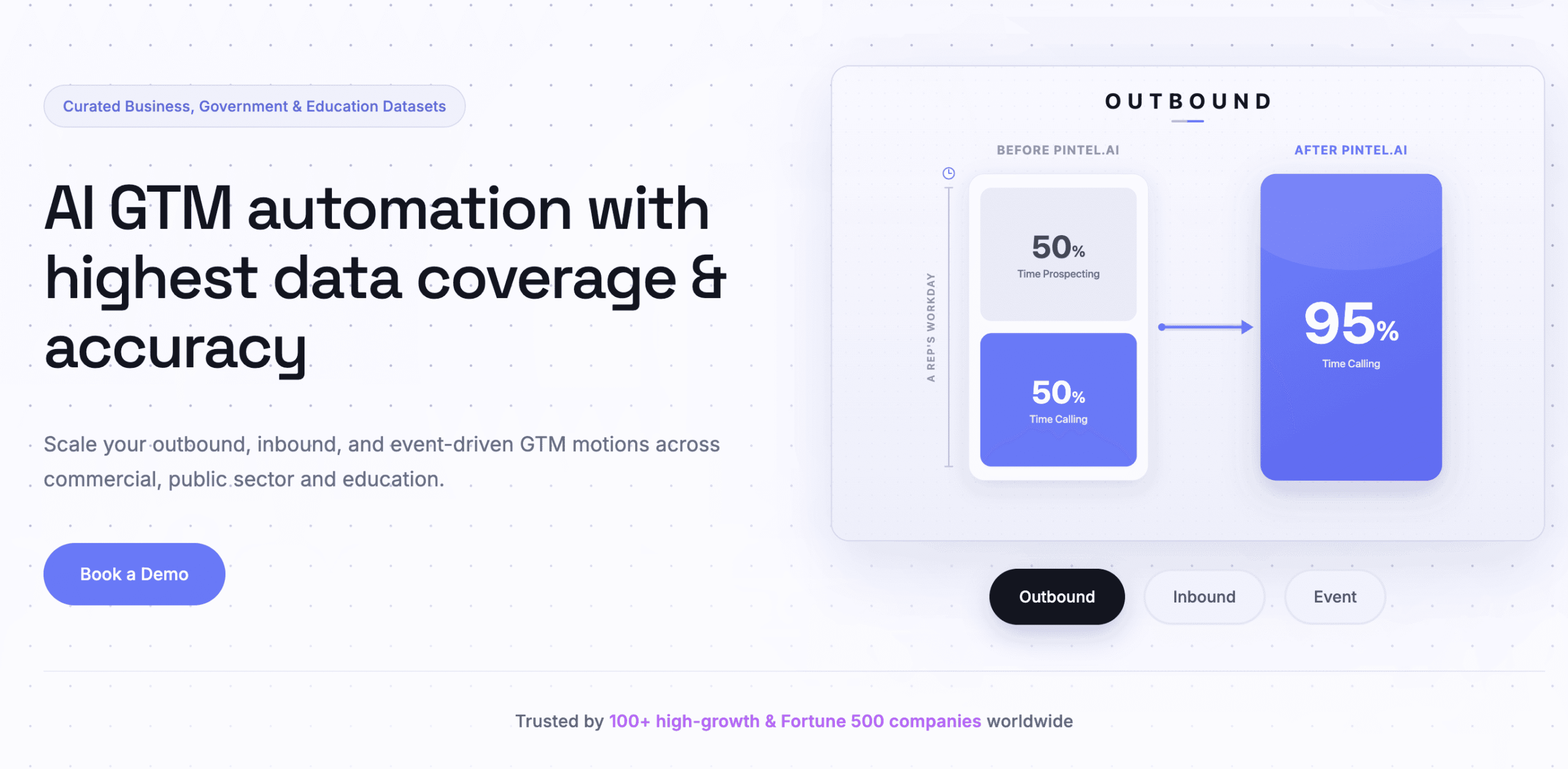
Pintel.ai helps GTM teams find verified UK contact data, including accurate email addresses and direct phone numbers for the right decision-makers. It also provides UK company data to help teams find the right companies and prioritize outreach with buying signals.
Pintel combines contact enrichment, company research, buying signals, and company data in one platform. This helps sales teams build better prospect lists, spend less time on manual research, and start outreach faster.
Why Choose Pintel.ai for UK Contact Data?
- Verified UK Company & Contact Data: Access accurate UK company records with verified email addresses and direct phone numbers for decision makers.
- AI-Powered Buying Signals: Prioritize accounts using funding events, hiring activity, leadership changes, technology adoption, and other buying signals.
- AI Account Research: Find high-fit accounts and identify the right stakeholders using AI-powered account research instead of manual prospecting.
- Commercial and Public Sector Coverage: Prospect across private companies, government agencies, education, healthcare, manufacturing, and other sectors from one platform.
- Global Coverage: Research companies and decision makers across the UK and international markets without switching between multiple tools.
- Enterprise Security & Compliance: ISO 27001 certified, SOC 2 (AICPA), GDPR compliant, HIPAA compliant, CCPA compliant, and VAPT certified.
Best for: GTM teams targeting the UK that need verified company and contact data, buying signals, AI powered account research, and support for both commercial and public sector sales in one platform
2. ZoomInfo: Enterprise UK Coverage, Thinner SME Depth
ZoomInfo builds its contact database mainly through community data contribution concentrated among US and large Western European enterprises, so UK small and mid-size company records depend more on secondary enrichment than direct sourcing. Coverage is noticeably deeper for large, well-known UK enterprises than for SMEs.
- Deep coverage for large UK enterprise accounts
- Established CRM and sales engagement integrations
- Limitations: UK SME and non-metro coverage relies on secondary enrichment, and update frequency lags for smaller companies
3. Apollo: Self-Serve SMB Outreach, Limited UK Compliance Depth
Apollo offers a large self-serve contact database built for SMB and mid-market teams, but its UK data is inherited from broader global scraping rather than dedicated Companies House cross-referencing, so job titles and company details outside London are frequently out of date.
- Native sequencing built into the same platform as the contact database
- Lower entry pricing for small teams
- Limitations: UK contact data is not independently verified against Companies House filings, and documentation of GDPR lawful basis is thinner than UK-native providers
4. Cognism: GDPR-First UK and European Sourcing, Thinner Non-Metro Depth
Cognism built its core data engine around GDPR-compliant sourcing with a well-established UK and European base, giving it genuinely deep coverage for London and major UK metro accounts, but SME and micro-business coverage outside those metro areas is thinner because those companies file less public data for any provider to draw from.
- Established compliance documentation for UK and EU outreach
- Direct dial coverage for London and major UK metro contacts
- Limitations: coverage thins out for small companies outside major UK cities
5. Lusha: Fast Individual Lookups, Inconsistent UK Sourcing
Lusha sources contact data through a browser extension and crowd-contributed network concentrated in North America and parts of APAC, so UK company profiles depend on whatever individual contributors happen to have entered, producing inconsistent coverage across sectors.
- Fast individual contact lookups through its browser extension
- Straightforward per-seat pricing for small teams
- Limitations: UK coverage is not systematically sourced, so accuracy varies widely by industry and company size
6. Kompass UK: Trade Directory Listings, No Contact Enrichment
Kompass UK operates as a structured business directory, listing verified company profiles by industry and trade activity, but it is organized as a directory rather than a sales enrichment tool, so it lacks buying signals, contact-level enrichment, and CRM integration.
- Deep listings for registered trade, manufacturing, and distribution companies
- Organized by industry classification, useful for market mapping
- Limitations: no verified contact-level data, no buying signals, and no native CRM sync
7. Companies House: Official Company Records, No Contact Data
Companies House is the UK government’s official company registry, giving free, complete access to incorporation records, filing history, and registered directors for every UK company, but it provides no email addresses, phone numbers, or buying signals, so it functions as a verification source rather than a prospecting tool.
- Complete and authoritative for company incorporation status and registered directors
- Free public access to filing history for any UK company
- Limitations: no contact data of any kind, and no signal or prioritization layer
Reading through all seven, the pattern is consistent: broad global databases inherit UK coverage as an afterthought, UK-native compliance-first providers trade non-metro depth for deep metro accuracy, and official records are authoritative but contact-free. That gap is exactly what the next section addresses.
A quick note on terminology, since it changes what a search actually returns. A generic business database uk search mixes results for company-level records, like Companies House and Kompass UK, together with contact-level tools, like Pintel, ZoomInfo, and Cognism, even though those two categories solve different problems. Knowing which category a team actually needs narrows the list from seven providers to two or three worth a real evaluation.
What Data Gaps Exist Even in Accurate UK Contact Databases?
Sole traders and partnerships are the most consistently underrepresented UK business type across every provider in this comparison. Unlike limited companies, they are not required to file the same level of public detail at Companies House, so gathering usable company intelligence on them depends far more on web presence and directory listings than on official filings.
Scotland and Northern Ireland add a second gap. Both maintain some administrative and legal distinctions from England and Wales, and providers built primarily around England-based sourcing patterns can under-cover companies registered or operating primarily in those nations.
Public sector and devolved administration contacts are the hardest segment of all. None of the 7 providers in this comparison are built to reach government or public body directories, which is a distinct data category from commercial company and contact databases.
How to Choose a UK Contact Database for Your Team
The right choice depends less on which provider looks most complete and more on which specific problem a team is trying to solve. The four questions below cover the decision in order.
Is the Problem Missing Accounts or Bad Contacts?
Start by identifying which problem matters more: too few UK accounts in your existing database, or accounts that exist but come with outdated titles and unreachable contacts. Companies House and Kompass UK solve the first problem for company-level coverage. A dedicated contact database provider solves the second for named, reachable people.
Should You Layer a UK Source on Top of an Existing Global Tool?
If your team already runs global outbound through ZoomInfo, Apollo, or Lusha, the fastest fix is not replacing that tool. It is layering a UK-native, GDPR-documented data source on top for the UK portion of your target account list. Teams also running LinkedIn lead generation at scale should treat that channel as a complement to a verified contact database, not a replacement for one, since LinkedIn titles alone do not carry GDPR lawful-basis documentation.
Is the UK a Primary Market or an Occasional Expansion?
If the UK is a primary market rather than an occasional expansion, a database built around UK-native sourcing and GDPR documentation from the start will consistently return better contact accuracy than one retrofitting UK coverage onto a US-first core.
How Does Team Size Change the Decision?
A single rep or founder doing occasional UK outreach alongside a broader territory can usually get by with Companies House verification plus a directory lookup, since the volume does not justify a dedicated data contract. A team of 3 or more reps running consistent UK outbound will lose more time to manual verification and GDPR documentation checks than a dedicated business database uk provider would cost, which is the point at which most teams move from manual lookups to a paid enrichment layer.
Final Takeaway
UK contact data fails in a predictable way: a company might still be listed correctly, but the person has moved on and the compliance documentation has not kept pace with GDPR requirements. Companies House and trade directories fix the company-level gap but stop at a static listing. The gap between those two extremes, verified, GDPR-documented, signal-tracked UK contact data, is where an accuracy-first data layer earns its place in the stack.
Book more qualified meetings with accurate global B2B data
Pintel.ai helps GTM teams identify high-fit accounts, enrich contact data, track buying signals, and prioritize the right opportunities across outbound, inbound, and event-driven workflows.Book a demo
Frequently Asked Questions
What is the most accurate UK contact database for B2B sales?
Accuracy depends on whether a team needs broad global coverage with UK included, or UK-native sourcing cross-referenced against Companies House and documented for GDPR. No single provider in this comparison wins on every dimension at once.
What is the difference between a UK contact database and a UK business database?
A UK business database typically covers company-level records like incorporation status and industry classification. A UK contact database adds named decision makers with verified emails and phone numbers on top of that company data.
Is Companies House data enough for B2B prospecting?
No. Companies House confirms a company is active and lists registered directors, but it provides no email addresses, phone numbers, or buying signals, so it works as a verification source rather than a standalone prospecting tool.
Do UK contact databases need to be GDPR compliant?
Yes. Any UK contact database used for outreach needs a documented lawful basis for processing personal data under GDPR and ICO guidance, which is a compliance requirement separate from raw contact accuracy.
How much does a UK contact database cost?
Pricing ranges from about $29 to $49 a month for self-serve global tools with inherited UK coverage, up to custom pricing for UK-native providers with verified contacts and GDPR documentation.
Why does UK contact data go out of date so quickly?
UK companies incorporate, dissolve, and change directors frequently at Companies House, and professionals change roles often without updating every profile in real time, so any database refreshed less than continuously falls behind.
Do I need a separate UK-focused provider if I already use ZoomInfo or Apollo?
If the UK is more than an occasional target, yes. Layering a UK-native, GDPR-documented data source on top of an existing global tool typically improves contact accuracy and compliance posture for that region specifically.