Most sales teams know they should prioritize the right accounts. Few have a repeatable system for doing it. Account intelligence is that system: a structured layer of data that tells you which companies are worth working, when the buying window is open, and what signal justifies the conversation. This guide covers how this data layer works across five distinct signal types and how SDRs, BDRs, and RevOps teams put it into practice.
Quick Takeaways
- This data layer combines five distinct signal types, each answering a different question about whether an account is worth pursuing now versus in three months.
- Firmographic fit tells you an account could buy. Intent signals and trigger events tell you it is actively in a buying window. Most outbound teams have the first and are missing the other two.
- Signal data works best upstream, at the point of prioritization before the rep picks who to contact. Using signals after a sequence starts corrects for mistakes already made.
- RevOps teams that encode account scoring into the CRM remove prioritization from individual rep judgment and put it into the system, which is where it belongs.
What Is Account Intelligence
Account intelligence is the structured collection and interpretation of data about a target company: its firmographic profile, technology stack, active research behavior, recent trigger events, and engagement history with your brand. Sales teams use it to answer three questions a contact list alone cannot answer.
- Is this company in our ideal customer profile right now?
- Is there an active buying signal at this account?
- Who inside the account is the right first contact?
Company research tells you what a business does and how it is structured. Account intelligence tells you what a business is doing right now and whether that behavior signals an intent to buy. The distinction matters because timing is what separates a conversation from a rejection.
A data provider that returns verified contacts at a target company gives you sales intelligence. A platform that tells you those contacts work at a company that just closed a $30M Series B, has been researching your product category for three weeks, and hired a new VP of Revenue last month gives you account intelligence. The two inputs serve different points in the sales workflow, and conflating them is why teams with plenty of contact data still struggle to build pipeline from it.

How it relates to adjacent concepts
These terms frequently appear together in B2B sales conversations. Each answers a different question.
| Concept | The question it answers |
|---|---|
| Account Intelligence | Which accounts matter, why, and when |
| Account Research | What do we need to learn about a specific account |
| Account Discovery | Which companies fit our ICP |
| Buying Intent | Whether an account is actively researching a solution |
| Prospect Prioritization | Which accounts or contacts reps should work first |
| ABM | How to engage a defined set of target accounts |
The 5 Data Layers
Five distinct data types make up this layer. Each answers a different question and comes from a different source. Most teams access the first and stop there.
| Data Layer | Question It Answers | Example Signal | Source |
|---|---|---|---|
| Firmographic | Is this a structural ICP fit? | SaaS, 200 to 500 employees, Series B, US-based | Government registries, data providers, directories |
| Technographic | What tools are they running? | Uses Salesforce CRM and Outreach for sequencing | Web scraping, SaaS tracking platforms, job postings |
| Intent | Are they researching your category? | Topic spike: “outbound data quality” for three consecutive weeks | Third-party intent providers, G2, content consumption data |
| Trigger Events | Is something changing here? | New VP Sales hired, $25M Series C closed, eight new SDR postings | LinkedIn signals, funding databases, job posting monitoring |
| Engagement | Have they shown interest in you? | Visited pricing page three times, liked a LinkedIn post on outbound prospecting, opened multiple emails | CRM, marketing automation, website visitor tracking, LinkedIn enrichment |
Why firmographic data alone falls short
Most outbound teams build a firmographic list and hand it to SDRs. The problem: firmographic fit tells you the account could buy, not that it is in a position to buy now. Intent data closes that gap. When a company has been consuming content directly related to your category for several consecutive weeks, that is an in-market signal. Paired with a trigger event, it defines an open buying window.
What technographic and engagement data add
- Technographic: Knowing a prospect runs the same CRM your product integrates with confirms technical fit before the first call.
- Engagement: First-party engagement is often among the strongest signals because it reflects direct interaction with your brand. A company that visited your pricing page multiple times, liked your LinkedIn post on a relevant topic, or opened your email sequence is likely further along the consideration journey than a third-party intent score alone captures.
How Account Intelligence Works in Practice
Collecting signal data is not the same as acting on it. High-performing teams run a repeatable six-step workflow that converts raw signals into rep actions rather than leaving each SDR to research accounts from a static export.
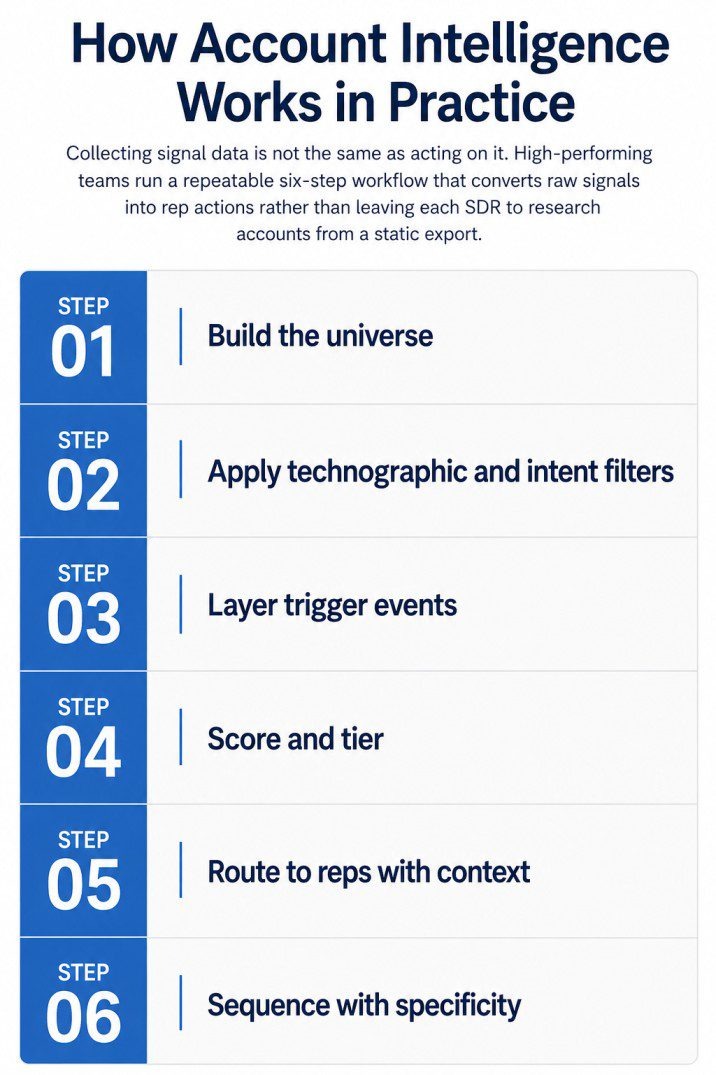
Step 1: Build the universe
Apply firmographic filters: industry, employee count, revenue range, geography, growth stage. This is your total addressable market, not your target list. You might have 30,000 to 50,000 accounts here.
Step 2: Apply technographic and intent filters
Narrow to accounts showing active in-market behavior or the tech stack that signals fit. For example, a 40,000-company universe could narrow to 3,000 to 5,000 accounts worth monitoring after this step.
Step 3: Layer trigger events
Flag accounts where something changed recently: a funding round, a leadership hire in a relevant function, or a job posting pattern signaling a GTM build-out. These accounts have an open buying window.
Step 4: Score and tier
Assign accounts to tiers based on signal density. Firmographic fit plus intent spike plus trigger event in the last 30 days is tier 1. Firmographic fit only is tier 3. Tiers drive rep behavior, not individual judgment calls.
Step 5: Route to reps with context
Tier-1 accounts go to the senior SDR or BDR with signal context attached: a summary of which signals fired and why the account ranked where it did. No blank LinkedIn research required.
Step 6: Sequence with specificity
The rep opens with something tied to the signal: the trigger event, the intent topic, or the technographic fit. Signal-driven messages tend to produce conversations. Generic templates tend to produce generic reply rates.
SDR Playbook: Signal-Driven Prioritization
For an SDR, account intelligence changes the first question of the day. Instead of asking “who should I call?” the question becomes “which accounts have the highest signal density right now?”
The static list problem
Without signal data, SDRs work lists sorted by industry. Conversion rates stay low because timing is random relative to the account’s actual buying window. An SDR might contact a perfect ICP-fit company that just renewed a competitor contract for two years. That same message sent after the account posts five new SDR openings and spikes on category intent lands in an entirely different context.
The signal-driven queue
With signal data, an account rises to the top not because a manager chose it, but because signals fired:
- A new VP Sales hired two weeks ago
- The account researching “outbound prospecting tools” for three consecutive weeks
- They run Salesforce, which integrates directly with the product being sold
A real-world example
An SDR covering mid-market SaaS sees a $30M Series B announced 10 days ago, five new SDR job postings, and an active intent spike on “data enrichment.” That is not a cold call. The opening references the Series B and the hiring surge. The value proposition maps directly to the problem a newly funded SDR team faces: accurate data without burning ramp time on bad records.
BDR Playbook: Breaking Into New Accounts
BDRs work larger portfolios across longer cycles. Signal data addresses two problems: which accounts are warming, and how to break into new ones without relying on referrals.
Identifying warming accounts
A BDR managing 300 enterprise accounts cannot actively work all 300 at once. Signal-based prioritization surfaces which accounts have shifted from cold to warm. An account inactive for 60 days that just posted three new VP-level GTM roles and visited the pricing page twice last week deserves immediate attention. One with no signals in 90 days stays in nurture.
Finding entry points
When breaking into a new account, BDRs traditionally search LinkedIn for the right title and send cold outreach. Signal data identifies which persona is most likely in active evaluation mode based on the nature of the trigger event and recent content consumption from the account’s domain.
A practical example: a BDR targeting enterprise healthcare IT sees an intent spike for “HIPAA-compliant data storage” and a new posting for an incoming CISO. That combination signals an active compliance project with a budget owner who has not finalized the vendor stack. The entry point is not the VP of IT, who has established vendor relationships. It is the incoming CISO, building the stack from scratch.
Enriching LinkedIn engagement
LinkedIn engagement can reveal relevant prospects. With Pintel.ai, you can identify people who like or engage with any relevant LinkedIn post and enrich them with verified email, direct phone, company details, and other contact data. This turns LinkedIn engagement into a prospecting signal you can use to prioritize and reach out.
RevOps: Building the Scoring Model
RevOps sits between the data layer and the rep layer. Its job is to ensure signal data flows through the system cleanly, scores correctly in the CRM, and routes to the right person at the right time without manual intervention.
The most common application is a CRM scoring model where signals automatically update account tiers as they fire and expire.
An illustrative scoring model for B2B outbound teams:
- Firmographic fit: up to 40 points. Industry match, employee count in target band, revenue bracket correct.
- Technographic fit: up to 20 points. Runs a primary integration partner’s tool, or uses a competitor product signaling a replacement conversation.
- Intent signals: up to 25 points. Active topic spike on primary category terms in the last 30 days.
- Trigger events: up to 15 points. Funding round, relevant leadership hire, or expansion announcement in the last 60 days.
Accounts above 70 route to the tier-1 SDR queue. Accounts at 40 to 70 get sequenced outreach. Below 40, accounts sit in nurture until their score moves. The result is a rep queue built on actual buying behavior, not on who last updated the CRM.
For a detailed breakdown of how to structure this model inside your CRM, see our guide on B2B lead scoring frameworks and criteria.
Signals vs Sales Intelligence
Sales intelligence and account intelligence solve different problems in the sales workflow.
Sales intelligence
Focuses on the contact layer: who works at the target company, what their title and seniority are, whether their email is verified, and whether a direct phone number is available. It answers one question: “Who do I reach at this account?”
Account intelligence
Focuses on the company layer: what the organization is actively doing, which signals have fired, whether the timing is right, and what angle is most relevant given the account’s current context. It answers: “Why this account, and why now?”
Why the distinction matters
Many teams invest heavily in contact data platforms and assume they have what they need. A verified email for the VP Sales at a 300-person fintech is sales intelligence. Knowing that firm just raised a Series B, has been researching “sales engagement tools” for three weeks, and posted six new SDR openings last month is the signal data that actually changes whether the message lands.
The two are complementary, not alternatives. Signal data identifies the right accounts at the right moment. Contact data delivers the message to the right person. Only contact data means well-crafted outreach sent to out-of-market accounts. Only signal data means knowing exactly who to target but being unable to reach them. Both gaps kill pipeline.
For a closer look at how AI-driven workflows combine these two layers into a single process, see our guide on AI account research and contact identification.
Platform Criteria
Not every account intelligence platform delivers what the category name suggests. Some are contact databases with a firmographic filter. Others are single-signal intent vendors with no company-level depth. Before evaluating, check for five capabilities.
Firmographic filter depth
Sub-industry classification, precise headcount bands, revenue ranges, and growth-stage filters are the baseline. If the only industry filter is a dropdown with 12 options, the platform is a contact database with a different label.
Multi-layer signal coverage
The value comes from layering all five signal types in a single interface. Platforms that sell intent and firmographic data as separate products push the correlation work back to RevOps, which is precisely the work the platform should eliminate.
Built-in account scoring
Look for platforms that score accounts on signal density and surface a prioritization queue. A platform that delivers only a CSV forces a manual rebuild of the scoring model every quarter with no institutional memory.
Bi-directional CRM integration
Check whether the integration is one-way (export only) or bi-directional: signals should update account records and trigger tasks automatically rather than requiring a manual import each week.
Compliance documentation
Evaluate how the vendor sources data, handles opt-out requests, manages privacy obligations, and documents compliance for the markets you operate in. Ask for specifics on data broker registration status and certification documentation, not just checkbox claims.
For teams evaluating the intent signal layer specifically, our breakdown of buyer intent tools for B2B sales covers how the major platforms source and deliver intent data and what each is actually measuring.
Pintel.ai: Discover Unique Account Intelligence
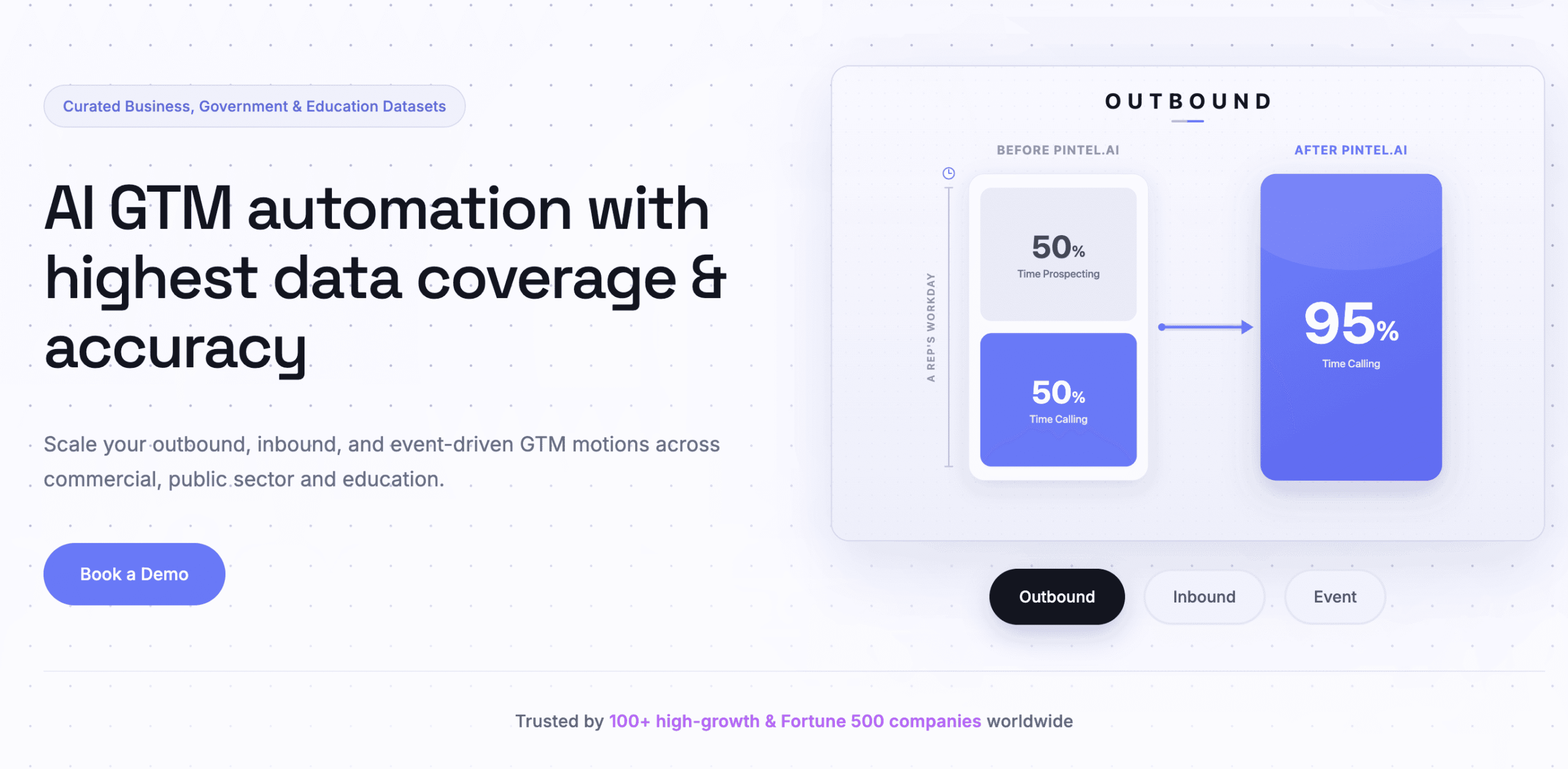
Pintel.ai gives GTM teams account intelligence to understand which companies fit their ICP, what is changing inside those accounts, and when they may be ready for outreach.
The platform helps teams:
- Identify high fit accounts: Find companies that match your ICP using firmographic, technographic, and other account criteria.
- Track company signals: Monitor funding events, hiring for specific roles, leadership changes, executive appointments, expansion, product launches, technology changes, company news, and other business events.
- Identify acquisition activity: Detect companies that have acquired another business or have been acquired, helping teams identify changes in ownership, strategy, budgets, technology, and leadership.
- Combine multiple signals: Layer firmographic fit with business activity and buying signals to identify accounts worth prioritizing.
- Research account context: Bring company data, financial information, funding activity, technology, news, and other account signals into one view.
- Prioritize accounts: Score and rank accounts based on fit and signal strength so reps can focus on the accounts most relevant to their outbound motion.
- Monitor accounts continuously: Keep account intelligence current as new company events and signals emerge.
Pintel.ai combines these signals with account discovery and scoring, helping teams move from a broad ICP to a prioritized set of accounts with current context for outreach.
Frequently Asked Questions
What signals indicate an account is entering a buying window in B2B sales?
No single signal proves that an account is ready to buy. A stronger buying window often appears when multiple relevant signals occur together, such as hiring for specific roles, a new sales or revenue leader, funding, an acquisition, expansion, technology changes, or increased research activity. The key is to evaluate the signal’s relevance, recency, and relationship to the account’s ICP fit.
Which account intelligence signals should B2B sales teams prioritize?
Prioritize signals based on relevance, recency, and combination rather than treating every event equally. A recent leadership change, specific hiring pattern, acquisition, or technology change can become more valuable when it aligns with ICP fit and buying intent. The strongest opportunities often have several relevant signals within a meaningful time window.
How do you distinguish a real buying signal from normal account activity?
A useful signal indicates a change that could affect the company’s priorities, budget, technology, or buying process. For example, one generic job posting may provide limited insight. Several new SDR hires combined with a new VP of Sales and increased research around sales technology provide stronger evidence that the account’s priorities are changing.
Can multiple weak signals together indicate a stronger B2B sales opportunity?
Yes. Multiple relevant signals can provide stronger evidence than one isolated event. An ICP fit combined with specific hiring, a leadership change, technology adoption, and recent research activity can indicate a meaningful change in an account’s priorities. Account scoring can combine these signals to determine whether the account deserves immediate attention.
How does account intelligence help sales teams prioritize accounts?
Account intelligence combines account fit with current business activity and buying signals to rank accounts by priority. Instead of working a static list, SDRs and BDRs can focus on accounts showing stronger evidence of relevance or a timely buying opportunity. The goal is to give reps a smaller, more actionable queue with context for why each account matters.
How do you prevent account intelligence from becoming another data dump for sales reps?
Account intelligence should lead to a decision, not another research task. Sales teams can convert raw signals into account scores, priority tiers, relevant contacts, and specific reasons to engage. The useful output is not more company data. It is knowing which account to work, who to contact, and why now.
How can account intelligence reveal opportunities competitors may miss?
Traditional account targeting often relies on firmographic fit and standard intent data. Account intelligence can surface less obvious changes, including hiring for specific roles, leadership changes, acquisitions, expansion activity, technology changes, company events, and engagement with relevant LinkedIn posts. Combining these signals can reveal changes in an account’s priorities before they become obvious through conventional intent data. Pintel.ai can identify and combine these account signals to surface opportunities based on current company activity.
Can account intelligence tell you which person to contact, not just which company to target?
Yes. Once an account is prioritized, the next step is identifying the people most relevant to its current situation. A new VP of Sales may be more relevant after a sales expansion, while a technology change may point toward an IT or operations stakeholder. Pintel.ai can identify relevant contacts within prioritized accounts and enrich them with verified contact and company information.
How can B2B sales teams turn LinkedIn engagement into an actionable prospecting signal?
Engagement with a relevant LinkedIn post can indicate interest in a topic related to your sales motion. Teams can identify the people who liked or engaged with the post, evaluate their role and company, and enrich their contact information. Pintel.ai can identify and enrich people who engage with relevant LinkedIn posts, including posts published outside your own company, turning LinkedIn activity into an actionable prospecting signal.
How does account intelligence differ from sales intelligence, account research, and account discovery?
These concepts support different parts of the B2B sales workflow. Account intelligence determines which accounts matter, why they matter, and when to act. Account research helps teams understand a specific company. Account discovery finds companies that match the ICP. Sales intelligence helps identify and reach the right people. Account intelligence connects these inputs to prioritization and action.