Sales teams have more data than ever. Most have hundreds of thousands of company records, contact fields, emails, and phone numbers sitting in a CRM or a data provider’s export. What they often don’t have is an answer to four questions: which accounts actually fit, which ones are changing right now, who the relevant stakeholders are, and which accounts deserve attention today instead of next quarter.
Sales intelligence is the layer that answers those questions by combining company, contact, and signal data with context, rather than just accumulating more records. This article covers what data it actually includes and how the pieces work together operationally.
That means: how firmographic filtering narrows an account list, how signals get weighted and scored, why single-contact engagement gets misread as intent, and what a signal stack looks like in the days before a rep sends an email.
What Is Sales Intelligence?
Sales intelligence is the use of company, contact, account, behavioral, and buying-signal data to identify which B2B accounts fit a target market, show signs of buying activity, and deserve sales attention now rather than later.
That definition only becomes useful once you separate three terms that get used interchangeably:
- Raw data is unprocessed information: a contact record, a firmographic field, a log of a website visit. It carries no context.
- Sales intelligence data is that same raw data enriched, validated, and filtered against your ICP, which is what turns a name in a spreadsheet into a usable record.
- Sales intelligence is sales intelligence data combined with account intelligence and buying signals to determine account fit, buying readiness, the right decision-makers, and timing.
- Sales intelligence insight is the conclusion drawn from all of it, such as “this account is showing active buying behavior” or “this contact has budget authority for this deal.”
A company with 1,000 employees is data. A company that fits your ICP, recently hired a CRO, is expanding its sales team, and has three identifiable stakeholders relevant to your deal is sales intelligence. A CRM full of contact records without that layer is not an intelligence system. It’s a filing cabinet.
What Data Does Sales Intelligence Include?
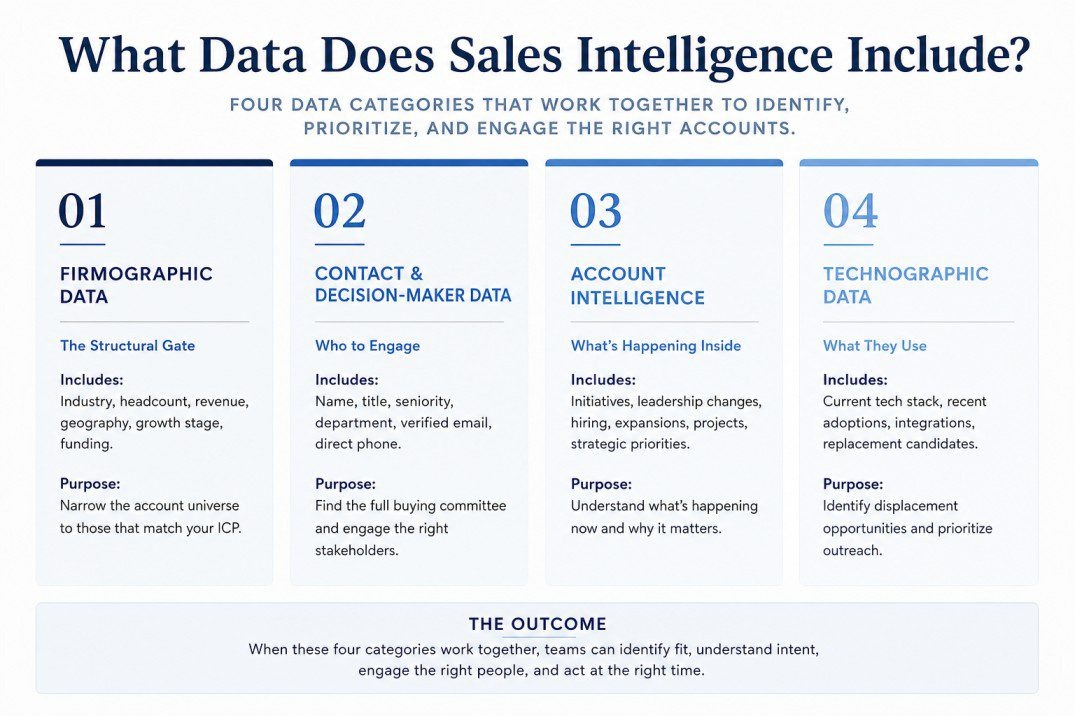
Four data categories form the base layer. None of them is sufficient alone, and the order they get applied in matters more than most teams realize.
Firmographic Data: The Structural Gate
Firmographic data tells you whether an account fits your ICP before you spend time researching or engaging it.
Includes:
- Industry
- Headcount
- Revenue
- Geography
- Growth stage
- Funding
Why it matters:
Firmographic fit is a prerequisite, not a reason to act. Filtering an account list against these criteria narrows the universe to companies worth watching. It does not tell you whether they are ready to buy.
Contact and Decision-Maker Data: Who to Engage
Contact data goes beyond finding a person with the right title. The real question is who owns, influences, supports, or can block the decision.
Key roles include:
- Economic buyer: Controls and approves the budget
- Champion: Lives with the problem and benefits most from solving it
- Influencer: Helps shape the evaluation and recommendation
- Blocker: Has a reason to defend the existing vendor or process
A verified email for the wrong role rarely gets a reply, no matter how accurate the address is.
Why Title-Only Matching Fails
Job titles alone can create misleading matches. A search for “digital transformation”, for example, can surface:
- People implementing transformation initiatives internally
- People selling transformation software to those companies
A title filter cannot reliably distinguish prospect intelligence from competitor intelligence. This becomes even harder in sectors such as government, where public professional profiles can be limited.
What good contact intelligence should do:
Match a prospect’s profile, role context, and account context against your ICP criteria, rather than relying on a title string alone.
Account Intelligence: What Is Happening Inside the Company?
Account intelligence adds current context to static company information.
Company data:
Company X has 2,000 employees.
Account intelligence:
Company X is undergoing a specific technology migration, and a named executive owns the initiative.
The first tells you what the company is. The second tells you what is happening and why it may matter now.
That context can turn a generic pitch into a relevant opening for a sales conversation.
Technographic Data: What Technology Do They Use?
Technographic data shows the technologies an account currently uses and helps identify potential displacement or replacement opportunities.
Includes:
- Current technology stack
- Recent technology adoptions
- Integrations
- Replacement candidates
When Technographic Data Becomes a Trigger
Technology data becomes a prioritization signal when it connects to a specific displacement window.
Strong trigger:
A target account uses a tool that was recently sunset or acquired.
Useful context, but not necessarily a trigger:
A target account uses a tool that integrates with your product.
The difference is important. Technology fit can tell you where you belong. A change in that technology can tell you when to act.
How Sales Teams Actually Use Sales Intelligence Data
Using sales intelligence data means routing the right piece of it to the right role at the right moment in the deal cycle, not centralizing it in a dashboard that only RevOps checks. Each of the four data categories above gets used differently depending on who’s looking at it and where the account sits in the funnel.
- SDRs work from a ranked, scored queue, not a raw account list. They use firmographic fit and signal strength to decide who to call today versus who stays on a watch list, and they use decision-maker data to know which role to open with.
- AEs pick up account intelligence and buying committee data mid-cycle, not just before the first call. Knowing that a champion has been vocal internally about a problem, or that a blocker’s contract renewal is approaching, changes how a live deal gets navigated.
- RevOps treats the scoring model as a living configuration, not a one-time setup. They adjust signal weights based on which stacks actually preceded closed deals, and they own the decay logic that keeps the queue current.
- Marketing and ABM teams use confidence tiers to decide which accounts get a 1:1 campaign versus a broader nurture motion, instead of running the same treatment across every account that clears the firmographic gate.
Here’s how that looks across a single account rather than in the abstract.
SDR stage: A $25 million ARR SaaS company clears the firmographic gate, then two signals stack in the same week:
- A third-party intent surge for a relevant category
- A new VP of Sales who just connected with the SDR on LinkedIn
The SDR reaches out same-day, referencing the VP hire specifically, because the account arrived at the top of a ranked queue instead of buried in a spreadsheet of 2,000 similar-looking companies.
AE stage: Three weeks later, an AE inherits the deal and pulls up the account brief before the second call. It shows:
- The VP of Sales as the likely champion
- A director of RevOps as the probable economic buyer, based on org structure
- The account’s current tool was recently acquired, a displacement window that’s still open
The AE leads the call with that context instead of re-discovering it live.
RevOps stage: Two months after the deal closes, RevOps reviews the quarter’s closed-won accounts and finds a pattern:
- Org-change signals correlated with faster close times
- Third-party intent alone, without a corroborating signal, mostly didn’t convert
The weighting for next quarter shifts accordingly. That feedback loop, not any single signal, is what keeps the model accurate over time.
A more complex example: compound ICP fit. Firmographic fit isn’t always industry and headcount. A mobile QA testing company’s real ICP wasn’t “software companies.” It was two conditions at once:
- The company owns and maintains its own mobile app
- The company has an in-house QA tester, not an outsourced testing function
Neither condition alone predicts fit. A company with a mobile app but no in-house tester already outsources QA and isn’t a real prospect. A company with in-house QA but no mobile app has nothing for a mobile-specific tool to test. Only the combination clears the gate, which is why a single filter like “software companies, 50 to 500 employees” would have returned a list mostly outside the real ICP.
How Buying Signals Actually Get Weighted
Treating “intent” as one signal type is one of the most common analytical mistakes in this category. There are four distinct buying signal types, and they don’t carry equal weight in a scoring model. Firmographic fit sits outside the signal stack entirely, as a prerequisite gate rather than a fifth signal.
| Signal Type | Examples | Typical Scoring Weight |
|---|---|---|
| First-party behavioral | Pricing page visits, product page sessions, repeat visits, demo engagement | Highest. Direct product interest, especially when tied to a known account |
| Organizational change | New executive hire in a revenue function, headcount growth in sales/RevOps, funding followed by hiring | High. A concrete buying-window indicator, particularly for VP-level hires |
| Third-party intent | Bombora surge data, G2 profile views, topic cluster research activity | Medium. Category interest, not product-specific. Unreliable as a standalone trigger |
| Engagement | Email replies, content downloads, event registrations, LinkedIn responses | Low, unless layered with a behavioral signal from the same account |
| Firmographic fit | Industry, size, revenue range | Not a score driver. A prerequisite gate that has to clear before anything else counts |
The practical implication: a third-party intent spike from an account that also shows firmographic fit is still weak evidence by itself. The same spike combined with a pricing page visit and a recent relevant hire is a different case entirely, because you now have signals from three independent categories agreeing.
A related, less obvious problem is detection, not weighting. Some of the most useful signals live in places no search engine has indexed:
- Contract renewal timing, often buried in board meeting minutes
- A competitor’s presence at a specific site, found only in local filings
- A safety or compliance event, documented in a PDF nobody crawled
A team relying on standard web search or a LinkedIn-centric tool doesn’t miss these signals because they’re weak. It misses them because nothing indexes them in the first place. That’s a detection problem, not a weighting one, and it sits upstream of everything else in this section.
Multi-Thread Validation
A single contact visiting your website could be research, competitive monitoring, or a job candidate checking your careers page. It’s not a pattern. Two or three contacts from the same account engaging within the same window is a pattern, and it’s one of the better proxies available for actual buying committee activity before anyone replies to an email.
This is why account-level signal patterns, not single-contact engagement, are what should trigger SDR assignment. Mapping the buying committee from the first touch, rather than after a reply comes in, is what separates teams that catch multi-threaded deals early from teams that don’t.
Those teams often find out a buying committee existed only after the deal stalls with a single champion who could never get budget approved alone.
Signal Stacking: A Three-Tier Framework
No single category produces a reliable buying signal alone. A practical framework sorts accounts into three tiers before any outreach decision gets made:
| Tier | Criteria | Action |
|---|---|---|
| High confidence | ICP fit, plus a third-party intent spike, plus a first-party pricing page visit, plus a VP-level hire in the last 60 days | Act now. Route to a senior rep immediately |
| Medium confidence | ICP fit plus one intent signal, with no first-party confirmation yet | Monitor and sequence, but don’t escalate |
| Low confidence | ICP fit only, no active signal | Watch list. Revisit if a signal fires |
The operating rule underneath this table: require at least two aligned, independent signals before triggering outreach. A single signal, no matter how strong it looks, is still one data point. Two independent categories agreeing is a pattern.
Signal Recency and Decay
A signal from 48 hours ago and a signal from six weeks ago are not the same input, even if they look identical in a spreadsheet. Contact and account data decay over time as people change roles and companies restructure, and behavioral signal value should decay even faster, on a weekly basis, if there’s no new activity to reinforce it.
Without decay logic built into a scoring model, an account that spiked six weeks ago can sit at the top of a priority queue long after the buying window it indicated has closed. That queue reflects last quarter’s activity, not this week’s.
The fix isn’t complicated: reduce a signal’s contribution to the composite score by a fixed amount for every week that passes without a new signal from that account.
An Illustrative Example: What a Signal Stack Looks Like
The scenario below is a composite, built to show the mechanics rather than describing them abstractly. It isn’t a specific named customer.
The account: An ICP-fit SaaS company, $25 million ARR, 180 employees, running HubSpot, with a new VP of Sales hired 45 days ago.
Signal stack over 7 days:
- A third-party intent spike for “sales engagement platform” and “outbound sequencing”
- Three contacts visit the pricing page; two return for a second session
- The VP of Sales connects with an SDR on LinkedIn and views the company page
What the scoring model registers: The firmographic gate clears. Three high-weight signals fire within the same window, spanning behavioral, intent, and organizational-change categories. Multi-thread validation confirms it, since three separate contacts engaged, not one.
What happens next:
- The account routes to the senior rep in the correct territory.
- A high-priority sequence enrolls automatically.
- The rep receives a contextual alert showing the VP hire, the pricing page activity, and the intent spike in a single view.
- The rep reaches out within hours of the stack forming, referencing the VP hire and expansion motion instead of sending a generic message.
That last part is the actual difference between signal-driven prospecting and list-based outbound: the intelligence doesn’t wait for someone to review it and decide it’s worth acting on. It’s designed to trigger the workflow as soon as the threshold is crossed, while the window is still open.
Common Mistakes That Undermine Sales Intelligence
Most of the value gets lost not in the data itself but in a handful of repeatable operational errors.
- Treating all signals as equal. A pricing page visit and a whitepaper download are not equivalent inputs. A scoring model without weighting produces noise, not prioritization.
- Over-relying on third-party intent. Intent data surfaces accounts worth watching. It doesn’t confirm buying readiness on its own. Require a corroborating signal from a different category before assigning an SDR.
- Ignoring signal decay. A model without decay logic keeps stale accounts at the top of the queue indefinitely.
- No feedback loop. If won and lost outcomes don’t feed back into the scoring model, it can’t learn which signal combinations actually preceded conversion, and the weights stay guesses indefinitely.
- Not gating on ICP fit. Acting on strong signals from accounts outside your ICP wastes rep time regardless of how loud the signal is. Firmographic fit is a gate, not a nice-to-have.
- Single-threading accounts. Chasing one contact’s engagement while ignoring whether other stakeholders are involved misses the buying committee pattern almost entirely.
Avoiding these errors gets the data right. The next step is turning that intelligence into something a rep can actually pick up and use before a message goes out.
Building the Account Brief
Before a message goes out to a Tier 1 account, the intelligence gathered so far should collapse into a single document, no more than half a page:
- An ICP fit rating (strong, moderate, developing)
- The key pain signals based on tech stack and firmographic data
- The active buying trigger and why it matters right now
- A stakeholder map noting the economic buyer, champion, influencer, and blocker where identifiable
- A recommended first message angle tied directly to the trigger
This brief is the handoff between the intelligence layer and the outreach layer. Every rep who touches that account starts from the same signal-backed foundation instead of re-researching it from scratch.
That handoff only works if the underlying data was worth acting on in the first place. That’s a separate question from what data sales intelligence includes, and it deserves its own criteria.
What Makes Sales Intelligence Data Useful
These ten dimensions evaluate the data itself, independent of which provider or platform produced it. They’re the criteria for judging any account or contact record you’re about to act on, whether it came from an internal team, a data provider, or a platform’s own enrichment pipeline.
| Dimension | The Question It Answers |
|---|---|
| Accuracy | Is the record correct, or does it just look complete? |
| Freshness | How recently was this verified? |
| Coverage | Does it find enough accounts and contacts across your actual target market, not just your home region? |
| Depth | Does it go beyond basic company and contact records? |
| Signal quality | Are the signals meaningful, or just numerous? |
| Signal recency | Are changes surfaced as they happen, or weeks later? |
| Context | Does it explain why an account matters, not just that it exists? |
| Actionability | Can a rep use it directly without more research? |
| Source diversity | Does it rely on one provider or combine several? |
| Workflow integration | Does it reach the CRM reps already work in? |
Coverage and accuracy deserve a specific caveat most teams underestimate:
- A single enrichment provider rarely covers a diverse account list completely, particularly across different regions, company sizes, and markets.
- Combining multiple providers closes more of that gap than relying on one.
- A provider’s stated accuracy rate usually reflects records it successfully matched, not the records it silently skipped.
- A list that’s meaningfully stale before you’ve sent a single email tends to bounce and underperform no matter how good the copy is.
What Should You Look for in a Sales Intelligence Tool?
The dimensions above judge data quality. This checklist judges whether a specific platform can actually deliver data that clears that bar, and operationalize it, on an ongoing basis rather than as a one-time export. A tool can score well here while still producing data that fails several of the dimensions above, which is why both lists matter separately.
| Capability | What to Ask |
|---|---|
| Company data | Can it identify accounts that match your ICP? |
| Contact data | Can it identify the full buying committee, not just one contact? |
| Enrichment | Can it fill missing fields in existing CRM records, not just new ones? |
| Account intelligence | Can it surface why an account matters, not just what it is? |
| Buying signals | Does it weight signal types differently, or treat every signal as equal? |
| Technographics | Can it identify displacement windows, not just current tools in use? |
| Scoring | Does the model include decay logic, or does it treat old and new signals the same? |
| Prioritization | Can reps see a ranked queue without manual sorting? |
| Coverage | Does it perform consistently outside your home region? |
| Workflow | Does intelligence sync into the CRM, or require a separate login to review? |
How Pintel.ai Approaches Sales Intelligence
Pintel.ai runs the account discovery, enrichment, signal, scoring, and activation layers as one connected workflow rather than five separate tools a team has to stitch together.
Account discovery filters against ICP criteria (industry, company size, geography, revenue, technology usage) across more than 150 aggregated global data sources, with segment-specific logic templates so scoring criteria can differ by industry, geography, or company size without breaking consistency elsewhere.
Enrichment covers company and contact data, verified emails and phone numbers, and buying committee mapping, including support for defining multiple prioritized persona cohorts per account so a startup’s co-founder-led buying process and an enterprise’s multi-role committee don’t get run through the same static title filter. It also handles resolving signups that arrive with only a personal email address to a verified professional identity at volume, which matters for any product-led motion with a high signup rate.
Signals layer hiring activity, funding events, leadership changes, technology changes, and custom signals a team defines itself, such as company type or pricing model, mapped to specific accounts and contacts rather than delivered as an undifferentiated feed.
Scoring combines ICP fit and signal strength into a single ranking model, so prioritization is consistent across the account list instead of depending on whichever rep happens to review a given record.
Activation syncs prioritized accounts and enriched contacts directly into the CRM and outbound tools a team already runs on a schedule, closing the gap between signal detection and rep action without someone exporting a spreadsheet.
This played out concretely for a QA automation SaaS company with more than $30 million in annual recurring revenue, a case Pintel has published in full.
- The company had relied on an 8 to 10 person research team to manually identify qualification signals, such as testing methodologies and product launch activity, and to enrich and validate accounts by hand.
- As account volume grew, that manual process became the bottleneck limiting coverage.
- Using Pintel.ai to automate signal discovery, enrichment, and scoring, the company qualified more than 75,000 accounts without expanding its research headcount.
- Enriched, prioritized accounts reached the SDR team faster than the manual process had allowed.
What This Means for Choosing a Sales Intelligence Approach
Sales intelligence isn’t about accumulating more records. A company can hold hundreds of thousands of contacts and still have no reliable way to answer which account to call first, or which of three stakeholders at that account actually controls budget. The value comes from:
- Weighting signals correctly
- Catching multi-threaded buying committee activity before a reply ever comes in
- Decaying stale signals out of the queue
- Feeding won and lost outcomes back into the model so it keeps improving instead of running on guesses from a year ago
Pintel.ai brings the discovery, enrichment, signal detection, scoring, and CRM activation layers together in one workflow, so the actual operational question, which accounts fit, who on the buying committee to approach, and why now, has a direct answer instead of a spreadsheet to sort through manually.
Frequently Asked Questions
What types of data are included in sales intelligence?
Firmographic data (industry, size, revenue, geography), contact and decision-maker data (including buying committee roles), account intelligence (business initiatives and organizational context), technographic data (current tools and displacement windows), and buying signals across first-party behavioral, organizational-change, third-party intent, and engagement categories. None of these categories is sufficient by itself; sales intelligence is what you get when they’re combined and weighted against your ICP.
How much weight should third-party intent carry in a scoring model?
Medium at most, and never as a standalone trigger. Third-party intent indicates category-level research, not product-specific buying readiness. It should raise an account’s score when combined with a firmographic fit and at least one other independent signal, such as a first-party page visit or a relevant hire, not on its own.
How do I know if a data provider’s coverage claims are reliable?
Ask what percentage of their database was verified in the last 90 days, and ask specifically about coverage in the regions and company sizes you actually target, not their overall claimed database size. A provider’s stated accuracy figure typically reflects the records it successfully matched, not the ones it silently skipped, so a sample export checked against a source like LinkedIn is a more reliable test than the number on their pricing page.
How is sales intelligence different from intent data?
Intent data is one input category within sales intelligence, specifically third-party category research activity. Sales intelligence also incorporates firmographic fit, buying committee data, technographic context, first-party behavioral signals, and organizational change signals, combined into a weighted score rather than treated as a single trigger.
What is multi-thread validation, and why does it matter?
It’s the practice of requiring signals from more than one contact at the same account, within the same window, before treating engagement as a real buying pattern rather than a single person’s research. Single-contact engagement is common and often means nothing. The same pattern across two or three contacts at once is a much stronger indicator of active buying committee involvement.
Do I need enrichment and sales intelligence, or just one of them?
Most mature GTM teams need both. Enrichment fills in missing or outdated fields on records already in the CRM. Sales intelligence adds the weighting, decay logic, and scoring layer on top, so enriched records also come with a reason to act and a rank order for where to start.
How does Pintel.ai fit into this?
Pintel.ai combines account discovery, multi-source enrichment, signal weighting, decay-aware scoring, and CRM activation in a single workflow, including support for mapping multiple buying-committee roles per account, rather than requiring a team to assemble that view manually across separate tools.