Your CRM has a lead scoring model. Your sales team treats it like background noise. This is not a trust problem. It is a design problem.
Most crm lead scoring setups are built around what is easy to measure: email opens, form fills, page views. These signals tell you a lead clicked something. They do not tell you a lead is ready to buy. When the score cannot predict whether someone will book a meeting, sales teams learn to stop checking it.
A CRM score that sales ignores is not a score. It is a number no one asked for.
A model built around the right signals surfaces contacts who are actively in a buying window, match your ICP, and have shown behavioral and structural signals that indicate readiness to talk to sales.
This guide walks through how to build a CRM lead scoring system using the Four-Signal Scoring Matrix, a framework built around the four signal types that predict pipeline conversion. You will get the setup steps, the scoring criteria, a model comparison, and the thresholds that make scores useful to your sales team.

What Is CRM Lead Scoring?
CRM lead scoring is a method for assigning points to leads inside a CRM based on fit and behavior to guide sales prioritization.
A lead scoring system works in two layers. The first layer scores for fit: how closely does this lead match your ICP on company size, industry, location, and job title? The second layer scores for readiness: what has this lead done that signals buying intent?
Both layers need to work together. A perfect ICP match who has never engaged scores differently from a lead who opened every email but works at a company twice your typical deal size. Most crm lead scoring models rank engagement. The ones that move pipeline score for intent.
According to Gartner’s sales prioritization research, teams relying solely on first-party engagement data consistently underperform teams that layer in external buying signals. Understanding what belongs in each scoring layer is where most models break down first.
Why Most CRM Lead Scoring Models Do Not Move Pipeline
Four design failures account for the majority of crm lead scoring builds that sales teams stop using. Each one is fixable once you know what you are looking at.
Scoring Engagement Instead of Intent
Opening emails and downloading ebooks show interest but not buying readiness. A lead who scores 90 points for webinar attendance and link clicks is not necessarily ready for sales contact. If your criteria rely primarily on marketing activity, the model produces high-scorers with no urgency to buy.
Treating ICP Fit as a Bonus Instead of a Gate
A lead who engages heavily but does not match your ICP is still the wrong lead. Most models add ICP fit as a small point contribution rather than a hard gate. The result: non-ICP leads appear as mid-score prospects and clog your funnel. ICP fit should be a weighted dimension, not an add-on to behavioral points.
No Connection to Buying Signal Data
A model built entirely on first-party data misses the strongest readiness signals: whether the company is currently in a buying window. Hiring spikes, funding events, tech migrations, and leadership changes are not visible inside your CRM. Without this layer, your scores reflect past behavior, not current intent.
No Feedback Loop With Sales
If sales never validates which score ranges convert, the model cannot improve. The most common gap: a threshold marketing set as sales-ready does not match what sales considers ready. Without a structured review cycle, this misalignment compounds every quarter.
Each of these failures maps directly to a fix in the Four-Signal Scoring Matrix. Here is how to build it from the ground up.
How to Build a CRM Lead Scoring System: The Four-Signal Matrix
The Four-Signal Scoring Matrix organizes crm lead scoring around four distinct signal types, each contributing points to a single composite score. The model surfaces leads that match your ICP, have shown behavioral intent, and sit at an account currently showing structural buying signals.
The teams that consistently fill pipeline score for timing and intent, not just marketing activity.
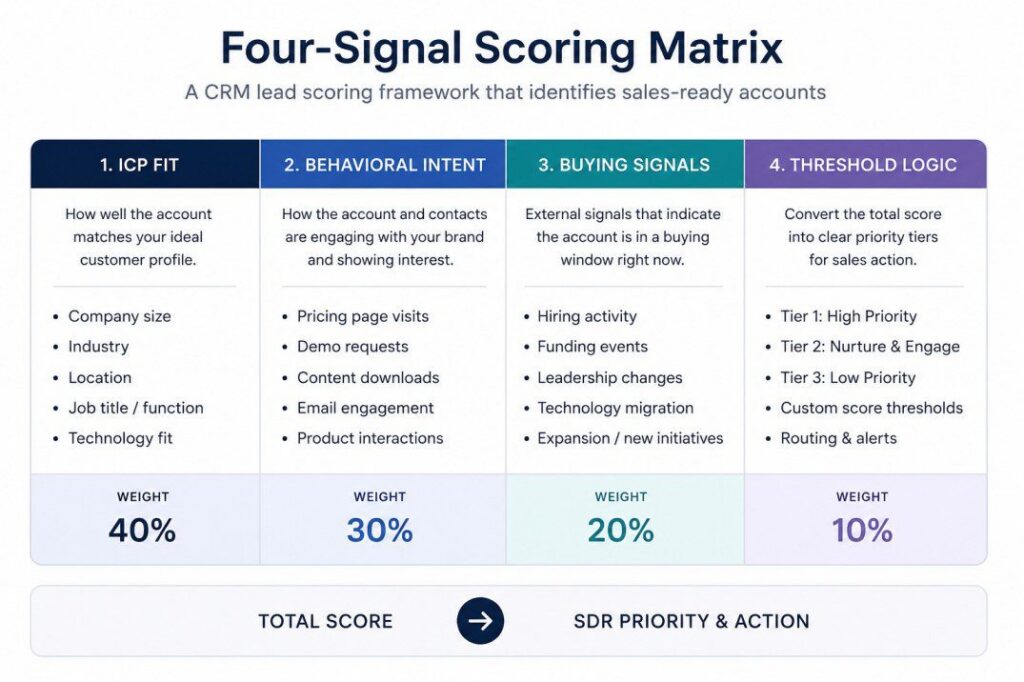
Step 1: Define Your ICP Fit Criteria
ICP fit is the foundation. Without a clearly defined fit layer, the model surfaces the wrong leads regardless of how well they score on other dimensions.
What to Include in ICP Fit Scoring
- Company size: employee range and revenue band that match your typical deal profile
- Industry: specific verticals your product solves problems in, not broad categories
- Location: geographies where your team has capacity to close
- Job title and function: the buyer role that owns the problem you solve
- Technology signals: CRM platforms or integrations that confirm product relevance
How to Weight ICP Fit
Assign ICP fit a maximum of 40 points. A lead matching all five dimensions scores 40. A lead matching three scores 20 to 25. Any lead scoring under 15 on fit alone should not advance to sales regardless of engagement score.
Teams building their ICP scoring rubric often under-weight firmographic data because it feels less dynamic than behavioral signals. If the ICP fit is wrong, no amount of engagement makes the lead worth pursuing.
Step 2: Add Behavioral Engagement Scoring
Behavioral scoring captures first-party signals: what a lead has done on your website, in your emails, and with your content. This data already lives in your CRM and marketing automation platform.
High-Intent Behavioral Signals (10 to 15 points each)
- Pricing page visit
- Demo request form fill
- Product comparison page visit
- Free trial signup or product activation
Mid-Intent Behavioral Signals (3 to 7 points each)
- Case study or ebook download
- Webinar registration or attendance
- Repeated blog visits (three or more in 30 days)
- Email click-through (not just an open)
Low-Intent Signals (1 to 2 points each)
- Single email open
- Newsletter subscription
- Homepage visit without further page views
Cap behavioral scoring at 30 points. A lead with 30 behavioral points but weak ICP fit should not rank the same as a strong-ICP lead with 20 behavioral points. Your lead qualification framework should make this weighting explicit before you configure rules in HubSpot or Salesforce. A pricing page visit is worth 12 points. A single email open is worth 1.
Step 3: Layer In Buying Signal Data
This is the step most crm lead scoring builds skip, and the biggest reason scores fail to predict pipeline. Buying signals are account-level events indicating a company is currently in a decision-making window.
Structural Signals (Account-Level)
- Funding events: recent Series A, B, or growth round indicating budget availability
- Leadership changes: new VP of Sales, CRO, or RevOps hire who evaluates tools
- Hiring spikes: rapid growth in sales, marketing, or operations headcount
- Tech migrations: switching CRM, moving off a legacy platform, building a new data setup
- Expansion signals: new office locations, market entries, or business unit announcements, etc.
Intent Signals (Third-Party Behavioral)
- Topic research patterns showing the account is actively reading about your product category
- Review site activity on G2 or Capterra
- Engagement with competitor content or ads
Assign buying signals a maximum of 20 points. A lead at a company showing two or more of these signals simultaneously should receive the full 20 points. Leads that match your ICP and show three concurrent buying signals convert at significantly higher rates than ICP matches with no external signal context.
This data comes from third-party intent platforms or enrichment providers that track structural events outside your CRM. For teams looking to surface buying signals at the account level, this is the layer that turns a decent model into a reliable pipeline predictor.
Step 4: Set Score Thresholds and Tiers
A crm lead scoring model without clear thresholds is just a number. Thresholds define when a lead moves from marketing to sales and what action sales takes at each level.
Recommended Scoring Tiers for the Four-Signal Matrix
- Tier 1 (80 to 100 points): ICP match confirmed, strong engagement, active buying signals. SDR outreach within 24 hours. This lead is in a buying window now.
- Tier 2 (50 to 79 points): Good ICP fit, moderate engagement, limited external signals. Outreach within 3 to 5 days. Use a personalized sequence.
- Tier 3 (under 50 points): Incomplete ICP fit or low engagement. Stay in nurture. Do not route to sales.
Score Decay for Behavioral Signals
Behavioral scores should decay over time. A lead who visited your pricing page six months ago is less ready than one who visited last week. Subtract 10 to 15 points from behavioral scores every 30 days of inactivity. Salesforce lead scoring and HubSpot lead scoring both support score decay natively.
ICP fit scores do not decay. Company size and industry change infrequently. Decay applies only to behavioral and buying signal scores.
Step 5: Close the Loop With Sales
The final step determines whether your model improves over time or drifts into irrelevance. Sales input is the quality signal that tells you whether your thresholds are set correctly.
What the Feedback Loop Looks Like
- Sales marks each routed lead as qualified or not qualified after first contact
- RevOps reviews conversion rates by tier every 30 days
- If Tier 1 converts at under 20%, thresholds or criteria need adjustment
- If Tier 2 outperforms Tier 1, scoring weights need rebalancing
- If sales consistently marks high scorers as unqualified, revisit the ICP fit criteria
A well-maintained lead scoring model improves as the feedback loop runs. Most teams see meaningful improvement in conversion rates within 60 to 90 days of structured monthly reviews.
With the framework in place, the question becomes which type of scoring model fits your team’s data maturity today. The comparison below helps you decide.
Which CRM Lead Scoring Model Fits Your Team?
Not every team can support every scoring approach from day one. The comparison below maps each model to the data it requires and where it breaks down.
| Scoring Model | What It Scores | Best For | Where It Breaks Down |
|---|---|---|---|
| Demographic / Firmographic | ICP fit: company size, industry, title | Teams with no behavioral data yet | No readiness signal. Surfaces too many leads who are not ready to buy |
| Behavioral Engagement | First-party activity: emails, pages, forms | High-volume inbound teams | Scores engagement, not intent. High scorers often not ready to buy |
| Predictive Scoring | AI model trained on won and lost deal data | Teams with 12 or more months of clean CRM data | Requires clean historical data. Breaks with product or market changes |
| Four-Signal Matrix | ICP fit, engagement, buying signals, timing | MOFU and BOFU teams with signal data available | Requires third-party signal data. More setup upfront |
This comparison is based on first-hand platform knowledge, publicly available product information, and commonly reported user experiences. Contact each vendor directly for the latest pricing and product details.
Teams new to crm lead scoring typically start with demographic and behavioral scoring, then layer in buying signals once the base model is validated with sales. The Four-Signal Matrix is the target state. Simpler models are the steps toward it.
How to Apply CRM Lead Scoring in Salesforce and HubSpot
Both platforms support native crm lead scoring and the Four-Signal Matrix applies to both.
Salesforce Lead Scoring
Salesforce supports Einstein Lead Scoring (AI-driven, requires Sales Cloud) and manual rules-based scoring via field criteria. Teams without 12 months of clean deal history get faster results starting with manual rules that map each Four-Signal layer to a point range, then adding Einstein once the model is validated.
HubSpot Lead Scoring
HubSpot’s native tool lets you create positive and negative scoring rules based on contact properties, company properties, and behavioral activity. Map one rule set to ICP fit, one to behavioral signals, and use custom properties to import buying signal data from an enrichment source into the same composite score.
The most common gap in both platforms is the absence of third-party buying signal data. Most teams run on first-party data only. Adding signal enrichment via API fills the timing and intent layers that separate a basic scoring setup from a pipeline predictor.
With the platform mechanics clear, here is how high-performing sales teams translate these scores into faster daily prioritization.
How Sales Teams Use CRM Lead Scoring to Prioritize Faster
A CRM lead scoring system is only as useful as the actions it drives. Scores decide who gets contacted today, who waits, and who stays in nurture.
Daily SDR Priority View
Build a saved CRM view filtered to Tier 1 leads (80 or more points) not contacted in the last 7 days. This becomes the first outreach block every morning. Every Tier 1 lead gets a contact attempt within 24 hours, with no manual sorting required.
Account-Level Signal Alerts
When a known account triggers a buying signal (funding round, new CRO hire, hiring spike), the score for all contacts at that account should update automatically. This surfaces re-engagement opportunities in cold accounts now showing intent. Most teams miss these windows because they only score new leads.
Automated Routing by Tier
Tier 1 routes directly to the covering SDR. Tier 2 enters an automated personalized sequence before manual contact. Tier 3 stays in marketing nurture and is reviewed monthly for upgrade signals.
For teams that want account-level buying signals layered onto existing CRM records, Pintel.ai’s prospect prioritization surfaces structural signals (funding rounds, VP-level hires, hiring spikes, tech migrations, etc.) and intent data via enrichment API. This gives your crm lead scoring model the timing dimension that first-party data cannot provide, and helps SDRs identify which accounts are in a buying window before a form is ever filled out.
Teams targeting niche verticals (education, government, healthcare, manufacturing, and similar sectors) also benefit from Pintel.ai’s access to non-traditional data sources like government procurement records and sector-specific directories that standard intent platforms do not reach.
Final Takeaway: Build a CRM Lead Scoring System That Predicts Pipeline
CRM lead scoring works when it is built around the right signals. The Four-Signal Scoring Matrix adds the dimensions that matter: ICP fit, behavioral engagement, buying intent, and timing signals from outside your CRM.
Start with ICP fit as your gate. Layer in behavioral scoring. Add account-level buying signals to catch leads in a window before they fill out a form. Set clear tiers and run a monthly feedback loop with sales.
A model that sales trusts shortens the time from lead creation to first meaningful contact and routes the right leads to the right reps before the buying window closes.
For teams building the broader prioritization layer, see how identifying in-market accounts connects directly to the signal layer in your crm lead scoring setup.
FAQ: CRM Lead Scoring
What is CRM lead scoring?
CRM lead scoring is a method for assigning points to leads in a CRM based on fit and behavior, so sales teams know which contacts to prioritize for outreach. Higher scores indicate stronger ICP fit, more engagement, or active account-level buying signals at the company.
How do you set up lead scoring in Salesforce?
Salesforce supports Einstein Lead Scoring (AI-based, requires Sales Cloud) and manual rules-based scoring using field criteria. Teams without 12 months of clean deal history get better results starting with manual scoring rules mapped to ICP fit and behavioral engagement before adding predictive layers.
What is the best lead scoring system for B2B sales?
The strongest B2B models score across four dimensions: ICP fit, behavioral engagement, third-party buying intent, and timing signals like funding or leadership changes. Systems that only score marketing engagement typically surface high-scorers who are not yet ready to buy.
What is the difference between demographic and behavioral lead scoring?
Demographic scoring ranks leads by ICP match (company size, industry, title). Behavioral scoring ranks by what they have done (page visits, email clicks, form fills). Effective crm lead scoring combines both dimensions with external buying signal data for the strongest pipeline prediction.
How do you use buying signals in CRM lead scoring?
Add a third scoring layer for account-level signals: funding events, leadership hires, hiring spikes, and tech migrations. These indicate a company is in a buying window. Assign 15 to 20 points for accounts showing two or more of these signals at the same time.
How often should you update your lead scoring model?
Review your model every 30 days for the first quarter, then quarterly after that. Check conversion rates by tier. If Tier 1 leads convert at under 20%, adjust your thresholds or criteria. Sales team feedback is the primary quality signal for each review cycle.
What is a good lead score threshold for sales handoff in crm lead scoring?
A score of 70 to 80 points out of 100 is a common starting threshold for sales handoff in B2B teams. Start at 70, measure conversion rates for 30 days, then adjust up or down based on what your conversion data actually shows.