Buying B2B data sounds straightforward until you have to decide where to get it, how much to trust it, and what to do with it after it enters your CRM. You can buy a database, source data through a marketplace, enrich records you already have, build lists manually, or outsource the research. Each approach solves a different problem.
The right choice depends on what your sales team needs most: contact volume, niche coverage, data accuracy, or ongoing data maintenance. This guide breaks down the main ways to source B2B data, what each option is best suited for, and what to consider before you spend your budget.
B2B Data Purchase: Quick Takeaways
- B2B data providers are best for sales teams that need high-volume contact and company data quickly.
- Data marketplaces can be useful when sales teams need B2B contacts or accounts that are harder to find through standard databases.
- B2B data enrichment is better when sales teams already have contact or company records that need missing fields, verification, or qualification.
- Data accuracy, coverage, freshness, and verification matter more than database size when buying B2B data.
- Your ICP should determine which B2B data source you choose, since coverage can vary by industry, company size, role, and market.
- B2B data pricing is only one part of the cost. Verification, cleanup, enrichment, and CRM preparation can add to the total cost of using purchased data.
- Compliance matters when buying B2B contact data. Check how the provider sources, verifies, and maintains its data before using it for sales outreach.
What a B2B Data Purchase Means for Sales and RevOps Teams
Before you compare where to buy B2B data, ask two questions: where does the data come from, and how do you keep it accurate after you buy it? Most bad purchases happen because teams only think about the first question.
Here’s the core distinction that decides which approach you need: if you need net-new contacts, start with a data provider or marketplace. If you already have records that need better coverage, accuracy, or qualification, use enrichment instead of buying a new list.
Four things matter most in any B2B data purchase: data freshness, schema alignment, seniority mapping, and function classification. Treating a one-time list like a full data strategy, with no plan for keeping it current, is why CRMs fill up with old titles, dead emails, and messy company records within a few months.
Where Can You Source or Purchase B2B Data?
B2B data can be sourced through several approaches, depending on your team’s data needs, budget, and scale. Here are the main options to consider.
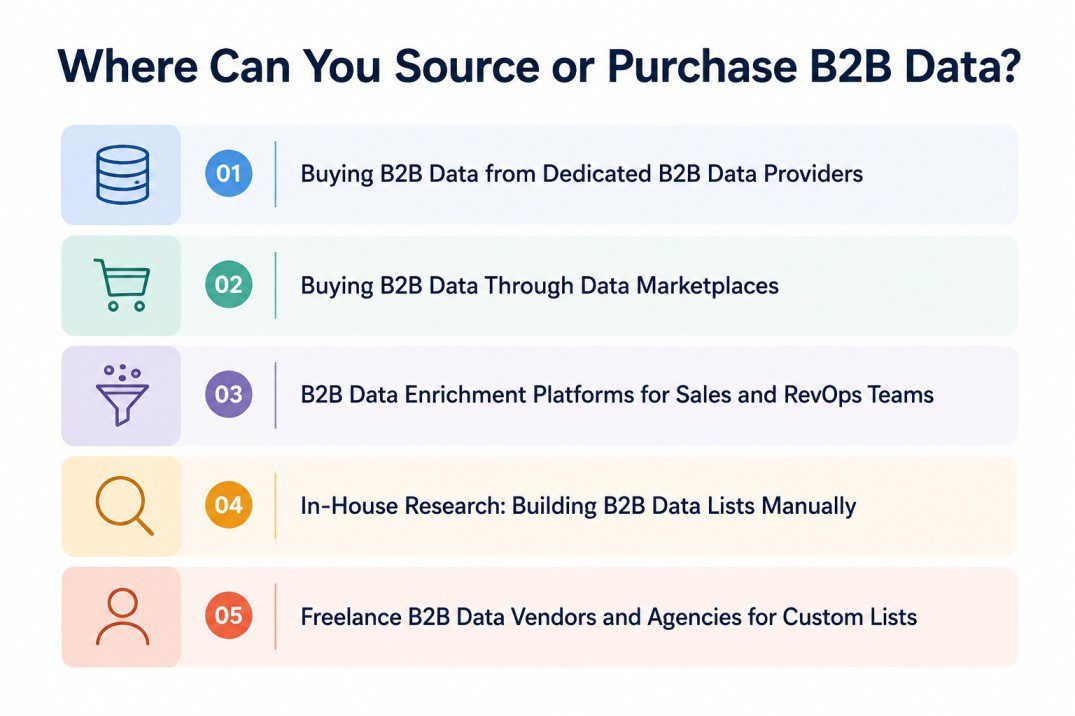
Buying B2B Data from Dedicated B2B Data Providers
Dedicated B2B data providers sell contact and account records, either as a one-time export or a subscription. This is what most people picture when they hear “buy B2B data.”
- Best for teams that need a lot of contacts fast and have a process to verify data before outreach.
- Works well for account-based lists, where company accuracy matters more than individual contact freshness.
- Needs a clear, specific ICP first, or the provider returns a large list full of poor-fit leads.
- Data is a snapshot from the day you buy it, so accuracy afterward depends on the provider’s own refresh schedule, not on you.
- Usually priced per contact or per credit. Predictable cost, but expensive at scale.
B2B Data Providers Compared: Pricing, Strengths, and Weaknesses
Coverage, verification method, and depth vary a lot between providers. The right pick depends on your ICP and budget, not brand name.
| Provider | Best For | What You Get | Limitation |
|---|---|---|---|
| Pintel.ai | Teams looking for accurate B2B data and ongoing data enrichment | Company data, verified contact details, email addresses, phone numbers, LinkedIn data, buying signals, and CRM sync | Newer platform with less market presence than established B2B data providers. |
| ZoomInfo | Large sales teams looking for an established B2B database | Company and contact data with intent and sales intelligence | High cost, especially for smaller teams |
| Apollo.io | Teams looking for B2B contacts and outreach tools | Contact data, email addresses, phone numbers, and sales engagement tools | Data accuracy can vary, especially for some senior and niche contacts |
| Cognism | Teams looking for verified mobile contact data | Contact data with a strong focus on mobile numbers and verification | Higher pricing can make it expensive for smaller teams |
| Clearbit | Teams looking to enrich existing leads and company records | Company and contact enrichment for known leads and website visitors | Not suited for building large cold prospect lists from scratch |
| Lusha | Teams looking for quick contact information | Contact details and browser-based prospecting | Lower coverage across some industries and markets |
This comparison is based on firsthand platform experience, user reviews, and publicly available information. For the latest product details, pricing, and capabilities, contact the respective vendor directly.
Buying B2B Data Through Data Marketplaces
Marketplaces combine data from many third-party sources. You filter, preview, and buy segments on demand, instead of relying on one vendor’s database.
- Best when your ICP falls outside the strongest coverage area of major single-source providers.
- Good for one-off campaigns that need reach, not a repeatable, standardized format.
- Formatting and job title conventions vary by underlying source, so plan on a normalization pass before the data works for automated routing or scoring.
- Data quality varies by segment. Check a sample before you buy the full list.
B2B Data Enrichment Platforms for Sales and RevOps Teams
Enrichment platforms do not sell you a list. They take data you already have, from inbound forms, website visits, or a CRM with gaps, and fill in missing fields by checking several sources until they find a match.
- Best fit for teams with inbound leads or partial CRM data that needs completing, not teams starting from zero.
- Cuts the manual research SDRs would otherwise do one contact at a time, by resolving title, seniority, and function automatically.
- Keeps data current through repeated cycles instead of a single purchase.
- Cannot generate net-new accounts you have never touched. It improves what you already have, it does not replace top-of-funnel sourcing.
- Pricing usually scales with match volume, so cost tracks usage rather than list size.
Pintel.ai is built around this workflow: it takes data you already have or just purchased, checks it against your ICP, and qualifies it before a rep ever works it.
In-House Research: Building B2B Data Lists Manually
Some teams still build lists by hand, using LinkedIn, company sites, and direct research. This is not a purchase in the usual sense, but it competes for the same budget and headcount.
- Good for small, specific target lists, like strategic accounts or ABM tiers.
- Gives full control over accuracy, since a person checks every record.
- Does not scale past a small number of contacts per rep each week.
- Uses SDR time that could go toward outreach instead, which is the real cost even without an invoice for the data.
- No ongoing freshness unless someone repeats the process on a schedule.
Freelance B2B Data Vendors and Agencies for Custom Lists
Some teams hire an individual researcher or a small agency to build a custom list to a specific brief. This sits between manual in-house work and a full data platform.
- Good for specific, judgment-based list criteria that self-serve filters cannot capture, like companies that just made a certain hire or switched a certain vendor.
- Fine for one-time projects with a clear scope and deadline.
- Slower turnaround than any self-serve platform or marketplace, usually days rather than minutes.
- Quality depends on the individual vendor, with no platform-level guarantee.
- Not a repeatable option for ongoing pipeline generation.
Which B2B Data Purchase Option Fits Your Sales Team
The right B2B data purchase depends on where your actual bottleneck is, not on which brand you recognize most.
- Bottleneck is volume and speed: a dedicated data provider gets a usable list into your CRM the same day.
- Bottleneck is coverage in a niche segment: a marketplace widens the pool, as long as someone normalizes the output afterward.
- Bottleneck is incomplete records you already have: an enrichment platform is the right tool, not a new list.
- Bottleneck is a small number of specific accounts: manual research or a freelance vendor works better than forcing a platform’s filters to match a narrow brief.
Most GTM teams need more than one of these at different stages. The mistake is not picking the wrong single option. It’s using one option for every stage, then wondering why data quality and routing break down a few months later.
| Option | Best Fit | Data Freshness | Schema Control | Typical Cost | Main Risk |
|---|---|---|---|---|---|
| Dedicated data providers | Fast, high-volume list building | Decays after export | Set by vendor | Per contact or per credit | List decay with no refresh plan |
| Data marketplaces | Niche or underserved segments | Varies by source | Needs normalization | Per segment or per record | Inconsistent formatting across sources |
| Enrichment platforms | Completing existing CRM records | Ongoing, cycle-based | High, matches your schema | Based on match volume | Cannot create new accounts |
| In-house research | Small, strategic account lists | One point in time | Fully manual | Rep or team time | Does not scale past small lists |
| Freelance vendors and agencies | Highly specific, custom lists | One point in time | Depends on vendor | Project or hourly fee | Slower turnaround, inconsistent quality |
How to Evaluate a B2B Data Purchase Before You Buy It
Ask the same core questions regardless of which option fits:
- How does the source handle seniority mapping and function classification? Bad title parsing is the top cause of misrouted leads after a purchase.
- Does the output schema match your CRM’s fields? Manual remapping is where most of the hidden cost in a “cheap” purchase shows up later.
- What happens to your routing and lead scoring once the new data lands? A purchase that grows your list but breaks existing workflows hasn’t saved work. It just moved the work from sourcing to cleanup.
- How does the provider source and verify consent for each record? This determines your compliance exposure, not just your data quality. Ask specifically whether records come from opt-in sources, public business directories, or third-party aggregation, since each carries different legal risk depending on where your prospects are located.
- Does the contract include any warranty on data accuracy or a process for reporting bad records? Providers without a stated accuracy commitment leave the cleanup cost entirely on you.
This is the point where teams often add an enrichment layer between the purchased data and the CRM, to catch schema mismatches and fix records before they reach a rep.
After a B2B Data Purchase: Why Sales Teams Still Need Data Enrichment
Every option above answers “where do I get the data?” None of them answer “what happens to it after it lands in the CRM?” That gap is where many data purchases lose value.
A purchase gets you contacts or accounts. It doesn’t guarantee they stay accurate, match your schema, or get classified correctly for routing. This is one of the areas where Pintel.ai can help by enriching and qualifying existing or newly purchased data while also supporting company discovery, contact intelligence, buying signals, and CRM workflows. This gives sales teams more ways to improve and activate their data without relying on a single approach for every stage of the data workflow.
B2B Data Purchase FAQ for Sales and RevOps Teams
Is it better to buy a static B2B data list or use a subscription platform?
A static list works for a single, time-boxed campaign with a fixed target list. A subscription or platform works better for ongoing coverage, since it supports refreshes without a new purchase each time.
How do you check the accuracy of a B2B data list before you commit budget to it?
Request a sample export before buying the full list. Spot-check a random sample of records against LinkedIn or the company’s own site for title and employment accuracy. Ask the provider what percentage of their database was verified in the last 90 days, and treat vague answers as a red flag.
What criteria matter most when evaluating a B2B data provider, beyond price?
Match rate against your specific ICP, refresh frequency, schema compatibility with your CRM, and how title and seniority fields are classified. A cheaper source that needs heavy manual remapping usually costs more in labor than a pricier source that matches your schema out of the box.
How do you load a new B2B data purchase into your CRM without breaking existing workflows?
Map the new data’s fields to your CRM schema before import, run deduplication against existing records, and test the batch against your lead routing and scoring rules on a small sample first. Loading a full list directly into production without this step is the most common cause of routing breakage after a purchase.
What is the difference between data enrichment and a data purchase?
A data purchase adds new contacts or accounts you did not have before. Enrichment fills in missing or outdated fields on data you already have. Most GTM teams use both: a purchase or marketplace for volume, and an enrichment step to qualify and clean what comes in.
When should a team enrich existing data instead of buying a new list?
Enrich when you already have partial records, such as inbound leads or a CRM with missing fields, and the gap is data completeness rather than volume. Buy a new list when you need net-new accounts you have never had contact with. Most GTM teams need both at different points in the funnel.
Are B2B data purchases compliant with GDPR and CCPA?
Compliance depends on how the data was sourced and how you use it. Under GDPR, you need a valid legal basis for processing personal data. Under CCPA, California residents have rights around their personal data and can opt out of its sale. Ask providers how they source and verify their data before purchasing, and confirm your specific requirements with legal counsel.
What should be in a data provider contract to limit legal and quality risk?
Look for a stated data refresh or accuracy commitment, a clear description of how records were sourced and consent was obtained, language on what happens if a batch is later found to violate opt-out or consent rules, and a defined process for removing records on request. Contracts that are silent on sourcing method are the highest-risk category to sign.
How much does B2B data cost per contact in 2026?
Cost varies a lot by data type, seniority level, and industry. Providers price by credit, seat, or per-record fee. Treat any single number as a range, not a fixed price, since niche or senior contacts always cost more than broad, general lists.
Should data purchases go through RevOps instead of individual reps?
Yes, in most cases. Centralizing purchases through RevOps keeps schema, naming, and refresh cycles consistent across the team. Purchases made by individual reps tend to create duplicate records and mismatched formats in the CRM, which means more cleanup later.