Most ABM tools comparisons give you a list. What you actually need is a clear decision.
In B2B teams, data, targeting, and execution often sit across different systems. Information moves, but not always in time. Campaigns run, but coverage is incomplete. Signals appear, but follow-up is not immediate.
This is where most ABM setups lose momentum.
Choosing the right ABM tools is not about adding more tools. It is about understanding how each layer works together and where the gaps are.
This guide breaks down the best ABM tools for B2B teams based on what they do, where they fit in your stack, and how to select the right combination.
Best ABM Tools for B2B Teams in 2026: Quick List
| Tool | Primary Strength | Best Team Size |
|---|---|---|
| Pintel.AI | Account intelligence, enrichment, and signal-based execution | SMB to Enterprise |
| Factors.ai | Multi-touch ABM platform with account intelligence and attribution | Mid-market to Enterprise |
| Demandbase | Full-funnel ABM platform | Enterprise |
| 6sense | Predictive intent and account scoring | Enterprise |
| Terminus | Multi-channel ad execution | Mid-market to Enterprise |
| ZoomInfo | B2B data and contact coverage | All sizes |
| RollWorks | Entry-level ABM advertising | SMB to Mid-market |
| Bombora | Third-party intent data | All sizes |
| Influ2 | Contact-level ad targeting | Mid-market to Enterprise |
| HockeyStack | ABM revenue attribution | Mid-market to Enterprise |
| LeanData | Lead routing and orchestration | Mid-market to Enterprise |
What Are ABM Tools?
ABM tools help B2B teams identify, target, and convert specific high-value accounts instead of generating large volumes of unqualified leads. Instead of casting a wide net, you start with a defined list of target companies and work backward to reach every decision-maker inside them.
The best ABM tools do four things well: identify which accounts match your ICP and are actively researching right now, map the buying committee across each account, coordinate messaging across ads, email, and sales outreach, and tie all of that activity back to pipeline and closed revenue.
The 5 Functional Categories of ABM Software
Most B2B teams build their ABM stack by combining two or three categories, not by buying a single all-in-one platform.
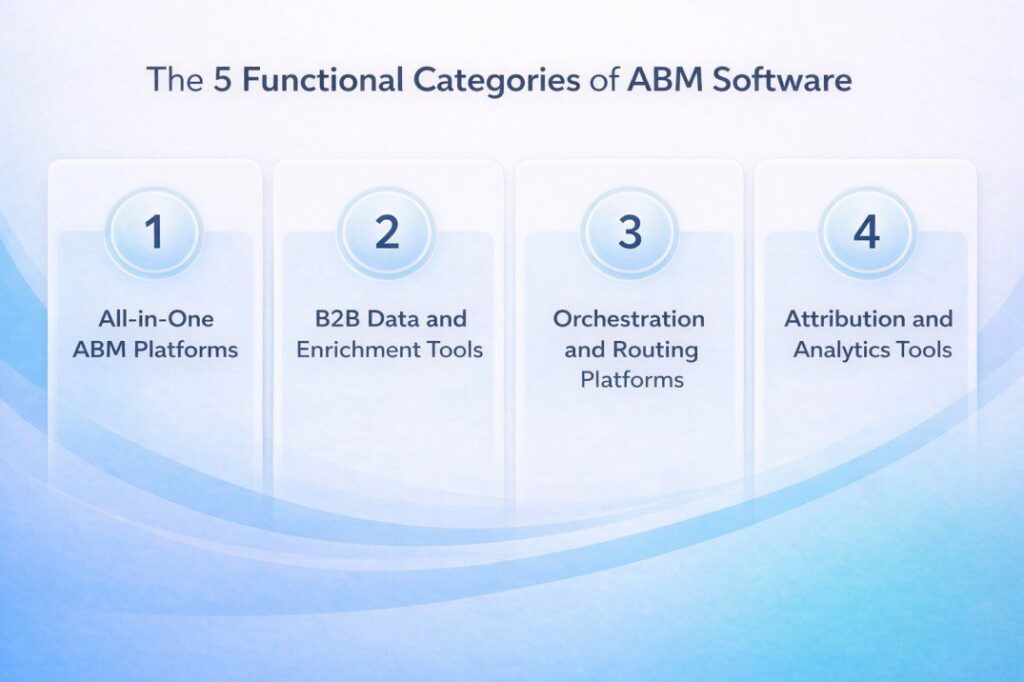
All-in-One ABM Platforms consolidate account identification, advertising, orchestration, and analytics into a single interface. Examples: Demandbase, 6sense, Terminus. Best fit: mature enterprise teams with dedicated ABM headcount.
Intent Data Providers surface buying signals by monitoring which accounts are researching your product category across B2B media networks before they ever raise their hand. Examples: Bombora, G2 Buyer Intent. Best fit: any team prioritizing outreach based on real buying behavior.
B2B Data and Enrichment Tools build the contact and company records your ABM program runs on. Without clean data, every other layer of your stack underperforms. Examples: ZoomInfo, Clay, Pintel.AI. Best fit: teams building or cleaning a target account list.
Orchestration and Routing Platforms coordinate what happens once an account is identified: routing leads to the right rep, triggering the right sequence, and syncing marketing signals to sales actions. Examples: LeanData, Cargo. Best fit: RevOps teams with complex routing logic.
Attribution and Analytics Tools answer what your CFO and CMO are actually asking: which ABM activities influenced pipeline and closed revenue? Examples: HockeyStack, Dreamdata. Best fit: teams that need to prove ABM ROI to leadership.
ABM Tools Breakdown: What Each Platform Actually Does
The goal is not to find the most impressive platform. It is to identify which gap in your current program is costing you the most pipeline and fill it with the tool that solves it cleanest. The ten best ABM tools below are grouped by function to make that decision easier.
Section 1: All-in-One Platforms and Data Foundations
These are the core layers most ABM programs are built on. If you are starting from scratch or rebuilding your stack, start here.
Pintel.AI
Best for:
B2B teams that need a strong data foundation with built-in signal prioritization and execution support
Pintel helps teams build and maintain accurate account lists by combining firmographic data, contact details, and buying signals such as intent activity, company growth, and engagement. It enriches accounts with key contacts, scores them against your ICP, and highlights which accounts are most relevant at a given time. Teams can then use these signals to trigger targeted outreach and coordinate follow-ups across sales and marketing.
Verdict:
Best for teams that want their account data to do more than sit in a CRM, using it to identify the right accounts and act on them at the right time.
Factors.ai
Best for:
Enterprise and Mid-market ABM teams who want to run multi-channel ABM
Factors.ai identifies up to 75% of companies visiting your website and layers on intent data from your website, G2, LinkedIn, Meta, and Google Ads, plus third-party signals from Bombora, covering all three intent layers in a single tool. Accounts are scored and segmented by engagement, and agentic workflows act on the signals: alerting sales in Slack, syncing high-intent accounts to LinkedIn and Google Ads audiences. Multi-touch attribution ties it all back to pipeline. Pricing is published and starts at $199/month, and a free trial is also available.
Verdict: The strongest signal-to-action platform for enterprise and mid-market teams that want to close the gap between intent and activation without an enterprise contract.
Demandbase One
Best for: Enterprise B2B teams running a mature ABM program with a dedicated team.
Demandbase is the most complete ABM platform available, with proprietary intent coverage across roughly 1.5 million companies, account-level web personalization, and display advertising and sales alerts in one workflow. It integrates deeply with Salesforce, Marketo, and HubSpot.
Where it falls short: teams without a dedicated ABM manager and clean Salesforce data will spend their first three months fighting configuration, not generating pipeline.
6sense Revenue AI
Best for: Enterprise teams who need to find in-market accounts before they surface through inbound.
6sense captures anonymous buying signals including content consumption, review site visits, and competitor research, then uses AI to predict which accounts are in an active buying cycle right now. It leads among the best ABM tools on predictive scoring and anonymous intent depth, while Demandbase leads on advertising execution and web personalization.
Verdict: Best-in-class for intent-driven ABM programs. Not the right entry point for teams still building their target account list.
ZoomInfo Marketing
Best for: Any B2B team that needs a reliable data foundation before any other ABM tool will work.
If your account and contact data is incomplete or stale, your intent signals will point to the wrong people, your ads will miss the buying committee, and your attribution will be wrong. ZoomInfo gives you the B2B contact database with continuous verification, technographic and firmographic filters for ICP list building, and intent signals layered directly onto account profiles
Section 2: Advertising and Execution Platforms
Once your data foundation is in place, these tools are responsible for reaching the right accounts and committees across channels.
Terminus
Best for: B2B marketing teams that want to surround buying committees with multi-channel campaigns.
Terminus runs unified campaigns across display, LinkedIn, connected TV, and email, with account-level engagement scoring that tracks committee coverage rather than individual clicks. It is more accessible and faster to deploy than Demandbase or 6sense, but it is an execution platform, not an intelligence platform. Pair it with Bombora for full-funnel coverage.
Verdict: The strongest multi-channel ABM advertising platform for teams that do not need an all-in-one solution.
RollWorks
Best for: Mid-market B2B teams launching their first ABM advertising program without an enterprise budget.
RollWorks gives mid-market teams access to account-based advertising without the implementation overhead of the larger platforms on this best ABM tools list. It integrates cleanly with HubSpot and Salesforce and shows where target accounts sit in the funnel via journey stages. Teams running a high-maturity strategy will hit its ceiling within a year.
Verdict: The right first ABM advertising tool for mid-market teams. Plan to upgrade as your program matures.
Influ2
Best for: B2B teams that need to reach specific named contacts inside target accounts.
Most ABM advertising tools work at the account level. Influ2 works at the contact level: you upload a list of specific people you want to reach, and Influ2 tracks whether those exact individuals are engaging with your ads. It is not an orchestration platform or intent data provider, but it works as a precision layer on top of an existing stack.
Verdict: The highest-precision ABM advertising tool for teams that need to know exactly who, not just which company, is engaging.
Section 3: Intelligence, Routing, and Attribution
Most tools above focus on data, targeting, or campaign execution. The real challenge is making sure those signals actually trigger coordinated action across sales and marketing rather than sitting in a dashboard nobody checks.
Bombora
Best for: B2B teams that need to know which accounts are actively in a buying cycle right now.
Bombora aggregates behavioral data from over 5,000 B2B media publishers. When a company’s employees consume content about your product category at a higher rate than their historical baseline, its Company Surge score rises and signals an active buying cycle. It integrates directly with Demandbase, 6sense, Terminus, Salesforce, and HubSpot. It is signal-only: it tells you who is researching but does not run any outreach.
Verdict: The most trusted source of third-party ABM intent data. Non-negotiable for teams that want to prioritize accounts based on real buying behavior.
LeanData
Best for: RevOps teams that need to fix account routing before any ABM signal gets wasted.
A common failure even in mature best ABM tools setups: the right intent signal fires, the right account surges in Bombora, and the lead routes to the wrong rep. LeanData prevents that with lead-to-account matching, a visual workflow builder for complex routing logic, and automatic play triggering based on ABM signals from connected platforms. It is Salesforce-native.
Verdict: Non-negotiable for enterprise teams running ABM through Salesforce. Without clean routing, the rest of your stack leaks pipeline.
HockeyStack
Best for: B2B teams that need to prove what ABM is actually doing to pipeline and revenue.
HockeyStack connects CRM data, ad platforms, website activity, and product usage into a single account-level view. Its visual funnel journeys show how accounts moved from first touch to closed deal, and an Odin AI layer generates plain-language pipeline reports for leadership. Setup requires clean CRM data.
Verdict: The attribution layer every serious ABM program needs. If leadership is questioning ABM ROI, this is what you buy to answer with data.
Recommended ABM Stack by Team Size
Early-stage or SMB: Pintel.AI (data foundation) + RollWorks (ABM advertising) + HubSpot ABM features (light orchestration). Start here. Get account coverage. Prove the model works before layering in intent data.
Mid-market: Clay or Pintel.AI (enrichment) + Bombora (intent) + Terminus (multi-channel ads) + HockeyStack (attribution). Add Pintel when your biggest bottleneck becomes the gap between signals and coordinated sales plays.
Enterprise: Demandbase or 6sense (all-in-one system of record) + Bombora (supplementary intent) + LeanData (routing) + HockeyStack (analytics) + Pintel.AI (execution layer). At enterprise scale, the failure point is almost always the handoff between systems. Pintel closes that gap.
Key ABM Metrics Worth Tracking
When running an ABM tools comparison internally, the metrics you track will determine whether leadership keeps funding the program. Focus on three: account progression rate (what percentage of target accounts moved from awareness to active pipeline in the last 90 days), buying committee coverage (how many decision-maker personas have been reached per account), and pipeline influence rate (what percentage of closed-won deals had at least three ABM touches). Stop reporting impressions, CPMs, and click-through rates. Those are brand metrics, not account-based ones.
Final Verdict
The best ABM tools comparison is not about finding the most impressive platform. It is about identifying which gap in your current account-based program is costing you the most pipeline right now and filling that gap with the tool that solves it cleanest.
If your data is broken, start with ZoomInfo. If your ads are not reaching the full committee, start with Terminus or RollWorks. If you are generating intent signals but not acting on them fast enough, that is the execution gap and that is exactly what Pintel is built to close.
The teams running the best ABM programs in 2026 are not the ones with the most tools. They are the ones who have connected the right tools together, eliminated the handoff gaps where accounts go cold, and built attribution models that tell them what to double down on and what to cut.
Build the stack that fits where you are today. Measure what moves accounts. Layer in more sophistication when the program is working, not before.
Frequently Asked Questions About the Best ABM Tools
What are the best ABM tools for B2B teams?
The best ABM tools for B2B teams are the ones that help you identify the right accounts and act on them quickly. Many tools focus on data or signals, but not all help you turn that into pipeline. Platforms like Pintel combine data enrichment with signal-based execution, helping teams move from insight to action faster.
How do I choose the best ABM tools for my team?
To choose the best ABM tools, start by identifying your biggest gap. If you already have data but are not converting it into pipeline, you need a tool that focuses on execution. If your challenge is identifying the right accounts, you need better enrichment and signal coverage. The right choice depends on what is slowing your pipeline today.
Do I need multiple ABM tools or just one platform?
Most teams use multiple ABM tools, but adding more tools does not always solve the problem. Many stacks fail because signals are not acted on in time. The best ABM tools reduce this gap by connecting data, signals, and execution in one flow.
What is the biggest mistake when choosing ABM tools?
The biggest mistake is choosing tools based on features instead of your actual bottleneck. Many teams invest in data or intent tools but fail to act on those signals. The best ABM tools are the ones that help your team move faster from signal to pipeline.
How do the best ABM tools impact pipeline?
The best ABM tools improve pipeline by helping you focus on the right accounts and act at the right time. Instead of targeting broadly, they enable coordinated outreach across decision-makers and reduce delays between signal detection and sales action.