
By the Pintel.ai GTM Research Team, B2B Sales Data and RevOps Analysts.
A rep who logs 8 hours a week on manual work loses one full working day out of five, every single week. That is not a rounding error in a productivity report. It is a day of selling time that never happens, repeated 48 times a year.
Most sales productivity statistics roundups list this kind of number next to a dozen unrelated statistics about email open rates or social selling, so the reader never sees what the number actually costs their own team. This page does the opposite, in the same worked-example format used to break down how little time reps actually spend selling. Every statistic below names the exact task, the exact role, and the exact math behind the cost, so a RevOps manager or sales manager can apply it directly to their own headcount without guessing.
How Much Time Do Sales Teams Lose to Manual Work?
Sales teams typically lose 8 to 13 hours per rep per week to manual work such as CRM data entry, admin tasks, and switching between disconnected tools, according to multiple 2026 sales productivity statistics. For a 10-rep team, that is 80 to 130 hours a week spent on tasks that do not involve talking to a buyer.
How Much Manual Work Costs a Team of Your Size
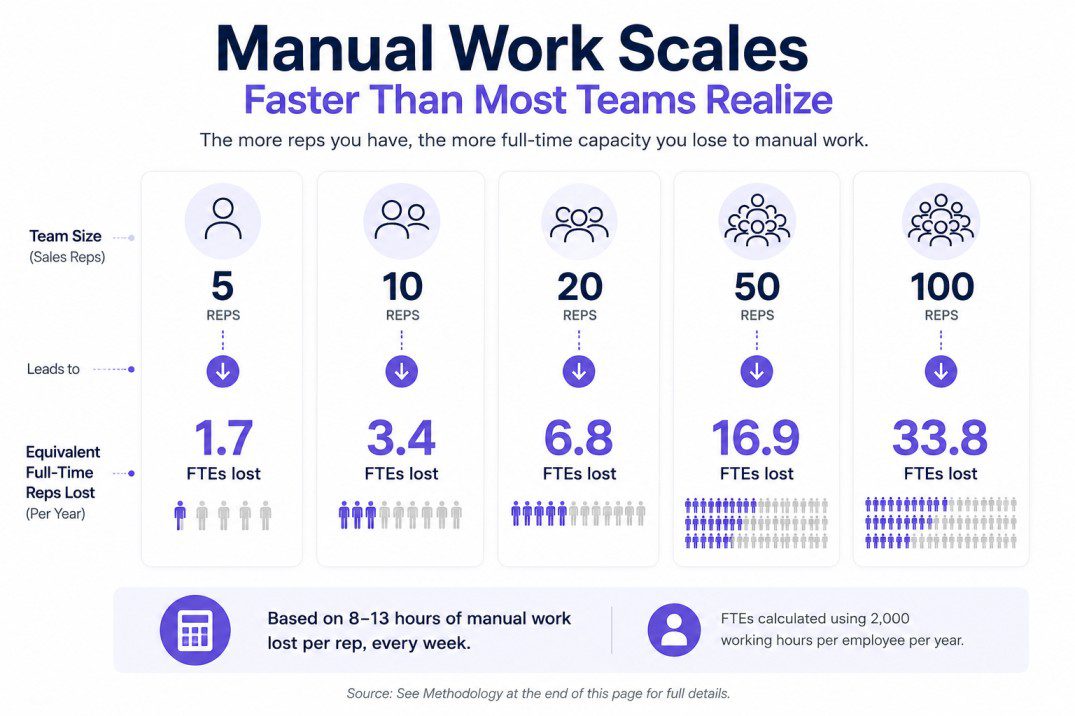
The 8 to 13 hours per rep per week range above scales differently depending on headcount. The table below applies that range directly to six common B2B sales team sizes, so a manager can find their own team size without doing the multiplication themselves.
| Team Size | Hours Lost Weekly | Hours Lost Yearly | Equivalent Full-Time Reps Lost Per Year |
|---|---|---|---|
| 5 reps | 40 to 65 hours | 2,080 to 3,380 hours | 1.0 to 1.7 reps |
| 10 reps | 80 to 130 hours | 4,160 to 6,760 hours | 2.1 to 3.4 reps |
| 20 reps | 160 to 260 hours | 8,320 to 13,520 hours | 4.2 to 6.8 reps |
| 50 reps | 400 to 650 hours | 20,800 to 33,800 hours | 10.4 to 16.9 reps |
| 100 reps | 800 to 1,300 hours | 41,600 to 67,600 hours | 20.8 to 33.8 reps |
| 250 reps | 2,000 to 3,250 hours | 104,000 to 169,000 hours | 52.0 to 84.5 reps |
Table basis: applies the 8 to 13 hours per rep per week range (Statistic 1 range, see Methodology below) directly to each team size, then annualizes across 52 weeks. Full-time-equivalent figures assume a standard 2,000 working hours per employee per year. These are illustrative calculations, not measured results from any specific company.

CRM Data Entry and Selling Time Statistics
The five statistics in this group all trace back to the same task: manually keying company and contact information into a CRM instead of using verified, pre-enriched records.
Sales Reps Spend an Average of 13 Hours a Week on Manual CRM Data Entry
According to Coffee.ai’s 2026 sales productivity research, the average sales rep spends 13 hours a week manually entering data into a CRM, which works out to 28% of a standard 46-hour work week.
Scaled to a team: Applied to a hypothetical B2B sales team of 8 reps, this 13-hour rate means the team loses 104 hours a week to CRM data entry alone (13 hours x 8 reps). Over a 4-week month, that team loses 416 hours to CRM data entry, more than double what one additional full-time sales rep would work in a month (160 hours at 40 hours a week).
71% of Sales Reps Say They Spend Too Much Time on Data Entry
Coffee.ai’s research also found that 71% of sales reps report spending too much time on data entry, ranking it among their top frustrations with the job.
Put in team terms: On a hypothetical 12-person B2B sales team, this 71% rate works out to roughly 8.5 sales reps who consider data entry a genuine productivity complaint, not a minor annoyance. That means 8 to 9 reps on that same 12-person team have day-to-day frustration directly tied to a task that adds no revenue.
Sales Reps Spend Only 28% of Their Time Actually Selling
Sales time-allocation research breaks down a rep’s week as 28% selling, 17% CRM data entry, 15% internal meetings, 14% email and admin, 12% scheduling, and 14% research.

Broken down by the hour: For a single B2B sales rep working a standard 40-hour week, only 11.2 hours (40 x 0.28) go to actual selling. The remaining 28.8 hours of that same rep’s week are split across five non-selling categories, meaning that rep is pulled away from selling by five separate manual tasks, not just one.
Reps Spend 19% of Their Workday Updating CRM Records
CRM usage research found that sales reps spend 19% of their workday, nearly one in five working hours, specifically updating CRM records rather than engaging with prospects or customers.
Per day and per week: For a single B2B sales rep working an 8-hour workday, this 19% rate works out to 1.52 hours a day spent solely on CRM updates. Across that same rep’s 5-day work week, it adds up to 7.6 hours, almost an entire extra workday consumed by CRM maintenance alone.
Sales Teams Lose 546 Hours a Year Per Rep to Data Entry and Chasing Bad Records
Industry research on CRM data quality found that sales reps lose 546 hours annually, or 27% of their productive time, on manual data entry and chasing down inaccurate records.
Applied to a 10-rep team: On a hypothetical 10-rep B2B sales team, this 546-hour rate means the team loses 5,460 hours a year to data entry and record-chasing combined (546 hours x 10 reps). At a standard 2,000 working hours a year per employee, that 5,460 hours is the equivalent of losing 2.7 full-time sales reps’ worth of annual working hours.
Across these five statistics, the pattern is the same regardless of which specific CRM task is measured: manual entry and manual updates consistently eat 13 to 28% of a rep’s week, not a rounding error but a second, unpaid job layered on top of selling. Tool switching and admin work, covered next, add a separate layer on top of this one.
Tool Switching and Admin Overhead Statistics
The five statistics in this group move beyond CRM data entry specifically, covering the broader admin load and the time lost jumping between the multiple disconnected tools most sales teams run today.
Field Sales Reps Spend 21% of Their Week on Data Entry and Admin Combined
Field rep time-tracking data shows 11% of a rep’s week goes to data entry and 10% goes to general admin tasks, adding up to 21% of total working hours, or roughly 8 hours in a standard 38-hour field sales week.
What that looks like at scale: A hypothetical field sales team of 6 reps loses 48 hours a week combined to data entry and admin (8 hours x 6 reps). That 48 hours is the equivalent of one full extra field sales rep’s weekly hours spent entirely outside customer conversations.
Reps Lose 3 to 5 Hours a Week Switching Between Disconnected Sales Tools
Sales tech stack research shows reps lose 3 to 5 hours a week context-switching between an average of 5 to 8 disconnected tools used to close a single deal, adding up to 150 to 250 lost selling hours per rep a year.
Run the numbers: A hypothetical B2B sales team of 8 reps loses between 24 and 40 hours a week to tool switching (3 to 5 hours x 8 reps). Over a year, that same 8-rep team loses 1,200 to 2,000 hours, enough time for one sales rep to work a full year twice over on nothing but switching screens.
42% of Sales Reps Feel Overwhelmed by the Number of Tools They Use
Sales tool adoption research found that 42% of reps feel overwhelmed by the volume of tools in their daily workflow, and reps who feel this way are 45% less likely to attain quota.
Put in headcount terms: On a hypothetical 15-person B2B sales team, this 42% rate is roughly 6 to 7 sales reps who report feeling overwhelmed by tool count. If quota attainment among that group of 6 to 7 reps drops by 45%, a team relying on 8 to 10 quota-carrying reps could see 3 to 4 of them structurally underperforming due to tool overload alone, not lack of pipeline.
Sales Managers Report That 50% of Rep Time Goes to Admin Work
According to Gartner research on sales rep time allocation, roughly 50% of a rep’s total working time is consumed by administrative work rather than direct selling or buyer-facing activity.
Translated into hours: For a single B2B sales rep working a 40-hour week, 20 hours (40 x 0.50) go to admin. Across a hypothetical 5-rep sales pod, that same 50% rate adds up to 100 admin hours a week, the working-hour equivalent of two and a half additional full-time reps doing nothing but admin.
A 10-Person Sales Team Loses Over 4,400 Hours a Year to Admin Tasks Alone
Sales admin research found that a 10-person sales team loses more than 4,400 hours annually to administrative tasks specifically, separate from data entry and tool switching.
Spread across the team: On that same hypothetical 10-person B2B sales team, the 4,400 hours a year works out to 440 hours per rep annually, or roughly 8.5 hours a week per rep (440 / 52), lost to admin work before a single manual CRM entry or tool switch is even counted.
Tool switching and admin work rarely get budgeted for in a headcount plan, yet this group shows they consume as much time as the CRM data entry burden covered above. The next group turns to what all of this actually costs in revenue, and what automation gives back.
Cost of Bad Data and What Automation Recovers
The final four statistics connect the dots: what manual work and bad data cost in real revenue terms, and how much of that time comes back once a team automates the underlying research and entry work.
Automating Admin Workflows Can Return 15% to 20% of Selling Time
McKinsey research on sales workflow automation found that automating manual admin tasks can return 15% to 20% of a rep’s selling time back to revenue-generating activity.
What that recovers: For a B2B sales rep working a 40-hour week, recovering 15% to 20% of that week through automation adds back 6 to 8 selling hours weekly (40 x 0.15 to 0.20). Across a hypothetical 10-rep sales team, that same 15% to 20% recovery rate adds up to 60 to 80 additional selling hours a week gained without hiring a single new rep.
Poor CRM Data Quality Costs Companies 15% to 25% of Annual Revenue
Research on CRM data quality found that bad or outdated records cost organizations 15% to 25% of annual revenue through wasted marketing spend, missed opportunities, and operational inefficiency.
In dollar terms: For a hypothetical B2B company generating $10 million in annual revenue, this 15% to 25% loss rate represents $1.5 million to $2.5 million a year, not from losing deals to competitors, but from data quality problems inside that company’s own systems.
Teams That Automate Manual Data Entry Save 6 Hours a Week Per Rep
Sales automation research found that teams implementing automation around manual data entry, duplicate work, and repetitive follow-up save an average of 6 hours per week per rep.
Annualized: For a single B2B sales rep, saving 6 hours a week through automation adds up to 312 hours a year (6 hours x 52 weeks), equivalent to nearly 8 additional full 40-hour work weeks of selling time recovered per rep, without adding headcount.
Fixing Manual Research Time Can Save a Sales Rep Over 6 Hours a Week
Pintel.ai’s own documented pattern from B2B sales teams shows that manual account and contact research typically takes about 10 minutes per lead, covering company lookups, contact verification, and cross-checking CRM records by hand.
Applied to a real workload: For a hypothetical B2B sales rep working 50 leads a day, cutting that research step from 10 minutes to 2 minutes per lead through automated enrichment saves 8 minutes per lead, which is 400 minutes, or 6.7 hours, of research time recovered in a single working day (50 leads x 8 minutes). Even spread across a full week rather than concentrated in one day, that same 8-minute-per-lead saving still returns well over 6 hours of additional selling capacity a week, without adding a single new hire.
What These Sales Productivity Statistics Add Up To
Every statistic above points to the same structural problem: manual work is not one task, it is five or six overlapping ones, data entry, admin, tool switching, record-chasing, and CRM updates, each quietly taking an hour or two a week per rep.
None of these tasks show up as a single alarming line item on their own. Stacked together across a real team size, they consistently add up to a full extra working day lost per rep, every week, before anyone accounts for the revenue lost to the bad data underneath it, the kind of gap covered in detail in how to evaluate B2B contact data accuracy.
Teams that reduce this drag do it by fixing the data layer first, since most manual work traces back to CRM records that were incomplete or wrong from the moment they were entered. Pintel.ai’s AI data enrichment approach is built around closing that gap at the source, so reps spend less time re-verifying records that should have been accurate the first time.
For teams evaluating where to start, the CRM data entry group (Statistics 1 through 5) and the tool-switching group (Statistics 7 and 8) are typically the two largest recoverable blocks in most sales productivity statistics, since both stem from disconnected systems rather than the sales process itself.
Frequently Asked Questions
How much time do sales teams lose to manual work?
Sales teams typically lose 8 to 13 hours per rep per week to manual work such as CRM data entry, admin tasks, and tool switching, based on 2026 sales productivity research across multiple studies.
How much time do sales reps spend on CRM data entry?
Sales reps spend an average of 13 hours a week, about 28% of a standard work week, manually entering data into a CRM, according to Coffee.ai’s 2026 sales productivity research.
What percentage of a sales rep’s time is spent actually selling?
Sales reps spend only about 28% of their time actually selling. The remaining time goes to CRM data entry, internal meetings, email and admin, scheduling, and research combined.
How much time do sales reps lose switching between sales tools?
Sales reps lose 3 to 5 hours a week switching between an average of 5 to 8 disconnected tools, adding up to 150 to 250 lost selling hours per rep every year.
How much revenue does poor CRM data quality cost companies?
Poor CRM data quality costs organizations 15% to 25% of annual revenue through wasted marketing spend, missed opportunities, and operational inefficiency, according to CRM data quality research.
How much selling time can automation recover for sales reps?
Automating manual admin workflows can return 15% to 20% of a rep’s selling time, according to McKinsey research, while teams automating data entry specifically save an average of 6 hours per rep per week.
How much time does a 10-person sales team lose to admin work each year?
A 10-person sales team loses more than 4,400 hours a year to administrative tasks alone, which works out to roughly 440 hours per rep annually, separate from data entry and tool switching.
Methodology: This page draws on four named 2026 research sources (Coffee.ai sales productivity research, Gartner sales time allocation research, McKinsey sales workflow automation research, and industry CRM data quality studies) plus one first-party operational pattern documented by Pintel.ai from its own B2B sales enrichment work. Only statistics measuring manual work time, admin burden, tool switching, or the revenue cost of bad data were included; stats on email open rates, social selling, and lead generation volume were excluded to keep the page narrowly focused on one problem.
Every “do the math” and table figure applies the published rate or hours directly to a representative team size, chosen to reflect common SMB, mid-market, and enterprise sales team structures (5 to 250 reps), using a standard 40-hour work week and 2,000 working hours per employee per year. These are illustrative calculations built on published research, not measured outcomes for any single company.