Most B2B contact data providers claim high accuracy. But once your campaigns go live, bounced emails, outdated contacts, and wrong-person replies tell a different story.
The problem is that “accuracy” means different things to different providers. Without knowing how providers source, verify, and refresh their data, it’s almost impossible to compare them fairly.
This guide breaks down the 10 factors that actually determine B2B contact data accuracy and the questions to ask before choosing a provider.
What Is B2B Contact Data Accuracy?
B2B contact data accuracy is the degree to which contact records reflect current, real-world information at the time they are used. It covers email validity, direct dial numbers, job title, company, and decision-maker identity. High-accuracy contact data reduces bounce rates, eliminates wrong-person touches, and improves outbound reply rates.
The core challenge is that contact data decays continuously. People change jobs, get promoted, and leave companies. Providers that source and verify data differently deliver materially different accuracy levels even when their headline numbers appear similar.
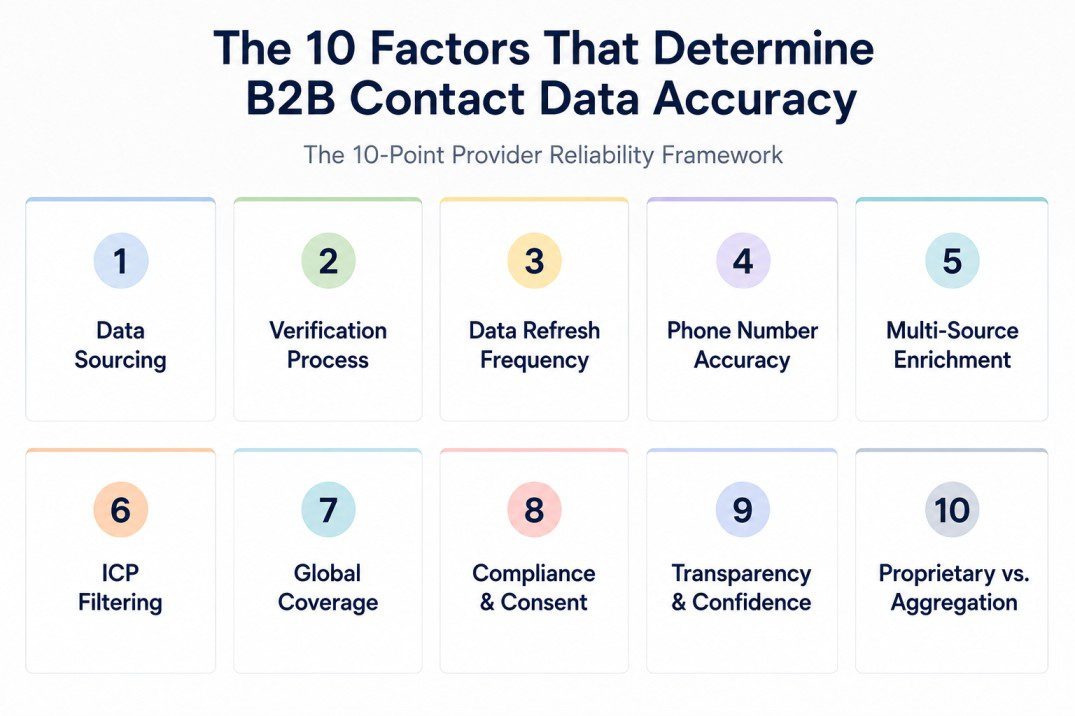
The 10 factors below form the 10-Point Provider Reliability Framework: a structured checklist for evaluating any b2b contact data provider before purchase, or diagnosing why current data is underperforming.
Why Does B2B Contact Data Become Inaccurate?
Roughly 25 to 30% of B2B contact records become stale each year. LinkedIn’s workforce research shows that professionals change roles or companies every two to three years on average. At that rate, a database refreshed only annually contains a significant percentage of outdated records at any given point.
Decay is not uniform. Senior executives change positions more frequently than individual contributors. Companies in high-growth sectors see more movement than stable industries.
Decay is only one dimension of inaccuracy. The other three are sourcing quality (whether the record was correct when added), verification depth (how thoroughly it was checked), and filtering precision (whether the contact actually matches the buyer profile). These four dimensions map to the 10 factors below.
What Are the 10 Factors That Determine B2B Contact Data Accuracy?
Use the 10-Point Provider Reliability Framework as a pre-purchase checklist and as a diagnostic when current data underperforms. Each factor connects directly to a measurable outbound outcome.
Factor 1: How Does the Provider Source Contact Records?
Data sourcing is the foundation of accuracy. The two most common models are community contribution, where users share each other’s contacts, and proprietary data engines that build and maintain their own databases through research and direct sourcing.
Community contribution models produce current records in segments where professionals actively share details, such as technology and finance, but create gaps elsewhere. Records are only as current as the last person who shared them. Proprietary engines control when records were last verified and which segments they cover.
The most reliable providers layer multiple sourcing methods and can explain which sources informed any given record. If a provider cannot explain where their data comes from, that is a meaningful signal.
Factor 2: How Deep Is the Verification Process?
Verification is where claimed accuracy often diverges from real-world accuracy. There are three levels, and they produce very different results.
Syntax verification checks whether an email address is formatted correctly. It catches broken addresses but cannot detect whether the inbox is active. A syntax-valid email for a person who left the company six months ago will pass verification and bounce on delivery.
Multi-layer verification combines SMTP ping (checking whether the mailbox accepts connections), catch-all detection, known bounce list matching, and MX record validation. Syntax-only verification can produce a false deliverability rate of 15 to 25% on lists that appear clean. Ask any b2b contact data provider which method they use before accepting their accuracy claim.
Factor 3: How Often Are Contact Records Refreshed?
A contact verified six months ago is not the same as a contact verified this week. At 25 to 30% annual decay, a six-month-old record has a statistically meaningful chance of being stale.
Time-based refresh updates records on a fixed schedule, such as quarterly or annually. Signal-triggered refresh updates a record when a real event is detected: a job change, a company announcement, or a domain change. Signal-triggered is more accurate because it responds to actual changes rather than assuming decay follows a calendar.
Before accepting a provider’s accuracy figures, ask what percentage of their records were verified within the last 90 days. That answer reveals how the database is actually maintained, not how it is marketed.
Factor 4: How Accurate Are Direct Dials and Mobile Numbers?
Email accuracy and mobile accuracy are different problems with different difficulty levels. Email is more commonly available and easier to verify. Direct dials and mobile numbers are harder to source and typically have lower fill rates even at high-quality providers.
A provider claiming 90% contact accuracy may have a 90% email fill rate and a 40% mobile fill rate. For roles where email access is limited, such as field sales, healthcare, and manufacturing, mobile coverage becomes the primary channel.
When evaluating any b2b contact data provider, request fill rates for email, direct dial, and mobile number separately. Overall “accuracy” figures that blend all three types will obscure the mobile gap entirely.
Factor 5: Does the Provider Use Multi-Source Cross-Referencing?
A single data source has a coverage ceiling. No matter how strong the sourcing method, one database can only know what it can see. Providers that query multiple sources and cross-reference results consistently outperform single-source providers on both fill rates and accuracy.
Waterfall enrichment is the mechanism: query the most accurate source first, then fall back to broader sources for records the primary source cannot fill. Cross-referencing across sources catches conflicting records and improves confidence scoring. Improving data quality through enrichment becomes significantly more effective when multiple sources are layered rather than swapped out one for another.
Waterfall enrichment across 30 or more vetted providers delivers 95%+ match rates. Teams running on a single data source frequently discover that 30 to 40% of their records are wrong or missing.
Pintel.ai’s multi-source waterfall enrichment queries over 30 vetted providers in priority order. One pharmaceutical company paying $160K per year for data that was 37% wrong reached a 95%+ match rate after switching, with their dead pipeline starting to convert.
Factor 6: How Precise Is the ICP Filtering?
Accurate contact information delivered for the wrong person produces the same result as inaccurate data: wasted sequences and no pipeline. Title keyword matching returns contacts with a specific word in their job title, but the same keyword appears in both buyers and sellers. Searching “SAP” in titles returns people managing SAP applications and people selling SAP software.
Profile-level filtering reads the full work history and current responsibilities before deciding whether a contact fits the ICP. This eliminates false positives and catches relevant people whose titles do not match standard keywords. Teams that invest in finding ICP contacts at the profile level reach the right person more often with fewer wasted touches.
For high-quality b2b contact data, the delivery mechanism matters as much as the underlying record quality.
Factor 7: Is Coverage Consistent Across All Regions?
Many providers claim global coverage. In practice, this typically means strong coverage in North America, reasonable coverage in Western Europe, and thin coverage in APAC, LATAM, and the Middle East.
The gap is structural. US-built providers using community contribution models have strong coverage where English-speaking LinkedIn users are most active. Coverage collapses in markets where fewer professionals share contact details publicly or where local professional platforms dominate over LinkedIn.
When evaluating b2b contact data providers for international outreach, ask for fill rates by specific country, not by region. A provider strong on US contact data but thin on European and Asian markets produces inconsistent results for global GTM teams.
Factor 8: What Compliance Standards Does the Provider Meet?
GDPR in Europe, CCPA in California, and HIPAA for healthcare data all require a lawful basis for processing contact records. A provider that cannot explain their legal basis for each record creates compliance exposure for the teams using their data.
Compliance certification is not the same as a compliance claim. Providers certified under ISO 27001, SOC 2, GDPR, and HIPAA frameworks have been independently audited. GDPR-compliant B2B data providers can show their lawful basis documentation. Ask for it before signing.
Factor 9: Does the Provider Offer Confidence Scoring?
Not all contact records are equally reliable, and providers that acknowledge this openly are more trustworthy than those that serve every record at the same confidence level.
A confidence score communicates how recently a record was verified, how many sources confirmed it, and how confident the provider is in its current accuracy. A high-confidence email has been verified against a live inbox recently. A low-confidence email may have passed syntax checking only, or was verified more than 90 days ago.
If a provider cannot tell you how confident they are in a specific record, they are hiding variance that will show up in your bounce rates.
Factor 10: Does the Provider Own Its Own Data or Just Aggregate?
Pure aggregators pull from the same underlying sources as each other. If two providers aggregate from the same publicly available databases, their coverage gaps are identical. Switching providers will not fix coverage problems that originate from shared source limitations.
Providers with proprietary data engines build their own datasets from non-public sources: government records, school directories, local business databases, and data behind captcha-protected pages. These cover segments that standard aggregators miss entirely. For teams targeting public sector, education, healthcare, manufacturing, and similar verticals, etc., non-traditional data sources like government procurement records and school directories reach decision-makers that no aggregated database covers.
These 10 factors are what separate contact data that performs as promised from data that underperforms once sequences run. The comparison below maps each factor to what it looks like at a reliable provider versus a risky one.
How Do Reliable and Risky B2B Contact Data Providers Compare?
The table below turns the 10-Point Provider Reliability Framework into a practical checklist. Use it when evaluating a new b2b contact data provider or when diagnosing why current data is not performing.
| Factor | Reliable Provider | Risky Provider |
|---|---|---|
| Data sourcing | Explains source types per record; layers multiple sourcing methods | Claims “proprietary database” without specifics; cannot explain sourcing |
| Verification depth | Multi-layer: SMTP ping + catch-all detection + MX record check | Syntax check only; passes dead inboxes as valid |
| Refresh rate | Signal-triggered: updates when job change or company event is detected | Annual or quarterly batch refresh only; no real-time signal response |
| Mobile coverage | Reports email, direct dial, and mobile fill rates separately by segment | Blends all contact types into one accuracy figure; obscures mobile gap |
| Multi-source logic | Waterfall across 30+ sources; fills gaps before returning blank fields | Single source; coverage ceiling creates blank fields with no fallback |
| ICP filtering | Profile-level matching; removes false positives before delivery | Title keyword matching; delivers buyers and sellers in the same list |
| Regional coverage | Provides fill rates by specific country; explains regional sourcing method | Claims “global coverage”; fill rates collapse outside North America |
| Compliance | ISO 27001, SOC 2, GDPR, HIPAA, CCPA certified; explains lawful basis per record | Claims compliance without certifications; consent chain is unclear |
| Confidence scoring | Surfaces confidence score per record with verification date and source | No confidence signal; every record treated as equally reliable |
| Proprietary data | Owns data from non-public sources; covers non-indexed segments | Pure aggregator; gaps identical to every other aggregator using the same sources |
Most providers score well on two or three factors and have significant gaps in the rest. The goal is not to find a provider that passes every check on day one. It is to understand exactly where their gaps are before building sequences around their data. The section below shows what delivery looks like when all 10 factors are addressed.
To see how these principles work together, let’s look at what a platform built around all 10 factors actually delivers.
What Does High Contact Data Accuracy Look Like in Practice?
For GTM teams that need accurate contact data across complex ICPs and global markets, the gap between a reliable and risky provider shows up in the first campaign cycle: fewer bounces, fewer wrong-person replies, more meetings with the right buyers.
Pintel.ai addresses all 10 factors through proprietary data engines combined with multi-source waterfall enrichment across 30+ vetted providers. The contact data enrichment techniques that reach 95%+ match rates depend on layering sources, not swapping one vendor for another.
Profile-Level Filtering for Clean ICP Delivery
Pintel reads the full LinkedIn profile, not just title keywords. This removes false positives before any contact reaches a sequence. Teams targeting buyers in technical roles, where title nomenclature varies across companies, see a significant reduction in wasted touches.
Proprietary Data for Non-Standard ICPs and Global Markets
For teams targeting public sector, education, healthcare, manufacturing, and similar verticals, etc., Pintel’s proprietary data engines reach decision-makers not represented in LinkedIn-based databases. Government procurement records, school directories, and local business data cover segments that standard aggregators miss entirely.
Buying Signals Layered onto Verified Contacts
High-quality b2b contact data is not only about verified emails. Pintel layers structural signals (VP hires, funding, tech migrations, etc.), contextual signals (active topic research), and behavioral signals (website visits, content downloads) onto contact records. This tells teams which accounts are ready to engage, not just which ones fit on paper.
Final Takeaway: Why B2B Contact Data Accuracy Matters
B2B contact data accuracy is not a single number. It is a combination of how data is sourced, how it is verified, how often it is refreshed, and how precisely it is filtered before delivery. A provider that claims “95% accuracy” without specifying which of these dimensions they are measuring is giving you a number without a definition.
The 10-Point Provider Reliability Framework in this guide gives you specific questions to ask before committing to any b2b contact data provider. Each factor connects directly to what you will experience in sequences: bounce rates, wrong-person replies, coverage gaps in specific regions, and ICP filtering quality.
Most teams discover the gaps in their current provider only after sequences have run. Running the 10-factor checklist before purchasing, or before renewing, is how high-performing GTM teams avoid the bad data problem that quietly erodes pipeline.
Frequently Asked Questions About Contact Data Accuracy
What is contact data accuracy?
Contact data accuracy measures how closely contact records match current business information, including email addresses, phone numbers, job titles, and company details.
Why is contact data accuracy important for B2B sales?
High contact data accuracy reduces bounce rates, improves deliverability, and helps sales teams reach the right decision-makers.
What happens if contact data is not accurate?
Poor contact data accuracy leads to bounced emails, wrong person outreach, lower response rates, and wasted sales effort. It also affects CRM quality, campaign performance, and pipeline generation.
What is the impact of having accurate contact data?
High contact data accuracy helps sales teams reach the right decision-makers, reduce bounce rates, improve campaign performance, and generate more qualified meetings with less manual effort.
How often should B2B contact data be updated?
B2B contact data should be refreshed regularly because records become outdated as people change roles, companies, or contact details.
How can I measure contact data accuracy?
Measure contact data accuracy using email bounce rates, contact match rates, direct dial coverage, and record freshness across your target accounts.
How do I evaluate a contact data provider?
Review the provider’s data sourcing, verification methods, refresh frequency, regional coverage, and compliance standards. Testing a sample of your target accounts before purchasing is also recommended.
What improves contact data accuracy?
Multi-source enrichment, real-time verification, frequent data refreshes, and profile-level ICP filtering all contribute to higher contact data accuracy.