Finding verified decision-maker contacts at private companies can be challenging without the right data provider. In this guide, we compare the 7 best private company contact data tools based on contact coverage, verification quality, regional reach, and pricing to help you choose the best platform for your prospecting needs.
What Is Private Company Contact Data?
Private company contact data is the verified contact information of decision-makers working at privately held businesses. It typically includes business email addresses, direct dials, mobile numbers, job titles, company details, and other information sales teams need to identify and reach the right buyers.
Unlike public companies, private businesses disclose very little information, making accurate contact data harder to find and verify. The best providers combine multiple data sources and verification methods to help GTM teams build reliable prospect lists at scale.
The tools below compare contact coverage, verification quality, regional strength, pricing, and ideal use cases, helping you choose the right platform for your target market.
How 7 Tools Compare for Private Company Contact Data
The table below maps each tool across the five dimensions that determine whether a platform delivers usable private company contact data or just returns names without reach.
| Provider | Contact Types | Verification Method | Private Co. Coverage | Regional Depth | Pricing |
|---|---|---|---|---|---|
| Pintel.ai | Email, direct dial, mobile | Waterfall enrichment (30+ providers), MX record validation | Global via proprietary registries and non-LinkedIn sources | US, EMEA, APAC, LATAM, GCC | Custom |
| ZoomInfo | Email, direct dial | Community contribution, AI verification | Strong for US private enterprise (200+ employees) | US-primary, limited non-US | From $15,000/yr |
| Apollo.io | Email, direct dial | Database aggregation, email verification | Good for US startup and SaaS private companies | US-primary, partial non-US | From $49/mo |
| Lusha | Email, direct dial, mobile | Community-sourced, direct dial focus | Good for APAC direct dial contacts | APAC, partial US and EMEA | From $29/mo |
| Cognism | Email, mobile (Diamond-verified) | Phone-verified mobiles, GDPR lawful basis | Strong for EMEA private company mobiles | UK, Germany, France, Benelux | Custom |
| Hunter.io | Email only | Domain pattern matching, deliverability check | Works where company domain is already known | Global (domain-based, no regional coverage) | From $49/mo |
| RocketReach | Email, direct dial, LinkedIn | Multi-source aggregation | Better fill rates for hard-to-find private contacts | US, UK, partial global | From $53/mo |
This comparison is based on first-hand platform knowledge, publicly available product information, and commonly reported user experiences. Contact each vendor directly for the latest pricing and product details.
Most tools perform well for one specific region or company profile. The evaluation criteria below explain which dimension matters most for your outreach motion.
What Should You Look for in a Private Company Contact Data Tool?
Before evaluating platforms, clarify what your specific outreach requires. Teams targeting manufacturing or government clients have fundamentally different needs from those targeting US SaaS startups.
- Decision-maker identification, not just contact lookup: The harder problem with private company contact data is finding out who inside the company is the right buyer. Platforms that identify the right contact from a company record using profile-level analysis are necessary for prospecting at scale.
- Multi-source verification: Single-database tools return addresses that looked valid when scraped but may no longer deliver. Waterfall enrichment across multiple providers consistently produces higher deliverability than single-source lookup for private company contact data at scale. The contact data enrichment techniques guide covers the mechanics in full.
- Direct dial coverage for your region: In Germany, the UK, and parts of APAC, phone-first outreach outperforms cold email. Direct dial coverage matters as much as email coverage for teams whose ICP is in those markets.
- Private company registry sourcing: The strongest tools pull from government registries, trade directories, and sector-specific databases rather than from LinkedIn and community contributions only. This sourcing model separates platforms built for private company prospecting from those built for publicly listed companies.
- Signal data for timing: Verified contacts are most actionable when paired with signals showing when a private company is hiring, expanding, or changing leadership. A contact with a relevant signal produces warm outreach context; without one, it is a cold reach.
Detailed Review of the Best Private Company Contact Data Tools
Here’s a detailed look at each platform, including its strengths, limitations, pricing, and the types of teams it serves best.
Pintel.ai: Verified Private Company Contact Data for Global GTM Teams
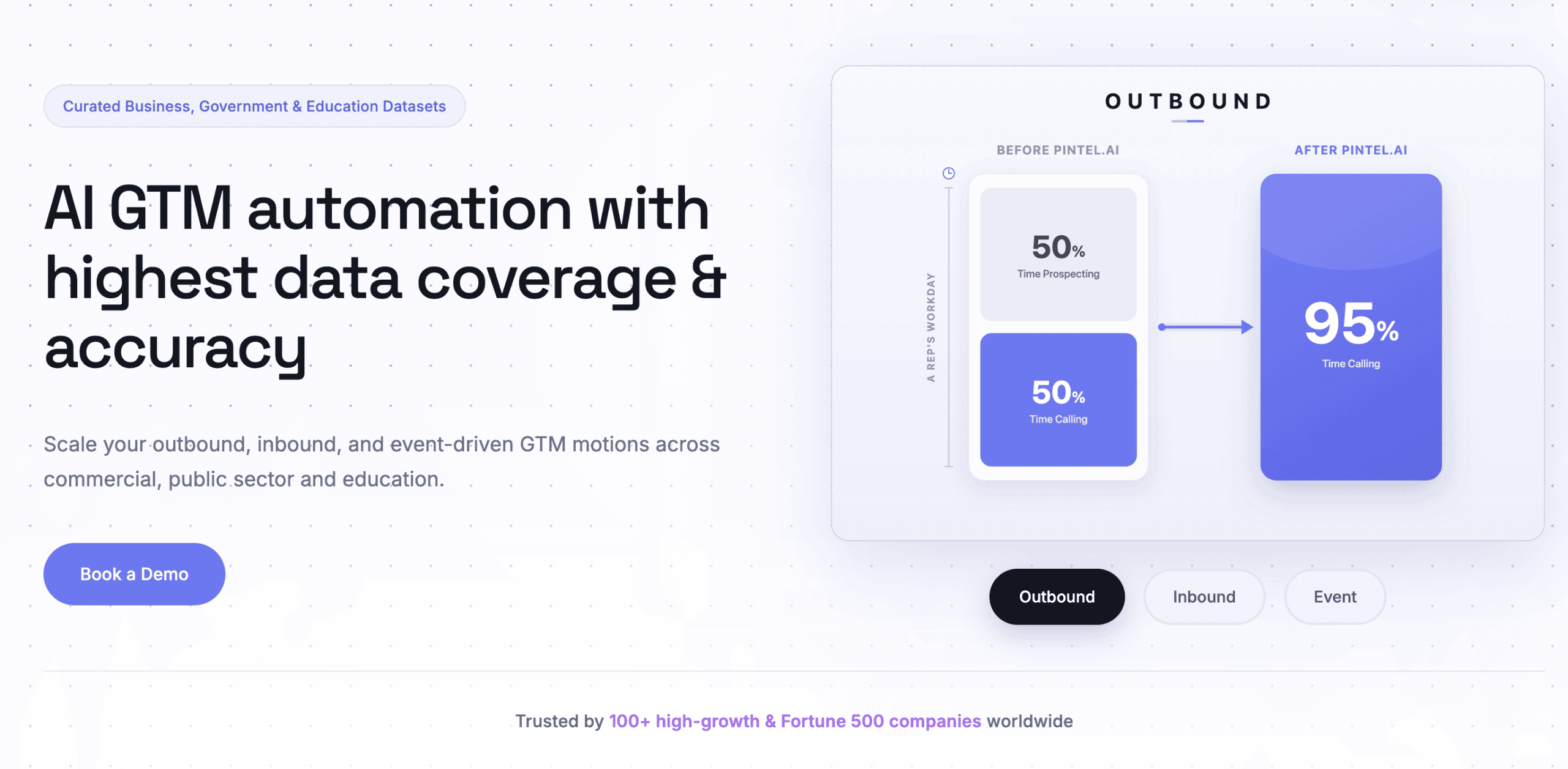
Pintel.ai helps B2B sales teams identify the right decision-makers at private companies and enrich them with verified contact data, company intelligence, and buying signals. It is built for teams targeting privately held businesses across global markets and industries where traditional B2B databases often have limited coverage.
What Pintel.ai Offers
- Identifies the right decision-makers based on their role, responsibilities, and company context, rather than relying only on exact job title matches.
- Enriches contacts with verified business emails, direct dials, mobile numbers, company information, and buying signals.
- Syncs enriched contact data to Salesforce, HubSpot, and other GTM workflows through APIs.
How It Works
- Uses waterfall enrichment across 30+ vetted data providers to maximize contact coverage.
- Verifies contact details before returning the best available record.
- Combines multiple data sources instead of relying on a single contact database.
Coverage & Data Quality
- Covers private companies across the US, EMEA, APAC, GCC, and LATAM.
- Sources data from company registries, government records, commercial databases, trade directories, and other non-traditional sources.
- Supports industries including manufacturing, healthcare, education, government, logistics, financial services, and professional services.
- Includes buying signals such as hiring activity, funding events, leadership changes, technology adoption, and company expansion to help prioritize outreach.
Security & Compliance
- ISO 27001 certified
- SOC 2 compliant
- GDPR compliant
- HIPAA compliant
- CCPA compliant
- VAPT certified
Pricing: Custom pricing
Best for: B2B sales, RevOps, and GTM teams looking for verified decision-maker contact data at private companies across global markets.
ZoomInfo: Strong for US Large Private Company Contacts, Weak for Small Private Companies and Non-US Markets
ZoomInfo’s community-contribution model generates solid email and direct dial records for US-headquartered private companies with 200-plus employees, but produces thin and stale data for smaller private businesses and non-US markets where fewer contributors participate to refresh records.
- Strengths: Good email and direct dial coverage for US private enterprise companies (200-plus employees); tech intent data via Streaming Intent identifies active buying windows
- Limitations: Small private companies under 50 employees are sparsely covered; contact coverage outside the US drops significantly; niche-sector private company records age without being refreshed
- Pricing: From $15,000/yr (custom)
- Best for: US sales teams targeting large private companies with 200-plus employees in technology, financial services, and professional services
Apollo.io: Strong for Self-Serve Contact Discovery, Weak for Deep Private Company Coverage
Apollo.io bundles a contact database with sequencing in a self-serve platform that works for US startup and SaaS-stage private companies, but coverage for non-LinkedIn private companies and non-US markets is inconsistent.
- Strengths: Large contact database with solid coverage for US startup and SaaS-stage private companies; sequencing built in, so teams find contacts and run outreach in the same platform
- Limitations: Private company contacts outside major US cities and outside tech frequently return incomplete records; mobile and direct dial coverage for private company executives is below average
- Pricing: From $49/mo
- Best for: SMB sales teams targeting US startup-stage and SaaS-stage private companies with limited tooling budget
Lusha: Strong for Direct Dials and APAC Contacts, Weak for Private Company Firmographics
Lusha specializes in direct dial and mobile number coverage for private company executives in APAC markets who are not reachable via email but appear in professional directories with phone numbers.
- Strengths: Above-average direct dial and mobile coverage for APAC individual contacts; Chrome extension pulls contacts directly from LinkedIn profiles
- Limitations: Firmographic data depth for private companies is thin compared to ZoomInfo or Pintel.ai; coverage for private companies in non-LinkedIn-active markets such as manufacturing and local services is limited
- Pricing: From $29/mo
- Best for: APAC outbound teams prioritizing direct dial numbers for private company contacts in Singapore, Australia, and Southeast Asia
Cognism: Strong for EMEA Private Company Mobile Numbers, Weak Outside Major European Markets
Cognism focuses on GDPR-compliant mobile numbers and direct dials for European markets, making it a practical choice for reaching private company decision-makers in the UK, Germany, and France where phone outreach outperforms cold email.
- Strengths: Diamond-verified mobile numbers with solid coverage in UK, Germany, France, and Benelux; GDPR compliance with documented lawful basis processing required for European outreach
- Limitations: Coverage drops in CEE (Central and Eastern Europe), Nordics, Southern Europe, and outside major cities; private company contacts with native-language titles are under-indexed
- Pricing: Custom (contact sales)
- Best for: EMEA outbound teams targeting private companies in UK, Germany, France, and Benelux with phone-first outreach
Hunter.io: Strong for Domain-Based Email Finding, Weak on Decision-Maker Identification
Hunter.io finds email addresses by querying a company’s domain against public web data, but it cannot identify who the right decision-maker is. You must already know the contact name before Hunter.io can help.
- Strengths: Email pattern finder works reliably for private companies where domain email formats are publicly listed; email verification produces above-average deliverability accuracy for confirmed addresses
- Limitations: No decision-maker identification: you must already know who to reach before the tool can help; does not cover direct dials or mobile numbers
- Pricing: From $49/mo
- Best for: Teams that already have a contact name at a private company and need a fast, verified email address
RocketReach: Strong for Multi-Source Contact Lookup, Weak for Buying Signals
RocketReach aggregates private company contact data from multiple sources, producing better fill rates for hard-to-find contacts than single-database competitors but without a signal layer to tell you when to reach out.
- Strengths: Multi-source aggregation produces better fill rates for private company contacts where single-database tools return blank; covers email, direct dial, and LinkedIn profile in one lookup
- Limitations: No buying signal layer: the tool delivers the contact but not the timing intelligence to know whether a private company is in an active buying window; data freshness can lag for companies that change leadership frequently
- Pricing: From $53/mo
- Best for: Teams needing multi-source contact lookups for private companies where single-database tools consistently return incomplete records
Why Is Finding Contact Data at Private Companies So Difficult?
The widely held assumption is that finding the private company is the hard part. It is not. The real difficulty is identifying the right decision-maker inside that company and then getting their verified contact. Public companies file leadership disclosures that naturally surface executive names. Private companies have none of this. Leadership changes happen without announcements, org charts are internal, and many private company decision-makers are minimally active on LinkedIn. The hard part of private company prospecting is not the company. It is the contact.
High-performing outbound teams solve this with what practitioners call the Three-Step Contact Discovery Stack for private companies:
- Step 1: Identity. Who is the right decision-maker at this private company? Title-keyword search misses people with non-standard titles, industry-specific nomenclature, and non-English profiles. Learning to find decision-makers accurately through profile-level analysis rather than keyword matching is the foundation of private company prospecting.
- Step 2: Enrichment. What is that person’s verified email and direct dial? Private company records age faster than public-company records because fewer third-party sources track leadership changes at private firms. Multi-source waterfall enrichment, querying multiple providers in priority order, is the reliable method at scale. For a deeper look at waterfall mechanics, the data enrichment tools comparison covers how different models handle private company coverage.
- Step 3: Validation. Does the email actually deliver? Email pattern matching produces plausible addresses that bounce at rates damaging to sender reputation. MX record verification and deliverability testing before outreach are non-negotiable for private company contact lists.
To illustrate the cost of skipping the stack: a team targeting private manufacturing companies ran a title search and pulled 400 contacts. After ICP filtering and waterfall enrichment, they had 38 verified contacts that delivered the same number of meetings with 95-plus percent deliverability and no domain damage.
How We Evaluated These Private Company Contact Data Tools
Every tool was assessed against four criteria specific to private company contact data.
- Private company sourcing model: Does the tool pull from company registries, trade directories, and sector-specific databases, or does it rely on LinkedIn scraping and community contributions? LinkedIn-only tools fail for private companies in non-tech sectors and non-English markets.
- Contact verification depth: Is verification limited to syntax checking, or does the tool run MX record validation and deliverability scoring? For private companies where contacts are harder to verify independently, verification depth matters more than for public-company lists.
- Decision-maker identification: Can the tool identify the right buyer from a company record alone, or does it require you to already know who to search for? Lookup-only tools are half a solution for private company prospecting. The B2B email finder guide covers the distinction between lookup and discovery.
- Regional coverage: Databases that perform well for US private companies often return incomplete results for EMEA, APAC, and LATAM. Coverage claims were evaluated by regional specificity, not global marketing language.
Final Takeaway
Private company contact data is harder to find than public-company contact data for one structural reason: private companies are not required to disclose anything. The tools that work are built on government registries, trade directories, and multi-source enrichment rather than on LinkedIn scraping and community contributions.
The Three-Step Contact Discovery Stack (Identity, Enrichment, Validation) is the right frame for evaluating any tool on this list. For teams where private company prospecting is a core motion, the right choice is a platform that handles all three steps and covers the regions where your ICP operates. Teams that also need firmographics, signals, and account-level data alongside private company contact data will find the B2B database providers comparison a useful companion.
Frequently Asked Questions
What is private company contact data?
Private company contact data is verified contact information for decision-makers at companies that do not trade publicly. Because private companies file no financial disclosures, contact records must be sourced from company registries, trade directories, LinkedIn profiles, and multi-provider enrichment rather than from public financial databases.
How do I find decision-maker contacts at private companies?
Use a three-step process: identify the right decision-maker using government registries and profile-level ICP filtering, enrich for their verified email and direct dial through a multi-source waterfall, then validate before outreach. Single-source email finders return unverified addresses that bounce at rates damaging to sender reputation.
Why is it harder to find contacts at private companies than public ones?
Private companies file no public financial disclosures. Leadership changes, org charts, and contact details are not in public records. Decision-makers at private companies are less active on LinkedIn than their public-company counterparts, so contact data must be assembled from registries, trade directories, and multi-provider enrichment.
What is the best tool for private company contact data?
Pintel.ai is the strongest option for private company contact data globally. Its waterfall enrichment across 30-plus vetted providers delivers 95-percent-plus match rates, and its proprietary registries surface contacts at private companies that LinkedIn-only tools miss entirely.
How accurate is private company contact data?
Accuracy varies sharply by tool and region. Teams relying on a single data source typically see 37 percent of contact records wrong or missing before outreach starts. Multi-source waterfall enrichment tools consistently deliver 90-percent-plus match rates with verified email deliverability that single-source tools cannot match.
Can I find mobile numbers for private company executives?
Yes, but coverage varies by region. Direct dial coverage is strongest for US enterprise and EMEA private companies. Lusha covers APAC direct dials; Cognism covers EMEA mobiles with GDPR compliance. For global private company contact data, Pintel.ai combines regional specialists into one waterfall.