A rep loads 200 fresh contacts from an Australia business email database, launches the first sequence, and a third of it bounces within 24 hours. That is rarely bad luck. Most of these lists are either scraped once and resold repeatedly, or verified against a generic global format check rather than Australian mail servers specifically, so the bounce shows up only after the send, not before.
This guide compares 10 Australian business email database providers on how they actually source and verify records, not just how large the list claims to be.
What Are the Best Australia Business Email Database Providers?
The strongest options split into three types: ANZ-native platforms built on local registry and web data (Firmable, KnowFirst), global email finders and verifiers (Hunter.io, Snov.io, RocketReach), and regional contact tools with APAC reach (Lusha, Apollo.io, Cognism). Pintel.ai combines verified email discovery with signal tracking, so contact data and buying context arrive in one workflow instead of two.
10 Best Australia Business Email Database Providers: Quick Comparison
Here is how the 10 options compare on sourcing model, verification method, and pricing.
| Provider | Sourcing Model | Verification Method | Coverage Beyond Sydney/Melbourne | Starting Price | Best For |
|---|---|---|---|---|---|
| Pintel.ai | AI and multi-source databases & enrichment | Multi-source cross-verification before delivery | Strong across Australia, ANZ, and APAC | Contact sales | Teams looking to sell to businesses across Australia and APAC |
| Firmable | AI web aggregation and entity resolution | Data updates | Broad coverage | Custom (20 free credits to trial) | Teams looking for contact and company data |
| KnowFirst | ABN and ASIC registry data | Registry-grounded, not SMTP-level for personal email | Broad at the company level, Australia-only | Custom | Company and director-level accuracy grounded in government records |
| Hunter.io | Domain-based web crawling | SMTP-level verification with confidence scoring | Depends entirely on target company’s indexed web domain | Free tier; paid from $49/mo | Verifying emails for companies with an indexed domain |
| Snov.io | Domain and LinkedIn-based discovery | Verification pass required separately from discovery | Depends on indexed web and LinkedIn presence | Free trial; paid from $39/mo | Teams wanting an all-in-one finder, sender, and warm-up tool |
| RocketReach | Broad indexed professional dataset | Publicly indexable data, not continuously re-verified | Wide but shallow outside major markets | From $399/yr + overage | Large general contact pool across industries |
| Lusha | LinkedIn browser extension | Reveals stored contact data on request | Limited to LinkedIn-indexed profiles | From $49/mo | Individual reps doing manual lookups |
| Apollo.io | LinkedIn-derived plus database | Basic email pattern matching | Sydney, Melbourne-heavy | From $49/mo | SMB teams needing a bundled database and sequencing tool |
| Cognism | Licensed plus phone-verified data | Phone-verified where covered | Limited outside major cities | Contact sales | Phone-heavy outbound teams already using it elsewhere |
| LeadsMunch | Static, one-time list compilation | SMTP, NCOA, and phone verification at time of sale | Broad, segmentable by state and city | From $169 per list | Low-budget, one-off list purchases |
This comparison is based on first-hand platform knowledge, publicly available product information, and commonly reported user experiences. Contact each vendor directly for the latest pricing and product details.
Most providers verify something, the question is what and when. The reviews below cover what each Australia email database actually checks before a record reaches your list.
How We Evaluated These Australian Business Email Database Providers
This comparison rates each provider against five criteria specific to buying an Australia business email database, not a generic global checklist:
- Verification method: whether emails are checked against live mail servers (SMTP-level), matched by pattern guess only, or verified once at the time of a static list sale
- Refresh cadence: whether the database re-crawls and updates records continuously or sells a fixed snapshot
- Coverage spread: how far records extend beyond Sydney and Melbourne into other Australian states and territories
- Compliance posture: whether the provider addresses Australia’s Spam Act 2003 consent and unsubscribe requirements directly
- Pricing transparency: whether starting price and plan structure are published or require a sales conversation to uncover
10 Australia Business Email Database Providers Reviewed in Detail
With those checks in mind, here is what each Australia business email database provider actually delivers.
Pintel.ai: Strong for Pintel.ai: Best for Verified Australia Business Email Data with Global Coverage
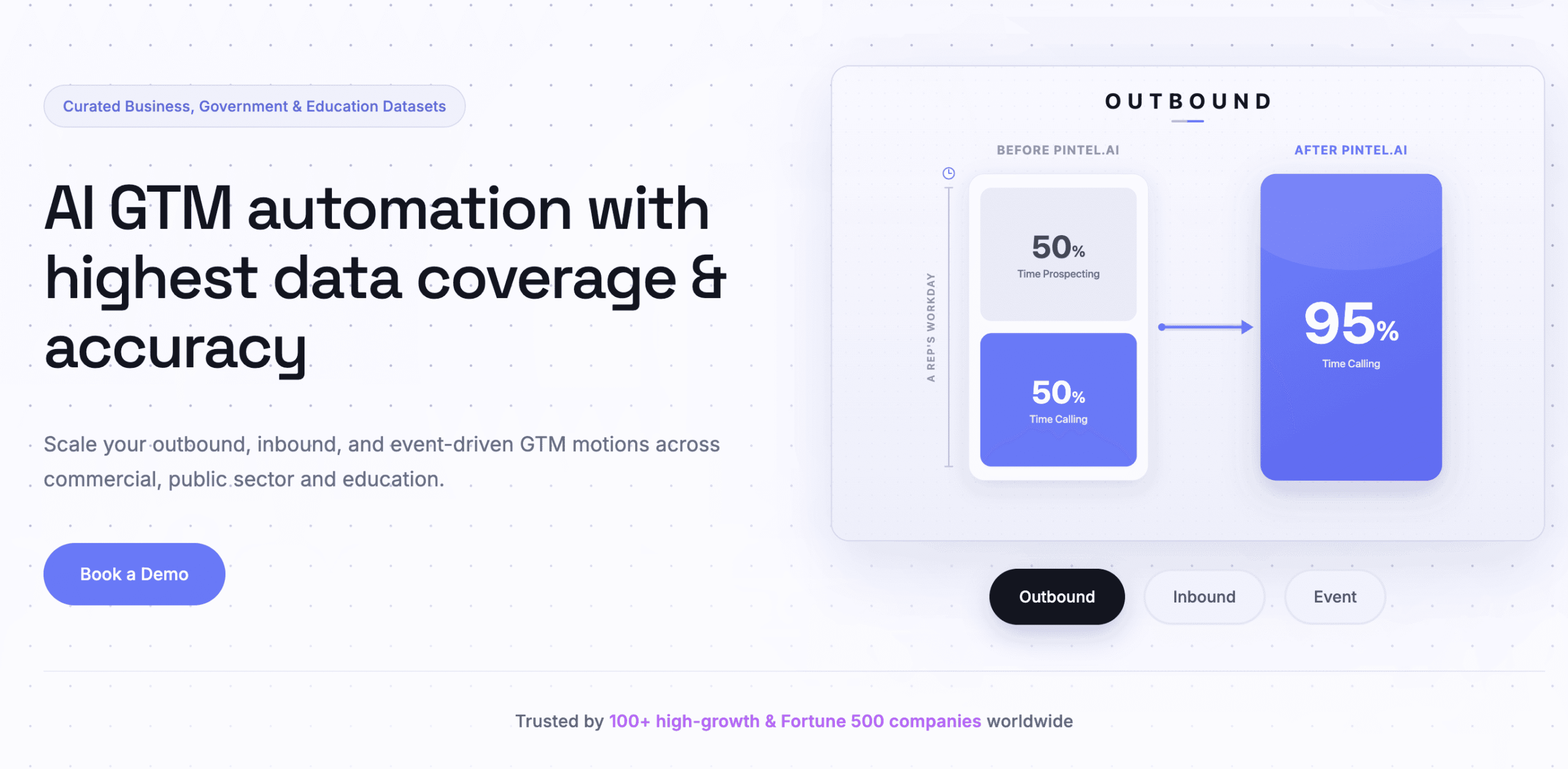
Pintel.ai helps GTM teams build accurate Australia business email lists by combining waterfall enrichment across multiple data sources instead of relying on a single database. Alongside verified business email addresses, it also provides company intelligence and buying signals, allowing teams to identify and prioritize the right Australian prospects from one platform.
Strengths
- Finds verified Australian business email addresses using waterfall enrichment across 30+ data providers, helping improve contact coverage when a single provider cannot return a verified email
- Covers businesses across Australia, including regional companies, public sector organizations, educational institutions, and other hard-to-reach segments that many LinkedIn-first databases overlook
- Continuously enriches contact and company records, helping teams work with fresher data instead of static one-time email lists
- Combines business email discovery with company data, contact enrichment, and buying signals, eliminating the need to purchase separate tools for each stage of prospecting
- Supports global prospecting beyond Australia, making it suitable for teams targeting APAC, North America, and EMEA from a single database
- Enterprise-ready with ISO 27001, SOC 2 (AICPA), GDPR, HIPAA, CCPA, and VAPT certifications
Pricing: Contact sales
Best for: Teams looking for an Australia business email database that combines verified contact data with company intelligence and global coverage.
Firmable: Strong for ANZ-Native Sourcing, Weak on Published Pricing
Firmable builds its Australian and New Zealand contact and company data from the ground up using AI-driven web aggregation, large language model extraction, and entity resolution, rather than reselling a global dataset repackaged for the region. Pricing sits entirely behind a sales conversation with no published tiers, so comparing cost against a self-serve tool takes an extra step.
Strengths
- More than 1 million Australian company profiles and 10 million individual contacts, continuously re-crawled rather than sold as a fixed snapshot
- Native HubSpot and Salesforce sync for enriched records
- Built specifically for ANZ, so filtering by local industry, hiring activity, and tech stack does not require adapting a US-first tool
Limitations
- No published pricing tiers; cost only becomes clear after a sales conversation.
Pricing: Custom, with 20 free credits to trial any plan
Best for: teams that want a purpose-built ANZ contact and company database rather than a global tool adapted for the region.
KnowFirst: Strong for Registry-Grounded Company Data, Weak on Personal Email Enrichment
KnowFirst builds its Australian database on ABN and ASIC registry data, giving company existence and director records a government-verified foundation that web-crawled datasets do not have, but by its own positioning, the platform is stronger at company and director-level intelligence than at personal email and mobile enrichment specifically.
Strengths
- More than 3 million Australian businesses sourced from ASIC, with officer-level director records
- A business data API for filtering by industry, headcount, and location
- Entity resolution grounded in a legal registry identifier, not name-matching alone
Limitations
- Personal email and mobile enrichment is a secondary capability rather than the platform’s core strength.
- Coverage is Australia-only, with no broader APAC or global reach for teams expanding beyond the country.
Pricing: Custom, no published tiers
Best for: teams that need company and director-level accuracy grounded in government registry data.
Hunter.io: Strong for Domain-Based Verification, Weak on Australian Company Coverage
Hunter.io finds and verifies professional email addresses tied to a company domain, using pattern detection combined with SMTP-level verification and a confidence score per result, but its database is built around crawling indexed company domains rather than a dedicated Australian company directory, so coverage of Australian SMBs without much of a web footprint is thin.
Strengths
- SMTP-level verification with a confidence score attached to each result, not just a pattern guess
- Free tier covers 25 searches and 50 verifications per month
- Browser extension and API for bulk verification workflows
Limitations
- No proprietary Australian company registry; coverage depends entirely on whether the target company has an indexed web domain.
Pricing: Free tier available; paid plans start at $49/month for 500 searches and 1,000 verifications
Best for: verifying emails for Australian companies that already have an indexed web domain.
Snov.io: Strong for Bundled Outbound Workflow, Weak on Verification Being a Separate Step
Snov.io combines email finding with a drip campaign sender, mailbox warm-up, and a small CRM, aiming to be a single subscription a small team uses to run outbound end to end, but discovery and verification are separate steps, so results sent without running the verification pass first carry a real bounce risk.
Strengths
- Bundles email finding, sending, warm-up, and a lightweight CRM in one subscription
- LinkedIn automation tools alongside email discovery
- Free trial with 50 credits before committing to a paid tier
Limitations
- Verification is a distinct step from discovery, so skipping it before a send carries a real deliverability risk.
Pricing: Free trial available; paid plans start around $39/month for 1,000 credits
Best for: small teams that want a single subscription covering discovery, sending, and warm-up together.
RocketReach: Strong for Contact Volume, Weak on Verification Depth
RocketReach indexes a broad professional dataset, more than 700 million profiles and 60 million companies globally, giving it wide reach across industries, but breadth comes at the cost of verification depth, since records skew toward what is publicly indexable rather than continuously re-verified.
Strengths
- Very large indexed contact pool spanning industries and regions
- Bulk lookup and a browser extension for on-page contact reveal
- Pay-as-you-go overage model for occasional lookups beyond a plan’s included volume
Limitations
- Verification depth is thinner than tools built specifically around SMTP-level checking.
Pricing: Annual plans from $399/yr, plus $0.30 to $0.45 per overage lookup
Best for: teams that need a large general contact pool across industries rather than a narrower, more frequently verified dataset.
Lusha: Strong for Individual Lookups, Weak on Building Lists at Scale
Lusha delivers contact data through a LinkedIn browser extension, useful for a rep looking up one contact at a time, but it cannot build a target account list from scratch and covers only LinkedIn-indexed profiles.
Strengths
- Quick, low-friction contact reveal for individual reps browsing LinkedIn
- Reasonable APAC contact depth for one-off lookups
Limitations
- Cannot proactively build an Australian account list; covers only LinkedIn-indexed profiles.
- No signal layer, so prioritizing which contact to reach first is left entirely to the rep.
Pricing: From $49/month
Best for: individual reps doing manual, one-at-a-time LinkedIn lookups.
Apollo.io: Strong for Bundled Database and Sequencing, Weak on Coverage Outside Major Hubs
Apollo.io bundles a contact database with sequencing at accessible SMB pricing, but its Australian data leans on LinkedIn-derived records, concentrating coverage in Sydney and Melbourne.
Strengths
- Database and outbound sequencing in one subscription
- SMB-friendly pricing with a low barrier to start
Limitations
- Coverage of Perth, Brisbane, Adelaide, and regional Australia is thin compared to the two largest cities.
Pricing: From $49/month
Best for: SMB teams that want a bundled database and sequencing tool at accessible pricing.
Cognism: Strong for Phone-Verified Contacts, Weak on Australian Coverage
Cognism provides licensed, phone-verified contact data with a strong UK and Western Europe base, but Australian coverage is limited compared to its core markets.
Strengths
- Phone-verified contact data where covered
- Established workflow for phone-heavy outbound teams
Limitations
- Australian coverage is limited outside major cities compared to its core European markets.
Pricing: Contact sales
Best for: phone-heavy outbound teams already using Cognism successfully in other markets.
LeadsMunch: Strong for Low-Cost Bulk Lists, Weak on Ongoing Freshness
LeadsMunch sells a static, one-time Australian business email list, verified through SMTP, NCOA, and phone checks at the time of sale, but once purchased, the list does not update itself, so accuracy decays the same way any static list does as people change roles and companies.
Strengths
- Low, one-time cost with segmentation by industry, state, city, and job role
- Sample data available to test accuracy before a full purchase
Limitations
- A static, one-time file rather than a living, continuously refreshed database; accuracy declines after purchase with no ongoing update.
Pricing: From $169 per list, scaling with size and segmentation
Best for: low-budget, one-off list purchases where ongoing refresh is not a requirement.
That covers all 10 Australia business email database providers on this list. Teams also mapping the company and firmographic layer can compare our Australia company databases guide, and teams running the same evaluation in a different market may find the India email database providers guide useful for a side-by-side view.
What to Look for in an Australia Email Database
The most common mistake when evaluating an Australia email database is judging it by list size alone. A database with 10 million global contacts can perform worse for Australian outreach than a smaller ANZ-focused database if its records are outdated or poorly verified. The quality and freshness of Australian contact data matter far more than the total number of records.
A useful way to evaluate providers is with a simple Verification-Freshness Check. Before choosing an Australia business email database, ask these questions:
- Verification depth: Does the provider verify email addresses against live mail servers (SMTP-level), or does it simply predict email patterns based on names and domains?
- Database freshness: Is it a continuously updated database that regularly refreshes records, or a static list compiled once and sold without ongoing updates?
- Australian coverage: Does the provider offer meaningful coverage across Perth, Brisbane, Adelaide, Canberra, and regional Australia, or is most of its data concentrated in Sydney and Melbourne?
- Compliance transparency: Does the provider explain how it supports compliance with Australia’s Spam Act 2003, including consent and unsubscribe requirements?
- Sample availability: Can you test a sample of contacts against your target accounts before purchasing a subscription or list?
- Data quality: Does the database provide complete, verified contact and company information that’s ready for outreach, or will it require significant manual cleanup?
According to the Office of the Australian Information Commissioner, organizations sending commercial electronic messages in Australia must comply with the Spam Act 2003. This includes obtaining the appropriate consent, clearly identifying the sender, and providing a functional unsubscribe option, regardless of where the contact data was obtained.
How to Choose the Right Australia Business Email Database
The right choice depends on which part of your list needs solving today, not which provider has the largest global record count.
If your ICP is Sydney and Melbourne tech and finance: Most LinkedIn-derived tools show reasonable coverage here, since this is where Australian LinkedIn activity concentrates. That coverage does not extend evenly to the rest of the country.
If your ICP includes Perth, Brisbane, Adelaide, or regional Australia: An ANZ-native platform like Firmable, or a registry-grounded tool like KnowFirst, is more likely to reach companies with a lower LinkedIn footprint than a LinkedIn-only tool.
If you need a one-time list for a single campaign: A static list provider like LeadsMunch can work at low cost, provided the freshness tradeoff is acceptable for that specific send.
If your team is licensing a separate tool for contact data, verification, and buying signals: That is usually three subscriptions solving what could be one workflow. Our guide on B2B contact database providers covers this consolidation question in more depth, and teams comparing options across the wider region should see APAC B2B data providers.
Before committing to any provider, pull a sample of 20 to 25 contacts from your actual Australian ICP, including some outside Sydney and Melbourne, and check deliverability by hand. Teams that verify a sample before a full lead database purchase avoid discovering a high bounce rate after the contract is signed, not before.
Final Takeaway: Picking an Australia Business Email Database That Fits Your ICP
The best Australia business email database is not the one with the largest record count. It is the one whose verification method and refresh cadence match how you actually plan to use the list. A one-time campaign has different requirements than an ongoing outbound motion.
Teams running a continuous outbound motion generally need a living, re-verified database rather than a static file that ages the moment it is purchased. Teams running a single, well-defined campaign may find a verified static list is enough, provided the freshness tradeoff is understood going in.
For an Australia business email database that needs to support outbound at scale, checking verification method and refresh cadence matters more than checking total contact count.
FAQ: Australia Business Email Database Providers
Why do Australia business email lists have high bounce rates?
Many lists are verified once at the time of sale or matched by pattern guess rather than checked against live mail servers on an ongoing basis, so accuracy declines the longer the list sits unused before a send.
What is the difference between a static email list and a live email database?
A static list is compiled and verified once, then resold as-is with no further updates. A live database is continuously re-crawled and re-verified, so contact records stay current as people change roles and companies.
Do global email finders like Hunter.io or Snov.io work well for Australian contacts?
They work well when the target company has an indexed web domain or LinkedIn presence, since both tools discover emails through domain and profile crawling rather than a dedicated Australian company registry.
How do I verify an Australia email database provider before buying?
Pull a sample of 20 to 25 contacts from your real Australian ICP, including some outside Sydney and Melbourne, and check deliverability directly before committing to the full database.
Is buying an Australia business email list legal under the Spam Act?
Buying the list itself is not restricted, but sending commercial messages from it must meet Australia’s Spam Act 2003 requirements: consent, clear sender identification, and a functional unsubscribe option.
What is the difference between an Australia business email database and an Australia company database?
An email database focuses on verified contact details for individuals. A company database focuses on firmographic and structural data about the business itself, size, industry, and registration details, often without direct contact information.
Which Australia email database providers refresh their records most often?
Continuously re-crawled platforms like Firmable and domain-verification tools like Hunter.io update more frequently than static list providers, which are compiled once and sold without ongoing refresh.