You upload 10,000 leads for enrichment, but thousands of them still come back without a work email or phone number.
The obvious assumption is that the data does not exist. Often, that is not the real problem.
Different email enrichment tools have different data coverage and sources. A contact that one tool cannot find may still be available through another source.
That is why match rate alone does not tell you whether an email enrichment tool is giving you the best possible coverage.
What Are the Best Email Enrichment Tools for B2B Sales?
The best email enrichment tool depends on how well it can find, verify, and complete missing email data for the contacts you want to reach.
Pintel.ai is a strong option for teams that need higher email coverage through its proprietary data and multi-source waterfall enrichment. ZoomInfo Enrich, Apollo.io, Cognism, and other platforms also offer different strengths across email coverage, verification, enrichment workflows, and compliance.
The sections below compare 10 email enrichment tools to help you understand how each one enriches email data and which option fits your sales or RevOps workflow.

Quick Comparison: 10 Email Enrichment Tools Rated for B2B Sales
The table below shows all ten platforms at a glance. Pintel.ai appears first as the recommended option for teams that need global coverage and verified deliverability. Full reviews follow the table.
| Tool | Enrichment Method | Email Enrichment | Key Limitation | Starting Price |
|---|---|---|---|---|
| Pintel.ai | Waterfall enrichment + own database | 95%+ email and phone enrichment | No self-serve trial | Custom |
| ZoomInfo Enrich | Proprietary database | Contact and email enrichment | Coverage gaps and stale data | Custom |
| Apollo.io | Platform database with sequencing | Email lookup and enrichment | Data accuracy issues | From $49/mo per user |
| Clearbit (Breeze Intelligence) | API-driven enrichment | Contact and email enrichment | HubSpot focused | Custom |
| Lusha | Partner and contributor data | Contact and email enrichment | Less coverage | From $36/mo per user |
| Cognism | Proprietary database with phone verification | Contact and email enrichment | Expensive for large data volumes | Custom |
| Clay | Multi-source workflow builder | Multi-source email enrichment | Build and manage your own workflows | From $149/mo |
| Hunter.io | Domain and email lookup | Email finding and verification | No phone or full contact data | From $34/mo |
| LeadIQ | Prospecting and enrichment platform | Email enrichment for prospects | Heavy LinkedIn dependence | From $36/mo per user |
| Dropcontact | Algorithmic data enrichment | Email and contact enrichment | Limited outside Europe | From $24/mo |
This comparison is based on first-hand product experience, product information, and user reviews. Features, pricing, and coverage may change.
Pintel.ai: Best Email Enrichment Tool for Waterfall Coverage and Global Accuracy
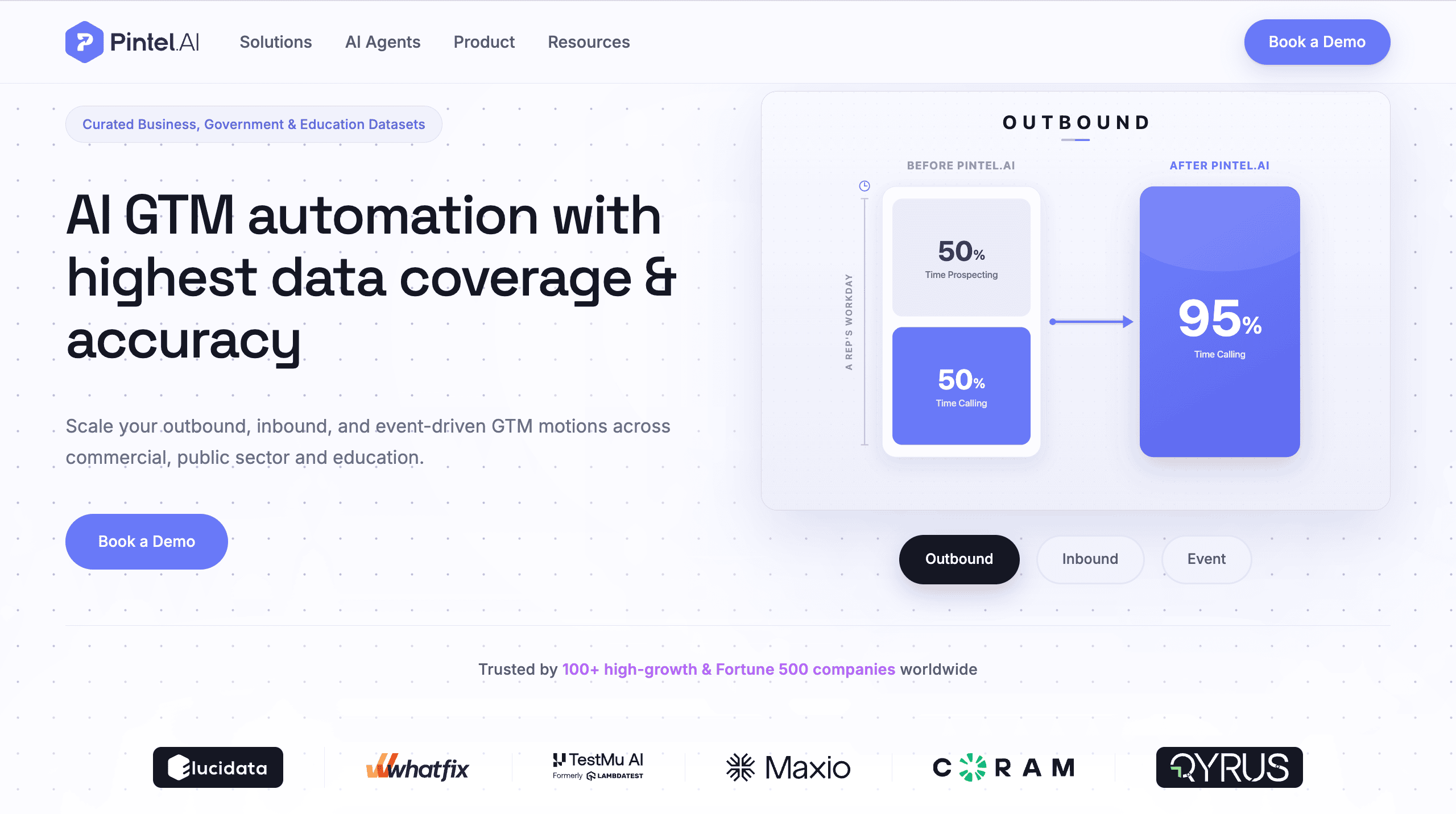
Pintel.ai is an email enrichment platform for B2B sales teams that need to find and enrich work email addresses at scale.
It combines its own database with waterfall enrichment across 20+ data providers. If one source cannot find an email, Pintel checks other sources to increase the chances of finding the missing contact data.
Pintel reports a 95%+ email and phone enrichment rate, making it useful for teams enriching large prospect lists or existing CRM records.
Pintel.ai Email Enrichment Strengths:
- Pintel.ai delivers 95%+ email and phone enrichment through waterfall enrichment across 20+ verified providers.
- Supports bulk email enrichment for large prospect lists and existing CRM records.
- Supports complex filtering, so teams can narrow down the contacts they want to enrich.
- Pintel.ai provides B2B data coverage across EMEA, APAC, public sector, education, and niche industries.
- ISO 27001 and SOC 2 certified, with GDPR, HIPAA, CCPA, and VAPT compliance support.
- Can sync enriched contact data directly to sequencing platforms for outreach.
- Pay only for the verified email and phone data you receive.
- Suitable for small teams, SMBs, and large enterprises.
Cons: Newer brand with less market tenure than legacy providers. No self-serve trial; a scoping call is required before access.
Pricing: Custom
Best for: Teams that need email enrichment for complex ICPs, global target markets, or multiple regions with different compliance requirements.
ZoomInfo Enrich: CRM Enrichment With Stale and Missing Data
ZoomInfo Enrich appends contact emails, direct dials, and firmographics to CRM records using ZoomInfo’s proprietary US-heavy database. The coverage for North American enterprise and mid-market contacts is usable. But you cannot buy enrichment on its own. ZoomInfo sells it as part of the full platform, which means enterprise pricing for what may start as a data quality problem. For smaller teams, that cost rules it out before the evaluation begins.
Strengths:
- Automated CRM sync to Salesforce and HubSpot with US contact data for enterprise and mid-market targets
- SalesOS and MarketingOS enrichment workflows inside the same platform as prospecting and sequencing
Limitations:
- Expensive: no standalone enrichment purchase; you pay for the full platform to access this feature
- Coverage outside North America is weak; EMEA and APAC match rates drop significantly
- No self-serve access; contract negotiation required before you can test it on your actual list
Pricing: Custom enterprise contract; no SMB tier or self-serve trial
Best for: Teams already paying for the ZoomInfo platform whose ICP is concentrated in North American enterprise
ZoomInfo’s enrichment is built on a US-centric database. If your ICP includes any meaningful EMEA or APAC volume, you will need something else alongside it.
Apollo.io: Email Enrichment and Sequencing With Data Accuracy Issues
Apollo.io bundles email enrichment with outreach sequencing in one platform. You get data and sequences under one roof, which removes one hand-off step. The data coverage is weighted toward US tech and SaaS. Outside that segment, accuracy drops and bounce rates climb. Apollo is not a dedicated enrichment platform: the data layer is shared across sequencing and other features, and verification depth is lighter than tools built specifically for enrichment.
Strengths:
- Combines email enrichment and outreach sequencing in one platform.
- Supports prospecting, contact data, and email outreach in the same workflow.
- Self-serve signup, so teams can start using the platform without a sales call.
Limitations:
- Poor coverage outside US tech and SaaS; EMEA, APAC, and non-tech sector bounce rates are noticeably higher
- Credit limits on lower tiers get expensive quickly once list volume scales
- Enrichment verification depth is lighter than dedicated platforms; not built for high-volume accuracy requirements
Pricing: From $49/mo per user (Starter); enrichment credits scale with plan and run out faster than the plan price suggests
Best for: Early-stage SMB teams targeting US tech contacts who want enrichment and sequencing in one tool and have a tight budget
Apollo is a reasonable starting point for a narrow US-tech ICP. It is not the right choice for teams that need accurate data beyond that segment or at high volume.
Clearbit: Contact Enrichment for HubSpot Users
Clearbit, now rebranded as HubSpot Breeze Intelligence, enriches contact and company records in real time at form submit, CRM import, or signup, without a manual trigger. It is a useful tool if you are running HubSpot and your ICP is US tech and SaaS. Outside those two conditions it falls short quickly: coverage thins on non-US and non-tech segments, and the integration is built around HubSpot. If your CRM is Salesforce, the setup that was straightforward in the Clearbit era now requires additional work.
Strengths:
- Enriches contact and company records when new data enters HubSpot.
- Adds company and contact data to existing HubSpot records.
- Built directly into the HubSpot ecosystem.
Limitations:
- Not useful outside HubSpot; Salesforce and other CRM users face integration complexity that defeats the real-time benefit
- Coverage is concentrated in US tech and SaaS; fill rates drop on non-US and non-tech records
- Pricing requires a HubSpot contract plus separate Breeze Intelligence credits; the combined cost is not transparent upfront
Pricing: Custom; Breeze Intelligence credits are purchased separately within a HubSpot contract
Best for: HubSpot-native teams running inbound enrichment for PLG or web-to-CRM workflows with a US SaaS ICP
Clearbit is purpose-built for one scenario: HubSpot, inbound, US tech. Outside that combination, it is the wrong tool for the job.
Lusha: Contact Enrichment With Less Data Coverage
Lusha is a contact enrichment platform accessed through a Chrome extension that overlays contact details on LinkedIn profiles. The data is crowd-sourced and partner-licensed, which means accuracy depends on how recently the database was updated for the specific contact you are searching. Job changes take time to propagate through crowd-sourced datasets, so you can end up with an email that was valid six months ago for someone who has since moved. There is no waterfall: if Lusha does not have the record, that is the end of the lookup.
Strengths:
- Chrome extension for quick contact lookup during LinkedIn research without switching tools
- ISO 27001 certified and GDPR compliant
- Lower per-seat cost than enterprise platforms
Limitations:
- Crowd-sourced data goes stale; accuracy is inconsistent and degrades faster than actively maintained databases
- No waterfall fallback; a missed record is a blank record
- Credit limits on lower plans make it expensive at scale relative to what you actually get
Pricing: From $36/mo per user (Pro plan); credit-based, runs out faster at high prospecting volume
Best for: SDRs doing occasional LinkedIn lookups who need a quick contact overlay and are not running high-volume enrichment
Lusha works for low-volume, LinkedIn-first prospecting. For bulk enrichment or mixed-region ICPs, the single-source ceiling and data staleness become real problems.
Cognism: Contact and Phone Enrichment With High Costs at Scale
Cognism is a sales intelligence platform focused on EU markets and GDPR compliance. Its Diamond Data tier adds mobile numbers verified by a human caller, which matters for teams that run phone outreach. That phone-verified tier costs extra and has credit limits on most plans. Outside Europe, coverage gets thinner: US and APAC records are available but the platform is not built around those markets, and match rates reflect that.
Strengths:
- Provides mobile numbers for sales outreach.
- Supports GDPR and SOC 2 compliance requirements.
- Includes Bombora intent signals for account research and prioritisation.
Limitations:
- Expensive at the phone-verified tier; Diamond Data credits are capped and priced separately from the base plan
- US and APAC coverage is not the platform’s focus; match rates outside Europe drop noticeably
- Custom pricing with no self-serve trial; requires a sales conversation before you can assess real coverage on your ICP
Pricing: Custom; Diamond Data tier priced separately from base enrichment
Best for: EU-focused teams running phone outreach where GDPR compliance and mobile number verification are required
Cognism is a good fit for EU phone-first outreach. If your ICP spans US or APAC, you will need a second data source and the cost adds up.
Clay: Build Your Own Enrichment Workflow, Requires More Technical Setup
Clay is a workflow builder that connects to 75+ data sources and lets teams configure their own multi-source enrichment sequence. There is significant flexibility here. But Clay has no proprietary data of its own. Every source in the waterfall must be selected, connected, and maintained by your team. If you configure it wrong, you get bad data. If a source changes its API, your workflow breaks. There is a real learning curve before you get usable output, and it does not go away once the workflow is built.
Strengths:
- Build enrichment workflows using multiple data sources.
- Create and customize enrichment steps based on your needs.
- Connect enriched data to CRMs, outreach tools, and other platforms.
Limitations:
- Steep learning curve; getting a working, accurate waterfall requires time, testing, and ongoing maintenance
- No proprietary data; output quality depends entirely on which sources you configure and how current they are
- Credits scale with usage and get expensive; the $149/mo entry price grows quickly at meaningful list volume
- Not suitable for teams without a dedicated RevOps function; you are building a data system, not buying one
Pricing: From $149/mo (Starter); credit-based, scales with table row volume and source usage
Best for: RevOps teams with the technical capacity to build and maintain enrichment workflows who want full control over data sources
Clay is a tool-building platform, not a data provider. If your team has the RevOps capacity to build and maintain it, the flexibility is real. If not, you will spend more time maintaining the stack than running outreach.
Hunter.io: Email Finding Without Full Contact Data
Hunter.io finds email addresses by company domain using publicly available web data and pattern inference. It is a simple tool with a simple use case: find an email for someone at a target company. That is where it stops. Hunter does not enrich full contact records, does not append phone numbers or firmographics, and does not integrate natively with CRMs. Pattern-inferred emails also carry more false-positive risk than verified addresses, because the tool is inferring a pattern rather than confirming the specific address exists.
Strengths:
- Quick domain search for finding publicly available email addresses at a specific target company
- Email verifier for cleaning existing lists before sending
- Clean API for integrating email finding into simple automation workflows
Limitations:
- Pattern inference produces false positives; not a substitute for full email verification
- No phone enrichment, no firmographic append, no CRM integration, no ICP filtering
- Not a scalable enrichment solution; runs out of utility fast once you move beyond single-company outreach
Pricing: From $34/mo (Starter, 500 searches); price scales with search volume
Best for: Small teams doing manual, company-specific outreach where you need a handful of verified emails per domain
Hunter is a lookup tool, not an enrichment platform. Do not try to run CRM enrichment at scale through it.
LeadIQ: LinkedIn-Based Enrichment With Limited Data Coverage
LeadIQ captures contact details from LinkedIn profiles and enriches them with email addresses and direct dials from its database. The Chrome extension works at the point of LinkedIn browsing, which reduces the hand-off between research and list building. The problem is that it is built around LinkedIn. Contacts that did not come from LinkedIn are not enriched from alternative sources. And coverage outside US tech is noticeably thinner, which you typically discover in bounce reports after the campaign has already run.
Strengths:
- LinkedIn-native capture with enrichment in one step; reduces tool-switching for SDRs doing profile-based prospecting
- Direct CRM push to Salesforce, HubSpot, Outreach, and Salesloft without a manual export step
- Signals feature for tracking job changes and leadership moves for outreach timing
Limitations:
- LinkedIn-dependent; if a contact was not sourced from LinkedIn, there is no alternative enrichment fallback
- Coverage outside US tech drops significantly; EMEA and APAC contacts produce lower fill rates and higher bounce risk
- Credit-based pricing gets expensive at scale; the freemium tier gives 20 credits per month, which is not meaningful for active SDR teams
Pricing: From $36/mo per user (Essential); freemium at 20 credits per month
Best for: SDR teams doing LinkedIn-first prospecting with a US tech ICP who need quick profile-to-CRM capture
LeadIQ works if your ICP lives on LinkedIn and sits in US tech. Beyond those two conditions, the coverage gaps compound into a bounce problem.
Dropcontact: Email Enrichment With Limited Coverage Outside Europe
Dropcontact is a GDPR-native email enrichment tool built specifically for French and Western European markets. It finds and verifies emails algorithmically without storing personal data on third-party servers, which satisfies strict EU compliance requirements. Outside Europe, it does not work well. US and APAC contacts return low fill rates, and the tool does not append phone numbers, firmographics, buying signals, or intent data. B2B contact data loses 25 to 30 percent of its accuracy every year, so even a fully EU-compliant list needs regular re-enrichment to stay usable.
Strengths:
- Finds and enriches work email addresses for B2B contacts.
- Built around GDPR and data privacy requirements.
- Integrates with Salesforce, HubSpot, Pipedrive, and Lemlist.
Limitations:
- Coverage is primarily France and Western Europe; US and APAC records return poor match rates
- No phone numbers, firmographic data, intent signals, or buying signal detection
- Very narrow use case; if you need anything beyond email enrichment for EU contacts, you need another tool
Pricing: From $24/mo (25 enrichments); scales with volume
Best for: France-based and Western European teams where GDPR-native architecture and no third-party data storage are hard compliance requirements
Dropcontact solves one problem well: GDPR-compliant email enrichment for EU and French contacts. For anything outside that scope, it is not the right tool.
The tools above solve different email enrichment needs and come with different limitations. Before choosing one, here are the key things to compare.
What Should You Look for in Email Enrichment Tools?
When comparing email enrichment tools for B2B sales, check these six things before choosing one:
Does It Cover Your B2B Market?
Some email enrichment tools have stronger data in the US, while others have better coverage in Europe or other regions. If your B2B sales team targets multiple markets, test the tool with your actual prospect list before buying.
Does It Verify B2B Email Addresses?
Finding a work email is not enough if it bounces. Check whether the tool verifies B2B email addresses before returning them.
What Happens When It Cannot Find a B2B Contact?
Some email enrichment tools rely on a single database. Others check multiple data sources when the first source cannot find the contact. This can make a big difference in how many B2B contacts you can actually enrich.
Does It Provide the B2B Contact Data You Need?
Some tools focus mainly on work email addresses, while others also provide phone numbers, LinkedIn profiles, and other contact data. Choose based on the data your B2B sales team actually needs.
Does It Meet Your B2B Compliance Requirements?
If you sell to companies in Europe, regulated industries, or enterprise accounts, check the vendor’s data privacy practices and compliance standards before buying.
Will the Pricing Work as Your B2B Data Volume Grows?
A tool may look affordable for a small list but become expensive as your enrichment volume grows. Check how credits, usage limits, and pricing change before committing.
Once you know what to look for, the next step is choosing the email enrichment tool that best fits your team’s needs.
Which Email Enrichment Tool Should Your Team Choose?
The right email enrichment tool depends on your target market, workflow, and the type of data you need.
If You Target Multiple Markets
Choose a tool with broad data coverage or multiple data sources. A single database may leave more contacts without an email as you expand into different regions or industries.
If Your Team Prospects on LinkedIn
Look for a tool that fits directly into your prospecting workflow and can enrich the contacts your team finds.
If You Need Ongoing Enrichment
Choose a tool that supports API or CRM enrichment if you need to automatically enrich new or existing contacts.
If You Need More Control
Some platforms let you build and manage your own multi-source enrichment workflows, while others handle the data sourcing and enrichment process for you.
The right email enrichment tool should help your team find usable contact data before outreach begins, not after.
Frequently Asked Questions About Email Enrichment Tools
What are the best email enrichment tools for B2B sales?
The right email enrichment tool depends on your target market, data volume, and the type of contact data you need. Some tools focus mainly on finding and verifying work emails, while others also provide phone numbers, company data, and multi-source enrichment.
What is email enrichment?
Email enrichment is the process of adding missing work email addresses to existing contact records. A team can enrich CRM records, prospect lists, or other B2B contact data.
How does email enrichment work?
An email enrichment tool uses the information already available about a contact, such as their name, company, or LinkedIn profile, to find a matching work email address. Some tools use one data source, while others check multiple sources when the first one cannot find the contact.
What is the difference between email enrichment and email verification?
Email enrichment finds a missing email address. Email verification checks whether an email address is valid and safe to use for outreach. A tool may offer one or both.
What is waterfall email enrichment?
Waterfall email enrichment checks multiple data sources in sequence. If the first source cannot find an email address, the tool checks the next source. This can help improve enrichment coverage compared with relying on only one data source.
Can you enrich an existing CRM contact list?
Yes. Many email enrichment tools allow teams to upload or connect an existing CRM contact list and add missing email addresses and other contact data.
Can email enrichment tools also find phone numbers?
Some email enrichment tools only focus on work email addresses. Others can also add direct phone numbers, LinkedIn profiles, company information, and other B2B contact data.
How accurate are email enrichment tools?
Accuracy depends on the provider, target market, data sources, and verification process. The best way to evaluate a tool is to test it on a sample of your actual prospect or CRM list.
Should I choose a single-source or waterfall email enrichment tool?
A single-source tool checks one main database. A waterfall enrichment tool checks multiple sources when the first source cannot find the contact. Waterfall enrichment can be useful when your target list includes different markets, industries, or company types.
How much do email enrichment tools cost?
Pricing varies based on the platform and enrichment volume. Some tools charge per user, while others use credits or charge based on the number of records enriched. Check how costs change as your contact volume grows before choosing a tool.