A leading digital adoption platform needed a better way to identify US companies and government organizations undergoing meaningful digital transformation, uncover hard-to-find stakeholders, and eliminate disconnected manual research.
By combining public signals, traditional company data, CRM records, and unstructured web sources, the company built a more precise account discovery and stakeholder mapping workflow.
Company Snapshot
| Details | |
|---|---|
| Industry | Digital Adoption Platform |
| Target Market | US Enterprises & Government Organizations |
| Target Buyers | IT & Learning and Development Teams |
| Use Case | Account Discovery, Signal-Based Qualification & Stakeholder Mapping |
| Challenge | Identifying accounts undergoing active digital transformation and finding hard-to-reach stakeholders |
| Data Sources | Public Signals, Traditional Data, CRM & Web Directories |
| Outcome | Signal-based account selection and automated lead-to-account matching |
The Challenge: Traditional Data Created an Enterprise Blind Spot
The company sold its digital adoption platform to IT and Learning and Development teams across US enterprises and government organizations.
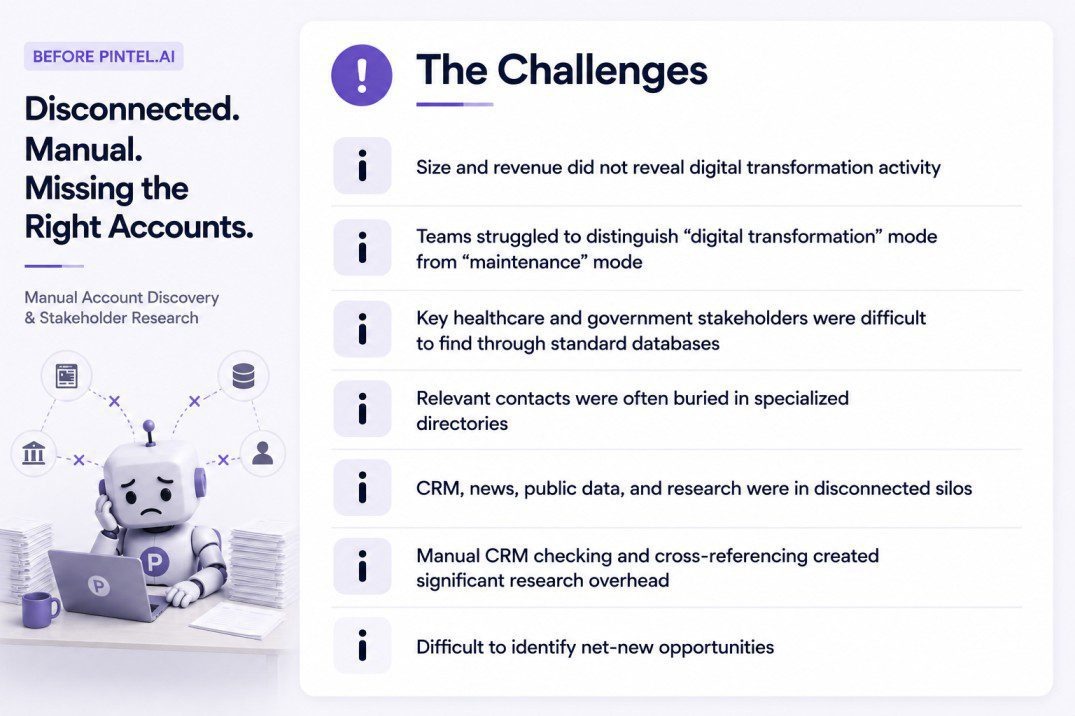
However, traditional company data could show basic attributes such as company size and revenue but couldn’t reliably distinguish between organizations actively investing in digital transformation and those primarily focused on maintaining existing systems.
The challenge became even more complex in healthcare and government, where relevant stakeholders were often buried in specialized directories and difficult to identify through conventional prospecting sources.
Key Challenges
✓ Company size and revenue couldn’t reveal which accounts were actively undergoing digital transformation
✓ Teams struggled to distinguish accounts in “digital transformation” mode from those in “maintenance” mode
✓ Key healthcare and government stakeholders were difficult to find through standard contact databases
✓ Relevant contacts were often buried in specialized web and government directories
✓ CRM, news, public data, and prospecting research existed in disconnected silos
✓ Manual CRM checking and cross-referencing created significant research overhead
How Pintel.AI Helped
Combined Public Signals, Company Data, and CRM Records
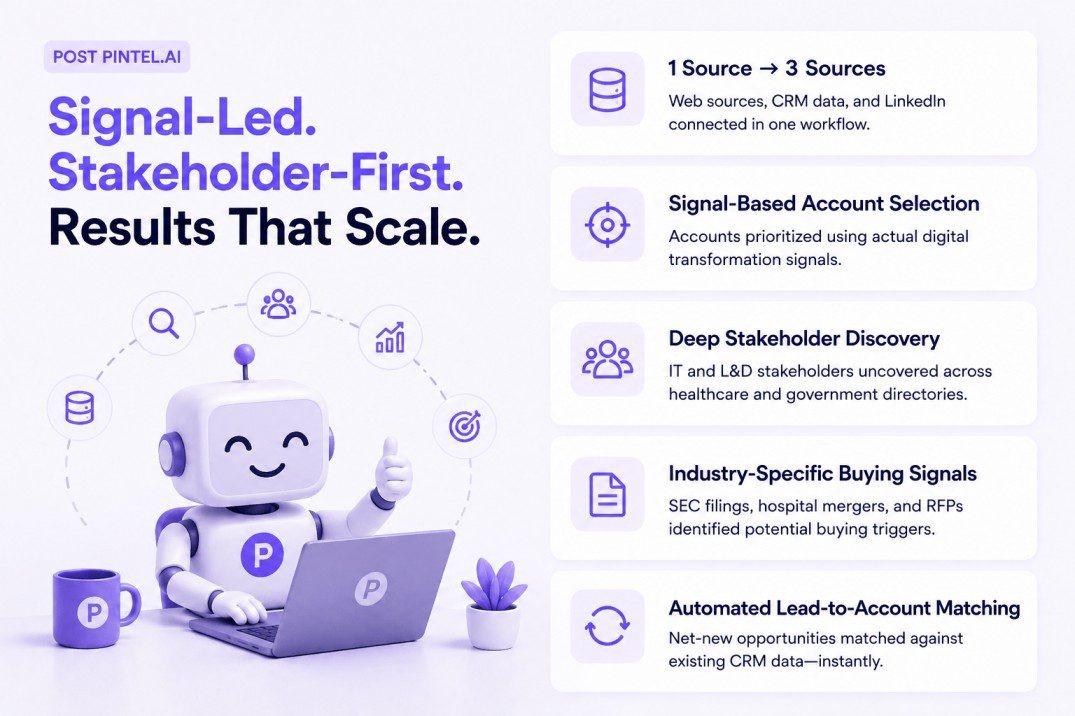
Pintel.AI cross-referenced public signals, traditional company data, and existing CRM records to identify relevant accounts while filtering for net-new opportunities.
Identified Accounts Using Actual Digital Shift Signals
Instead of selecting accounts based only on company size or revenue, Pintel.AI used signals indicating active organizational and digital change to improve account qualification.
Found Stakeholders in Unstructured Web Directories
Pintel.AI identified relevant IT and training stakeholders across healthcare and government directories, expanding prospect discovery beyond surface-level contact databases.
Detected Buying Signals Across Industries
Pintel.AI analyzed sources such as SEC 10-K filings, hospital merger activity, and RFPs to identify account-specific signals and potential buying triggers.
Automated Lead-to-Account Matching
Prospect and account intelligence was connected back to existing CRM data, reducing the need for manual CRM checking and account matching.
Results Achieved
Expanded from 1 Data Source to 3
The team moved from relying primarily on a single data source to combining web directories, CRM data, and LinkedIn in one research workflow, giving account and stakeholder research broader coverage.
More Precise Account Selection
The team moved beyond company size and revenue to identify organizations showing actual digital transformation signals, helping distinguish accounts in active transformation mode from those primarily maintaining existing systems.
Deeper Healthcare and Government Stakeholder Discovery
Instead of relying only on surface-level contact data, the team could identify relevant IT and Learning and Development stakeholders across specialized healthcare, government, and web directories.
Better Identification of Net-New Accounts
External account intelligence was cross-referenced with existing CRM data, helping the team separate net-new opportunities from accounts already known to the business.
Automated Lead-to-Account Matching
Prospects could be matched against existing CRM accounts automatically, reducing the need for manual CRM checking and account reconciliation.
More Scalable Enterprise Research
The team could research complex enterprise, healthcare, and government accounts using one connected workflow instead of manually working across disconnected data sources.
Customer Outcome
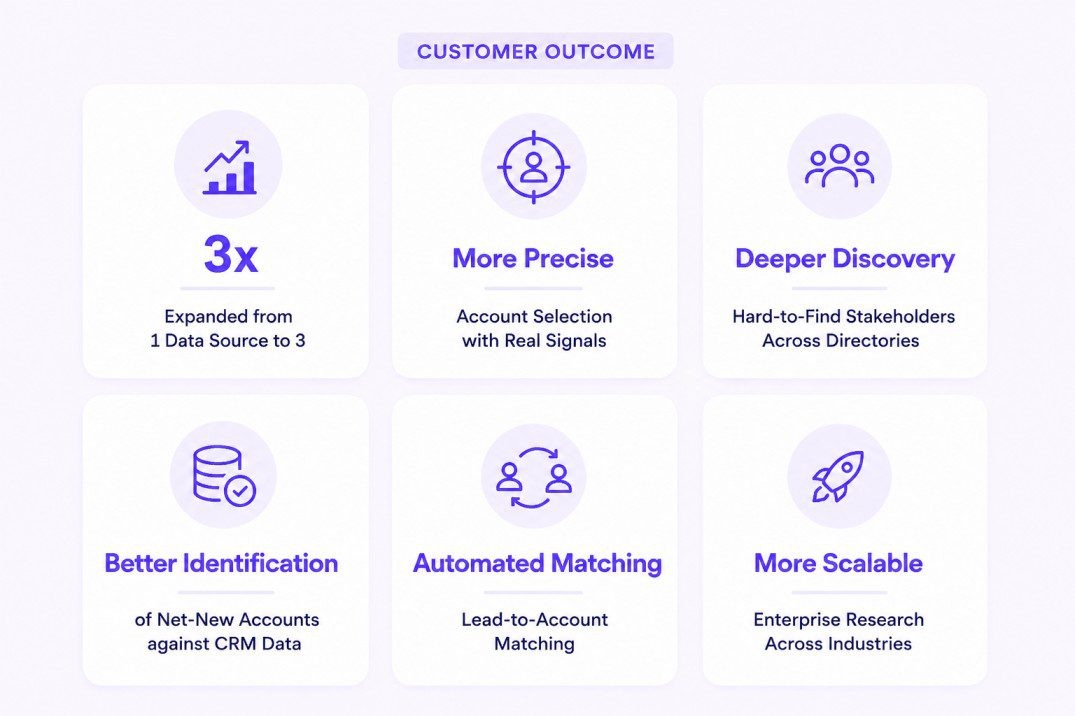
What was once a fragmented research process became a multi-source account intelligence workflow capable of identifying digital transformation signals, discovering hard-to-find stakeholders, and connecting new prospects with existing CRM data.
Instead of selecting accounts primarily by company size or revenue, the team could prioritize organizations based on actual signs of digital change. At the same time, deeper research across healthcare, government, and public sources expanded access to stakeholders that conventional prospecting databases often missed.
What Became Possible with Pintel.AI
✓ Accounts prioritized using digital transformation signals
✓ Public signals, traditional data, and CRM records cross-referenced
✓ Net-new accounts identified against existing CRM data
✓ Healthcare and government stakeholders discovered through deeper directories
✓ SEC 10-K filings analyzed for relevant account signals
✓ Hospital merger activity incorporated into account research
✓ RFP activity used to identify potential buying triggers
✓ Manual CRM checking reduced through automated lead-to-account matching
✓ Enterprise account research scaled across multiple data sources

Frequently Asked Questions
Why wasn’t traditional firmographic data enough for account selection?
Company size and revenue could indicate whether an organization fit the company’s broad target market, but they couldn’t show whether the account was actively undergoing digital transformation or primarily maintaining existing systems.
How did Pintel.AI identify accounts undergoing digital transformation?
Pintel.AI cross-referenced public signals, traditional company data, and CRM information to identify account-level indicators of organizational and digital change.
How did Pintel.AI find healthcare and government stakeholders?
Pintel.AI extended prospect research beyond conventional contact databases by identifying relevant stakeholders across specialized healthcare and government web directories.
What data sources were used for account research?
The workflow combined public signals, traditional company data, CRM records, web directories, SEC 10-K filings, hospital merger activity, and RFPs.
How did Pintel.AI identify net-new accounts?
External account intelligence was cross-referenced with existing CRM records, helping the team identify accounts that were not already part of its known account universe.
How did Pintel.AI reduce manual CRM work?
Automated lead-to-account matching reduced the need for sales teams to manually check prospects and accounts against existing CRM records.
Can Pintel.AI identify industry-specific buying signals?
Yes. In this workflow, Pintel.AI analyzed sources such as SEC 10-K filings, hospital merger activity, and RFPs to identify signals relevant to the company’s target markets.