If you’re evaluating Australia company databases, you’ll quickly find that most vendors make similar claims about coverage and data quality. What they rarely explain is where their company data comes from, how often it’s updated, and which types of Australian businesses they’re actually strongest at.
Those differences matter more than most buyers realize because they directly affect the companies you discover, the quality of your target account list, and the opportunities your team can actually pursue.
To make that comparison easier, we’ve reviewed 10 Australia company databases based on company coverage, data quality, sourcing, refresh frequency, pricing, and the teams they’re best suited for.
What Is an Australia Company Database?
An Australia company database is a structured collection of business records, company names, industry classification, size, and often contacts, covering companies operating across Australia’s states and territories.
The distinction that matters most is sourcing. A database built mainly from LinkedIn activity will reflect wherever LinkedIn usage concentrates. A database that blends that with proprietary or verified company data reaches further into companies with a lower LinkedIn footprint.
What Information Does an Australia Company Database Include?
Most Australia company databases include a combination of company and firmographic information to help sales, marketing, and RevOps teams identify target accounts. Depending on the provider, you’ll typically find:
- Company name and website
- Industry and business classification
- Employee count
- Revenue (where available)
- Headquarters and office locations
- ABN or ACN identifiers
- Technology stack
- Funding and growth signals
- Parent and subsidiary relationships
- Decision-maker contacts (for providers that include contact data)
Not every provider includes all of these fields. Some focus on company records, while others combine company data with contact information, buying signals, or sales intelligence capabilities.
10 Best Australia Company Databases: Quick Comparison
Here is how the 10 options compare on data sourcing model, entity resolution, and pricing.
| Provider | Australia Sourcing Model | Entity Resolution | Coverage Beyond Sydney/Melbourne | Starting Price | Best For |
|---|---|---|---|---|---|
| Pintel.ai | LinkedIn-sourced data plus proprietary data | Multi-source cross-verification | Moderate to broad, depends on ICP | Contact sales | Teams needing Australia coverage plus global reach |
| ZoomInfo | Community-contributed database | Firmographic fields only | Concentrated in large cities | $15,000+/yr | Global teams with Australia as a secondary market |
| Apollo.io | LinkedIn-derived plus database | Basic | Sydney, Melbourne-heavy | From $49/mo | SMB teams needing bundled database and sequencing |
| D&B Hoovers | Business registry and credit data | Strong, credit-bureau grade | Broad across major industries | Contact sales | Enterprise teams screening by financial fit |
| Cognism | Licensed plus phone-verified data | Firmographic fields only | Limited outside major cities | Contact sales | Phone-heavy outbound teams |
| Lusha | LinkedIn extension | None | Limited to LinkedIn-indexed profiles | From $49/mo | Individual reps doing manual lookups |
| Clearbit (HubSpot) | US/EU-focused enrichment sources | Basic | Limited outside major cities | Custom (HubSpot tiers) | HubSpot teams enriching inbound Australian leads |
| Crunchbase | Startup and funding-focused database | Basic | Strong for funded startups only | From $29/mo | Teams tracking Australian startup funding |
| illion | Credit bureau and business registry data | Strong, credit-bureau grade | Broad, including regional businesses | Contact sales | Credit risk and financial screening |
| Kompass | Business directory listings | Basic | Broad but listing-only, low signal depth | Contact sales | Bulk directory-style outreach |
This comparison is based on first-hand platform knowledge, publicly available product information, and commonly reported user experiences. Contact each vendor directly for the latest pricing and product details.
Most tools reach Sydney and Melbourne reliably, then vary widely on everything else. The reviews below explain what each Australia company database actually delivers.
How We Evaluated These Australia Company Databases
This comparison rates each provider against five criteria specific to the Australian market, not a generic global feature checklist:
- Sourcing transparency: whether the provider discloses if its Australian records come from LinkedIn activity, licensed registry data, credit-bureau data, or a blend
- Entity resolution method: whether companies are matched using a stable identifier like an ABN or ACN, or by name alone
- Coverage spread: how far records extend beyond Sydney and Melbourne into other states and territories
- Signal depth: whether the provider tracks ongoing changes such as funding, hiring, or leadership moves, or only static firmographic fields
- Pricing clarity: whether starting price and plan structure are published or require a sales conversation to uncover
What to Look for in an Australia Business Database
The most common mistake when evaluating an Australia business database is assuming a large global record count automatically means solid Australia-specific coverage. What matters is how the database sources and resolves Australian company records specifically.
A useful way to check this is what we call the LinkedIn-Plus Check. The LinkedIn-Plus Check looks at whether a database combines LinkedIn-sourced data with proprietary or verified data, resolves companies using a stable identifier rather than name matching alone, and extends at least moderately beyond the two largest cities. Run these checks before committing to any Australia company database:
- Sourcing blend: Does the provider combine LinkedIn-derived data with proprietary or licensed data, or rely on LinkedIn scraping alone?
- Entity resolution: Does the database resolve companies using a stable identifier such as an ABN (Australian Business Number) or ACN (Australian Company Number), or match on company name alone, which is prone to duplicates?
- Coverage spread: Does coverage extend at least moderately into Perth, Brisbane, and Adelaide, or concentrate almost entirely in Sydney and Melbourne?
- Record freshness: How often are Australian company records refreshed against real business changes?
- Signal layer: Can the platform track funding, hiring, and leadership changes for Australian companies, or does it stop at static firmographic records?
- ICP scoring readiness: Does the data arrive structured enough to plug into an ICP scoring model, or does it need significant manual cleanup first?
Choosing an Australia company database is really one part of the broader question of how sales teams choose B2B data providers generally. The checks above are the Australia-specific version of that same evaluation discipline.
According to Gartner’s research on go-to-market data strategy, sourcing model transparency is one of the clearest early signals of long-term data reliability. Salesforce’s State of Sales report points to a related pattern, teams expanding into markets outside their primary database’s home region consistently underestimate how much accuracy varies by sourcing model, not just database size.
10 Australia Company Databases Reviewed in Detail
With those checks in mind, here is what each Australia company database actually delivers.
Pintel.ai
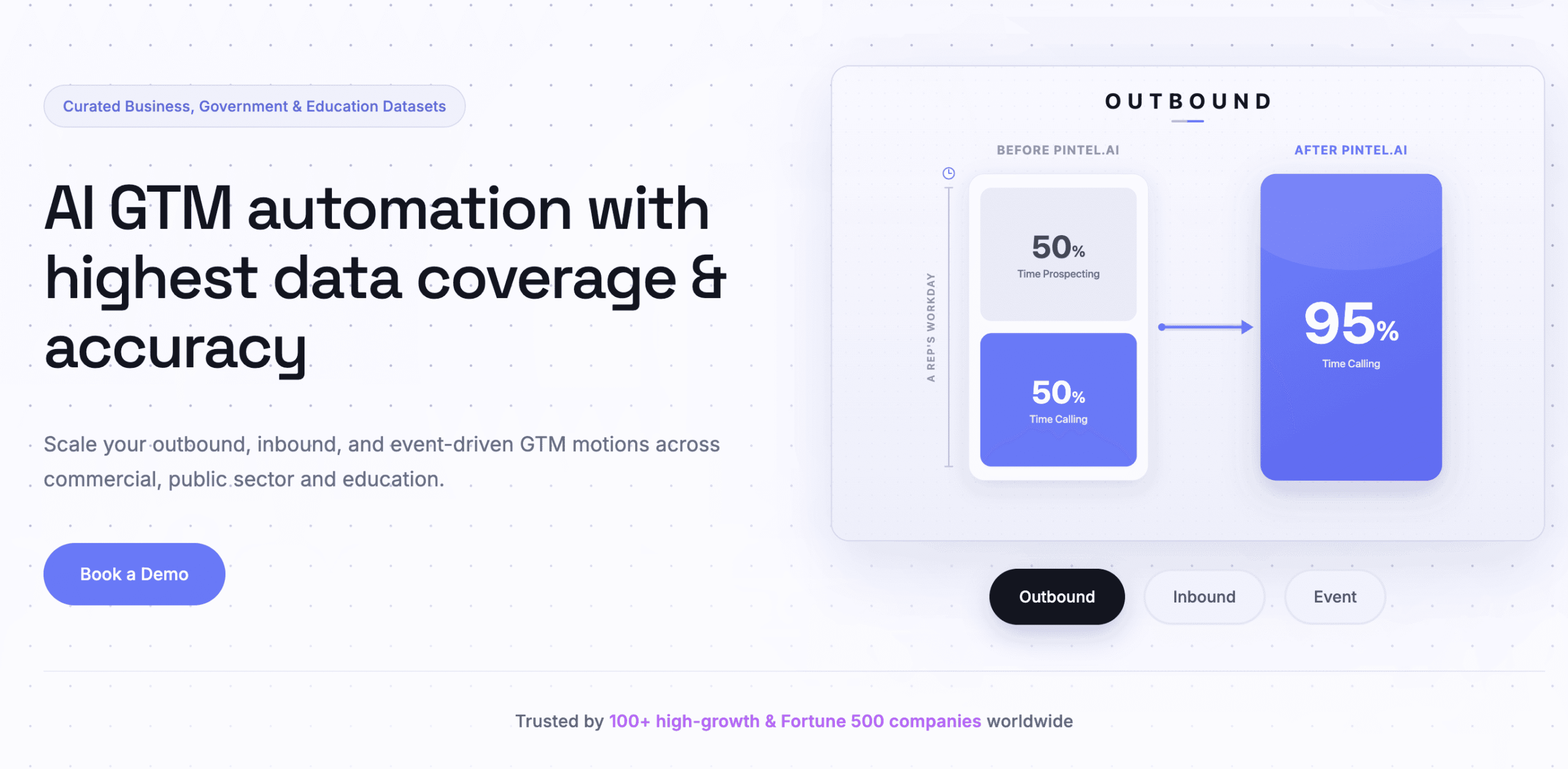
Pintel.ai combines LinkedIn-sourced cPintel.ai helps GTM teams find the right Australian companies, not just search a static Australia company database. It combines proprietary Australian company data with waterfall enrichment across multiple data providers to deliver broader company coverage, more accurate company records, and verified decision-makers.
Teams can also identify buying signals like funding, acquisitions, leadership changes, hiring activity, and technology adoption to prioritize the right Australian accounts for outreach.
Strengths
- Find Australian companies that match your ideal customer profile using filters like industry, company size, revenue, location, technology stack, and other firmographic data.
- Access accurate Australian company data by combining proprietary data with waterfall enrichment across multiple trusted data providers.
- Discover buying signals such as funding rounds, acquisitions, new leadership hires, expansion plans, hiring activity, and technology changes to prioritize accounts.
- Find verified decision-makers with work email addresses and phone numbers alongside Australian company records.
- Build complete target account lists with Australian company data, contact data, and buying signals from one platform instead of using multiple tools.
- Expand beyond Australia with global company data and contact coverage across APAC, North America, and EMEA.
- Enterprise-ready with ISO 27001, SOC 2 (AICPA), GDPR, HIPAA, CCPA, and VAPT certifications.
Pricing: Contact sales
Best for: Teams looking for an Australia company database with accurate Australian company data, verified decision-makers, and buying signals in one platform.
Pintel.ai is a reasonable option for teams that want Australia coverage alongside global reach, though newer to the market than established local providers.
ZoomInfo
ZoomInfo’s Australian coverage reflects its US-primary, community-contributed sourcing model: solid for large multinational subsidiaries, thinner for Australian mid-market and SMB companies.
Strengths
- Reasonable coverage of large Australian enterprises and multinational subsidiaries
- Established CRM integrations for teams already on Salesforce or HubSpot
Limitations
- Coverage concentrates in large cities, with limited depth for Australian mid-market and SMB companies.
Pricing: $15,000+/yr (custom)
ZoomInfo is best for global teams that need Australia as a secondary market, but falls short as a primary Australia company database.Teams finding the pricing hard to justify for Australia-specific coverage may want to compare ZoomInfo alternatives built for a more targeted footprint.

Apollo.io
Apollo.io offers a database and sequencing tool at accessible pricing, but its Australian data leans on LinkedIn-derived records, concentrating coverage in Sydney and Melbourne.
Strengths
- Reasonable coverage of Australian tech and SaaS companies in major hubs
- Built-in sequencing at SMB-friendly pricing
Limitations
- Coverage of Perth, Brisbane, Adelaide, and regional Australia is thin.
Pricing: From $49/mo
Apollo.io is best for SMB teams needing Australian tech hub coverage, but falls short once the ICP extends beyond Sydney and Melbourne.
D&B Hoovers
D&B Hoovers draws on Dun & Bradstreet’s business registry and credit data for solid Australian firmographic coverage, but contact-level depth trails purpose-built prospecting tools.
Strengths
- Strong firmographic and credit-related data across major Australian industries
- Entity resolution grounded in credit-bureau-grade business identifiers
Limitations
- Contact-level depth trails purpose-built prospecting tools.
Pricing: Contact sales
D&B Hoovers is best for enterprise teams screening Australian companies by financial and firmographic fit, but falls short on contact-level prospecting depth.
Cognism
Cognism provides licensed, phone-verified contact data with a strong UK and Western Europe base, but Australian coverage is limited compared to its core markets.
Strengths
- Phone-verified contact data where covered
- GDPR-aligned data handling practices
Limitations
- Australian coverage is limited outside major cities compared to its core European markets.
- Fewer Australia-specific case studies to benchmark expected accuracy against before committing.
Pricing: Contact sales
Cognism is best for phone-heavy outbound teams already using it in other markets, but falls short as a standalone Australia company database.
Lusha
Lusha delivers contact data through a LinkedIn browser extension, useful for individual lookups, but it cannot build target account lists from scratch and covers only LinkedIn-indexed profiles.
Strengths
- Quick contact lookup for individual reps browsing LinkedIn
- Low friction for one-off lookups
Limitations
- Cannot build account lists proactively; covers only LinkedIn-indexed profiles.
- No signal layer or ICP scoring, so prioritization is left entirely to the rep.
Pricing: From $49/mo
Lusha is best for individual reps doing manual LinkedIn lookups, but falls short for building an Australia company database from scratch.
Clearbit (HubSpot)
Clearbit, now part of HubSpot, enriches inbound leads well for companies with a US or EU digital footprint, but Australian coverage outside that overlap is limited.
Strengths
- Good enrichment for Australian companies with US or EU operations
- Native HubSpot integration for teams on that CRM
Limitations
- Australian SMBs without an international footprint are largely uncovered.
- Built for inbound enrichment, not outbound account discovery from scratch.
Pricing: Custom (HubSpot tiers)
Clearbit is best for HubSpot-native teams enriching inbound Australian leads, but falls short for outbound-first Australia coverage.
Crunchbase
Crunchbase tracks Australian startups and funding activity well, but its depth drops sharply for established or non-tech Australian businesses.
Strengths
- Strong tracking of Australian startup funding rounds and investors
- Useful for timing outreach around funding events
Limitations
- Limited coverage of established, non-funded, or non-tech Australian companies.
- Contact-level data is thin compared to dedicated prospecting tools.
Pricing: From $29/mo
Crunchbase is best for teams tracking Australian startup funding activity, but falls short as a general Australia company database.
illion
illion, formerly Dun & Bradstreet Australia, provides credit bureau and business registry data with broad reach across Australian industries, including regional businesses, but it is not built for outbound sales prospecting.
Strengths
- Broad coverage including regional and non-metro Australian businesses
- Credit-bureau-grade entity resolution and business verification
Limitations
- Built for credit risk and financial screening, not outbound contact discovery.
- No buying signal layer for timing outbound outreach around active triggers.
Pricing: Contact sales
illion is best for credit risk and financial screening, but falls short as a sales prospecting database.
Kompass
Kompass operates as a global business directory with broad Australian listings, but data is largely static and lacks a signal or scoring layer.
Strengths
- Broad directory-style coverage across industries and regions
- Simple to search for basic firmographic listings
Limitations
- No buying signals or ICP scoring layer; listing-style data ages between updates.
- Contact-level detail is minimal, mostly firmographic listing information.
Pricing: Contact sales
Kompass is best for bulk directory-style outreach, but falls short for signal-based or ICP-filtered prospecting.
That covers all 10 Australia company databases on this list. For teams also expanding into the wider region, our guide to APAC B2B data providerscovers the broader picture, and teams comparing Commonwealth markets may find our Canada company databases guide useful for a side-by-side view.
How to Choose the Right Australia Company Database
The right choice depends on which part of the Australian market your ICP actually touches, not which provider has the largest global record count.
If your ICP is Sydney and Melbourne tech and finance: Most LinkedIn-derived tools will show reasonable coverage here, since this segment is where Australian LinkedIn activity concentrates. That coverage will not extend evenly to the rest of the country.
If your ICP includes Perth, Brisbane, Adelaide, or regional Australia: A database that blends LinkedIn-sourced data with proprietary data, like Pintel.ai, is more likely to reach companies with a lower LinkedIn footprint than a LinkedIn-only tool.
If your ICP spans Australia plus other regions: A firmographic data provider with genuine global reach, not a single-country tool, avoids managing separate subscriptions per market. Pintel.ai’s combined sourcing approach is built for exactly this case.
If you are tracking startup funding activity specifically: This is a narrow, specific need, separate from broad company discovery. Most general-purpose Australia company databases, Pintel.ai included, are built for full-market prospecting rather than funding-event tracking alone.
Before committing to any provider, pull 20 to 25 records from your actual Australian ICP, including a few outside Sydney and Melbourne, and check accuracy by hand. Teams that build a target account list this way before committing avoid discovering coverage gaps after a contract is signed.
Final Takeaway: Picking an Australia Company Database That Fits Your ICP
The best Australia company database is not the one with the largest global record count. It is the one whose sourcing model actually matches where your ICP lives, whether that is Sydney and Melbourne specifically or a broader spread across the country.
Teams that rely on a LinkedIn-only database for Australian outbound typically find solid coverage in the largest cities and thinner coverage everywhere else. A database blending LinkedIn-sourced and proprietary data reduces that gap without requiring a separate credit-bureau subscription just to fill it.
For a company database in Australia that needs to support a full national outbound motion, checking the sourcing model and entity resolution method matters more than checking the total record count.
FAQ: Australia Company Databases
What is the best Australia company database for B2B sales?
The best Australia company database depends on your ICP’s geography and industry. Providers blending LinkedIn-sourced and proprietary data reach further beyond Sydney and Melbourne than LinkedIn-only tools.
Why do some Australia business databases miss companies outside Sydney and Melbourne?
Many databases source primarily from LinkedIn activity, which concentrates in Australia’s largest business hubs. Companies with a lower LinkedIn footprint, especially outside major cities, get underrepresented as a result.
What is an ABN or ACN, and why does it matter for company databases?
An ABN (Australian Business Number) and ACN (Australian Company Number) are official Australian business identifiers. Databases that resolve companies using these identifiers avoid the duplicate and mismatched records that name-only matching creates.
What is the difference between an Australia company database and a US company database?
An Australia company database typically covers a smaller, more concentrated market, with coverage often skewed toward Sydney and Melbourne. A US company database usually spans a much larger, more geographically distributed set of records.
How do I verify an Australia business database provider before buying?
Pull 20 to 25 records from your real Australian ICP, including some outside Sydney and Melbourne. Check accuracy, entity resolution, and how current the records are before committing.
Which Australia company database covers startups best?
Crunchbase specializes in tracking Australian startup funding and investor activity. For broader company discovery beyond funded startups, a general-purpose Australia company database with wider sourcing covers more ground.
Does an Australia business database need a signal layer?
It depends on your motion. Static firmographic data is enough for basic list-building, but teams timing outreach around funding, hiring, or leadership changes need a database with an active signal layer.
Is Australian company data harder to source than US company data?
Not structurally, Australia has a unified national business register through ASIC. The practical gap comes from tools sourcing mainly through LinkedIn, which concentrates coverage in Sydney and Melbourne regardless of the underlying registry system.