A RevOps (Revenue Operations) manager buys a company database expecting it to double as a contact list, then finds zero verified emails once the trial ends. Another team buys a contact finder expecting detailed company and funding data, and gets neither. Both bought a provider of US B2B data. Neither bought the right one.
US B2B data providers aren’t one category. Some sell company and firmographic records. Others focus on verified contact data, while a few provide predictive intent signals instead of raw records. Providers also differ in how they source, verify, and handle data, and what compliance practices they follow.
This guide compares 10 providers of US B2B data based on the data they deliver, sourcing and verification methods, pricing, and compliance considerations, so RevOps and sales leaders can match the provider to their actual data gap.
Quick Comparison: 10 B2B Data Providers in the USA
Here is how the top B2B data providers in the USA compare on the data layer they actually deliver.
| Provider | What It Actually Provides | Data Sourcing Model | Contact-Level Depth | Starting Price |
|---|---|---|---|---|
| Pintel.ai | Verified contacts, company data, and buying signals in one platform | Waterfall enrichment across 30+ vetted providers plus proprietary US sources | High: 95%+ match rate with profile-level filtering | Contact sales |
| D&B Hoovers | Company, firmographic, and org chart data | Proprietary Dun and Bradstreet company database | Basic; contact credits are billed separately from company credits | From $49/mo (Essentials tier) |
| Data Axle | US business and consumer data for list building | In-house verification team, not aggregation | Moderate; phone and email included, no intent layer | Contact sales |
| Crunchbase | Company, funding, and investor data | Licensed data, user submissions, and applied AI | Low; contact unlocks are limited even on paid tiers | From $99/user/mo |
| 6sense | Account-level buying intent and predictive scoring | Predictive AI layered on third-party contact data partners | Low direct; contact data comes through partners, not natively | Contact sales |
| ZoomInfo | US enterprise contact and company data | Community-contributed profiles plus licensed data | High for enterprise; drops for mid-market | From ~$15,000/yr (entry-level estimate) |
| Apollo.io | Contact data bundled with email sequencing | Web crawling and a data contributor network | Moderate; strongest in tech-sector accounts | From $59/user/mo |
| Lusha | Mobile numbers and direct contact lookups | Chrome extension capture from LinkedIn profiles | High for direct dials; no company or funding data | From $29-36/user/mo |
| HubSpot Breeze Intelligence (formerly Clearbit) | Firmographic and technographic enrichment inside HubSpot | Enrichment API layered onto existing records | Moderate; enriches records you already have, does not build new lists | From $45/mo (HubSpot add-on) |
| LeadGenius | Custom target lists for complex ICPs | Human researchers plus AI, not a searchable database | High but slow; built per request, not instant | Contact sales |
This comparison is based on first-hand platform knowledge, publicly available product information, and commonly reported user experiences. Contact each vendor directly for the latest pricing and product details.
What Is a B2B Data Provider in the USA?
A B2B data provider in the USA supplies company records, contact details, buying signals, or compliance information to sales and marketing teams.
These providers typically cover four areas:
- Company data: Industry, revenue, employee count, funding, and other firmographic details.
- Contact data: Verified emails, direct dials, and mobile numbers.
- Intent data: Signals that indicate potential buying interest.
- Compliance: Data sourcing, privacy practices, and support for requirements such as CCPA and CAN-SPAM.
Some providers specialize in one area, while others combine multiple data types in a single platform. Knowing which data you need and how the provider sources and handles it is the first step in choosing the right one.
How We Evaluated These B2B Data Providers USA
Every one of these B2B data providers in the USA was scored against the same eight-criteria Data Fit Framework, not brand size or market share, so the ranking reflects what each tool actually delivers for a sales team.
- 1. US coverage: Does it draw on proprietary US sources, or license the same records other providers resell?
- 2. Company data depth: How complete are firmographic details such as industry, revenue, employee count, and funding history?
- 3. Contact data depth: How current and complete is direct-dial and email coverage for named contacts?
- 4. Data sourcing: Is the data a self-serve database, a human-verified managed service, an enrichment add-on, or a predictive AI layer?
- 5. Verification: How is accuracy checked, and how often is the underlying data refreshed?
- 6. Buying signals: Does the platform surface intent, funding, or hiring signals, or only static records?
- 7. Pricing transparency: Is starting price published, or is it contact-sales only?
- 8. Ease of use: Does it work standalone inside a typical outbound stack, or does it need another platform or a companion tool alongside it?
This evaluation approach focuses on choosing a provider based on its fit for a specific operational gap rather than category reputation. The Data Fit Framework above is the single lens used for choosing a provider and evaluating each one that follows.
How to Choose the Right B2B Data Provider USA
Run each of these B2B data providers in the USA through the Data Fit Framework in three passes before signing, not the category label on its homepage.
Step 1: Coverage and Data Depth
Decide whether the gap is company data, contact data, predictive intent, or a combination (criteria 1-3) before evaluating any vendor. A 10-person outbound team that signs up for a funding-and-company database, then still needs a second tool to find verified emails, hits the mismatch described above on day one. Checking a broader B2B prospecting tools comparison before signing catches it early.
Step 2: Sourcing, Verification, and Buying Signals
Ask whether the provider runs a self-serve database, a human-verified managed service, an enrichment layer bolted onto another platform, or a predictive model that leans on third-party partners for the underlying contact records (criteria 4-6). Each model has a different refresh cadence and a different failure point.
Step 3: Pricing and Ease of Use
Some providers only work inside a specific CRM. Others are contact-sales only with no published pricing, which changes how quickly a team can actually start using the data (criteria 7-8). Confirm the provider works with your existing CRM (customer relationship management) and outreach stack before signing.
How Does Each B2B Data Provider in the USA Actually Perform?
The reviews below cover 10 B2B data providers in the USA, applying the same Data Fit Framework and grouped by data layer rather than listed alphabetically. Pintel.ai comes first since it is the only platform spanning all three layers. Next come the company-data specialists (D&B Hoovers, Data Axle, Crunchbase), the one intent platform (6sense), the contact-data specialists (ZoomInfo, Apollo.io, Lusha), then the enrichment add-on and custom-list service (HubSpot Breeze Intelligence, LeadGenius).
Pintel.ai: US Company Data, Verified Contacts, and ICP Intelligence in One Platform
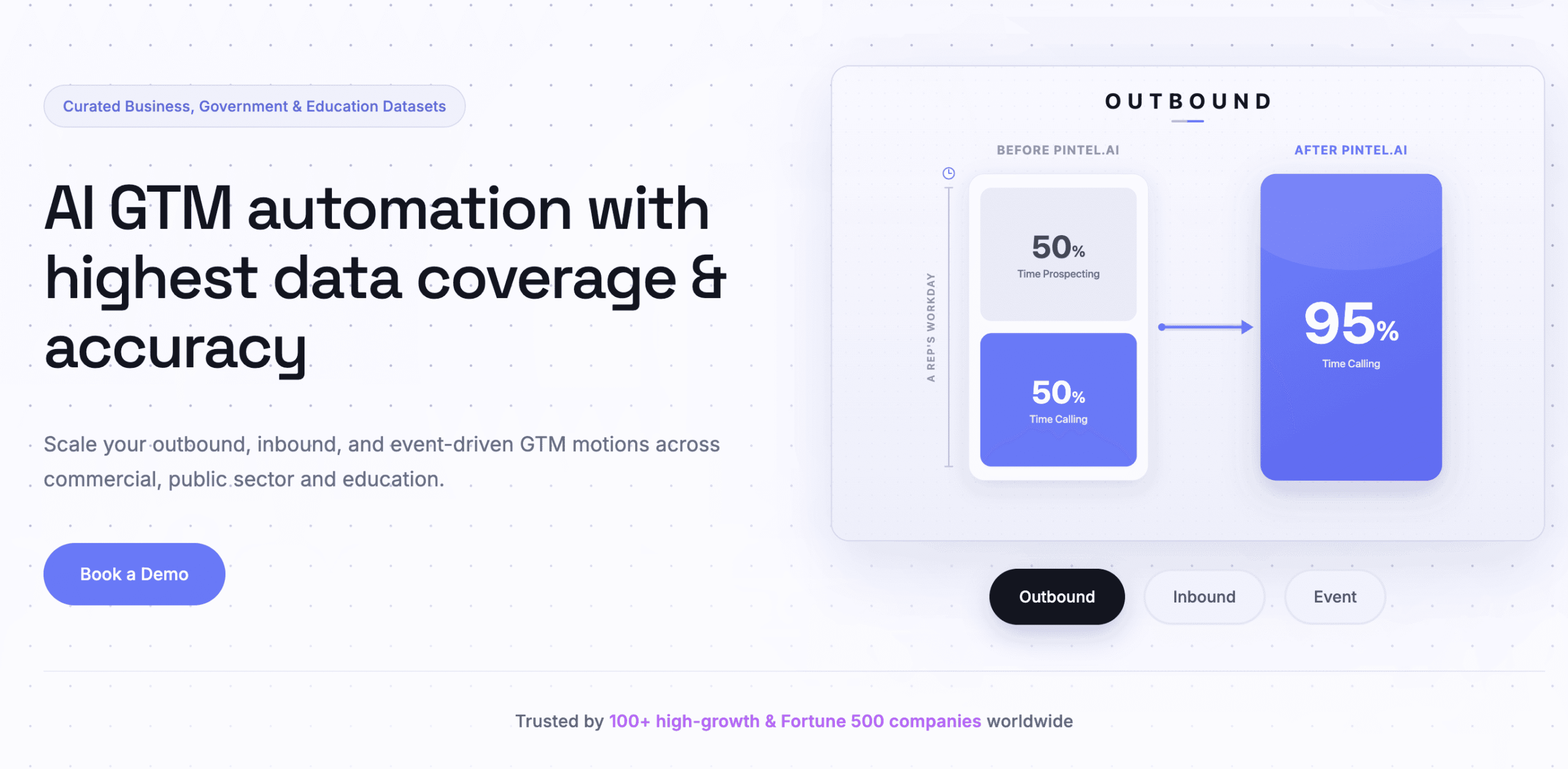
Pintel.ai is one of the few B2B data providers in the USA that combines verified contact data, company and firmographic records, and buying signals in a single platform, so outbound teams do not need to stitch together a company database and a separate contact tool.
Waterfall enrichment across 30+ vetted providers plus proprietary US sources delivers 95%+ match rates on contact records. One Pintel.ai customer was paying $160,000 a year for a single-source vendor before discovering that 37% of their contact records were wrong or missing.
For teams targeting the public sector, education, healthcare, manufacturing, and similar verticals, Pintel.ai’s non-traditional data sources include government procurement records, school district directories, and local business data that most providers on this list do not index.
- Contact coverage: Global: US, EMEA, APAC, GCC with no regional gaps
- Company data: Firmographic and org-level records alongside contact data, not sold as a separate product
- ICP filtering: Profile-level, plain-English prompt filtering at scale
- Signals: Structural, contextual, and behavioral buying signals
- Security and compliance: ISO 27001 certified, SOC 2 (AICPA), GDPR compliant, HIPAA compliant, CCPA compliant, and VAPT certified
Limitation: Less brand recognition than legacy providers like D&B and ZoomInfo, typical for a newer AI-native platform.
Pricing: Contact sales
Best for: Global GTM (go-to-market) teams that need company data and verified contact data in one workflow instead of separate subscriptions.
D&B Hoovers: Company and Firmographic Verification, Weak on Cost Per Contact
D&B Hoovers draws on Dun and Bradstreet’s company database to deliver verified firmographic records and org charts, but company and contact credits are billed separately, so unlocking one prospect can cost twice as much as with a unified credit.
- Strong at: Verified company and firmographic data backed by DUNS-linked records
- Strong at: Org chart mapping for enterprise account research
- Weak at: Contact-level freshness and a credit system where unused credits expire
Pricing: From $49/mo (Essentials tier); enterprise tier is contact sales | Best for: Teams that need verified company data first and contact data second.
Data Axle: US Business and Consumer Data Breadth, Weak on Modern Intent Signals
Data Axle verifies its US business and consumer records through an in-house research team rather than aggregation, but the platform has no native buying-signal or intent layer, so account prioritization needs a separate tool.
- Strong at: Broad US and Canada business data with phone and email included
- Strong at: Human-verified records instead of scraped or crowdsourced data
- Weak at: No intent signals natively and no coverage outside North America
Pricing: Contact sales | Best for: US and Canada-only teams that value verified breadth over buying-signal intelligence.
Crunchbase: Funding and Company Data, Weak on Contact-Level Depth
Crunchbase tracks funding rounds, investors, and company data for millions of private companies, but contact unlocks are limited even on paid tiers, so outbound teams still need a dedicated contact-finding tool.
- Strong at: Funding and investor data for identifying recently funded target accounts
- Strong at: Company-level data across a large database of private companies
- Weak at: Verified phone numbers at scale and no ICP filtering beyond firmographics and funding stage
Pricing: From $99/user/mo | Best for: Teams building target account lists around funding events who already have a separate contact tool.
6sense: Account-Level Buying Intent, Weak on Contact-Level Specificity
6sense scores accounts on predictive buying-stage signals rather than selling contact data directly, and the contact records underneath its account intelligence are sourced through third-party partners, so it tells you which company is in-market, not which specific person to contact.
- Strong at: Predictive account scoring based on buying-stage signals
- Strong at: Technographic and company-level intelligence
- Weak at: Contact data depends on third-party partners rather than a proprietary database
Pricing: Contact sales | Best for: Marketing and ABM (account-based marketing) teams prioritizing which accounts to target, paired with a separate contact tool.
ZoomInfo: US Enterprise Contact Depth, Weak on ICP Filtering Beyond Firmographics
Among B2B data providers in the USA, ZoomInfo builds its contact and company database through community contributions and licensed data, producing coverage for US enterprise accounts, but filtering options stop at standard firmographics with no profile-level or sub-industry filtering.
- Strong at: US enterprise contact depth for technology, finance, and professional services
- Strong at: Combined company and contact records in one product
- Weak at: Mid-market accuracy outside enterprise sectors and no plain-English ICP (Ideal Customer Profile) filtering
Pricing: From ~$15,000/yr (entry-level estimate; ZoomInfo disputes this figure publicly) | Best for: Enterprise teams that need US contact and company data together and can absorb enterprise pricing.
Apollo.io: Contact Data Bundled with Outreach, Weak on Company and Funding Data
Apollo bundles contact data with email sequencing for tech-sector outbound, but it has no dedicated company database and no funding or investor data, so account research for a target list still requires a separate tool.
- Strong at: Self-serve US contact data with built-in sequencing
- Strong at: Affordable per-seat pricing for SMB (small and midsize business) teams
- Weak at: No firmographic depth beyond basic filters and no funding or investor signals
Pricing: From $59/user/mo | Best for: Early-stage teams that want contact data and outreach in one tool without needing company-level research.
Lusha: Mobile Number Accuracy, Weak on Company and Firmographic Data
Lusha captures direct dials and mobile numbers through a Chrome extension on LinkedIn profiles, delivering accurate contact-level data, but it has no company database and no funding or firmographic depth beyond basic filters.
- Strong at: Direct mobile number accuracy for individual contact lookups
- Strong at: Fast Chrome extension workflow for SDRs (sales development representatives) working a target list
- Weak at: No company-level or funding data and no account discovery at scale
Pricing: From $29-36/user/mo depending on billing term | Best for: Individual reps who already have a target list and need direct phone numbers fast.
HubSpot Breeze Intelligence: Enrichment Inside HubSpot, Weak on Standalone Use
Breeze Intelligence, the product formerly known as Clearbit before HubSpot’s acquisition, enriches existing contact and company records with firmographic and technographic detail, but it only works inside HubSpot, so teams on Salesforce or another CRM cannot use it at all. Whether contact data enrichment alone solves the gap depends on whether the missing data is on the record already or needs to be found from scratch.
- Strong at: Enriching records already inside a HubSpot CRM
- Strong at: Auto-filling form fields to shorten lead capture
- Weak at: No standalone access and no list-building or prospecting function
Pricing: From $45/mo as a HubSpot add-on | Best for: Teams already running HubSpot who need to enrich existing records, not build new lists.
LeadGenius: Custom List Building for Complex ICPs, Weak on Speed and Self-Serve Access
LeadGenius pairs human researchers with automation to build custom target lists for ICPs that standard filters cannot capture, but lead times to first delivery are longer, so reps who need a list in minutes will not get one.
- Strong at: Precision on complex or niche ICP definitions that filter panels cannot build
- Strong at: Human-verified list quality for specialized targeting
- Weak at: No instant self-serve access and no public pricing
Pricing: Contact sales | Best for: Teams with a genuinely complex ICP who can plan for a longer research cycle instead of an instant list.
What Makes the Best B2B Data Providers in the USA Stand Out?
Run back through the Data Fit Framework across these B2B data providers in the USA and the gap is rarely data quality. It is data-type mismatch. Most score well on 2-3 of the eight criteria and weak on the rest, usually because they cover exactly one data layer, company data, contact data, or intent scoring, and nothing outside it.
Buyers who define which layer they actually need before evaluating vendors avoid the mismatch covered above. Teams weighing alternatives to a single-source contact vendor should start there, since company data and contact data are rarely sold by the same specialist.
D&B Hoovers and Data Axle fit teams that need verified company data first. Crunchbase fits teams tracking funding events, while 6sense fits marketing teams prioritizing accounts, both typically paired with a separate contact tool. ZoomInfo and Apollo.io fit teams that already know they want contact data first. Pintel.ai fits teams that want company data and verified contacts in one workflow instead of assembling several B2B data providers in the USA to cover both layers.
Teams evaluating data enrichment tools separately should confirm whether the tool adds new records or only cleans up the ones already in the CRM. A closer look at company data enrichment goes deeper on the firmographic side of that mismatch, and teams whose actual gap is volume rather than data type should see how a lead scoring framework helps prioritize which records are worth enriching first.
Frequently Asked Questions About B2B Data Providers in the USA
What should I look for in a B2B data provider in the USA?
Start with the data gap you need to solve. Check US company coverage, contact data, ICP filters, verification, buying signals, enrichment, pricing, and compliance. If you need several of these in one workflow, a platform such as Pintel.ai can be worth considering instead of stitching together multiple data sources.
How do I know if a B2B data provider is accurate?
Do not rely only on database size or accuracy claims. Test the provider using a sample of your actual ICP and check company matches, job titles, emails, phone numbers, and data freshness. This is especially important if you are evaluating a platform for outbound prospecting.
Should I choose a company database or a contact database?
It depends on your starting point. If you need to identify target accounts, prioritize company and firmographic data. If you already have accounts and need decision-makers, prioritize contact data. If you need both, look for a platform that combines them. Pintel.ai can fit this use case when teams need company data and verified contacts together.
How can I check whether a provider covers my US ICP?
Test your actual ICP rather than relying on overall US coverage claims. Use filters such as industry, location, company size, revenue, technology, and other ICP criteria, then check whether the resulting companies and contacts are relevant.
Should I test a B2B data provider before buying?
Yes. Run a proof of concept using your own target accounts. Measure coverage, accuracy, freshness, contact availability, and match rates. For a platform like Pintel.ai, you can also evaluate whether its company discovery, ICP targeting, and contact enrichment fit your workflow before committing.
What should I do if a provider does not have enough data for my ICP?
First identify what is actually missing: company coverage, contact coverage, specific fields, or data freshness. If the problem is fragmented data, a platform using multiple enrichment sources, such as Pintel.ai’s waterfall enrichment approach, may be worth evaluating rather than simply buying a larger database plan.
How should I compare B2B data provider pricing?
Look beyond the subscription price. Compare the cost of usable data, including credits, enrichment, exports, contact limits, minimum commitments, and whether company and contact data are priced separately.