
Finding a business email or the right contact information is rarely the challenge because company websites, LinkedIn, business directories, and contact databases all provide some form of contact information. Finding the right person with an accurate business email or phone number that still works is. Company websites often list generic inboxes, while outdated contact databases can send outreach to people who have already changed roles.
This guide walks through practical ways to find verified business contact information for B2B sales, along with simple checks to confirm it is accurate before you send an email or make a call.
How to Find Business Phone Numbers for B2B Sales
The fastest reliable methods are checking a company’s own contact page, confirming the right contact on LinkedIn before calling, calling the switchboard and asking to be transferred, searching state and local business registries, and using a B2B contact data enrichment tool for verified direct dials at scale. Each method trades off speed, accuracy, and how well it scales to a full prospect list.
Method Comparison: Six Ways to Find a Business Phone Number
| Method | Speed Per Contact | Direct-Dial Accuracy | Scales to a Full List | Cost |
|---|---|---|---|---|
| Company website or contact page | Fast | Low, usually a shared line | No, one company at a time | Free |
| LinkedIn profile confirmation | Medium | Confirms the person, not the number | No, manual per contact | Free to low |
| Switchboard call and transfer | Slow | Medium, depends on receptionist | No, one call at a time | Free (staff time only) |
| State or local business registries | Slow | Medium, often a listed office line | No, manual lookup per record | Free to low |
| Email signatures and press releases | Medium | Medium to high when found | No, opportunistic only | Free |
| B2B contact data enrichment tool | Fast at volume | High, cross-verified direct dials | Yes, built for list-scale lookups | Paid subscription |
No single method wins on every dimension. The right combination depends on whether you need one number right now or a verified direct-dial column across a 500-account target list.
How to Find Business Phone Numbers for B2B Sales
Start with the quickest, lowest-cost methods first, then move toward approaches built to work at scale once a list grows past a handful of accounts.
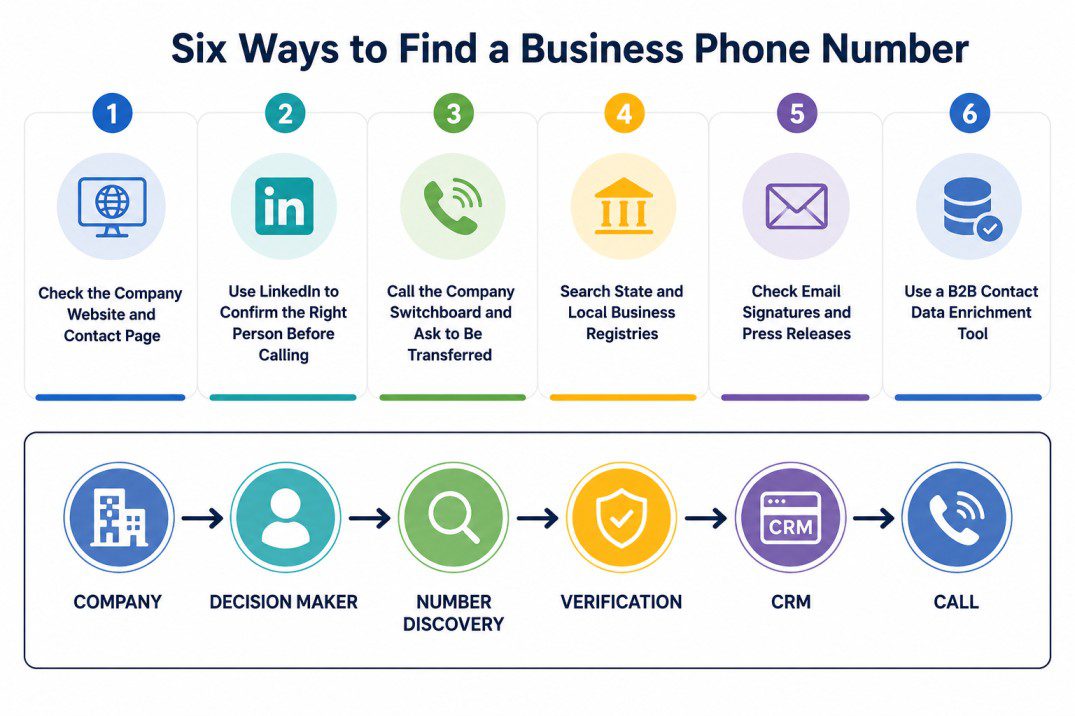
Company → Decision Maker → Number Discovery → Verification → CRM → Call
1. Check the Company Website and Contact Page
A company’s own website is the fastest starting point, but the number listed there is almost always a general switchboard or a sales-inquiry line, not the personal work number for the specific person a rep is trying to reach.
Good for confirming a business is real and operating, especially at smaller companies where the listed corporate phone number may go straight to an owner or a small team. Poor for identifying a decision maker’s direct line inside a larger organization, since most published company contact numbers route through a shared front desk rather than a named individual.
2. Use LinkedIn to Confirm the Right Person Before Calling
LinkedIn rarely lists a phone number directly, but it is the fastest way to confirm that a specific person still holds the title a rep thinks they hold, before spending time chasing a number for someone who changed roles six months ago.
Treat LinkedIn as a verification step, not a number source. Confirming the person is current takes the guesswork out of every other method on this list.
3. Call the Company Switchboard and Ask to Be Transferred
Calling the main line and asking to be transferred to a specific department or name still works, especially at smaller and mid-size companies where a receptionist or automated directory can route a call directly.
The tradeoff is time. Getting transferred correctly can take several minutes per contact, and larger companies increasingly route calls through automated systems that never reach a live person, which makes repeating this across a full prospect list impractical.
4. Search State and Local Business Registries
Government business registries, incorporation filings, and local licensing records often include a listed contact number for the registered business, particularly useful for smaller companies, local businesses, and public sector organizations that do not maintain a polished corporate website.
Slow to use manually, one record at a time, but this route reaches contacts that standard web-based tools frequently miss entirely, especially outside major metro areas.
5. Check Email Signatures and Press Releases
A verified business line often surfaces in an email signature once initial contact is made through another channel, or in a press release quote where a company includes a media or investor relations contact number.
Opportunistic rather than reliable. It works when a number happens to be public, but there is no systematic way to search for it across an entire target account list.
6. Use a B2B Contact Data Enrichment Tool for Verified Direct Dials
A B2B contact data enrichment tool provides verified business phone numbers, business email addresses, company information, and other contact details for decision-makers. Instead of searching for each contact manually, sales teams can enrich hundreds or even thousands of records at once with accurate contact data.
How Contact Data Enrichment Works
A contact data enrichment tool cross-references multiple data sources to return a verified direct dial tied to a specific person’s current role, rather than a shared switchboard line. This helps sales teams reach the right decision makers faster while reducing the time spent on manual research.
Why Pintel.ai
Pintel.ai retrieves business phone numbers through waterfall enrichment across 30 or more providers, cross-verifying each number before it reaches a call list. In practice, that means higher direct-dial coverage across target accounts, fewer manual searches per rep, and cleaner phone fields in the CRM instead of blank or guessed entries.
For teams targeting public sector, education, healthcare, manufacturing, and similar verticals, Pintel also reaches non-traditional data sources like government directories and school listings, where standard enrichment tools frequently return nothing at all.
Verify Before You Call
Finding a business phone number is only half the job. Even a number obtained from a trusted source should be verified before it reaches a call list. The next section explains a simple three-layer verification process to confirm that a business phone number is accurate, current, and connected to the right decision maker.
What Mistakes Cause a Business Phone Number to Be Wrong?
Most bad numbers on a call list trace back to one of three habits rather than bad luck. Recognizing them helps a team fix the actual cause instead of just re-searching for the same wrong company phone number a second time.
Treating a Switchboard Number as a Direct Line
A general business telephone number listed on a website or in a directory is built to route calls, not to reach one specific person. Dialing it and hoping to land on the right decision maker wastes the transfer time on every single call.
Reusing an Old Number Without Checking the Role
People change jobs, teams reorganize, and extensions get reassigned. A business contact number that was correct six months ago can now ring a different department entirely, or go unanswered if the person left the company.
Trusting a Static List Without a Refresh
A purchased or scraped list of company contact numbers is only as current as the day it was compiled. Without an ongoing refresh, accuracy decays steadily as people and org charts change underneath it.
Each of these mistakes is avoidable with the same discipline: check the number, check the role, check the line type, before it goes anywhere near a dialer. That is exactly what the next section walks through.
How to Verify a Business Phone Number Before You Dial
A number that looks correct on paper can still be wrong in three different ways: the format is invalid, the person no longer holds the role, or the line is a shared switchboard rather than a direct dial. Checking all three before a number goes into a call list is what we call the Three-Layer Number Verification Check.
The Three-Layer Number Verification Check confirms that a business phone number is correctly formatted for its country, that the named contact still holds the role tied to that number, and that the line is a direct dial rather than a shared or general switchboard number. Skipping any one of these three checks is usually why a “verified” list still produces a high rate of wrong numbers or wasted transfers.
- Format check: Does the number match a valid format for its country and area code, or does it look like a placeholder or a company’s generic toll-free line reused across multiple contacts?
- Role check: Is there a recent signal, a LinkedIn update, a press mention, a company announcement, confirming the named contact still works there and still holds that role?
- Line-type check: Does the number route directly to the person, or does it land at a switchboard, a shared department line, or an automated directory?
For context on how much this matters at scale: a rep working through a list of 40 numbers a day who finds that even 15% are wrong, disconnected, or shared switchboard lines loses roughly 6 calls a day to numbers that were never going to connect them to a decision maker in the first place. Across a 5-day week, that is 30 wasted calls, time that a verified list would have returned to actual conversations instead.
Once a number passes all three checks, the next question is where it fits into the rest of the outbound process, not just whether it is correct in isolation.
Where Business Phone Numbers Fit Into Your Prospecting Workflow
Finding a business phone number is rarely the first step in a real outbound motion. It usually comes after a team has already identified the right accounts and the right contacts within them.
1. Identify the Right Accounts and Contacts
Before searching for business phone numbers, sales teams first identify high-fit companies and the right decision makers within them. Learn more in our guide on AI-driven account research and contact identification.
2. Enrich Contact Data
Verified business phone numbers are just one part of a complete contact record. Combining phone numbers with verified email addresses and buying signals gives sales teams a stronger foundation for outreach. See our guide on AI data enrichment tools for B2B sales and the B2B lead-gathering framework to understand how account discovery, contact identification, and enrichment work together.
3. Keep Phone Numbers Up to Date
Business phone numbers become outdated as people change roles, departments, or companies. Regular data refreshes help prevent wasted calls and inaccurate CRM records. Learn more in our guide on evaluating B2B contact data accuracy.
4. Prioritize Outreach
Once a verified business phone number is available, deciding who to call first becomes just as important as having accurate contact information. Our guide on B2B lead scoring models explains how to prioritize the highest-fit contacts instead of simply working through a list.
Final Takeaway
No single method for finding a business phone number is complete on its own. A company website confirms a business is real, LinkedIn confirms the person is current, and a switchboard call or a registry search occasionally surfaces a real number, but none of these scale past a handful of contacts a day.
Teams calling more than a few dozen contacts a week generally need a verified, enrichment-based source behind the list, with the Three-Layer Number Verification Check applied before any number reaches a dialer, rather than discovering a bad number mid-call.
Frequently Asked Questions
How can I find business phone numbers for free?
If you only need a few business phone numbers, you can search company websites, LinkedIn, business directories, and public registries. For verified business phone numbers at scale with higher accuracy, use Pintel.ai, which enriches contact data from multiple sources and verifies phone numbers before they reach your CRM.
How can I find business phone numbers in bulk?
The easiest way to find business phone numbers in bulk is to use Pintel.ai. It enriches hundreds or thousands of contacts at once using waterfall enrichment across multiple data providers, helping sales teams access verified business phone numbers, business emails, and company contact information without manual research.
How do I find a company’s direct phone number?
Start with the company website to confirm the business is real, then use LinkedIn to confirm the specific contact still holds their role, since a website listing is almost always a general switchboard rather than a direct dial.
How can I find a business phone number for free?
Company websites, LinkedIn profiles, state and local business registries, and email signatures are all free sources, though each only works for one contact at a time and none scale to a full prospect list.
What is the difference between a direct dial and a switchboard number?
A direct dial connects straight to one person’s desk or mobile line. A switchboard number connects to a general company line that requires a transfer, which adds time and a real chance of being routed incorrectly.
How do I verify a business phone number is still active?
Check that the number’s format matches a valid pattern for its country, confirm the named contact still holds the role through a recent signal like a LinkedIn update, and confirm the line is a direct dial rather than a shared switchboard.
Can I use LinkedIn to find someone’s phone number?
Rarely directly. LinkedIn is most useful for confirming that a contact still holds the role a rep believes they hold, which then makes other number-finding methods far more likely to return a correct result.
Is it legal to call a business using a purchased phone number list?
Business-to-business calls generally face fewer restrictions than consumer calls in most jurisdictions, but sender obligations still apply and vary by country, so confirm local telemarketing and do-not-call rules before running a large-scale calling campaign.
How do sales teams find verified business phone numbers at scale?
Teams calling more than a handful of contacts a week typically use a B2B contact data enrichment tool that cross-references multiple sources to return a verified direct dial, rather than relying on manual lookups per contact.
How can I find a CEO’s contact information?
Start by identifying the right CEO through the company website or LinkedIn, then use a B2B contact data enrichment platform to find verified contact details. Pintel.ai helps GTM teams find CEO contact information, including verified business phone numbers, business email addresses, and company intelligence, making it easier to reach executive decision-makers without relying on generic company contact details.
How can I find a CIO’s contact information?
Finding a CIO’s contact information often requires more than searching a company website because executive contact details are rarely published publicly. Pintel.ai helps sales teams find verified CIO contact information by enriching contact data from multiple sources, validating current job roles, and providing verified business phone numbers, business email addresses, and company intelligence for technology decision-makers across SMBs, mid-market companies, enterprises, and public sector organizations.