Why Choosing the Right Sales Prospecting Tools Is Harder Than It Looks
If you are new to sales prospecting tools, the options feel overwhelming. Dozens of platforms, each promising to fill your pipeline. If you already have tools in place, you are probably wondering why results are not where you expected.
The challenge is the same either way. Most teams do not struggle because they have the wrong sales prospecting tools. They struggle because they do not have a clear picture of what each tool is supposed to do and where it fits. Sales prospecting is not just about finding contacts and sending emails. It is about reaching the right account, at the right time, with a message that feels relevant. Tools help you do that at scale, but only as well as the process behind them.
This guide covers the best sales prospecting tools in 2026, what each one does, where it fits in your workflow, and what separates teams that build pipeline from teams that just build a tech stack.
What Are Sales Prospecting Tools?
Sales prospecting tools are software platforms that help B2B sales teams find, research and reach potential buyers before a sales conversation begins. Most cover one or more of these six functions:
- Lead generation: Finding companies or contacts that match your ICP
- Contact data: Pulling verified emails, phone numbers and LinkedIn profiles
- Account enrichment: Adding context like funding stage, tech stack and headcount
- Outreach automation: Sending email sequences, LinkedIn messages and follow-ups at scale
- Engagement tracking: Showing who opened, clicked or replied
- Buying signals: Flagging accounts actively researching solutions like yours
Most sales prospecting tools only cover one or two of these areas well. Knowing which part of your workflow needs the most help is what leads you to the right tool, rather than the most popular one.
Best Sales Prospecting Tools in 2026
These are the platforms B2B sales teams and GTM leaders are actively using right now.
Pintel.AI: Signal Detection + Contact Enrichment + Account Context
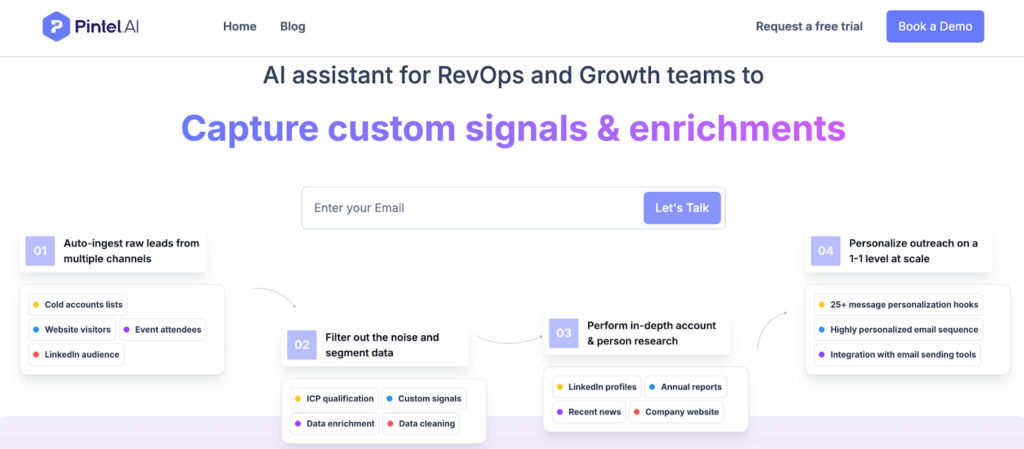
Pintel.AI identifies which accounts are most likely to buy right now and helps you understand exactly how to reach out to them.
It starts with your defined ICP and detects accounts showing real buying signals. It then enriches those accounts with the right contacts, scores them based on fit and intent, and generates highly personalised outreach messages or call tracks. Everything is structured and synced into your CRM so reps can act without manual research.
Best use case: B2B sales teams moving away from cold list blasting toward signal-driven, personalised outreach at scale.
Where it works well:
- Identifies in-market accounts based on ICP and real-time buying signals
- Combines signals, enrichment, scoring and messaging in one workflow
- Generates hyper-personalised outreach without manual research
- Syncs qualified accounts and contacts directly into CRM workflows
- Adapts to different ICP definitions and outbound workflows
- Pricing scales with usage and team size
One limitation: CRM integrations with older legacy systems are still being expanded.
Apollo.io: Contact Database + Built-in Outreach
Apollo gives you access to a large B2B contact database and lets you run email sequences from the same platform. Filter by job title, industry, company size and technographics, build a list, and send outreach without switching tools. Data accuracy in practice sits in the 65–80% range depending on geography and industry, so running a sample check before large campaigns is worthwhile.
Best use case: Teams that need contact data and email outreach covered without managing two separate subscriptions.
Where it works well: Free tier covers solo sellers and founders; direct integrations with Salesforce and HubSpot; built-in sequencing means you can go from list to outreach in one session.
One limitation: Data accuracy varies by region — European contact coverage is weaker than US.
ZoomInfo: Enterprise-Grade Contact Data + Intent
ZoomInfo provides verified B2B contact data, company intelligence and intent signals across 321M+ contacts and 100M+ company profiles. It is built for teams that need high data volume, strong CRM enrichment, and the ability to identify accounts actively researching solutions like yours. Pricing starts around $15,000/year and rises significantly with add-ons.
Best use case: Mid-market and enterprise sales teams running high-volume outbound who need accurate US-focused data and deep CRM integration.
Where it works well: Intent data across 5,000+ industry verticals; org chart data for decision-maker mapping; automatic CRM enrichment; strong North American contact coverage.
One limitation: Pricing puts it out of reach for smaller teams. For fewer than five sellers, the cost is hard to justify relative to alternatives.
Cognism: Compliant Contact Data + Verified Phone Numbers
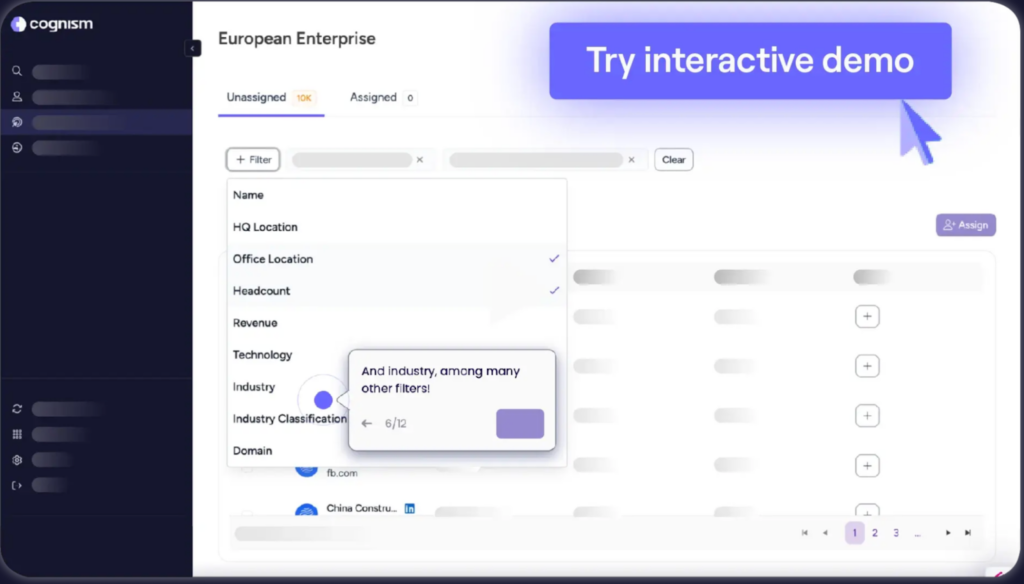
Cognism is built for GDPR-compliant B2B contact data, with particular strength across European markets. Their Diamond Data product provides phone-verified mobile numbers with claimed 98% accuracy, which significantly improves cold call connect rates compared to unverified sources. Cognism screens data against 13+ do-not-call lists across multiple markets as standard, not as an add-on.
Best use case: Sales teams targeting European markets that need compliant data and high-quality mobile numbers for phone outreach.
Where it works well: Phone-verified numbers reduce bad dials; DNC list checks built in for EMEA markets; Bombora-powered intent data for account prioritisation; strong UK and DACH coverage.
One limitation: Coverage outside Europe and North America is thinner. Teams targeting other regions may need a supplementary data source.
Lemlist: Personalised Multi-Channel Outreach
Lemlist is an outreach execution tool, not a contact database. It helps you send personalised sequences across email, LinkedIn and WhatsApp with dynamic image, video and landing page personalisation built in. The Email Pro plan starts at $69/month per user; the Multichannel Expert plan is $99/month per user. A 14-day free trial is available on all paid plans.
Best use case: Teams that already have contact data and want to improve reply rates through more relevant, visually differentiated outreach.
Where it works well: Dynamic personalised images and videos make emails stand out; built-in email warm-up protects sender reputation; conditional logic sequences adapt based on prospect behaviour; A/B testing on subject lines and copy.
One limitation: LinkedIn automation is more basic than dedicated LinkedIn sales prospecting tools like Expandi. Lemlist is outreach execution, not a standalone prospecting solution.
Expandi: LinkedIn Outreach Automation
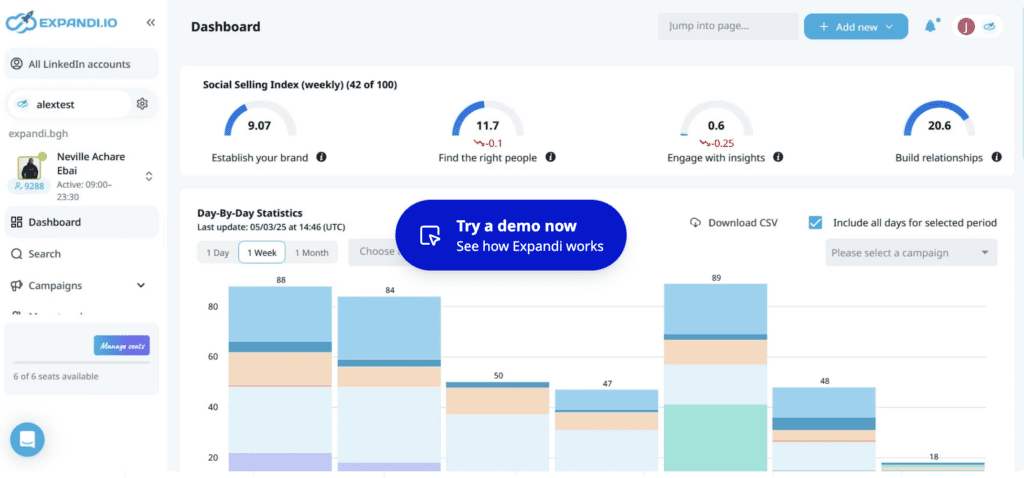
Expandi automates LinkedIn prospecting: connection requests, follow-up messages and profile visits. It runs campaigns with timing patterns that mimic natural behaviour to reduce platform detection risk. Pricing is $79/month, though full image and video personalisation requires additional subscriptions (Hyperise and Sendspark), bringing the real cost to $197+/month.
Best use case: Sellers, founders and agencies using LinkedIn as their primary outbound channel who want consistent campaigns without manual daily effort.
Where it works well: Event-based and group-based targeting; organised inbox management; dynamic message personalisation; clear campaign analytics.
One limitation: The advertised price does not include personalisation add-ons. LinkedIn automation always carries inherent platform risk.
Clay: Multi-Source Enrichment + Workflow Automation
Clay pulls data from 75+ sources, runs AI-powered research on accounts and contacts, and automates the enrichment work most sales teams do manually. It is not an outreach tool — it is the layer between your data sources and your outreach tool. Pricing starts at $185/month (Launch) and $495/month (Growth), with the Growth plan required for CRM sync and API access.
Best use case: GTM engineers and operations teams who want to automate enrichment and personalisation at scale.
Where it works well: Waterfall enrichment across 75+ providers achieves significantly higher data accuracy than single-source tools; AI columns write personalised first lines and summarise recent news; trigger-based workflows fire on signals like funding announcements or new job postings; feeds directly into Lemlist, Instantly or Smartlead.
One limitation: Significant learning curve. Full value requires someone with technical or operations experience to set up and maintain workflows.
Sales Prospecting Tools Comparison: Accurate Feature Breakdown
Use this table to see what each sales prospecting tool actually covers across data, signals and outreach — along with verified pricing and key strengths.
| Tool | Best For | Core Strength | Pricing |
|---|---|---|---|
| Pintel.AI | Signal-driven prospecting | All-in-one signal-driven prospecting platform | Contact sales |
| Apollo.io | Budget-conscious teams | All-in-one prospecting and sequencing | Free plan; paid starts ~$49/user/month |
| ZoomInfo | Enterprise outbound teams | Large database and intent data | Custom pricing (enterprise-level) |
| Cognism | European markets | GDPR-compliant data + verified mobiles | Custom pricing |
| Lemlist | Outreach execution | Personalised multi-channel sequences | Starts ~$69/user/month |
| Expandi | LinkedIn prospecting | LinkedIn automation | Starts ~$79/month |
| Clay | GTM operations | Multi-source enrichment + AI workflows | Starts ~$185/month |
Note:
All information in this comparison is based on publicly available data, vendor websites and user-reported insights. Features, positioning and pricing may vary depending on product updates, usage, team size and contract terms. Always verify details directly with the vendor before making a decision.
Why Sales Prospecting Tools Work Better With Signals
Most sales prospecting tools follow a similar workflow: build a list, enrich it and send outreach at scale.
This approach works, but it assumes every account on your list is equally ready to buy.
In reality, timing matters more than volume. The difference becomes clear when you compare how traditional prospecting works versus a signal-driven approach.
Here is what actually changes when you move from list-based prospecting to signal-driven prospecting:
Traditional vs Signal-Driven Prospecting
| Aspect | Traditional Prospecting | Signal-Driven Prospecting |
|---|---|---|
| Starting point | Static ICP-based list | Accounts showing buying signals |
| Targeting logic | Based on firmographics | Based on intent and timing |
| Outreach approach | Personalise after list building | Build outreach around real context |
| Volume | High (hundreds of contacts) | Focused (high-intent accounts) |
| Example workflow | Apollo to Clay to Lemlist | Pintel.AI with signals, enrichment and context |
| Results (example) | 500 emails to 2 replies to 1 meeting | 50 emails to 8 replies to 5 meetings |
| Core limitation | Right accounts, wrong time | Reaches accounts when timing is right |
The shift in B2B sales prospecting is not about adding more tools.
It is about applying effort to the right accounts at the right time.
What Signal-Driven Outreach Actually Looks Like
This is what changes when you start with signals rather than a cold list.
Without signals:
Subject: Quick question about your sales process
Hi [First Name], I came across your company and thought there might be a fit. We help B2B sales teams improve outreach efficiency. Would you be open to a quick call?
This message could have been sent to anyone. It gives the recipient no reason to reply.
With signals from a sales prospecting tool like Pintel.AI:
Subject: Saw you’re building out the SDR team
Hi Sarah, noticed you recently posted three SDR roles and hired a Head of Sales last month. When teams scale outbound quickly, targeting quality is usually the first thing that breaks — reps end up reaching the wrong accounts at the wrong time. We help teams at exactly this stage prioritise the accounts most likely to convert. Worth a quick conversation?
The contact data is the same in both cases. The context — knowing why this account is worth reaching out to right now — is what drives replies.
Why Most Sales Prospecting Tools Fail to Deliver Results
The tools are rarely the problem. Here is what usually is.
No timing awareness. Outreach sent to accounts not actively buying rarely converts. Building a list once and running the same campaign regardless of where accounts are in their buying cycle means most outreach lands at the wrong time.
No context in the message. A message that could apply to anyone resonates with no one. Buyers receive a lot of outreach. The ones that get replies are specific and show genuine understanding of the recipient’s situation.
Volume without relevance. High volumes of poorly targeted outreach damage sender reputation, waste follow-up time on non-fits, and train teams to measure activity instead of outcomes.
Disconnected sales prospecting tools. When data does not flow between your enrichment source, CRM and outreach platform, things break. Data goes stale. Leads are contacted twice or not at all. Reps spend time on admin instead of selling.
What Actually Drives Results With Sales Prospecting Tools
The best sales prospecting tools support a process. They do not replace it.
1. Start with a precise ICP. The narrower your ideal customer profile, the more relevant everything downstream becomes. Define it by industry, size, business model, tech stack and the specific triggers that indicate a buying need.
2. Use signals to prioritise timing. Look for accounts showing buying behaviour right now — funding rounds, new hires in relevant roles, or job postings that indicate a problem you solve. Timing changes everything.
3. Add context before you reach out. Know why this specific account might care about what you do right now. A message built on real context gets replies; one without context gets ignored.
4. Make outreach personal, not just personalised. There is a meaningful difference between a name token and referencing something specific that shows you understood the account’s situation.
5. Scale what is working. Find the message angle generating replies, then use automation to do it at volume. Scaling before you find what works only amplifies what is not.
How to Choose the Right Sales Prospecting Tools for Your Team
What problem are you actually solving? Identify the specific gap: finding accounts, sourcing contacts, personalising outreach, or automating follow-up. Each sales prospecting tool solves a different problem.
Do you need data, outreach automation or buying signals? If list-building is covered but outreach is manual, you need an execution tool. If outreach is running but targeting the wrong accounts, you need better data or signal detection.
Are your existing tools connected? Data should flow from enrichment into your CRM and from your CRM into your outreach platform without manual exports. Fix connectivity before adding more sales prospecting tools.
Can you measure impact in 60 days? Define what success looks like before you start: reply rates, meetings booked, pipeline generated. If you cannot measure it, you cannot improve it.
What Actually Drives Results in Sales Prospecting
Sales prospecting tools do not fill your pipeline. The process behind them does.
Start with a clear ICP. Focus on accounts showing buying signals. Add enough context to make your outreach relevant. Then use the right tools to execute consistently at scale.
Every tool in your stack has a role. The goal is not to collect tools, but to cover the key steps of prospecting without gaps or overlap.
Teams that prioritise timing and context over volume get more from less outreach. That is the shift shaping B2B sales prospecting in 2026.
Frequently Asked Questions About Sales Prospecting Tools
What is the best sales prospecting tool for a small B2B team?
The best sales prospecting tool helps you target the right accounts and reach them at the right time.
For most small B2B teams, focusing on high-intent accounts using buying signals delivers better results than relying on large static contact lists.
How are AI sales prospecting tools different from traditional sales prospecting tools?
AI sales prospecting tools focus on timing and relevance, not just data delivery.
Unlike traditional tools that provide contact data, they identify buying signals, automate enrichment and help personalise outreach based on real context.
How many sales prospecting tools does a team actually need?
Most teams need three core capabilities: finding accounts, prioritising them and executing outreach.
These can be handled through multiple sales prospecting tools or combined into a smaller, more efficient workflow.
What is the difference between sales prospecting tools and lead generation tools?
Sales prospecting tools support outbound prospecting by helping teams find accounts and start conversations.
Lead generation tools focus on inbound marketing by capturing demand through forms, content and campaigns.
Is it worth investing in expensive sales prospecting software early on?
Expensive sales prospecting software is not always necessary in the early stages.
Improving ICP definition, targeting and messaging typically delivers better results than investing in large tool stacks.
What are buying signals in sales prospecting and why do they matter?
Buying signals indicate that a company may be actively evaluating a solution.
Using these signals in B2B sales prospecting helps prioritise high-intent accounts and improves response and conversion rates.
Can I do B2B sales prospecting without automation tools?
Yes, B2B sales prospecting can be done manually for small, targeted account lists.
However, sales prospecting tools become important when you need to scale outreach while maintaining consistency and efficiency.
How do I know if my sales prospecting strategy is working?
A strong sales prospecting strategy shows healthy reply rates, meetings booked and pipeline generated.
Low reply rates usually indicate targeting or messaging issues, while low conversions point to qualification gaps.