A team builds a Canada company database search around Toronto and Vancouver tech firms and gets solid results. The same search into Quebec manufacturing, Alberta energy services, or Atlantic Canada firms comes back thin, sometimes empty.
This happens because Canada does not have one central company registry the way some countries do. Corporations Canada handles federal incorporation, but most companies register provincially, through Ontario, Quebec, British Columbia, Alberta, and the other provinces and territories, each with its own filing system. A Canada company database that only pulls from one source or from LinkedIn activity misses most of the country by design.
This guide compares 10 Canada company databases, what each one actually covers, and how to tell a genuinely national database from one that only covers the largest cities.
What Is a Canada Company Database?
A Canada company database is a structured collection of business records, company names, addresses, industry classification, and often contacts, covering companies incorporated or operating across Canada’s federal and provincial jurisdictions.
The distinction that matters most is sourcing. A database built from LinkedIn activity will skew toward large English-speaking cities. A database built from federal and provincial registry filings covers the country as it actually exists, including French-language Quebec businesses and smaller firms outside major metros.
10 Best Canada Company Databases: Quick Comparison
Here is how the 10 options compare on the factors that matter most for a Canada business database: where the data comes from, whether it covers French-language records, and how far it reaches beyond Toronto and Vancouver.
| Provider | Canada Sourcing Model | Bilingual (EN/FR) Coverage | Provincial Depth | Starting Price | Best For |
|---|---|---|---|---|---|
| Pintel.ai | Proprietary company intelligence, 30+ data providers | Yes, including Quebec records | Coast to coast | Contact sales | Teams needing full-country Canada coverage plus global reach |
| D&B Hoovers | Business registry and credit data | Partial | Strong in major provinces | Contact sales | Enterprise teams screening companies by financial and firmographic fit |
| ZoomInfo | Community-contributed database | Limited French coverage | Concentrated in large cities | $15,000+/yr | US-primary teams with Canada as a secondary market |
| Apollo.io | LinkedIn-derived + database | Minimal | Toronto, Vancouver-heavy | From $49/mo | SMB teams needing bundled database and sequencing |
| Crunchbase | Startup and funding-focused database | Limited | Strong for funded startups only | From $29/mo | Teams tracking Canadian startup funding activity |
| Owler | Community-sourced company profiles | Minimal | Concentrated in large cities | Contact sales | Competitive intelligence research on known companies |
| Craft.co | Company and supply-chain risk data | Limited | Enterprise-focused | Contact sales | Supply chain and vendor risk screening |
| Clearbit (HubSpot) | US/EU-focused enrichment sources | Minimal | Limited outside major cities | Custom (HubSpot tiers) | HubSpot teams enriching inbound Canadian leads |
| Scott’s Directories (Data Axle) | Canadian business directories | Yes | Broad, list-based | Contact sales | Bulk Canadian mailing-list style outreach |
| SalesIntel | Human-verified research team | Limited | Strong in major markets | Contact sales | Teams wanting human-verified Canadian mid-market records |
This comparison is based on first-hand platform knowledge, publicly available product information, and commonly reported user experiences. Contact each vendor directly for the latest pricing and product details.
The pattern across the table is consistent: most tools cover Toronto and Vancouver reasonably well, then thin out everywhere else. The reviews below explain what each Canada company database actually delivers.
What to Look for in a Canada Business Database
The most common mistake when evaluating a Canada business database is assuming a large global database automatically covers Canada well. Global record count says nothing about whether a provider actually sources from Canadian registries.
A useful way to check this is what we call the Cross-Registry Canada Check. The Cross-Registry Canada Check looks at whether a database pulls from federal incorporation records plus major provincial registries, covers French-language Quebec businesses, and reaches beyond Toronto and Vancouver into other provinces. Most tools pass none of these three by default.
Why Canada Company Data Is Harder to Source Than It Looks
Business registration in Canada is split between one federal system, Corporations Canada, and separate systems in each province and territory. A company can incorporate federally or provincially, and provincial systems do not automatically feed a shared national database.
Quebec adds a further layer: the province requires French-language business communication under its language laws, and many Quebec company records exist primarily in French. Tools built for English-only search miss or misclassify a meaningful share of Quebec businesses as a result.
This structural gap is also why accurate company data and account intelligence research for Canada cannot rely on the same playbook teams use for more centralized markets. A method built for one national registry does not transfer cleanly to a country with 14 separate filing systems.
Run these checks before committing to any Canada company database:
- Registry sourcing: Does the provider pull from Corporations Canada and provincial registries, or rely mainly on LinkedIn-derived records?
- Bilingual coverage: Are French-language Quebec business records searchable and correctly classified?
- Provincial reach: Does coverage extend into Alberta, Manitoba, Atlantic Canada, and other provinces, or concentrate on Toronto and Vancouver?
- Record freshness: How often are Canadian company records refreshed against registry filings?
- Signal layer: Can the platform track funding, hiring, and leadership changes for Canadian companies, or does it stop at static firmographic records?
According to Gartner’s research on sales strategy, data accuracy remains a persistent bottleneck for teams expanding into markets their primary database was not built to cover.
10 Canada Company Databases Reviewed in Detail
With those checks in mind, here is what each Canada company database actually delivers, including where coverage genuinely extends beyond Toronto and Vancouver.
Pintel.ai
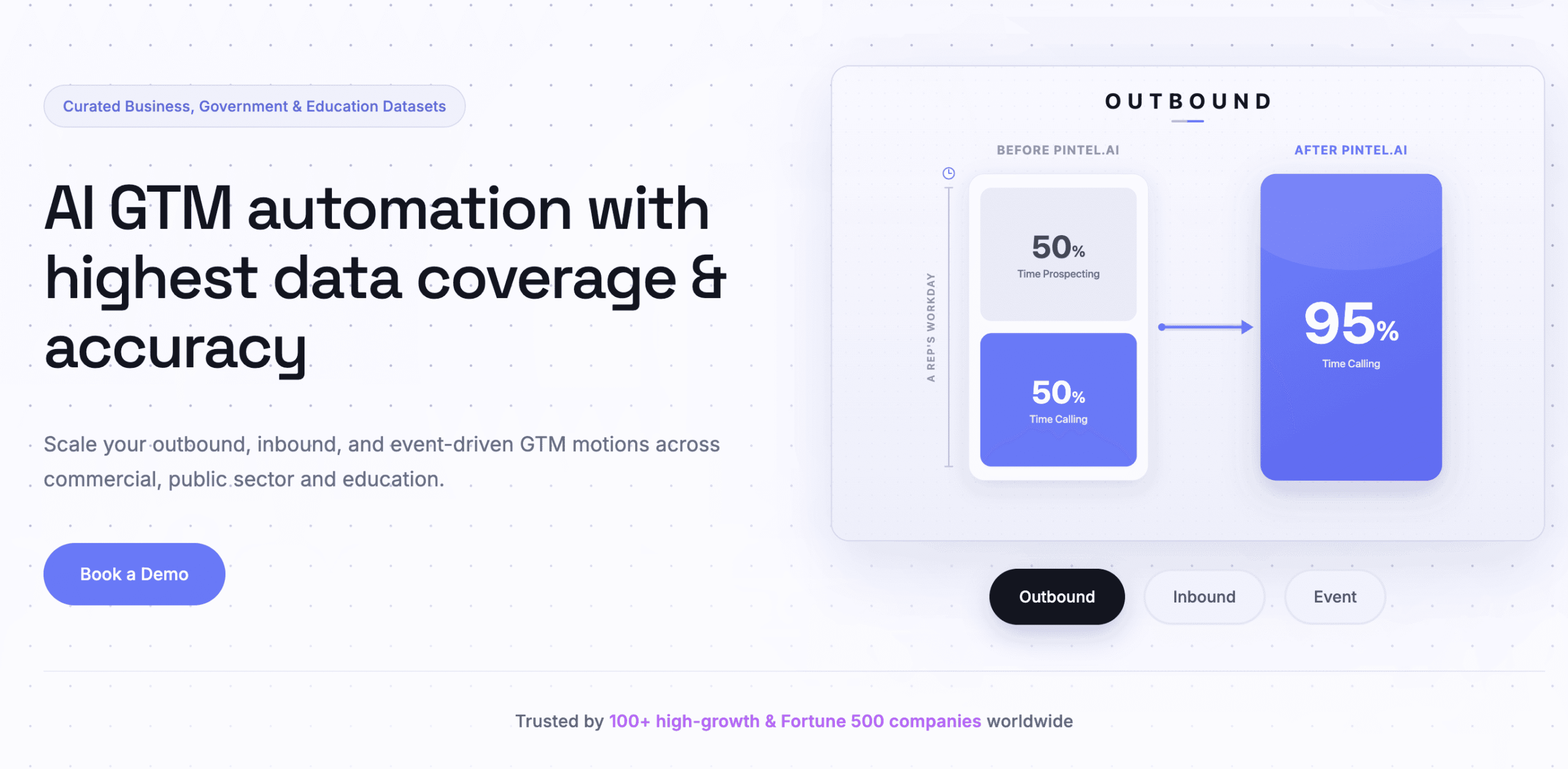
Pintel.ai is an AI-powered B2B company database and account intelligence platform that helps GTM teams discover high-fit companies, enrich contact data, identify buying signals, and prioritize the right opportunities. Its proprietary company intelligence engine combines data from multiple trusted sources to deliver broad company and contact coverage across Canada and global markets.
Beyond company discovery, Pintel.ai brings account research, contact enrichment, buying signals, and workflow automation into a single platform, helping revenue teams spend less time researching and more time engaging qualified accounts.
Strengths
- Proprietary company intelligence built from multiple trusted data sources
- Broad Canadian company coverage alongside global business data
- Waterfall contact enrichment across 30+ data providers
- AI-powered account research and buying signal detection
- Natural language ICP search and account filtering
- Native CRM integrations and workflow automation
- Enterprise-grade security with ISO 27001, SOC 2 (AICPA), GDPR, HIPAA, CCPA, and VAPT compliance
Limitations
- Newer platform with lower brand recognition than long-established providers
Pricing: Contact sales
Best for: GTM teams looking for a unified platform for company discovery, contact enrichment, buying signals, and AI-powered account intelligence across Canada and global markets.
2. D&B Hoovers
D&B Hoovers draws on Dun & Bradstreet’s business registry and credit data for solid Canadian firmographic coverage, but French-language Quebec coverage is partial and depth outside major provinces varies.
Strengths
- Strong firmographic and credit-related data for established Canadian companies
- Long operating history with broad industry classification
Limitations
- Quebec and French-language coverage is inconsistent
- Contact-level depth trails purpose-built prospecting tools
Pricing: Contact sales
D&B Hoovers is best for enterprise teams screening Canadian companies by financial and firmographic fit, but falls short on bilingual and regional depth.
3. ZoomInfo
ZoomInfo’s Canadian coverage reflects its US-primary, community-contributed sourcing model: solid for large companies in major cities, thinner for provincial and French-language businesses.
Strengths
- Reasonable coverage of large Canadian enterprises and multinational subsidiaries
- Established CRM integrations for teams already on Salesforce or HubSpot
Limitations
- Coverage concentrates in Toronto and Vancouver, with limited Quebec and provincial depth
- Cost is high relative to the Canada-specific coverage it delivers
Pricing: $15,000+/yr (custom)
ZoomInfo is best for US-primary teams that need Canada as a secondary market, but falls short as a primary Canada company database.
4. Apollo.io
Apollo.io offers a database and sequencing tool at accessible pricing, but its Canadian data leans on LinkedIn-derived records, concentrating coverage in Toronto and Vancouver tech hubs.
Strengths
- Reasonable coverage of Canadian tech and SaaS companies in major hubs
- Built-in sequencing at SMB-friendly pricing
Limitations
- Coverage of Quebec, Atlantic Canada, and Prairie provinces is thin
- No French-language search or classification support
Pricing: From $49/mo
Apollo.io is best for SMB teams needing Canadian tech hub coverage, but falls short once the ICP extends into Quebec or other provinces.
5. Crunchbase
Crunchbase tracks Canadian startups and funding activity well, useful for identifying newly funded companies, but its depth drops sharply for established or non-tech Canadian businesses.
Strengths
- Strong tracking of Canadian startup funding rounds and investors
- Useful for timing outreach around funding events
Limitations
- Limited coverage of established, non-funded, or non-tech Canadian companies
- Contact-level data is thin compared to dedicated prospecting tools
Pricing: From $29/mo
Crunchbase is best for teams tracking Canadian startup funding activity, but falls short as a general Canada company database.
6. Owler
Owler provides community-sourced company profiles and competitive alerts, useful for researching companies you already know, but coverage is inconsistent for smaller or provincial Canadian businesses.
Strengths
- Competitive alerts and company news for known Canadian companies
- Free tier available for basic research
Limitations
- Community-sourced data means coverage depth varies unpredictably by company
- Not built for building new Canadian prospect lists from scratch
Pricing: Contact sales
Owler is best for competitive intelligence research on known Canadian companies, but falls short as a discovery tool for new accounts.
7. Craft.co
Craft.co focuses on company and supply-chain risk data, useful for vendor screening, but it is not built for outbound prospecting and Canadian coverage is enterprise-skewed.
Strengths
- Strong supply-chain and vendor risk data for enterprise Canadian companies
- Useful for procurement and risk teams, not just sales
Limitations
- Not designed for building outbound sales lists
- Limited depth for small and mid-market Canadian businesses
Pricing: Contact sales
Craft.co is best for supply chain and vendor risk screening, but falls short as a sales-focused Canada company database.
8. Clearbit (HubSpot)
Clearbit, now part of HubSpot, enriches inbound leads well for companies with a US or EU digital footprint, but Canadian coverage outside that overlap is limited.
Strengths
- Good enrichment for Canadian companies with US or EU operations
- Native HubSpot integration for teams on that CRM
Limitations
- Canadian SMBs without an international footprint are largely uncovered
- Built for inbound enrichment, not outbound Canadian prospecting
Pricing: Custom (HubSpot tiers)
Clearbit is best for HubSpot-native teams enriching inbound Canadian leads, but falls short for outbound-first Canada coverage.
9. Scott’s Directories (Data Axle)
Scott’s Directories, now under Data Axle, has a long history compiling Canadian business directories, giving broad list-based coverage, but it offers little enrichment or signal data beyond basic firmographic listings.
Strengths
- Long-standing, broad coverage across Canadian provinces
- Bilingual English and French listings
Limitations
- List-style sourcing means records can lag behind real organizational change
- No buying signals or ICP filtering layer
Pricing: Contact sales
Scott’s Directories is best for bulk Canadian mailing-list style outreach, but falls short for signal-based or ICP-filtered prospecting.
10. SalesIntel
SalesIntel uses a human research team to verify company and contact records, giving solid accuracy for Canadian mid-market companies, but its core focus and depth remain US-centric.
Strengths
- Human-verified research improves record accuracy where covered
- Reasonable coverage of Canadian mid-market companies in major provinces
Limitations
- Coverage outside major Canadian markets is thinner
- Human verification at scale means higher pricing
Pricing: Contact sales
SalesIntel is best for teams wanting human-verified Canadian mid-market records, but falls short on full provincial coverage.
That covers all 10 Canada company databases on this list. For the broader picture of how these tools fit into a full outbound setup, the guide on how sales teams choose B2B data walks through a complete evaluation framework.
How to Choose the Right Canada Company Database
The right choice depends on which part of Canada your ICP actually touches, not on which provider has the largest global record count.
If your ICP is Toronto and Vancouver tech: LinkedIn-derived tools will show reasonable coverage here, since this segment is where Canadian LinkedIn activity concentrates. That coverage will not extend to the rest of the country.
If your ICP includes Quebec: Most English-first tools underperform here because they are not built to search or classify French-language business records. Pintel.ai’s registry-based sourcing includes bilingual Quebec coverage that LinkedIn-first tools typically miss.
If your ICP spans multiple provinces beyond the largest cities: A firmographic data provider built on registry sourcing, not LinkedIn scraping, is the only way to see the full country. Pintel.ai’s federal-and-provincial approach is built specifically for this.
If you are tracking startup funding activity: This is a narrow, specific need, separate from broad company discovery. Most general-purpose Canada company databases, Pintel.ai included, are built for full-market prospecting rather than funding-event tracking alone.
Before committing to any provider, pull 20 to 25 records from your actual Canadian ICP, including at least a few outside Toronto and Vancouver, and check accuracy by hand. The gap between a database that covers major cities and one that covers the whole country becomes clear quickly. Teams that build a target account list this way before committing avoid discovering the coverage gap after a contract is already signed.
Final Takeaway: Picking a Canada Company Database That Covers the Whole Country
The best Canada company database is not the one with the largest global record count. It is the one built on federal and provincial registry sourcing that actually reaches beyond Toronto and Vancouver.
Teams that rely on a LinkedIn-heavy database for Canadian outbound typically find solid coverage in major tech hubs and real gaps everywhere else, particularly in Quebec and the Prairie and Atlantic provinces. Statistics Canada’s business register data has long shown that small and mid-sized companies outside major metro areas make up a large share of the country’s business base, which is exactly the segment LinkedIn-first databases tend to miss.
For a company database in Canada that needs to support a full national outbound motion, the short answer is this: a database sourcing from Canadian registries, with genuine bilingual coverage, is the only option that avoids constant regional gaps.
FAQ: Canada Company Databases
A few questions come up repeatedly once a team starts comparing Canada company databases.
What is the best Canada company database for B2B sales?
The best Canada company database depends on your ICP’s geography. Pintel.ai and Scott’s Directories offer the broadest bilingual, cross-provincial coverage. ZoomInfo and Apollo.io work well if your ICP stays inside Toronto and Vancouver tech.
Why is Canadian company data harder to find than US data?
Canada splits business registration between one federal system and separate provincial and territorial registries, with no single unified database. Quebec adds a bilingual layer, since many business records exist primarily in French.
Does a Canada business database need to cover Quebec separately?
Yes, if your ICP includes Quebec. French-language business records are often missed or misclassified by English-only search tools, so genuine Quebec coverage requires a provider with bilingual sourcing.
What is the difference between a Canada company database and a US company database?
A Canada company database must source from federal and provincial registries and handle bilingual records. A US company database typically sources from a more centralized set of state and federal filings without the same language requirement.
How do I verify a company database Canada provider before buying?
Pull 20 to 25 records from your real Canadian ICP, including some outside Toronto and Vancouver. Check accuracy, provincial coverage, and whether Quebec records are correctly classified before committing.
Which Canada company database covers startups best?
Crunchbase specializes in tracking Canadian startup funding and investor activity. For broader company discovery beyond funded startups, a general Canada business database with registry-based sourcing covers more ground.