Most B2B teams already have ZoomInfo, Clay, Cognism, or Lusha somewhere in the stack, and most still hit the same wall: a coverage gap outside the core region, contact records that go stale within months, or a signal that never got flagged until a deal was already lost to a faster-moving competitor.
Those four tools cover the basics of contact and company data well for a lot of teams. The ten B2B data tools below are not more of the same thing. Each one fills a specific gap none of the four touch: intent signals none of them track natively, a contact-discovery mechanism none of them use, or company and funding data built to sit next to a contact record instead of duplicating it.
What Are the Best B2B Data Tools Beyond ZoomInfo, Clay, Cognism, and Lusha?
They split into three layers: company and funding data (Crunchbase, D&B Hoovers), contact discovery (RocketReach, UpLead, LeadIQ, Seamless.AI, SalesIntel), and intent signals (6sense, Bombora). Pintel.ai combines all three layers in one platform instead of specializing in just one.
The 3-Layer B2B Data Platform Stack
Every B2B data platform on this list sits in one of three layers, and most teams already have one layer covered without realizing the other two are thin.
Company and Funding Layer
Who exists, how they are structured, and how they are funded. This is firmographic and corporate hierarchy data, plus funding stage for prospecting into growth-stage accounts.
Contact and Verification Layer
Who to reach at a company, and whether the email or phone number is still current. This is the layer that decays fastest as people change jobs.
Intent and Signal Layer
When to reach out. This layer tracks which accounts are actively researching a relevant topic or showing a buying signal right now, rather than six months ago.
Most single-purpose B2B data providers specialize in one layer. The comparison below shows which layer each tool actually covers, and where Pintel.ai differs by covering all three at once.
10 B2B Data Providers and Platforms Compared
| Provider | Data Sourcing Model | Best For | Weakest Area | Pricing |
|---|---|---|---|---|
| Pintel.ai | Waterfall across 30+ providers plus non-traditional sources | Company, contact, and signal data in one platform | Newer brand than the category incumbents | Contact sales |
| 6sense | Proprietary intent network plus Slintel technographic data | ABM account scoring | No native contact discovery | From $50,000/yr |
| Bombora | Co-op network of 5,000+ B2B publisher sites | Topic-level intent layered on existing data | Topic-level only, no named contact | From $30,000/yr |
| RocketReach | Broad indexed professional and company dataset | Large general contact pool across industries | Verification depth thinner than niche tools | From $399/yr + per-lookup overage |
| UpLead | Contact database plus technographic and intent signals | Technographic filtering at mid-market scale | Accuracy guarantee limited to email deliverability | Custom |
| D&B Hoovers | Dun and Bradstreet Data Cloud | Corporate hierarchy and firmographic depth | Enterprise pricing, not self-serve | Custom |
| Crunchbase | Founder- and community-submitted funding data | Funding and company-stage signals | No contact discovery | Custom |
| LeadIQ | Contact database plus job-change tracking | Job-change alerts on existing CRM contacts | Thinner coverage outside North America | From $36/mo |
| Seamless.AI | Real-time AI web search at query time, not a static database | Surfacing contacts a static database has not indexed yet | Email accuracy 60-75%, phone accuracy 45-60% per user reports | Free tier; Basic from $147/mo |
| SalesIntel | Contact database plus human-verified research on demand | Manual verification for hard-to-find contacts | Slower turnaround for manual research | Custom |
This comparison is based on first-hand platform knowledge, publicly available product information, and commonly reported user experiences. Contact each vendor directly for the latest pricing and product details.
How We Evaluated These B2B Data Providers
Every one of these B2B data providers was evaluated on the following criteria, specific to where each one fits in the stack:
- Layer specificity: whether the tool covers company data, contact data, or intent signals, and how clearly it stays in that lane.
- Data sourcing model: whether records come from a proprietary network, community submission, indexed crawling, real-time web search, or a waterfall of multiple sources.
- Genuinely beyond the big four: whether the tool does something ZoomInfo, Clay, Cognism, and Lusha do not do natively, not just a cheaper or smaller version of the same function.
- Coverage depth outside North America: whether fill rates hold up in EMEA, APAC, and niche industries or thin out fast.
- Standalone usability: whether the tool functions on its own or needs to be paired with a tool from a different layer.
- Pricing transparency: whether pricing is public or requires a sales conversation before a team can evaluate fit.
We excluded single-purpose email verifiers, tools whose primary use case is outbound sequencing rather than the data layer, and any tool that could not point to a specific gap in ZoomInfo, Clay, Cognism, or Lusha’s coverage, since a smaller or cheaper version of a tool you already have does not belong on a “beyond” list.
10 B2B Sales Data Tools, Reviewed in Detail
Each of these B2B sales data tools solves one narrow job well. None of them combine company data, contact verification, and buying signals in a single workflow the way Pintel.ai does, which is why Pintel.ai is reviewed first below, and why most teams evaluating this list end up adding Pintel.ai instead of stitching together three or four separate specialist subscriptions. The rest are profiled with what each does well, where it genuinely falls short, and specifically what ZoomInfo, Clay, Cognism, or Lusha does not do that it does instead.
1. Pintel.ai: Strong for End-to-End GTM Prospecting
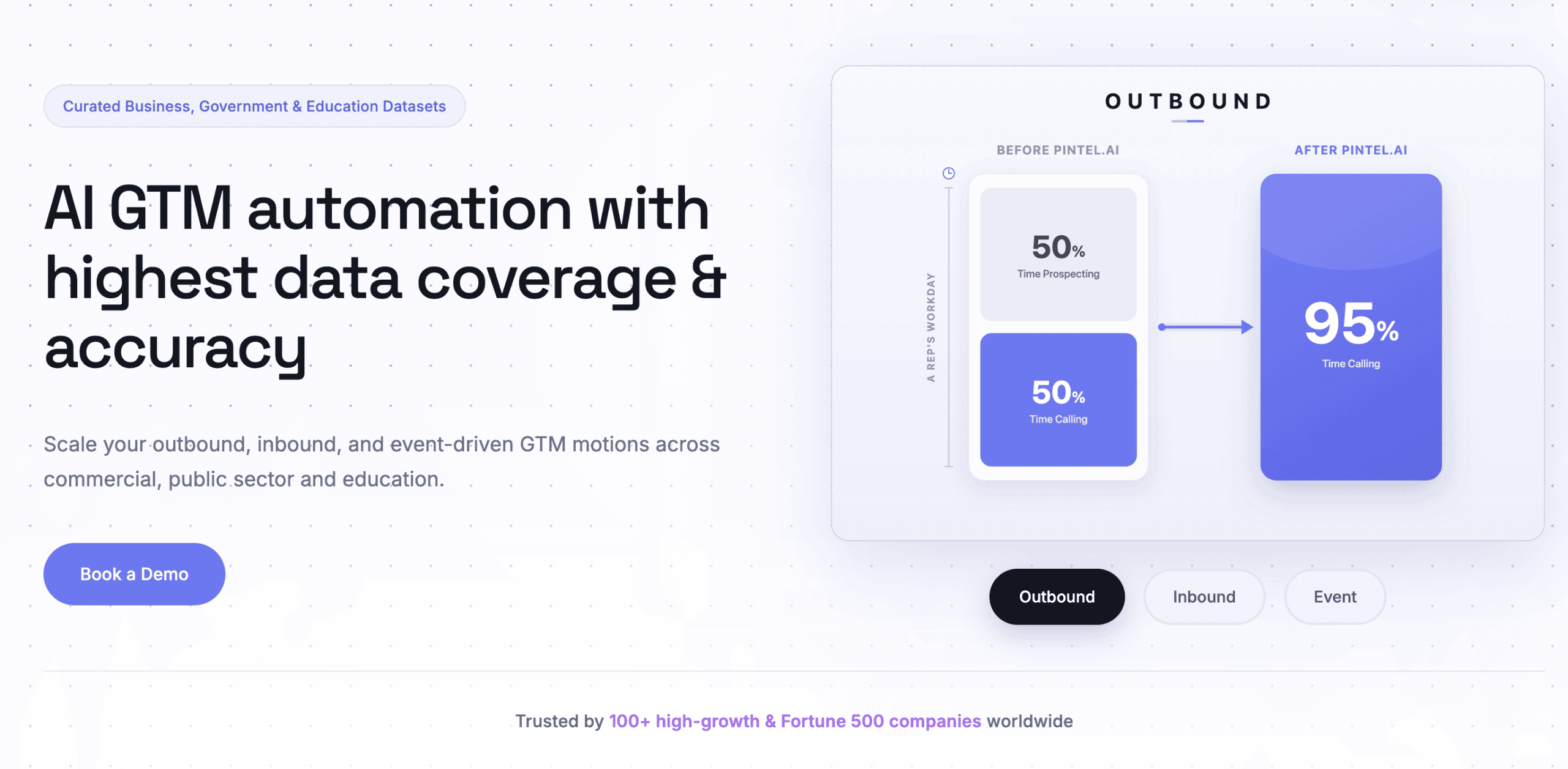
Pintel.ai helps GTM teams discover high-fit accounts, identify verified decision-makers, uncover buying signals, generate hyper-personalized outreach, and sync enriched data directly to their CRM from a single AI-powered platform.
Key capabilities
Find the right accounts
- Discover companies that match your ideal customer profile using industry, revenue, employee size, location, technology stack, buying signals, and other filters.
- Search in plain English instead of building complex filter combinations.
Find the right decision-makers
- Identify key stakeholders and buying committees within target accounts.
- Access verified work emails and phone numbers alongside company information.
- AI-powered profile analysis helps reduce false positives by identifying the most relevant decision-makers instead of relying only on job title matching.
Improve data accuracy and coverage
- AI verification agents combine proprietary data with waterfall enrichment across 30+ providers to improve company and contact coverage.
- Verify records before they reach your CRM, helping improve data accuracy and reduce missing or incomplete contacts.
Prioritize accounts with buying signals
- Identify companies showing funding, acquisitions, leadership changes, hiring activity, expansion, technology adoption, and other buying signals.
Personalize outreach at scale
- Generate hyper-personalized LinkedIn messages, cold emails, talk tracks, and outreach based on company research and buying signals.
Sync directly to your CRM
- Push enriched companies, verified contacts, buying signals, and account intelligence directly into your CRM to keep records up to date.
Enterprise-ready
- Global company and contact coverage backed by ISO 27001, SOC 2 (AICPA), GDPR, HIPAA, CCPA, and VAPT certifications.
Why we selected it
Most tools specialize in one part of the GTM workflow, such as company data, contact enrichment, workflow automation, or buying signals. Pintel.ai brings them together in a single platform, helping teams spend less time managing multiple tools and more time finding, prioritizing, and engaging the right accounts.
Pricing: Contact sales
Best for: GTM teams looking for an AI-powered platform to discover accounts, verify data, personalize outreach, and sync everything to their CRM.
2. 6sense: Strong for ABM Account Scoring, Weak on Native Contact Discovery
6sense tracks account-level buying intent through its own data network, Signalverse, which the company states pulls in more than a trillion B2B data points daily, plus technographic and keyword-level intent absorbed through its Slintel acquisition. The platform is built for scoring accounts already on a target list, not for discovering new contacts from scratch, and G2 users score its ease of setup at 7.5 out of 10, reflecting a genuinely involved onboarding process for a platform this data-heavy. Gartner Peer Insights tracks 6sense under its revenue data solutions category, alongside several other providers evaluated on this list.
Why we selected it as a ZoomInfo/Clay/Cognism/Lusha alternative: 6sense adds predictive buying-stage scoring on top of a signal network the four do not have, a narrow, ABM-specific need. That scoring layer comes at enterprise-only pricing with no native contact discovery of its own, so it still has to sit on top of a separate contact tool.
Key features: predictive buying-stage models, a built-in demand-side platform for ABM advertising, and orchestration workflows that route scored accounts to sales and marketing automatically.
Pricing: bundled enterprise packages typically run from $50,000 to $150,000 per year, depending on data volume and modules included.
Best for: ABM teams that need predictive account scoring layered on top of contact data they already have.
3. Bombora: Strong for Third-Party Intent, Weak on Named Contact Detail
Bombora sells third-party intent data sourced from a co-op network of more than 5,000 B2B publisher sites, tracking content consumption across roughly 12,000 topic clusters to show which companies are researching a given category, but the signal reflects interest at the topic level rather than which specific person or exact use case is behind it. The platform holds a 4.4 out of 5 rating on G2 across 150-plus reviews, remains privately held and profitable, and acquired conversational AI startup Lem0n in March 2026 to expand its intent product line.
Why we selected it as a ZoomInfo/Clay/Cognism/Lusha alternative: Bombora adds a third-party topic-intent layer the four do not track on their own, useful for marketing teams building a top-of-funnel signal feed. That signal stays topic-level only, with no named contact behind it, so it still has to be paired with a separate contact tool.
Key features: Company Surge topic scoring across 12,000-plus clusters, and native integrations with more than 100 platforms including Salesforce, HubSpot, 6sense, and Apollo.
Pricing: standalone intent packages typically run from $30,000 to $60,000 per year.
Best for: marketing teams that already have contact data and want a third-party layer of topic-level intent on top of it.
4. RocketReach: Strong for Contact Volume, Weak on Verification Depth
RocketReach indexes a broad professional dataset, more than 700 million profiles and 60 million companies, giving it wide reach across industries and regions, but breadth comes at the cost of verification depth: records skew toward what is publicly indexable rather than continuously re-verified.
Why we selected it as a ZoomInfo/Clay/Cognism/Lusha alternative: RocketReach indexes a much broader public dataset at a fraction of ZoomInfo or Cognism’s enterprise price, a low-cost backfill option for the occasional company those tools return nothing on. That breadth is exactly why its records are less consistently re-verified.
Key features: bulk lookup, a browser extension for on-page contact reveal, and a pay-as-you-go overage model priced at $0.30 to $0.45 per additional contact lookup beyond a plan’s included volume.
Pricing: annual plans start around $399 per year, plus per-lookup overage charges once included credits run out.
Best for: teams that need to search a very large, general contact pool across industries rather than a narrower, more frequently verified dataset.
5. UpLead: Strong for Verified Contacts, Weak at Enterprise Scale
UpLead pairs contact data with technographic and intent signals across more than 160 million contacts, backing records with a stated accuracy guarantee that applies to email deliverability specifically, not to firmographic or signal accuracy more broadly. Teams evaluating it should ask for a sample export against their own target list rather than relying on the headline accuracy number alone.
Why we selected it as a ZoomInfo/Clay/Cognism/Lusha alternative: UpLead ships technographic filtering natively at a self-serve, mid-market price, where ZoomInfo and Cognism bundle the same filter into enterprise-only packages and Clay requires building a custom recipe for it. The accuracy guarantee that comes with it only covers email deliverability though, not the technographic or firmographic fields themselves, so it fits a narrow case: mid-market teams that specifically need technographic filtering without an enterprise contract.
Key features: real-time email verification at the point of export, mobile number append, and technographic filtering by the specific tools a company uses.
Pricing: paid plans scale by contact credit volume, published on UpLead’s site; enterprise tiers move to custom pricing.
Best for: mid-market teams that want technographic filtering alongside contact data without moving to a full enterprise platform.
6. D&B Hoovers: Strong for Corporate Hierarchy, Weak on Renewal Pricing
D&B Hoovers builds company and contact data on top of the Dun and Bradstreet Data Cloud, anchored to D-U-N-S numbers that get refreshed thousands of times a day, giving it corporate hierarchy data most contact-first tools do not track, including parent-subsidiary relationships. That hierarchy data matters most for account-based selling into large, multi-subsidiary organizations, where a rep needs to know which entity actually signs versus which one just uses the product. The platform holds a 4.1 out of 5 rating on G2 across roughly 790 reviews, though its Trustpilot profile sits far lower, with recurring complaints about renewal pricing and billing surprises.
Why we selected it as a ZoomInfo/Clay/Cognism/Lusha alternative: D&B Hoovers answers a question none of the four are built for, which subsidiary in a corporate family actually holds signing authority, useful specifically for enterprise account-based selling into multi-entity organizations. That structural depth is priced and packaged for enterprise procurement, not self-serve signup, and renewal terms are a recurring complaint.
Key features: AI-assisted prospect list building, Bombora intent data layered in natively, and D-U-N-S-based entity resolution across corporate family trees.
Pricing: enterprise procurement pricing, not published; renewal terms are a common source of user complaints.
Best for: enterprise teams that need verified corporate hierarchy and firmographic depth, not just a flat contact list.
7. Crunchbase: Strong for Funding Data, Weak on Contact Discovery
Crunchbase tracks company profiles, funding rounds, and investor data, often more current on recent raises than sales-focused databases since much of it is submitted directly by founders and investors at the time of a round, but it is not built for contact discovery, so most teams pair it with a separate contact tool. The gap shows up fastest right after a funding announcement, when several vendors are reaching out to the same newly funded account within days.
Why we selected it as a ZoomInfo/Clay/Cognism/Lusha alternative: Crunchbase flags a newly funded account before it registers as a live signal in any of the four, a narrow but real timing edge for teams prospecting funding events specifically. That funding focus comes at the cost of contact discovery, which Crunchbase does not attempt.
Key features: funding round tracking, investor and acquisition data, and a public API for pulling company-stage data into other tools.
Pricing: a free tier covers basic company lookups; paid team and enterprise tiers are published on Crunchbase’s site and scale from there.
Best for: teams that prioritize funding and company-stage signals, particularly for prospecting into recently funded startups.
8. LeadIQ: Strong for Job-Change Tracking, Weak Outside North America
LeadIQ focuses on contact discovery paired with job-change tracking and CRM enrichment, flagging when a contact already in a CRM changes companies, but coverage outside North America is thinner than its domestic dataset.
Why we selected it as a ZoomInfo/Clay/Cognism/Lusha alternative: LeadIQ proactively re-checks a contact already in a CRM and flags it when that person changes jobs, something ZoomInfo, Cognism, and Lusha are not built to do once a contact has already been found. That job-change alert is a narrow, US-centric feature though, with noticeably thinner coverage outside North America.
Key features: a Chrome extension for capturing contacts while browsing LinkedIn, job-change alerts on contacts already in a CRM, and direct sync to Salesforce and HubSpot.
Pricing: a freemium tier is available; paid plans start at $36 per month billed annually.
Best for: teams that want job-change alerts on contacts already sitting in their CRM, not just net-new contact discovery.
9. Seamless.AI: Strong for Real-Time Web Search, Weak on Consistent Accuracy
Seamless.AI searches the live web at the moment of a query using AI-driven lookups, rather than serving results from a static, periodically refreshed database, and independent reports from G2 and Reddit users put email accuracy at 60 to 75 percent and phone accuracy at 45 to 60 percent, with credits charged even when a result turns out to be invalid. Teams typically run it as a supplementary layer for a contact a primary database missed, then verify the result before it enters a sequence.
Why we selected it as a ZoomInfo/Clay/Cognism/Lusha alternative: Seamless.AI’s real-time web search can surface a contact that a static database like ZoomInfo or Cognism, or a LinkedIn-only tool like Lusha, has not indexed yet, a narrow supplementary use case rather than a primary source. That same real-time approach is exactly why its accuracy is less consistent than a dedicated verification-first tool.
Key features: more than 100 search filters, a Chrome extension for LinkedIn overlay lookups, sales messaging analysis, and automated prospecting that continuously refreshes a saved list.
Pricing: free tier with 50 credits; Basic runs approximately $147 per month for 250 credits; Pro around $197 per month; Enterprise moves to custom pricing.
Best for: teams that need a real-time web search layer for a contact a static database has not indexed yet, paired with a verification step before that contact enters outreach.
10. SalesIntel: Strong for Human-Verified Research, Weak on Turnaround Speed
SalesIntel combines a standard contact database, covering 22 million accounts and more than 100 million contacts, with a human-verified research-on-demand service, where a research team manually verifies a contact when the automated match is not confident. That manual verification step adds turnaround time compared to a fully automated match, so teams typically reserve the request for a short list of strategic accounts rather than running it across an entire prospect list. On G2, SalesIntel users score its contact data accuracy at 7.6 out of 10 and its quality of support at 9.1 out of 10.
Why we selected it as a ZoomInfo/Clay/Cognism/Lusha alternative: SalesIntel offers a human-in-the-loop escalation path for the rare case an automated match comes back low-confidence, something none of the four provide, but it is meant for a short list of strategic accounts, not a full prospect list, and the manual step behind it adds turnaround time no automated tool has to deal with.
Key features: human-verified Research on Demand for hard-to-find contacts, technographic filtering, and native CRM integrations.
Pricing: custom, based on account and contact volume.
Best for: teams that need a small number of hard-to-verify contacts researched manually rather than a fully self-serve database.
What Teams Get Wrong When Stacking B2B Data Solutions
Buying by Layer Instead of by Gap
A team already running one intent tool sometimes adds a second one for more intent coverage, when the actual gap the whole time was contact verification, not more signal volume.
Treating Pricing Pages as Comparable
A tool priced per seat looks cheaper than one priced per credit or per contact, until a team scales past a handful of users, at which point the per-seat model can end up costing more. A 5-person outbound team paying $49 per seat per month for a bundled database and sequencing tool sees a clean $245 monthly bill. The same team growing to 15 reps at that same per-seat rate crosses $735 a month, often more than a per-contact enrichment platform would have charged for the same volume of records, because per-seat pricing scales with headcount, not with how many records a team actually pulls.
Skipping a Coverage Test Outside the Primary Market
A tool that returns strong fill rates on a US list can still return a mostly blank result on an EMEA or APAC list, and that gap rarely shows up until a rep is already working the account.
Assuming a Single-Purpose Tool Will Eventually Add the Missing Layer
Most contact-focused tools stay contact-focused, and most intent tools stay intent-focused, because the data sourcing model behind each layer is different enough that bolting on a second layer rarely matches a platform built for it from the start.
Where B2B Contact Data Tools Fit in a Broader Data Stack
The intent layer covered here overlaps with buyer intent tools built specifically around that signal, and once a tool surfaces a ranked account, a lead scoring framework decides which contact a rep works first.
Teams that want a deeper cut of the contact layer, dedicated email finders rather than full platforms, can compare options in lead finder tools. For the enrichment side specifically, data enrichment tools and AI data enrichment tools cover ground this list does not, including several platforms not named here.
Once contact and company data are flowing in, keeping that data usable long-term is a separate problem: CRM hygiene tools handle deduplication and field standardization, and company data enrichment keeps firmographic fields current as accounts change.
Frequently Asked Questions
What are the best B2B data tools beyond ZoomInfo, Clay, Cognism, and Lusha?
They split into three layers: company and funding data (Crunchbase, D&B Hoovers), contact discovery (RocketReach, UpLead, LeadIQ, Seamless.AI, SalesIntel), and intent signals (6sense, Bombora). Pintel.ai combines all three layers in one platform instead of specializing in just one.
What is the difference between a B2B data provider and a B2B data platform?
A B2B data provider typically supplies one layer: contact records, company data, or intent signals. A B2B data platform combines multiple layers, filtering, and CRM sync in one workflow, reducing the number of separate tools a team has to license.
Do B2B contact data tools work well outside North America?
Coverage varies widely. Tools like LeadIQ and RocketReach are strongest in North America, while Pintel.ai’s waterfall model and non-traditional data sources keep fill rates more consistent across EMEA, APAC, and niche verticals.
Is intent data enough on its own for B2B sales prospecting?
No. Intent data from tools like 6sense or Bombora shows which accounts are researching a topic, but it does not include contact discovery or verification, so most teams pair it with a separate contact data tool.
Which B2B data tools include buying signals, not just contact data?
6sense and Bombora specialize in buying signals. Pintel.ai also tracks signals, funding rounds, hiring spikes, and tech-stack migrations, etc., alongside contact and company data, so signal tracking does not require a separate tool.
How do B2B data solutions differ in their data sourcing model?
Some, like RocketReach, index a broad public dataset. Others, like Crunchbase, rely on community and founder submissions. Pintel.ai uses waterfall enrichment across 30+ providers, querying the highest-accuracy source first.
What should a team check before buying a B2B sales data tool?
Check which layer the tool actually covers (company, contact, or intent), its data sourcing model, coverage outside North America, and whether pricing is public or requires a sales conversation before committing budget.
Does Pintel.ai replace the need for a separate contact database?
For most teams, yes. Among the B2B data tools covered here, Pintel.ai is the one built to combine company data, contact verification, and buying signals in one platform, so teams that would otherwise license three separate tools can run one workflow instead.