Your CRM is only as good as the data inside it. Right now, most GTM teams are running workflows on records that are incomplete, inconsistent, or quietly out of date. Leads get misrouted, scoring models rely on wrong attributes, and reps reach out with messaging that does not match the account.
Lead enrichment tools are meant to fix this, but most only solve part of the problem. This guide breaks down the top eight tools, what they actually do, where they fall short, and which one fits how your team works.
What Are Lead Enrichment Tools?
Lead enrichment tools automatically fill in missing company and contact information on your CRM records. When an account or contact enters your system, the tool appends attributes like company size, industry, revenue, location, job title, and technology stack without anyone doing it manually.
GTM teams use this data to:
- Route leads to the right rep based on company size, region, or segment
- Score accounts based on ICP fit
- Build target account lists from verified firmographic attributes
- Segment accounts for campaigns and prioritization
- Personalize outreach with context that makes messaging relevant
Without reliable enrichment, teams make decisions on incomplete records, build lists from wrong data, and spend time on manual research that should not exist.
Top 8 Lead Enrichment Tools at a Glance
| Tool | Best For | Strength | Limitation |
|---|---|---|---|
| Pintel.ai | End-to-end enrichment and activation | Complete data, prioritization, and personalization | Not a standalone outreach tool |
| Apollo.io | High-volume prospecting | Large database, built-in sequences | Inconsistent data in structured workflows |
| Clearbit (Breeze) | HubSpot firmographic enrichment | Clean segmentation and scoring data | HubSpot-dependent, limited contact depth |
| Clay | Custom enrichment workflows | Flexible, connects many data sources | Requires ongoing technical setup |
| ZoomInfo | Enterprise data access | Large US database, broad coverage | Expensive, rigid, inconsistent refresh |
| Cognism | Compliant EMEA prospecting | Strong GDPR-compliant coverage | Weak outside Europe |
| Lusha | Individual contact lookup | Easy to use, fast lookups | Too shallow for workflow enrichment |
| RocketReach | Email and contact finding | Good at locating contact details | Not built for CRM workflows |
Top Lead Enrichment Tools (2026): Detailed Breakdown
Here is how each tool performs in practice.
Pintel.AI
Best for: GTM and RevOps teams that need enrichment, prioritization, and personalization working together in one system
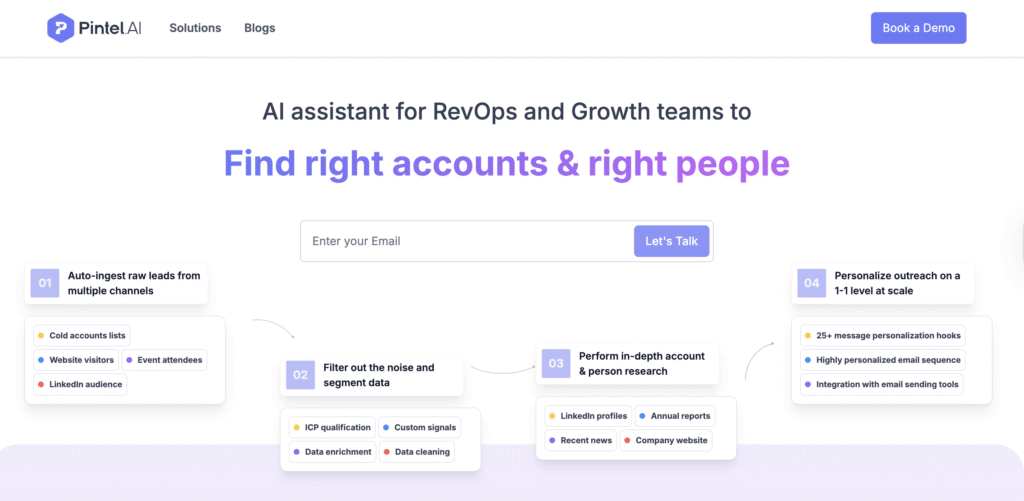
Pintel.AI connects the full enrichment workflow into a single system. It helps teams find the right accounts, enrich them with accurate and up-to-date data, prioritize them based on fit and signals, and generate personalized outreach from the same data layer.
Because everything runs from one consistent source, the data stays structured and usable across routing, scoring, account lists, and outreach, reducing manual research and keeping GTM workflows reliable.
Teams can also use Pintel.AI for specific needs, such as enriching existing account lists or filling in missing contact and persona data, without adopting the entire workflow.
What it delivers:
- Enriches accounts and contacts with firmographic and technographic data from globally validated sources
- Continuously updates attributes so CRM data reflects current company state
- Accurately matches contacts to accounts for reliable routing and scoring
- Prioritizes accounts based on ICP fit and signals
- Generates personalized outreach from real account and prospect data
- Syncs clean, structured data to CRM for immediate use
Where it stands out:
Pintel.AI combines global data coverage with flexible usage, allowing teams to enrich accounts, add persona data, or find contact details without changing their workflow. The data goes beyond basic contacts and is structured to be used directly in routing, scoring, and outreach without manual cleanup.
Pintel.AI is built on a secure, compliant data foundation (ISO 27001, SOC 2, GDPR, HIPAA), ensuring the data used across your GTM workflows is reliable, consistent, and privacy-safe.
Key strengths:
End-to-end workflow coverage, continuously refreshed data, global coverage, personalization from real account signals, and clean CRM sync
Where it falls short:
Not a built-in sequencing tool. Teams that need email sequences will need a separate sales engagement platform
Apollo.io
Best for: Teams that need a large contact database with outreach built in, but data inconsistency becomes a real problem as workflow complexity grows
Apollo combines a broad contact database with built-in sequencing, keeping the tool count low for teams on a budget. It works well for volume prospecting but struggles when clean, structured data matters.
Firmographic attributes are inconsistent, especially for smaller companies and non-US markets. Job title and company classification variations cause routing and scoring failures that compound as your GTM system grows.
- Pricing: Budget-friendly, with tiered plans
- Ideal team: SDR-heavy teams that need volume and want to keep costs low
- Skip it if: Your workflows depend on consistent firmographic data for routing, scoring, or precise segmentation
Clearbit (Breeze by HubSpot)
Best for: Teams on HubSpot that need firmographic enrichment in their existing stack, but it adds limited value anywhere else
Clearbit appends company attributes to records automatically inside HubSpot. It feeds segmentation and scoring logic cleanly within that ecosystem. Outside it, the value drops significantly. Coverage gaps exist in non-technology industries and contact-level depth is thin.
- Pricing: Mid-market, bundled into HubSpot tiers
- Ideal team: Marketing Ops and RevOps teams running HubSpot as their primary platform
- Skip it if: You are not on HubSpot or need enrichment to support outreach and account list building beyond basic segmentation
Clay
Best for: Technical teams that want full control over enrichment, but the setup and maintenance cost is real
Clay lets you build custom enrichment workflows by pulling from multiple data sources through a flexible table-based system. It is powerful in the right hands. The problem is that data sources break, workflows need ongoing maintenance, and someone on your team has to own it continuously.
- Pricing: Mid-market, with usage-based components
- Ideal team: Technical RevOps teams building a fully custom enrichment pipeline
- Skip it if: You do not have dedicated RevOps or engineering support to maintain it
ZoomInfo
Best for: Large enterprise teams that need broad database access, but cost and data freshness are consistent pain points
ZoomInfo has one of the largest B2B databases among lead enrichment tools and works well for teams with the internal resources to match. Refresh cycles mean attributes lag behind real company changes, international coverage outside North America is inconsistent, and pricing requires significant budget commitment.
- Pricing: Enterprise, with significant minimum commitments
- Ideal team: Large enterprise sales teams with dedicated data operations support
- Skip it if: Your target market extends beyond the US or your budget is mid-market
Cognism
Best for: EMEA-focused teams with strict compliance requirements, but coverage declines sharply outside Europe
Among lead enrichment tools for European markets, Cognism is one of the more reliable compliance-focused options. GDPR-compliant data sourcing and phone-verified contacts across the UK and Europe are its core strengths. Outside Europe, both coverage depth and value drop considerably.
- Pricing: Mid-market to enterprise
- Ideal team: EMEA sales teams where GDPR compliance is non-negotiable
- Skip it if: Your target market goes beyond Europe and you need consistent global firmographic coverage
Lusha
Best for: Individual reps that need quick lookups, but too shallow for any team-level enrichment workflow
Lusha is a browser extension for fast individual contact and company lookups. It is easy to use but was not built for structured enrichment workflows. Firmographic attributes are thin, there is no infrastructure for scaled enrichment, and it does not feed routing or scoring in any meaningful way.
- Pricing: Budget-friendly
- Ideal team: Individual AEs or SDRs who need occasional lookups
- Skip it if: Your team needs enrichment to power routing, scoring, or personalization at scale
RocketReach
Best for: Finding specific contact details when you already know who you are looking for, not for CRM workflow integration
RocketReach does one thing reasonably well: finding emails and phone numbers for specific people. It was not designed to function as lead enrichment software inside a GTM workflow, and data depth beyond contact details is limited.
- Pricing: Budget-friendly
- Ideal team: Small teams or researchers doing targeted individual lookups
- Skip it if: You need enrichment to feed into any downstream workflow, routing, scoring, or personalization
Why Lead Enrichment Tools Break GTM Workflows
The data looks fine inside the tool. The problems show up when it hits your CRM.
Inconsistent job titles cause routing failures. One tool says VP of Sales. Another says Head of Sales. A third says Sales Director. Your routing rule misses two of them. Records sit unrouted or land with the wrong rep.
Conflicting attributes break scoring models. The same company shows different headcounts, industry classifications, and revenue ranges depending on which source updated last. Scoring models get inconsistent inputs and produce unreliable outputs.
Stale data misleads reps. A record gets enriched on entry. Six months later the person changed roles, the company raised a round, or headcount crossed a qualification threshold. Your CRM still shows the old data.
Lists built on bad data target the wrong accounts. Unreliable firmographic attributes mean wrong company sizes, outdated industries, and mismatched roles make it into your priority lists. The right accounts get missed.
Messy CRM fields break automations downstream. Inconsistent data formats and missing values cause automations to break, reports to pull wrong numbers, and RevOps to spend hours on cleanup that should not be necessary.
These are the predictable results of using lead enrichment tools that prioritize data volume over consistency.
How to Choose the Right Lead Enrichment Tool
Choosing between lead enrichment tools comes down to one question: what breaks first in your current workflow?
If data inconsistency is breaking routing and scoring, you need lead enrichment software built around consistency, not volume. The number of records matters less than whether those records are structured reliably every time.
If your team spends too much time on manual research, you need enrichment that updates continuously, not a tool that requires manual batch uploads or periodic refreshes.
If account lists keep including the wrong companies, the problem is attribute quality. Tech stack data that is inferred rather than verified, outdated headcount ranges, and inconsistent industry classifications all produce lists that do not reflect your actual ICP.
If personalization is generic despite having enrichment data, the gap is between having data and using it. Most lead enrichment tools deliver attributes but do not connect them to outreach. Pintel.AI is one of the few that does.
If compliance is a hard requirement, not all lead enrichment tools treat GDPR-compliant sourcing as a core capability. Make sure it is, not an add-on.
If you need the full workflow covered, from account discovery through enrichment, prioritization, and personalized outreach, most individual tools reach their limit. Pintel.AI is built specifically for teams that need all of that working from the same clean data layer.
Choosing the Right Lead Enrichment Approach
Most lead enrichment tools solve for data access. They fill in missing attributes. What they don’t solve is what comes next, routing records correctly, scoring them accurately, building reliable account lists, and reaching out with relevant messaging.
As GTM systems grow, the gaps between disconnected tools become costly. Inconsistent data breaks automations. Stale records mislead reps. Lists built on unreliable firmographics waste pipeline.
The teams that get the most from enrichment treat it as a system, not just a data source. Enrichment feeds into prioritization, and prioritization connects directly to personalized outreach, all running from one consistent data layer.
That’s what Pintel.AI is built for. If you only need basic contact lookup, simpler tools will work. If you need enrichment to power your GTM system end-to-end, Pintel.AI is designed for that.
FAQs
What are lead enrichment tools?
Lead enrichment tools automatically add missing company and contact attributes to your CRM records, including company size, industry, revenue, job title, location, and technology stack, without manual research.
What is the best lead enrichment tool for B2B teams?
For teams that need enrichment, prioritization, and personalization in one reliable system, Pintel.AI is the most complete option. For high-volume prospecting on a budget, Apollo.io is widely used. For EMEA compliance, Cognism is the stronger choice.
Why do lead enrichment tools break GTM workflows?
Most B2B lead enrichment tools prioritize volume over consistency. When attributes are formatted differently across sources, refreshed infrequently, or inaccurate for specific markets, they cause failures in routing, scoring, and CRM automations.
Should you use multiple lead enrichment tools? It is common but reintroduces data conflicts. When two sources disagree on the same attribute, your CRM needs a rule for which one wins. A single lead enrichment tool that covers your core needs is a cleaner approach.
Do lead enrichment tools help with personalization? Most stop at data delivery. Pintel.AI uses enriched account and prospect signals to generate outreach that reflects what each company actually looks like, not a generic template with a name inserted.
What is the difference between lead enrichment tools and data providers? Data providers give you database access to query or download. Lead enrichment tools actively append and maintain attributes on records inside your CRM. The best B2B lead enrichment tools do both.