Most outbound sales stacks cost $400 to $800 per month before a single email goes out. Clay charges for enrichment credits. n8n requires a developer to build and maintain. Zapier hits its limits the moment you try to run a multi-step workflow. The result is that most sales teams either overpay for automation or do manually what their competitors automate: researching prospects, verifying contacts, scoring accounts, and updating CRM records one record at a time.
The best free sales automation tools close that gap. This guide covers five platforms outbound teams use in 2026 to source leads, enrich contacts, score by ICP, generate AI research, and sync to CRM without paying platform fees or hiring a developer. For each tool, we map what it automates, where it fits in the workflow, and where it falls short.
One note on framing: this guide covers outbound automation platforms for teams doing direct prospecting, not tools agencies use to manage client campaigns. The two categories share platforms but serve opposite directions, and conflating them produces the wrong shortlist.
What Are the Best Free Sales Automation Tools for Sales Teams?
The best free sales automation tools in 2026 are Pintel.ai, HubSpot CRM, Phantombuster, n8n, and Zapier. For teams that need a complete pipeline, Pintel.ai is the only platform in this list that orchestrates all four stages without technical setup. The platform itself is free: it sequences your existing data providers in a waterfall, runs ICP scoring, generates AI research per account, and syncs to your CRM. Teams without existing provider contracts can add Pintel.ai’s own B2B data as a paid add-on.
| Tool | FLOW Coverage | Free Access | Setup Required | Best For |
|---|---|---|---|---|
| Pintel.ai | Find, Layer, Orchestrate, Wire | Free workflow automation | No-code, under 1 hour | End-to-end prospecting, B2B data enrichment, and AI-powered automation |
| HubSpot CRM | Wire | Free CRM | Low | Contact management, deal tracking, and CRM automation |
| Phantombuster | Find | Limited free usage | Low | Automated LinkedIn lead sourcing and data extraction |
| n8n | Find, Layer, Orchestrate, Wire | Free self-hosted version | High, developer knowledge required | Custom technical workflows and API integrations |
| Zapier | Wire | 100 tasks/month | Low | Simple app-to-app sales automation |
What Sales Teams Are Actually Trying to Automate
Most outbound teams are not just trying to send more emails. They are trying to remove the manual work that happens before an email gets written. That means automating six jobs in sequence:
- Lead sourcing: pulling accounts and contacts that match the ICP without manually filtering LinkedIn each morning
- Waterfall enrichment: checking multiple data sources in order until a verified email and direct dial are found for every contact
- ICP scoring: automatically removing records that do not meet minimum criteria before they reach a rep
- AI research: reading a company website, recent news, or LinkedIn activity and generating talking points per account
- Outreach personalisation: producing a first-line opener from enriched data before the email enters the sequence tool
- CRM sync: pushing every qualified, enriched, scored record into Salesforce or HubSpot without manual data entry
When all six run automatically, a rep spends the day on conversations. Getting all six to run without a developer is the core problem the tools below are built to solve.
Why n8n and Zapier Fall Short for Most Sales Teams
Both tools can technically do parts of the above. Here is where each one breaks down in practice:
- n8n requires a developer to build and maintain. A working enrichment pipeline takes two to four weeks to set up and breaks every time a data provider updates its API schema. Most sales teams do not have that resource, and those that do are spending engineering time on prospecting infrastructure instead of product.
- Zapier cannot run a waterfall enrichment sequence natively. Teams patch this with multiple connected Zaps, which burns through the free task limit in days on any real volume and creates brittle workflows that fail without warning.
- Neither tool understands what a sales-ready contact record looks like. Both are general-purpose. Building a scoring layer, a research column, or a waterfall fallback in either means writing that logic from scratch, every time.
That gap is where sales-native platforms step in. The comparison below shows how each tool in this list fills it.
What Sales Teams Struggle With Before They Find the Right Tool
Most sales teams hit the same four walls before they get outbound working at scale:
- Building a lead list takes hours. Filtering LinkedIn, bouncing between databases, manually checking if contacts match the ICP. Most of that time produces a list that is out of date by the time the rep opens it.
- One data provider is never enough. A contact that has no email in one source often exists in another. Teams either pay for every provider at once or accept gaps in coverage.
- Reps are doing research that a tool should do. Reading a company website, pulling recent news, finding a talking point. Reps spend two to three hours per day on prep work that does not require a human.
- Qualified records never make it into the CRM cleanly. Manual export, copy-paste, mismatched fields. By the time a contact reaches the sequence tool, the data is stale or incomplete.
The FLOW framework (Find, Layer, Orchestrate, Wire) maps one stage to each of those problems. Use it to test any free sales automation tool before committing your pipeline to it.
Find: Can it pull the right accounts without a manual search every morning?
- Solves the hours-of-list-building problem
- Should identify accounts matching your ICP and surface the right contacts automatically
- A tool that only works after you already have a list does not solve this stage
Layer: Does it check multiple data sources so contacts do not fall through the gaps?
- Solves the single-provider coverage problem
- Tries each connected source in order and stops at the first verified result
- Avoids paying redundant credits across every provider for the same contact
Orchestrate: Does it score contacts and generate research automatically?
- Solves the rep-doing-manual-research problem
- ICP scoring removes unqualified records before they reach a rep
- AI research columns pull talking points per account from websites, news, and LinkedIn
Wire: Does it push finished records into your CRM without a manual export?
- Solves the stale-data-in-CRM problem
- Pushes qualified, enriched records directly into Salesforce, HubSpot, or Pipedrive
- Without this stage, manual data entry re-enters the workflow at the last mile
Only one platform in this list covers all four stages for free without a developer. The comparison below shows where each tool sits.
Detailed Review of the Best Free Sales Automation Tools
Each tool offers a different approach to sales automation. Let’s look at its key features, free capabilities, limitations, and how well it supports the outbound prospecting workflow.
Pintel.ai
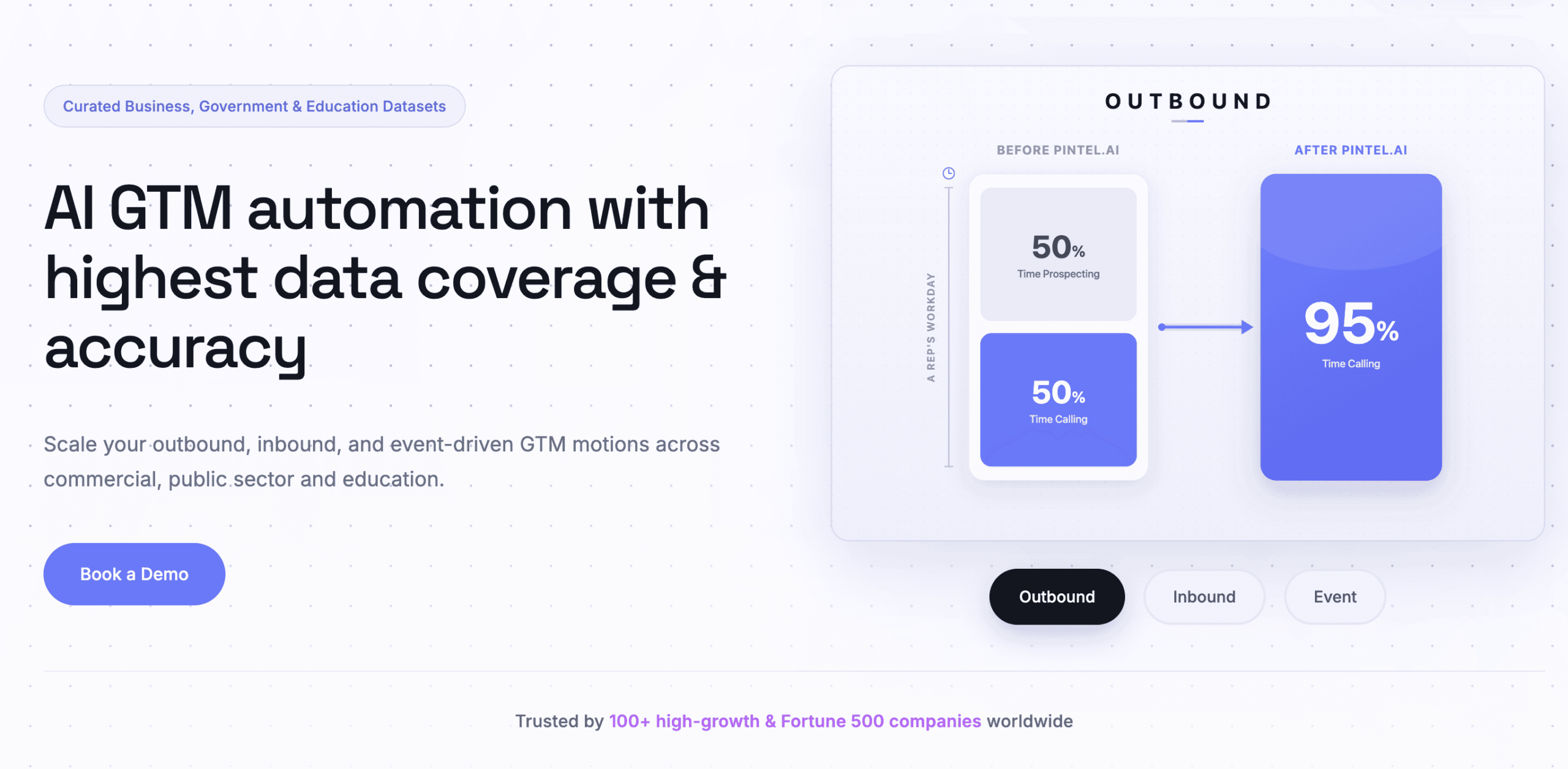
Best for: B2B sales teams looking to automate end-to-end prospecting, from finding target accounts and decision-makers to enriching contact data, scoring prospects, and generating AI-powered account research.
What it does: Pintel.ai is a full workflow automation platform with a spreadsheet-style interface. Each column represents a step in the prospecting workflow. Teams can connect data providers, AI agents, and CRM systems in one place, configure their workflows, and automate the entire process without building complex automation nodes.
Key features:
- Waterfall enrichment: Connect multiple data providers and automatically check them in sequence until a verified contact result is found.
- ICP scoring and filtering: Evaluate prospects against your ideal customer profile using company attributes, job roles, industry, geography, and other criteria.
- AI-powered account research: Automatically gather and summarise information from company websites, LinkedIn, and news sources.
- Custom AI agents and API integrations: Bring your own AI agents and connect external tools and services through APIs to automate specialised prospecting tasks.
- Automated CRM sync: Push enriched and qualified prospect records directly to HubSpot and Salesforce without manual exports.
B2B Sales Intelligence and Prospecting: Pintel.ai is also a B2B sales intelligence and GTM workflow automation platform that combines prospecting data with automated workflows. Teams can find target companies, identify decision-makers, access B2B contact data, enrich records, and automate account research in one place.
Limitations: Pintel.ai does not offer native email sequencing or LinkedIn outreach automation.
HubSpot CRM
Provides: Free forever CRM with contact management, deal tracking, email sequences, and pipeline reporting. Weak on: lead sourcing and enrichment.
HubSpot’s free CRM is the Wire stage of any outbound automation stack. It receives the qualified, enriched records from your sourcing and enrichment workflow and manages them through the pipeline. Its free tier includes email sequences, meeting scheduling, deal tracking, and basic reporting, enough for a small team to run a full outbound motion without paying for a CRM seat.
- Free forever with unlimited users and up to 1,000,000 contacts stored
- Email sequences, templates, and open or click tracking on the free tier
- Deal pipeline with activity logging and basic reporting
- Native integration with Pintel.ai for receiving enriched records directly from the pipeline
Limitations: HubSpot’s free CRM has no lead sourcing, enrichment, or AI research capability. It is the destination for qualified records from your automation stack, not the pipeline that builds them.
Phantombuster
Provides: LinkedIn and social media scraping for lead lists and engagement data on a free tier. Weak on: enrichment, scoring, and CRM sync.
Phantombuster automates lead sourcing from LinkedIn, Sales Navigator, and social platforms using pre-built automations that run on a schedule. The free tier includes two hours of monthly runtime, enough to pull a targeted list from a LinkedIn search or extract post engagement data for warm outreach. It covers the Find stage and feeds output into an enrichment workflow downstream.
- Pre-built automations for LinkedIn search export, Sales Navigator scraping, and post engagement data
- 2 hours of free monthly runtime; outputs delivered as CSV for workflow integration
- Schedule runs on a cadence to pull fresh leads automatically on a weekly basis
- Output connects to Pintel.ai for enrichment, scoring, and CRM sync downstream
Limitations: The two-hour free runtime limits volume substantially. Phantombuster has no enrichment, scoring, or CRM sync built in, and it must be used carefully within LinkedIn’s terms of service.
n8n
Provides: Open-source workflow automation covering all four FLOW stages with full API connectivity and custom logic. Weak on: ease of use for non-technical sales teams.
n8n is the most capable free option for teams with developer resources. Self-hosted, it covers all four FLOW stages: pulling leads from APIs and scrapers, running waterfall enrichment across multiple providers, applying AI agent nodes for research, and syncing results to any CRM or outreach tool. The workflow designer is visual, but each node requires API knowledge and production-grade builds take weeks.
- Open source: free to self-host with no per-task charges on your own server infrastructure
- Connects to any API: Apollo, Hunter, Clearbit, OpenAI, Salesforce, HubSpot, Outreach, Salesloft
- AI agent nodes for multi-step research workflows that browse the web and return structured summaries
- Cloud-hosted option from $20/month if self-hosting is not practical for your team
Limitations: n8n requires a developer to build, test, and maintain. Sales workflows break when APIs change, and debugging requires technical knowledge most SDR teams do not have. For non-technical teams, Pintel.ai delivers the same pipeline output in a fraction of the time and without the ongoing maintenance burden.
Zapier
Provides: Simple trigger-action automation connecting sales apps on a 100-task free tier. Weak on: multi-step enrichment logic and cost at scale.
Zapier covers simple Wire-stage automation: a new lead fills a form, Zapier creates a CRM contact and sends a Slack notification. Its 100-task free tier handles low-volume trigger-based flows for small teams. It is not a prospecting tool and cannot run waterfall enrichment natively, but it remains useful as a lightweight connector between tools in a free automation stack for teams with simple trigger requirements.
- 100 free tasks per month across two-step Zaps connecting 6,000+ apps
- No-code interface: connects HubSpot, Gmail, Slack, Salesforce, and Apollo without developer input
- Useful for simple triggers: a Calendly booking creates a deal, or a form submission routes to a rep in Slack
- Multi-step Zaps and higher task limits require paid plans from $20/month
Limitations: The 100-task free limit is consumed within days on any real outbound volume. Zapier is not designed for a full prospecting pipeline and waterfall enrichment logic requires a paid plan even then.
Matching the right tool to each FLOW stage, or choosing a platform that covers all four, determines whether your outbound stack scales past 200 contacts a month or routes work back to the rep.
How to Build a Free Sales Automation Stack in Under an Hour
The fastest path to a working outbound pipeline uses Pintel.ai as the orchestration layer, your existing data providers as enrichment sources, and HubSpot as the CRM destination. The following four steps take a team from zero to a running pipeline without writing a line of code.
Step 1: Define Your ICP in Plain English Inside Pintel.ai
Open Pintel.ai and describe your ideal customer: company type, employee range, geographic market, and the specific role you are targeting. Use plain language: “B2B SaaS companies with 50 to 200 employees in the UK, targeting Head of Sales or VP Sales.” Pintel.ai translates this into a filtered account list without requiring SIC codes or database query syntax.
Step 2: Connect Your Data Providers in a Waterfall Sequence
Add your data providers as enrichment sources using their API keys. Pintel.ai sets the waterfall order and runs each provider in sequence, stopping at the first verified result per contact. The orchestration layer, the logic that sequences providers and handles fallbacks, is free inside Pintel.ai regardless of which providers you connect or how many you add.
Step 3: Configure ICP Scoring and AI Research Columns
Set the minimum criteria for a record to advance: company size, job seniority, geographic market, and any technographic signals you require. Pintel.ai filters out records that do not qualify before they consume enrichment credits from your providers. Enable AI research columns to generate a one-paragraph account summary from the company website and recent news automatically for every qualifying record.
Step 4: Wire to HubSpot and Your Outreach Tool
Connect HubSpot as the CRM destination. Qualified, enriched, and research-ready records sync automatically as new contacts with enriched data mapped to the correct CRM fields. Connect your outreach tool, Smartlead, Lemlist, or Instantly, as the final stage so records enter a sequence without manual import. From ICP definition to first CRM-ready record, the full setup runs in under an hour.
Which Free Sales Automation Tool Is Right for Your Team?
The right choice depends on your team’s technical capability and what stage of the workflow you need to fix first. If you have a developer and need maximum custom logic across both sales and non-sales workflows, n8n remains the most capable free option. If you need a simple trigger between two apps and volume is under 100 contacts per month, Zapier covers that without any significant setup.
For teams that need the full pipeline, sourcing through enrichment, scoring, research, and CRM sync, running without a developer and without paying platform fees, Pintel.ai is the only free sales automation tool in 2026 that covers every stage. Clay charges $149 to $800 per month for the same workflow Pintel.ai orchestrates for free. The comparison is not whether Pintel.ai is better than n8n; it is whether your team can afford the weeks of setup and the developer hours n8n requires to reach the same output.
Teams evaluating their broader outbound data stack can benchmark these platforms against the full range of B2B prospecting databases available in 2026 in that comparison. For teams prospecting specifically into agencies, the Pintel.ai GTM workflow automation overview covers how the orchestration layer connects to specialist data sources for that ICP.
Frequently Asked Questions
1. What are the best free sales automation tools in 2026?
Some of the best free sales automation tools in 2026 include Pintel.ai, HubSpot CRM, n8n, Zapier, and Phantombuster. Each serves a different purpose. Pintel.ai offers free workflow orchestration for prospecting, HubSpot provides CRM capabilities, n8n supports custom workflow automation, Zapier connects applications, and Phantombuster automates lead sourcing.
2. What is sales automation software?
Sales automation software automates repetitive sales tasks such as prospect sourcing, contact enrichment, lead qualification, account research, and CRM updates. It helps sales teams reduce manual work, improve prospect data quality, and spend more time engaging with qualified leads.
3. How can I automate the entire sales prospecting process?
You can automate sales prospecting by connecting data providers, setting ICP criteria, configuring enrichment workflows, and using AI to research target accounts. A prospecting automation platform like Pintel.ai brings these steps together, from finding target companies and identifying decision-makers to enriching contacts, scoring prospects, and syncing qualified records to your CRM.
4. Is there a free alternative to n8n for sales prospecting?
Yes. Pintel.ai is an alternative to n8n for teams that want to automate sales prospecting without building workflows from individual nodes and API connections. It provides free workflow orchestration for prospect sourcing, waterfall enrichment, ICP scoring, AI research, and CRM sync. Teams can connect their existing data providers and AI services, while Pintel.ai’s own B2B data and paid AI resources are charged separately.
5. Can I automate B2B lead generation without paying for expensive software?
Yes. You can use free sales automation platforms, free CRM plans, and existing data provider accounts to reduce software costs. Pintel.ai offers workflow orchestration without a platform fee, allowing teams to automate prospecting workflows using their connected data sources. Additional costs may apply when using paid data providers, Pintel.ai’s B2B data, or paid AI resources.
6. What is waterfall enrichment in sales automation?
Waterfall enrichment is a process that checks multiple B2B data providers in a predefined sequence to find missing or verified contact information. Instead of relying on a single database, the workflow moves to another provider when the previous one cannot return a suitable result. This can improve data coverage and reduce unnecessary enrichment spending.
7. What is the difference between sales automation and sales engagement software?
Sales automation software handles repetitive operational tasks such as prospect sourcing, enrichment, lead scoring, research, and CRM updates. Sales engagement software focuses on communicating with prospects through email sequences, calls, and follow-ups. Many sales teams use both to manage prospecting and outreach.