Your SDR pulls a list of procurement directors at mid-sized automotive parts manufacturers in Germany. Forty names come back. Half have no verified email. Twelve bounce on the first send. Three are listed under a holding company with no visible role. This is not a one-tool problem. It is the standard output of most manufacturing company data providers today.
This guide compares the 7 best manufacturing company data providers for industrial sales teams in 2026, evaluated on contact depth, multilingual search, manufacturing-specific signals, and coverage outside the US.

What Is a Manufacturing Company Data Provider?
A manufacturing company data provider is a platform that supplies verified contacts, firmographic data, and buying signals for sales teams targeting industrial accounts.
These platforms go beyond generic B2B databases. A manufacturing-focused provider needs to cover:
- Operational roles that rarely appear in standard directories (plant managers, procurement directors, VP Engineering)
- Sector-specific signals like facility expansions, equipment procurement cycles, and CAD or ERP migrations
- Companies registered under trade classification codes rather than software-style categories
Understanding how B2B company data providers makes it easier to evaluate which platform actually fits your manufacturing prospecting workflow.
The Three-Layer Industrial Contact Gap
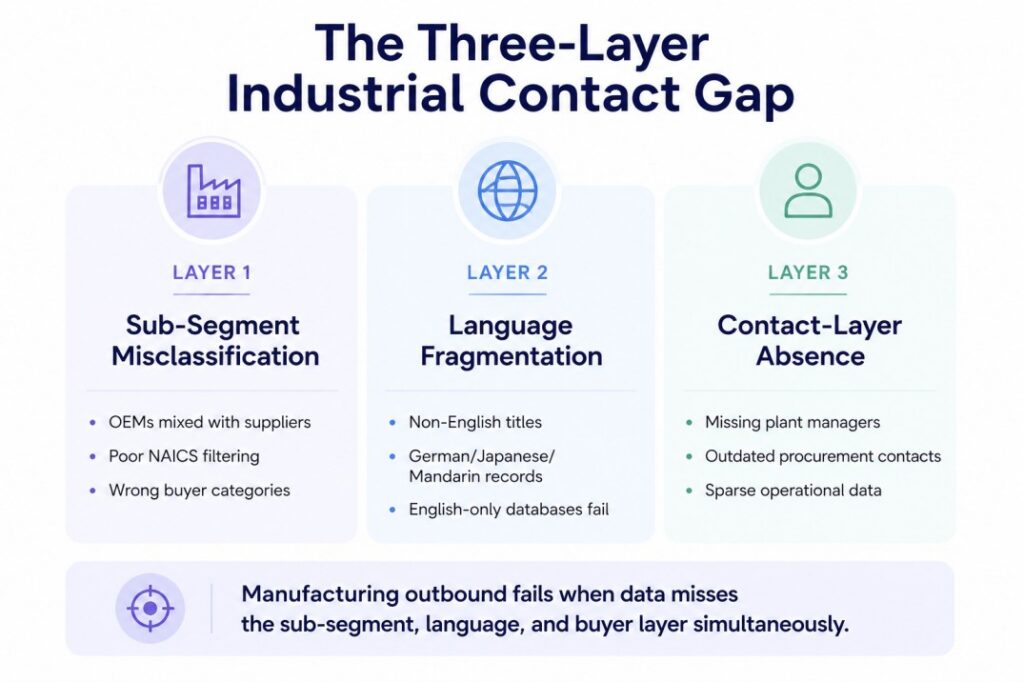
Most outbound teams hit the same three failure points when prospecting into manufacturing accounts. Together, these form The Three-Layer Industrial Contact Gap — the combination of sub-segment misclassification, language fragmentation, and contact-layer absence that leaves industrial sales teams working off incomplete lists.
Why Most Manufacturing Company Data Providers Miss the Real Buyer
Layer 1: Sub-Segment Misclassification
Generic industry filters return a mix of contract manufacturers, distributors, component suppliers, and OEMs under the same NAICS or SIC code. The actual buyer for your product might represent only 20 to 30 percent of that raw list. Without sub-segment filtering at the company and contact level, significant outreach goes to accounts that will never convert.
Layer 2: Language Fragmentation
Germany, Japan, China, and Mexico collectively represent a massive share of global manufacturing output. Most manufacturing databases search and match records in English only. A plant manager at a Bavarian automotive supplier whose title is “Werksleiter” will not surface in an English keyword search — the same applies to Japanese, Mandarin, and Spanish titles.
Layer 3: Contact-Layer Absence
Industrial companies are well-documented at the firmographic level: revenue, employee count, location, ownership structure. But the individual who approves a capital equipment purchase is often unlisted, listed without contact data, or listed with information 18 months out of date. Most manufacturing databases have the company but not the person who signs the contract.
Knowing which layer your current tool fails on tells you exactly what to look for in a replacement. Here is how the major platforms compare across all three.
How We Evaluated These Manufacturing Data Providers
We assessed each platform against six criteria specific to manufacturing prospecting. Total database size was not a factor — what matters is coverage depth where industrial buyers actually are, and whether the platform supports outbound-ready contact enrichment without heavy supplementation from additional tools.
- Industrial sub-segment coverage: Can the tool differentiate automotive tier-2 suppliers from food processing equipment makers, or does it return a flat list under a broad industry code?
- Contact coverage for operational roles: How well does it surface plant managers, procurement directors, VP Engineering, and operations leads?
- Multilingual search and record matching: Can the platform find contacts whose titles are listed in German, Japanese, Mandarin, or Spanish?
- Manufacturing-specific signal coverage: Does it surface facility expansion, equipment procurement, CAD or ERP migration, and engineering hiring spikes?
- Access to non-indexed industrial sources: Does it reach trade registries, government procurement records, or industrial association directories?
- Pricing transparency: Is pricing visible and does it scale for outbound teams running 100 to 500 accounts per month?
With these criteria set, here is how the leading platforms stack up.
7 Best Manufacturing Company Data Providers (2026)
The table below summarizes each platform. Individual breakdowns with strengths and limitations follow.
| Tool | Best For | Industrial Contact Depth | Multilingual Search | Manufacturing Signal Coverage | Weakest Area | Pricing |
|---|---|---|---|---|---|---|
| Pintel.ai | Global industrial teams targeting DACH, APAC, US, GCC, LatAm, etc. | Plant managers, procurement directors, VP Engineering via 30+ provider waterfall and trade registry access | German, Japanese, Mandarin, Spanish, Korean, and more | Structural, contextual, and behavioral manufacturing signals | Steeper onboarding for teams new to signal-based workflows | Custom |
| ZoomInfo | US large enterprise manufacturing accounts | Strong for Fortune 1000; thin for tier-2 suppliers and mid-market plants | English only | Basic funding and hiring signals; no manufacturing-specific signals | Industrial sub-segments, procurement contacts, non-English markets | From ~$15,000/yr |
| D&B Hoovers | Firmographic research and credit assessment | Strong on company records; sparse on plant managers and procurement directors | Basic company-level records; no contact-level multilingual search | None: static company and financial data only | Individual contact data for outbound | From ~$99/mo |
| ThomasNet | US industrial supplier discovery | Very limited: company and product listings only, minimal individual contacts | English only, US-focused | None: built for procurement discovery, not outbound | Direct contacts, non-US markets, outbound workflows | Contact sales |
| Cognism | EMEA teams in UK and DACH with GDPR requirements | Moderate for UK and DACH enterprise; thin for CEE and MENA industrial contacts | Primarily English records with some European company data | Basic Bombora-powered signals; no manufacturing-specific signals | Manufacturing depth outside UK and DACH, trade registry access | Custom |
| Apollo | SMB teams needing combined data and sequencing | Broad but shallow; limited industrial role specificity | English only | Basic job and funding signals; no manufacturing-specific signals | Industrial niche accuracy, non-English markets | From $49/mo |
| Kompass | Global industrial account research via trade classification codes | Company-level strong; individual emails and mobile numbers sparse and unverified | Multi-country company records; English-first search interface | None: static trade directory data only | Verified individual contacts, no signal layer | From ~$99/mo |
This comparison is based on first-hand platform knowledge, publicly available product information, and commonly reported user experiences. Contact each vendor directly for the latest pricing and product details.
Among these providers, a few platforms attempt to solve manufacturing-specific coverage gaps more directly.
Pintel.ai: Strong for Industrial Contact Coverage and Multilingual Prospecting
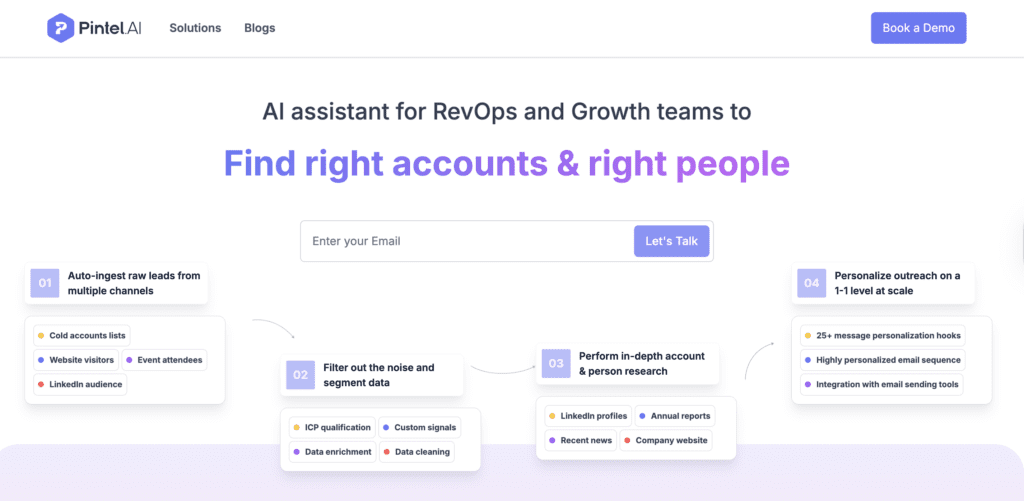
Pintel.ai is built for GTM teams prospecting into hard-to-reach industrial accounts where decision-makers are unlisted, titles vary by country, and buying cycles are tied to facility and equipment investment signals. It is the only platform on this list that combines multilingual prospecting, trade registry access, and manufacturing-specific signal tracking in one workflow.
Multilingual Prospecting
Pintel.ai searches and matches contacts across native-language records in German, Japanese, Mandarin, Spanish, Korean, and more. A procurement director listed as “Leiter Einkauf” in a DACH supplier database surfaces in a Pintel.ai search where an English-only tool returns nothing. For teams targeting Japan’s automotive supplier chain or Mexico’s electronics manufacturing corridor, this closes the Layer 2 gap entirely.
Accurate Contact Enrichment
Pintel.ai combines a proprietary industrial data layer with non-traditional sources that standard B2B providers rarely index, including industrial trade registries, government procurement records, sector-specific directories, and native-language manufacturing databases. For contact enrichment, it runs a waterfall across 30+ vetted providers — when one source has no email for a plant manager, the next provider in the sequence is queried automatically.
- In one DACH-focused pharmaceutical equipment campaign, the initial industrial contact dataset contained 37% missing or inaccurate records. After applying Pintel.ai’s waterfall enrichment workflow across 30+ vetted providers, enrichment coverage exceeded 95%.
Manufacturing Signal Coverage
Pintel.ai tracks three signal layers relevant to industrial buying cycles:
- Structural signals: facility expansion announcements, equipment procurement cycles, ERP and CAD migration projects, engineering hiring spikes, etc.
- Contextual signals: which industrial categories a company is actively researching across B2B publisher networks
- Behavioral signals: website visits, content downloads, and review site engagement
Hyper-Personalized Outreach
Pintel.ai extracts message-ready context from these signals. An SDR reaching an operations VP who just announced a new production facility in Monterrey, Mexico has a specific, relevant opening line that no generic sequence can produce. The right manufacturing company data providers cover the sub-segment, language, and signal together, not just the industry code.
Best for: Global industrial sales teams targeting DACH, APAC, US, GCC, LatAm, and similar manufacturing markets, etc. Especially strong for teams selling capital equipment, industrial software, MRO products, and technical services.
Security and compliance: ISO 27001 certified, SOC 2 (AICPA), GDPR compliant, HIPAA compliant, CCPA compliant, and VAPT certified.
ZoomInfo: Strong for US Enterprise Manufacturing, Weak for Industrial Sub-Segments
ZoomInfo builds its database through community contributions, producing strong coverage of US large enterprise manufacturers, but industrial sub-segment depth collapses below the Fortune 1000 level because fewer mid-market industrial professionals contribute records actively.
- Strong at: US Fortune 1000 manufacturers, executive-level contacts, standard firmographic depth
- Weak at: Tier-2 suppliers, specialty chemical producers, contract electronics manufacturers — often thin or outdated. No manufacturing-specific signal layer. Coverage declines sharply outside the US.
Best for: US-focused teams prospecting into large enterprise manufacturing accounts where executive-level contacts are the primary audience.
D&B Hoovers: Strong for Firmographic Intelligence, Weak for Contact Coverage
D&B Hoovers sources deep firmographic data from Dun and Bradstreet records, making it useful for understanding a manufacturer’s size, ownership structure, subsidiaries, and credit profile, but individual operational contacts for outbound prospecting are sparse and inconsistently verified.
- Strong at: Company hierarchy mapping, credit profiles, DUNS-linked entity matching, global company records
- Weak at: Individual contact data for plant managers and procurement directors, no signal layer, no buying cycle indicators
Best for: Research-focused teams mapping account hierarchies or verifying company credentials before enterprise sales cycles. Not suitable as a primary outbound contact source.
ThomasNet: Strong for US Industrial Supplier Discovery, Weak for Outbound Prospecting
ThomasNet indexes US industrial suppliers and manufacturers with detailed product capability and certification data, but the platform is designed for procurement teams finding suppliers — not for sales teams reaching buyers. Direct email and phone data for outbound outreach is largely absent.
- Strong at: US manufacturer account lists by product category, capability, and certification depth
- Weak at: Direct contact data, non-US markets, signal tracking, outbound prospecting workflows
Best for: Teams building a US industrial account list by product category who will enrich contacts through a separate provider. Not suitable as a standalone outbound tool.
Cognism: Strong for EMEA Manufacturing Compliance, Weak for Industrial Depth
Cognism provides GDPR-compliant contact data for European outbound teams and covers enterprise-level contacts in the UK and DACH markets reasonably well, but manufacturing-specific titles and industrial sub-segment depth outside these two regions are limited.
- Strong at: GDPR compliance, UK and DACH enterprise contacts, basic European coverage
- Weak at: CEE manufacturing (Poland, Czech Republic, Hungary), Southern Europe, MENA — contact coverage for plant-level roles drops significantly. No trade registry access.
Best for: UK and DACH manufacturing outreach where GDPR compliance is a hard requirement and executive-level contacts are the primary audience.
Apollo: Strong for SMB Outbound Speed, Weak for Industrial Niche Contacts
Apollo bundles a broad contact database with built-in sequencing at an accessible price point, but contact coverage for industrial operational roles is inconsistent and non-English record coverage for global manufacturing markets is limited.
- Strong at: Combined data and sequencing, SMB pricing, broad US contact coverage
- Weak at: Industrial niche accuracy, non-English markets, operational role depth (plant managers, procurement directors), no manufacturing signal layer
Best for: Small outbound teams prospecting into broad US manufacturing categories where contact volume matters more than contact precision.
Kompass: Strong for Global Trade Classification Data, Weak for Contact Accuracy
Kompass indexes businesses across 70+ countries using detailed trade classification codes, making it one of the broader global industrial directories available, but individual contact records are often company-level only and verified email or mobile for direct outreach is sparse.
- Strong at: Global industrial company discovery by trade classification, multi-country presence, broad sector coverage
- Weak at: Verified individual emails and mobile numbers, no signal layer, no enrichment capability — account prioritization is fully manual
Best for: Teams doing global industrial account discovery by trade classification who will enrich contacts separately and do not need signal-based prioritization.
How to Choose Manufacturing Company Data Providers for Your Team
The comparison table tells you what each tool does. These four questions help you decide which one fits your specific workflow. The most common reason company data fails at scale is not bad records overall — it is coverage collapse for the specific roles a team actually needs.
What to Look for in Manufacturing Company Data Providers
Step 1: What industrial sub-segment are you targeting?
Automotive tier-1, food processing, contract electronics, and pharmaceutical equipment all sit under the same broad “manufacturing” category in most databases but have completely different buyer profiles and buying signals. Confirm any shortlisted provider can filter at the sub-segment level before evaluating anything else.
Step 2: Which roles do you need to reach?
Executive contacts (VP Operations, COO, CFO) are covered reasonably well by most enterprise databases. Plant managers, procurement directors, and operations leads are not. Test any provider with a live pull from your exact sub-segment before committing to a contract.
Step 3: Do your target markets include non-English regions?
If you are targeting accounts in Germany, Japan, China, Mexico, or South Korea, an English-only database leaves a large portion of your addressable market unreachable. According to the National Association of Manufacturers, manufacturing is a globally distributed sector — and a US-only data layer misses significant portions of the global supply chain. Confirm that any provider can search native-language profiles and match non-English titles.
Step 4: Do you need manufacturing signals, or just contacts?
A list of plant managers is useful. A list of plant managers at companies currently expanding production capacity or migrating their ERP system is pipeline. If signal-based prioritization is part of your workflow, shortlist only providers that surface manufacturing-specific signals — not just generic funding or intent data.
For a broader comparison of the B2B database market, see the full comparison of B2B database providers for outbound sales.
How to Build Your Manufacturing Outbound Data Setup
The right tool combination depends on your geographic focus and workflow structure. Here are three setups that cover most industrial sales teams, applying the same principle: data quality upstream saves budget and time downstream.
US-Focused Teams
- Start with ThomasNet for company-level account discovery by product category or certification
- Enrich contacts through a waterfall provider that queries multiple sources for operational roles
- Add a signal layer that surfaces facility expansion and procurement cycle activity for prioritization
- Do not rely on a single enrichment source — plant-level contacts are underrepresented in any one database
EMEA Manufacturing Teams
- Use a GDPR-compliant source for UK and DACH English-language contacts (compliance layer)
- For CEE, Southern Europe, and MENA industrial depth, add a separate data layer with trade registry access and native-language search
- The biggest contact gaps are usually not in Germany or the UK — they are in markets where no standard tool has built a proper industrial contact layer
Global Manufacturing Teams
- A single-provider approach collapses when targeting DACH, APAC, US, GCC, LatAm, and similar manufacturing markets, etc. simultaneously
- The setup that works: proprietary data layer covering non-indexed industrial sources and native-language records, combined with waterfall enrichment across 30+ providers for contact fill rate
- Add a unified signal layer capturing structural, contextual, and behavioral indicators across all markets
Final Takeaway
Manufacturing outbound fails most often not because of bad sequences or weak copy but because the underlying data has the wrong contacts, missing context, or skips the accounts that matter most. The Three-Layer Industrial Contact Gap (sub-segment misclassification, language fragmentation, and contact-layer absence) is a structural problem that generic databases are not designed to solve.
A data provider with US-only depth fails the moment you target a German plant manager. The best manufacturing company data providers cover your specific sub-segment, search in the language your buyers use, surface signals that indicate an active buying cycle, and provide verified contacts for the operational roles that actually sign procurement decisions.
Test any provider with a live pull from your exact sub-segment and target region before committing. For teams comparing options across European industrial markets specifically, the EMEA provider comparison covers the same regional gaps in detail.
Frequently Asked Questions
What is the best manufacturing company data provider?
Pintel.ai is the strongest manufacturing company data provider for teams prospecting globally. It covers industrial contacts across DACH, APAC, US, and GCC markets, enriches hard-to-find roles like procurement directors and plant managers, and surfaces manufacturing-specific buying signals that standard tools miss.
How do I find contact data for plant managers and procurement directors?
Use a provider with waterfall enrichment across 30 or more vetted sources. Plant managers and procurement directors rarely appear in LinkedIn-based manufacturing databases. Tools that access industrial trade registries and government procurement records surface these contacts where standard providers return blank or outdated records.
Which manufacturing databases cover companies outside the US?
Pintel.ai covers global industrial markets including DACH, APAC, GCC, and LatAm. Cognism covers UK and DACH with GDPR compliance. ZoomInfo has limited depth outside the US. ThomasNet and Kompass have global company coverage but sparse individual contact data for outbound prospecting.
What signals should I use to prioritize manufacturing accounts for outreach?
Prioritize accounts showing three or more signals simultaneously: facility expansion plans, engineering hiring spikes, CAD or ERP migration activity, new procurement announcements, and capital expenditure cycles. Single-signal prioritization produces too much noise for manufacturing outbound to be efficient.
Are manufacturing contacts available in non-English languages in B2B databases?
Most standard manufacturing databases search in English only, missing profiles listed in German, Japanese, Mandarin, or Spanish. This creates a significant coverage gap for markets in Germany, Japan, China, and Mexico. Pintel.ai matches contacts across native-language records in all major manufacturing languages.
How accurate is manufacturing company data from standard B2B providers?
Standard B2B databases typically have 30 to 40 percent bad or missing data for manufacturing operational roles. Plant managers and procurement directors turn over frequently and are rarely active on LinkedIn. Waterfall enrichment across multiple manufacturing company data providers consistently improves fill rates to 90 percent or higher.