Who this is for: B2B sales and marketing teams building pipeline, whether you are a founder doing early sales, an SDR running sequences, or a sales leader creating a repeatable outbound system.
Outbound lead generation in 8 steps: Define your ICP → Build your account list → Identify decision makers → Enrich and segment data → Craft your message → Set up outreach channels → Build your cadence → Measure and optimize.
When your pipeline depends on finding the right customers, waiting for inbound is not enough. You need a way to consistently reach high-fit accounts on your own terms.
Outbound lead generation is that system. It is a structured process of identifying, targeting, and reaching out to the right prospects through email, LinkedIn, and phone.
In this guide, you will learn a step-by-step outbound lead generation process to build a consistent and scalable pipeline.
What is Outbound Lead Generation?
Outbound lead generation is the process of actively reaching out to prospects who fit your ideal customer profile, before they show interest. You identify, target, and contact them directly.
Outbound works because:
- You control the target list and messaging
- You reach decision makers who are hard to find through organic search
- You can test and optimize quickly
- Results become consistent once your process is dialed in
The goal: move prospects from “unaware of you” to “qualified conversation” as efficiently as possible.
Outbound vs Inbound Lead Generation
Inbound relies on content, SEO, and ads to pull prospects toward you. Outbound means you go to them. You find them, research them, and initiate contact.
| Aspect | Outbound | Inbound |
|---|---|---|
| Control | High – you choose who to reach | Low – you wait for interest |
| Time to first conversation | Faster (days to weeks) | Slower (weeks to months) |
| Cost | Variable (tools, research, labor) | Fixed (content, ads, infrastructure) |
| Scalability | Limited by outreach bandwidth | Unlimited once content works |
| Qualification | Pre-qualified by targeting | Mixed quality, self-qualified |
Most successful B2B companies use both. Inbound builds authority. Outbound fills pipeline gaps and reaches your best-fit accounts directly.
Once you understand the difference, the next question is: why does most outbound fail?
Why Most Outbound Fails
Before building a system, it helps to understand what breaks one.
Most outbound underperforms for four reasons:
- Poor targeting – Reaching out to anyone who loosely fits the ICP, rather than accounts with a real reason to buy now
- No signals – Working from static lists with no context about what accounts are doing or experiencing
- Generic messaging – Sending the same email to everyone, disconnected from the prospect’s actual situation
- Wrong timing – Reaching the right company before the problem is urgent enough to act on
Teams consistently invest in outreach volume before outreach precision. The signal-led model below is built to fix all four.
The Signal-Led Outbound Model
The most effective teams today do not blast cold lists. They layer signals.
The 4 layers of signal-led outbound:
- Firmographic fit – Does the company match your ICP (size, industry, revenue)?
- Role fit – Is the contact the right decision maker?
- Technographic signals – Do they use tools that indicate they have the problem you solve?
- Behavioral triggers – Did something happen recently (a hire, funding, product launch) that makes now the right time?
Each layer filters your list and improves relevance. A prospect who matches all four layers responds at 3-5x the rate of someone who matches only one.
This model runs through every step in this guide. It shapes how you build your ICP, how you segment your list, and how you write your messages.
From Manual Outbound to Automated Systems
Once you understand signals, the next challenge is executing on them at scale.
Most teams start manually: researching accounts one by one, writing emails individually, tracking follow-ups in spreadsheets. This works early, but it does not scale. The core problem is a forced tradeoff: add more accounts, and personalization quality drops. Prioritize personalization, and you cannot reach enough accounts.
How modern outbound teams break that tradeoff:
- Automated enrichment – Tools pull company and contact data automatically, so reps start with context instead of building it
- Signal-based prioritization – Teams surface accounts showing real buying intent: visiting your site, hiring for relevant roles, switching tools, or raising capital
- Sequencing at scale – Outreach platforms automate multi-touch cadences across email and LinkedIn while keeping messages personalized
- Workflow automation – When a trigger fires, an outreach sequence starts automatically without manual intervention
One important distinction: automation without signals just increases noise. More emails sent to the wrong accounts at the wrong time does not produce more pipeline. It produces more unsubscribes. The shift that matters is not sending more. It is prioritizing better.
Platforms like Pintel are built around this idea. Rather than just automating outreach, Pintel powers the signal detection and prioritization layer that tells you which accounts to reach, and when. Your team spends time on conversations, not on deciding who to contact next.
Outbound Lead Generation Process Explained
Step 1: Define Your Ideal Customer Profile (ICP)
Your ICP is the first filter in the signal-led model. Without it, no signal can tell you whether an account is worth pursuing.
Your ICP should answer:
- What industry do they operate in?
- What is their company size (revenue, headcount)?
- Who makes the buying decision?
- What problem are they facing?
- What is their budget range?
Analyze your best current customers: easiest to close, fastest to expand, lowest churn. Reverse-engineer what they share.
A simple ICP framework:
| Dimension | Questions to Answer | Example |
|---|---|---|
| Firmographic | Industry, size, revenue | B2B SaaS, 50-500 employees, $5M-$50M ARR |
| Role | Title, seniority, function | VP of Sales or Head of Revenue |
| Problem | What pain are they feeling? | Rep ramp time too slow, pipeline unpredictable |
| Technographic | What tools signal the problem? | Using Salesforce but no sales engagement tool |
| Trigger | What event makes now the right time? | Just hired 3+ AEs, raised Series B |
Your ICP is the foundation of all outbound. Get it wrong, and even the best messaging will not help.
Step 2: Build Your Target Account List
Now find the companies that match your ICP. Focus on quality, not volume.
Build your list using:
- LinkedIn Sales Navigator – Filter by company size, industry, location, tech stack
- Apollo.io or Hunter.io – Search companies matching your criteria
- ZoomInfo or Clearbit – Enriched B2B company databases
- Manual research – Competitor customer lists, industry award lists, analyst reports
- Intent data platforms – Tools like Pintel.AI, Bombora, or 6sense surface accounts actively researching solutions like yours
- Where to start: Apollo.io works well for most teams since it combines prospecting, enrichment, and sequencing. Layer in intent signals to prioritize accounts that are in-market right now.
Start with 100-500 target accounts. This list becomes the foundation of your entire outbound system.
Step 3: Research and Identify Decision Makers
Most B2B purchases involve multiple stakeholders. Find the primary decision maker and map the buying committee around them.
Common decision makers by function:
- Sales tools – VP of Sales, Sales Operations Manager
- Marketing platforms – VP of Marketing, Head of Demand Gen
- Finance software – CFO, Controller, Finance Manager
- HR tech – VP of People, CHRO
Use LinkedIn, Pintel, Apollo.io, Clearbit, or RocketReach to find contacts. Trace the buying pattern from your existing customers: who you spoke to first, who influenced the deal, who signed. Aim for 3-5 contacts per account.
Step 4: Enrich Your Data and Build Segments
Clean, enriched data is what makes personalization possible at scale. Think of this step as applying the signal-led model to your list: you are grouping accounts by shared signals so your message can speak directly to their situation.
Enrich your list with:
- Company size, industry, tech stack, funding news (Clearbit, Apollo.io)
- Email verification (Hunter.io)
- Job changes and engagement signals (Apollo.io, LinkedIn Sales Navigator)
- Tool usage data (G2)
Platforms like Pintel automate enrichment and signal-scoring, keeping your data fresh as accounts change without manual upkeep.
Then segment by:
- Company size (Enterprise, Mid-market, SMB)
- Use case (improve sales productivity vs reduce costs)
- Trigger event (new hire, funding, tool change)
- Industry (SaaS vs Financial Services)
Segmenting before you write copy is what separates teams with 3% reply rates from those with 15%.
Step 5: Craft Your Outreach Message
This is where most outbound campaigns succeed or fail. Shorter, specific, and personalized wins every time.
Follow this 5-part structure:
- Open with something specific about them – A real observation about their company, recent hire, or tech stack. Not “I noticed you work at Acme.”
- Reference a problem they are likely facing – Connect their situation to a pain you solve
- Say why you are reaching out – Be direct. One clear sentence
- Make one specific ask – Name a day and a time window, not “let’s connect sometime”
- Keep it under 75 words – One paragraph. No more
Example of a high-performing cold email:
Hi Sarah,
I noticed that Momentum SaaS just posted three AE roles on LinkedIn. Onboarding reps fast is hard when your CRM data is incomplete and your playbooks are not connected to what is actually in the pipeline.
We help B2B SaaS teams cut AE ramp time by 30% by syncing CRM gaps with coaching triggers automatically.
Would 20 minutes on Thursday work to show you how it works?
Best, Daniel
What makes this work: it references a live hiring signal, names the specific friction that follows (incomplete CRM data, disconnected playbooks), and ties it to a measurable outcome. No generic claims. No vague asks.
This type of message gets 15-25% response rates. Generic messages get 2-3%.
Now that your message is ready, the next step is deciding how to deliver it.
Step 6: Set Up Your Outreach Channels
Channels do not drive results. Signal-timed channels do.
Most teams treat channel selection as a tactical choice. It is actually a sequencing decision: which channel reaches this prospect at this moment, given what we know about their behavior and engagement?
Email (70% of outreach)
- Use a professional domain (not Gmail)
- Warm up your sending domain before scaling volume
- Set up SPF, DKIM, and DMARC for deliverability
- Send from a rep’s account, not a company alias
- Tools: Apollo.io, Lemlist, Outreach
LinkedIn (20% of outreach)
- Personalize every connection request
- Follow up 2-3 days after they accept
- Lead with value before pitching
- Tools: LinkedIn Sales Navigator
Phone (10% of outreach)
- Reserve for warm accounts (opened emails, visited your site) or high-value targets
- Best times: 8-11 AM or 2-4 PM on Tuesday-Thursday
- Always leave a voicemail
Teams that add LinkedIn or phone to their email sequences consistently book 50% more meetings. Once your channels are set up, the next step is building the sequence that connects them.
Step 7: Build Your Outreach Cadence
One email will not get a response. Most prospects need 3-5 touches before they reply.
14-21 day email sequence:
- Day 1 – Initial email
- Day 3 – First follow-up (check if it landed)
- Day 7 – Second follow-up (new angle or insight)
- Day 14 – Third follow-up (more direct ask)
- Day 21 – Final attempt or move to nurture
Parallel LinkedIn sequence:
- Day 1 – Connection request with personalized note
- Day 4 – First message
- Day 10 – Value-add message (not a pitch)
- Day 15 – Final message or passive nurture
Phone (high-value accounts):
- Day 2 – Call if they opened your first email
- Day 8 – Call if they engaged with a follow-up
- Day 20 – Final attempt
Modern sequencing tools (Apollo.io, Outreach, Salesloft) automate this entire workflow. When a prospect opens your email three times without replying, the system triggers a LinkedIn message or call automatically. That signal-responsive sequencing is what separates modern outbound from spray-and-pray.
Escalate slightly with each touch:
- “Thought you might find this relevant”
- “Wanted to make sure this reached you”
- “Quick question about [specific pain point]”
- “Not sure if the timing is right, but worth a quick conversation”
Step 8: Measure, Track, and Optimize
If you are not tracking, you are not improving.
Key metrics to monitor:
- Open rate – Target: 25-35%
- Reply rate – Target: 5-10%
- Meeting rate – Target: 20-40% of replies
- Unsubscribe rate – Stay under 0.5%
- Cost per meeting – Total spend divided by meetings booked
Track by segment, not just overall. Your message to mid-market SaaS will perform differently than your message to enterprise fintech.
Common mistakes:
- Judging results before week 3
- Optimizing for open rates instead of reply rates
- Testing multiple variables at once
- Skipping segment-level analysis
Test one thing at a time. One new subject line. One different hook. That is how you find what moves the needle.
Common Mistakes to Avoid
The most common reasons outbound fails come back to the same issues covered at the top: targeting too broad, no signals, generic messaging, and quitting before the 6-week mark. The second tier of mistakes worth watching:
- Optimizing for open rates instead of reply rates
- Reaching out to only one contact per account
- Using the same message across segments
- Sending follow-ups on the same day as the initial email
Outbound Lead Generation Process: Quick Summary
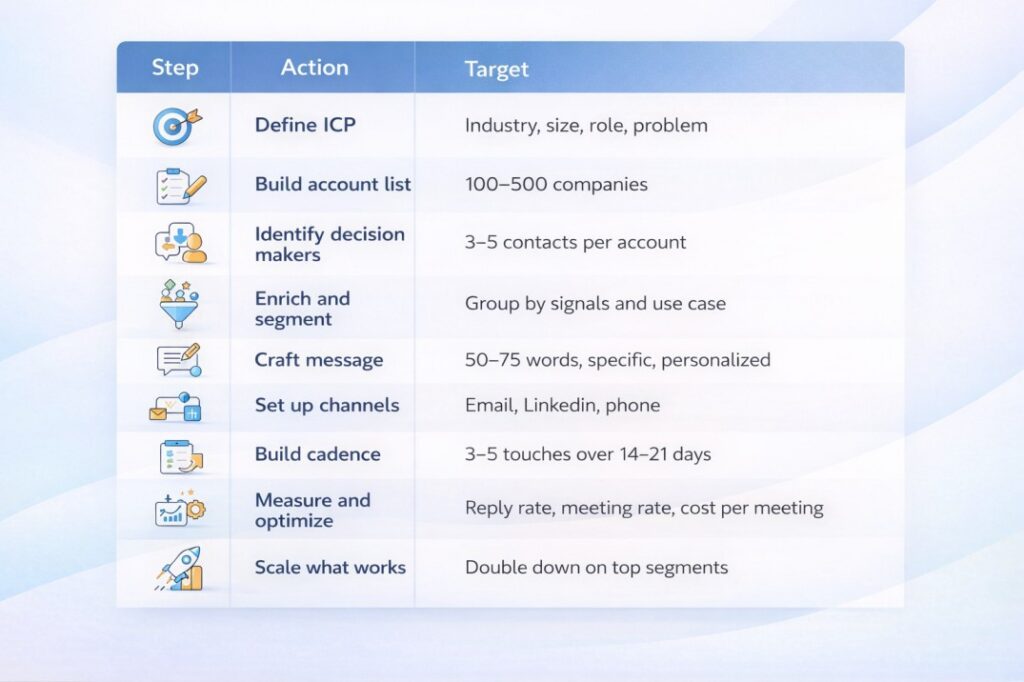
Expect early signals by week 2-3. Do not judge overall performance until week 6.
Best Outbound Lead Generation Strategies
Strategy 1: Account-Based Marketing (ABM)
Go deep on 20-50 high-value accounts with coordinated email, LinkedIn, content, and phone.
Best for: Enterprise deals ($50K+ ACV), 3-6 month sales cycles. Expected results: 30-40% meeting rate on best-fit accounts.
Strategy 2: Volume with a High-Quality List
Build 500-1,000 accounts and run consistent sequences.
Best for: Mid-market software ($10-50K ACV), filling pipeline quickly. Expected results: 5-10% reply rate, 20-30% of replies become meetings.
Strategy 3: Trigger-Based Outreach
Reach out the moment a signal fires: a new VP hire, a funding round, a tool change. This is the signal-led model in its most direct form. Platforms like Pintel automate trigger detection so your team responds at the right moment, not weeks later.
Best for: Teams prioritizing relevance and speed over volume. Expected results: 15-25% reply rate on triggered campaigns.
Strategy 4: Network Outreach
Warm introductions from customers, partners, or connections.
Best for: Companies with strong customer bases or partner networks. Expected results: 50-70% reply rate.
Most successful teams combine elements from multiple strategies.
Outbound Lead Generation That Actually Works
Most teams think outbound is a volume problem. Send more emails, book more meetings. That thinking produces mediocre results and high unsubscribe rates.
The teams that win have made a different bet. Outbound is not about sending more. It is about reaching the right accounts at the right time, with a message built on real context.
That is what the signal-led model delivers. When you layer firmographic fit with role fit, technographic signals, and behavioral triggers, you stop guessing and start acting on evidence. Your ICP becomes a precision filter. Your segments become signal clusters. Your messaging reflects where each account actually is.
Platforms like Pintel.AI are built to power exactly this: automating signal detection, prioritizing accounts by buying intent, and giving your team the context to reach out at the right moment. The result is not just more outreach. It is better-timed, better-targeted outreach that converts.
Here is what to do next:
- Define your ICP based on your best current customers
- Build your first 100-account list using intent signals, not just firmographic filters
- Write one personalized sequence for your strongest segment
- Run it consistently for 6 weeks before drawing conclusions
Outbound works when it is built on systems and signals, not on volume and hope. Build the system, trust the process, and the pipeline follows.
FAQ
What is outbound lead generation?
Outbound lead generation is the process of identifying and reaching out to prospects who match your ideal customer profile. You initiate contact through email, LinkedIn, or phone rather than waiting for inbound interest.
Is outbound lead generation still effective?
Yes. Most teams see 5-15% reply rates with proper targeting, and 20-40% of those convert into meetings. The key shift is moving from volume-based outreach to a signal-driven outbound lead generation strategy.
What is the best outbound lead generation strategy?
It depends on deal size. Enterprise teams use ABM, mid-market teams run structured sequences, and SMB teams focus on volume with simple cadences. Most companies combine all three B2B outbound lead generation approaches.
How does the outbound lead generation process work?
Define your ICP, build a target account list, identify decision makers, enrich and segment your data, run personalized multi-touch sequences across email and LinkedIn, and optimize continuously based on reply and meeting rates.
How long does it take to see results?
Initial replies come within 2-3 weeks. Meaningful results take 6-8 weeks, as most conversions happen after multiple touches in your outbound prospecting sequence.
Which tools are best for outbound lead generation?
Apollo.io for prospecting and sequencing, LinkedIn Sales Navigator for research, and Lemlist or Instantly for deliverability. For signal tracking and account prioritization, platforms like Pintel add an advanced layer to your B2B outbound lead generation stack.
What is the difference between outbound lead generation and outbound prospecting?
Prospecting is one part of the broader outbound lead generation process. Prospecting identifies and qualifies leads; outbound lead generation covers the full workflow from targeting to booking meetings and converting leads.