An SDR opens a CRM record for a company that looks like a perfect ICP (Ideal Customer Profile) fit: right industry, right size, right revenue band. Three outreach sequences land with no response. What the SDR does not know: the company just paused all new vendor evaluations after a leadership change. The signal was there. Nobody was tracking it.
Company intelligence closes that gap. This guide covers exactly what it includes, why it changes pipeline outcomes, and how B2B sales teams gather it systematically without adding research overhead.
What Is Company Intelligence?
Company intelligence is business data that tells sales teams which companies to target, when to engage, and why they are likely to buy. It combines firmographic data (what the company is), technographic data (what tools it uses), behavioral signals (what it is doing right now), and relational data (who it is connected to).
Together, these layers turn a static prospect list into a live, signal-driven prioritization engine. Most sales teams have access to one layer. The teams consistently booking meetings have built all four.
Example: How Multiple Intelligence Layers Create a Better Prospect
Imagine you’re selling RevOps software to mid market SaaS companies.
A company first appears on your radar because it matches your ICP: around 300 employees, headquartered in the UK, and growing steadily. That is your firmographic filter.
A week later, you notice it’s hiring Salesforce administrators and RevOps analysts while job postings mention HubSpot. That adds technographic context by revealing the systems the company already relies on.
Two weeks later, the company announces a new Chief Revenue Officer and opens multiple sales leadership roles across Europe. Those behavioral signals suggest a significant GTM expansion is underway.
Finally, you discover one of your existing customers shares the same venture capital investor as the prospect. That relational insight gives your team a credible introduction instead of relying on cold outreach.
None of these signals alone guarantee a buying opportunity. Together, they paint a clear picture of a company entering a period of operational change, making it a far stronger outbound priority than another company that simply matches your ICP.

What Does Company Intelligence Include? The Company Intelligence Stack
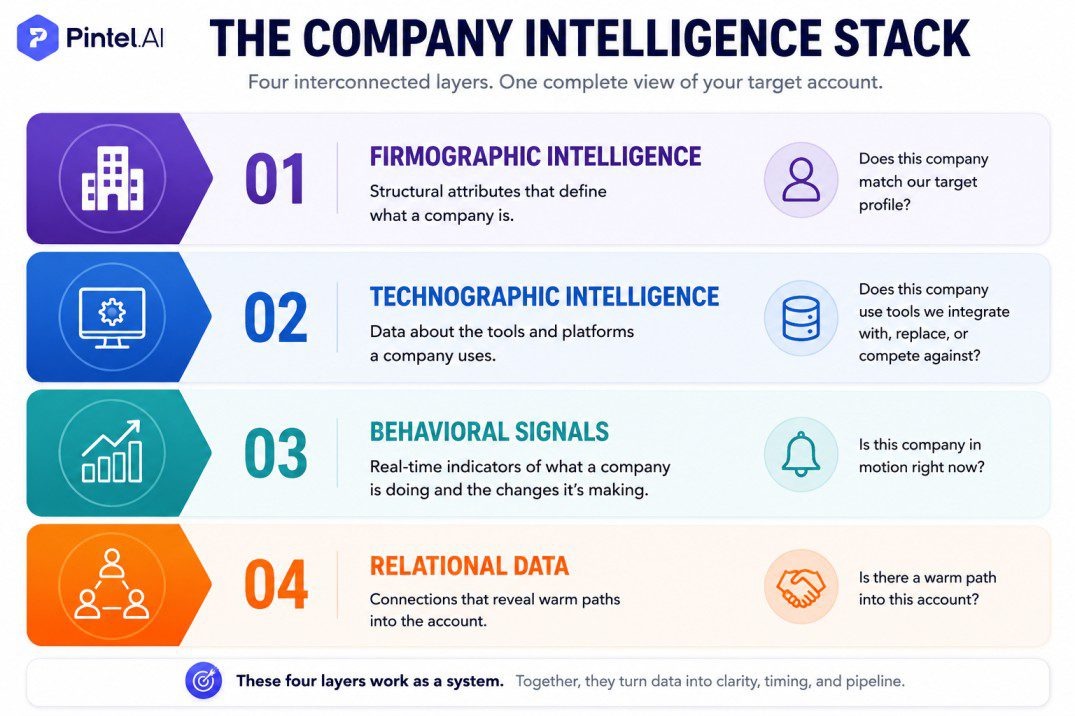
Company intelligence is not a single data type. It is a stack of four interconnected layers, each answering a different question about a target account. A company’s firmographic profile tells you what it is. Its signals tell you when to call.
Layer 1: Firmographic Intelligence
Firmographic intelligence covers the structural attributes of a company: industry, employee count, annual revenue, headquarters location, legal entity type, and ownership structure. It is the foundation of any ICP (Ideal Customer Profile) filter and the first layer every B2B data provider supports.
Firmographic data answers the question: does this company match our target profile? It does not tell you whether the company is ready to buy. A company can match every firmographic criterion perfectly and still be in the wrong stage of its budget cycle to engage.
Layer 2: Technographic Intelligence
Technographic intelligence is data about what tools and platforms a company currently uses: CRM, marketing automation, ERP, cloud infrastructure, security software, and so on. It is gathered by analysing job descriptions, web code, G2 reviews, and third-party data providers.
Technographic data answers the question: does this company use tools our product integrates with, replaces, or competes against? For SaaS companies, it is one of the highest-signal ICP qualifiers available. A team selling a Salesforce integration does not need to pitch a company running HubSpot, unless they are about to switch.
Layer 3: Behavioral Signals
Behavioral signals are real-time indicators of what a company is actively doing: funding announcements, senior leadership hires, hiring spikes in specific departments, office expansions, tech migrations, regulatory filings, and product launches. These signals indicate movement and change: the conditions that most often precede a buying decision.
Behavioral signals answer the question: is this company in motion right now? A company that just hired a new VP of Sales is building a new outbound team. A company that just raised a Series B is deploying capital. These are buying windows, not hypothetical interest.
Single-signal intelligence is a guess. Three signals firing simultaneously is a buying window.
Layer 4: Relational Data
Relational data maps how a company connects to others: existing customer relationships, partner networks, supplier chains, board member affiliations, and investor connections. It answers the question: is there a warm path into this account?
A shared investor, a mutual customer, or a former colleague now sitting at the target company changes the nature of outreach entirely. Relational data is the hardest layer to scale, but it consistently produces the shortest sales cycles because it removes the cold-start problem from outreach.
These four layers work as a system. Building only one or two produces a fragmented picture. Account intelligence research methods that combine all four layers consistently outperform single-source approaches on pipeline conversion rates.
Why Does Company Intelligence Matter for B2B Sales Revenue?
The commercial case for company intelligence comes down to timing. Most B2B outreach is sent to the right companies at the wrong time. The timing problem is expensive: it drives up sequence volume, exhausts SDR capacity, and produces declining reply rates that get blamed on messaging rather than timing.
Company intelligence changes three variables that directly affect revenue:
- Account prioritization. When accounts are ranked by signal strength rather than just firmographic fit, SDRs spend time on the 20% of accounts showing active buying signals rather than cycling through the entire ICP list equally. This alone materially reduces wasted sequences.
- Outreach timing. Behavioral signals create natural entry points for outreach. A funding announcement, a new VP hire, or a tech migration is a legitimate reason to reach out, not just a cadence step. Buying signals derived from company intelligence reduce the number of touches needed to book a first meeting.
- Personalization at scale. Company intelligence gives SDRs specific, verifiable context for opening lines. “I noticed you hired three RevOps managers in Q2” is more compelling than any template. The context is not a tactic. It is evidence that the outreach is relevant.
Teams with strong company intelligence systems do not just book more meetings. They book meetings with accounts more likely to close, because intelligence filtered for buying-window timing before the first sequence was sent. The right company intelligence tools make this filtering automatic rather than manual.
What Are the 4 Types of Company Intelligence?
Each layer of company intelligence serves a specific sales workflow. The table below maps each type to the question it answers, the sales motion it enables, and where it typically falls short on its own.
| Intelligence Type | What It Answers | Sales Motion It Enables | Limitation Used Alone |
|---|---|---|---|
| Firmographic | Does this company match our ICP profile? | ICP filtering, initial list building | Does not indicate buying readiness or timing |
| Technographic | What tools do they use or are about to replace? | Tech stack displacement, integration-led sales | Data goes stale fast; misses companies not publicly visible |
| Behavioral Signals | Is this company actively changing right now? | Timing-based outreach, event-triggered sequences | Noisy without ICP filtering; false positives at scale |
| Relational Data | Is there a warm path into this account? | Warm intros, mutual connection outreach | Hard to gather at scale without dedicated tooling |
The teams with the most efficient outbound pipelines layer all four types. Firmographic data builds the universe. Technographic and behavioral signals filter it down to the accounts in motion. Relational data determines which ones get a personalised first touch versus a standard sequence.
How Do You Gather Company Intelligence for B2B Sales?
Gathering company intelligence is not a research task. Done at scale, it is a data pipeline that runs continuously in the background and routes relevant signals to the right SDRs automatically. Here is how high-performing outbound teams build that pipeline.
Step 1: Define What a Buying Signal Looks Like for Your ICP
Before building any intelligence system, define 3 to 5 trigger events that historically precede a closed deal in your pipeline. For a SaaS company selling to growing sales teams, those triggers might be: new VP of Sales hired, headcount above 50 in sales, Series B or later funding, and migration away from a competing tool.
These triggers become the filters for your company intelligence pipeline. Without them, you are collecting everything and acting on nothing.
Step 2: Layer Multiple Intelligence Types
A single data point tells you a company has potential. Multiple simultaneous signals tell you a company is in a buying window. A company that just raised funding (behavioral) AND is hiring for RevOps (behavioral) AND runs the CRM you integrate with (technographic) AND matches your ICP profile (firmographic) is not a cold prospect. It is a warm account that should be in sequence within 48 hours.
The teams consistently booking first meetings are not the ones with the biggest contact lists. They are the ones triangulating three or more signals before a sequence starts. This approach is covered in detail in the guide on buyer intent tools and how they stack with firmographic filters.
Step 3: Automate the Data Collection Pipeline
Manual research does not scale past a handful of accounts. SDR teams that research accounts manually spend a disproportionate share of their week on tasks that data pipelines can automate, as LinkedIn’s State of Sales research consistently documents. Automated pipelines pull signals from job postings, funding databases, news monitoring, and intent data platforms, then route them into CRM automatically.
The critical design principle: automation should surface the signal, not make the outreach decision. SDRs still review flagged accounts and write the opening lines. The pipeline removes the research bottleneck, not the human judgment layer.
Step 4: Connect Intelligence to Outreach Triggers
Company intelligence produces value only when it triggers action. Map each signal type to a specific outreach sequence. A funding announcement triggers outreach within 48 hours. A VP-level hire triggers a sequence 30 days after the hire, once the executive is past initial onboarding. A tech stack migration triggers a displacement sequence immediately.
Intelligence that does not trigger a specific action is research overhead. The goal is a system where a signal fires automatically, an SDR reviews it, and a sequence starts within the same business day.
What Tools Help Teams Gather Company Intelligence?
Company intelligence tools generally fall into three categories, with each supporting a different part of the intelligence gathering process.
Data enrichment platforms strengthen firmographic and technographic data by filling gaps in company records and contact databases. They help sales and RevOps teams maintain complete, accurate company profiles before outreach begins and typically support ongoing CRM enrichment workflows.
Signal monitoring tools track changes that may indicate buying intent, including leadership hires, funding announcements, hiring activity, product launches, technology adoption, and procurement opportunities. These tools reduce manual research by automatically surfacing accounts showing meaningful business activity.
Company intelligence platforms bring these capabilities together into a unified workflow. Instead of switching between multiple enrichment, monitoring, and research tools, sales teams can discover, prioritize, and engage high potential accounts from a single platform.
Rather than relying on separate tools for each intelligence layer, Pintel.ai combines multiple data sources into one workflow that helps GTM teams identify accounts with the highest potential.
| Company Intelligence Layer | How Pintel.ai Helps |
|---|---|
| Firmographic Intelligence | Discover companies using filters such as industry, employee count, revenue, location, ownership type, and other firmographic attributes. |
| Technographic Intelligence | Find companies based on the technologies they use, helping identify integration opportunities, competitive replacements, and ideal product fit. |
| Behavioral Signals | Surface buying signals such as leadership changes, hiring trends, funding events, procurement activity, company expansions, and other indicators of business change. |
| Account Intelligence | Combine proprietary company data, government procurement records, trade directories, local business registries, and real time market signals to prioritize accounts showing multiple buying indicators. |
The strongest company intelligence platforms extend beyond publicly indexed web data. By combining proprietary datasets with real time intelligence, they help sales teams uncover high potential accounts earlier, prioritize outreach more effectively, and spend less time on manual account research.
What Is the Difference Between Company Intelligence and Sales Intelligence?
Company intelligence and sales intelligence are related but not the same. Understanding the difference matters for choosing the right tools and building the right workflow.
Company intelligence focuses on the organisation: what the company does, its structure, its tools, its buying signals, and its network connections. It answers the question “should we target this account and when?”
Sales intelligence is a broader category that includes company intelligence AND contact-level data: specific decision-maker email addresses, phone numbers, LinkedIn profiles, seniority levels, and individual buying intent signals. It answers the additional question “who do we reach at this account and how?”
In practice, a complete outbound stack needs both. Company intelligence drives account prioritization and timing. Contact intelligence drives personalised outreach to the right people within those accounts. Building a target account list from company intelligence signals before enriching contacts is the correct sequencing, and the step most teams skip.
What Do Most Teams Get Wrong About Company Intelligence?
Four mistakes account for most of the underperformance in company intelligence programs.
Treating firmographic data as sufficient
Company size and industry tell you a company fits a profile. They do not tell you whether the company is in a buying window. Firmographic-only outreach is essentially cold outreach to a pre-filtered list. Better than random, but far from signal-driven. Most teams upgrade from no filtering to firmographic filtering and stop there, missing the three layers that actually drive timing.
Using company intelligence as a one-time snapshot
Company intelligence that is gathered once and not refreshed decays quickly. Senior leadership changes, funding rounds, tech migrations. These happen continuously. An account that was not ready six months ago may be a top-priority account today. Continuous signal monitoring is not a nice-to-have. It is the difference between a live intelligence system and an expensive static list.
Relying on a single data source. The best company intelligence lives outside LinkedIn: in government records, board minutes, and trade registries
LinkedIn covers the professional layer of a company’s story well. It does not cover procurement records, regulatory filings, contract renewal timelines, or the non-indexed data sources where the most predictive buying signals actually live. Teams using only LinkedIn-derived company intelligence miss the accounts that government filings, trade directories, and local business registries would have surfaced.
Gathering intelligence without connecting it to outreach triggers
Intelligence that sits in a spreadsheet or a CRM field that no one reads does not generate pipeline. The last step: mapping signals to specific outreach sequences, is where most programs fail. The intelligence is gathered, it is accurate, and it is simply never acted on because there is no automated routing from signal to action.
Avoiding these four mistakes does not require a complete systems overhaul. It requires defining signal triggers, adding two more data layers, and building a routing rule that connects each signal to a specific outreach response. Lead scoring models that incorporate company intelligence signals can be a practical starting point for teams building this workflow incrementally.
Final Takeaway: Company Intelligence Is About Timing, Not Just Data
Company intelligence is not a data quality project. It is a pipeline timing project. The goal is not to have more complete CRM records. The goal is to reach the right accounts at the moment they are most likely to buy, consistently, at scale, without burning out the SDR team on manual research.
The four-layer Company Intelligence Stack (firmographic, technographic, behavioral signals, relational data) gives every account a full picture. Automated signal monitoring keeps that picture current. Outreach trigger rules turn signals into sequences without human bottleneck. This is how high-performing outbound teams consistently outperform teams with identical ICP definitions and similar contact databases. The difference is not the list. It is the intelligence layer on top of it.
For teams evaluating company intelligence software and tools, the guide on how sales teams choose data providers covers the evaluation criteria in detail.
FAQ: Company Intelligence
What is company intelligence in B2B sales?
Company intelligence is business data that tells sales teams which companies to target, when to engage, and why they are likely to buy. It includes firmographic data, technographic data, behavioral signals, and relational data combined into a prioritization system.
What is the difference between company intelligence and sales intelligence?
Company intelligence covers organisation-level data: structure, tools, signals, and network. Sales intelligence is broader: it adds contact-level data (email addresses, phone numbers, decision-maker details). Company intelligence drives account prioritization. Sales intelligence adds the contact layer for direct outreach.
What are examples of company intelligence signals?
Common company intelligence signals include: funding announcements, senior leadership hires (VP, C-suite), hiring spikes in specific departments, tech stack migrations, office expansions, regulatory filings, and product launches. Each signals a change in company direction that may create a buying window.
What is a company intelligence platform?
A company intelligence platform is software that collects, aggregates, and surfaces data about target companies across firmographic, technographic, behavioral, and relational layers. It automates the account research that SDRs would otherwise do manually and routes signals to outreach workflows.
How is company intelligence used in outbound sales?
Outbound teams use company intelligence to rank accounts by buying-window signals before sequencing begins, write personalised opening lines from specific signals, time outreach around trigger events, and reduce wasted sequences on accounts outside their current buying window.
What is the difference between company intelligence and intent data?
Intent data is one type of behavioral signal within company intelligence: third-party data showing which topics a company’s employees are researching across publisher networks. Company intelligence is the broader category that includes intent data alongside funding signals, hiring data, technographic data, and relational data.
How do you gather company intelligence without manual research?
Automated pipelines pull data from funding databases, job boards, intent data providers, technographic tools, and news monitoring services, then route signals to CRM automatically. A company intelligence platform combines all these sources into one workflow, eliminating the need for manual research per account.
What is the difference between company intelligence and revenue intelligence?
Company intelligence helps sales teams identify the right companies to target using firmographic data, buying signals, and account insights. Revenue intelligence helps improve pipeline performance by analyzing sales activities, customer interactions, and deal progression after opportunities enter the pipeline.