Your reps are working the list. Calls go out, emails get sent, sequences run. Yet pipeline keeps stalling because too many accounts are the wrong fit, not ready to buy, or not in a purchasing cycle right now. Lead scoring was meant to solve this. For many B2B sales teams, it has not, because the model was built on the wrong signals. T
his guide covers the scoring criteria that reflect genuine buying readiness, how to weight them, and how to build a three-layer lead scoring framework your team will actually use.

What Is B2B Lead Scoring?
A lead scoring model is a system that ranks potential buyers by assigning numerical values based on how well they match your ideal customer profile and how ready they are to purchase in the near term.
Each lead receives a score built from three types of inputs: firmographic fit, behavioral engagement, and buying intent signals. The total determines whether a lead moves to an SDR queue immediately, stays in nurture, or sits deprioritized until conditions change.
In B2B sales, the purpose is triage, not qualification. Volume is lower than B2C. Deal sizes are higher. A rep spending five days on a low-fit account has a real cost in pipeline. A working lead scoring model protects that time by surfacing only the accounts with genuine purchase potential at the right moment.
The criteria you choose determine whether the model works. Fit without signals produces a qualified list that never moves. Signals without fit produce noise. The combination is what separates models that change rep behavior from models that sit in the CRM untouched after six months.
Why Most Lead Scoring Models Fail to Move Pipeline
Most B2B lead scoring models are built almost entirely on marketing engagement data: email opens, content downloads, page visits, and webinar sign-ups. These signals measure whether a prospect interacted with your content. They do not measure whether the prospect is ready to buy.
An account downloading three whitepapers and opening every nurture email scores 90 out of 100 in a standard model. An account that raised a Series B two weeks ago, brought in a new Chief Revenue Officer, and started a CRM migration scores 0, because none of those signals live in a marketing automation platform.
The accounts burning the most pipeline capacity are usually ones that score high on engagement but show zero buying readiness. Reps spend weeks on over-engaged, wrong-fit accounts while the ones in an active purchasing cycle sit untouched in the database.
The structural flaw: engagement measures who is interested in your content, not who is in a buying window. The two groups overlap, but they are not the same group.
Gartner research on B2B sales analytics consistently notes that buyers complete a large portion of their evaluation before engaging any vendor. An engagement-only scoring model misses the most advanced buyers entirely.
The fix is not to remove engagement signals from your model. It is to stop treating them as the primary evidence of purchase intent. Fit criteria should form the foundation. Buying signals should carry the highest predictive weight. Engagement confirms interest. It does not create it.
The Right Lead Scoring Criteria for B2B Sales
A working B2B lead scoring framework uses three types of criteria: fit, engagement, and buying signals. Each measures something different. Together they produce a score that reflects actual purchase probability, not just activity levels.
Fit Criteria: Does This Account Match Your ICP?
Fit criteria measure whether an account matches your ideal customer profile, independent of any engagement. A perfect-fit account with zero content engagement is still worth pursuing. A poor-fit account scoring 100 on engagement is a time sink.
Core fit dimensions to score:
- Industry and sub-industry alignment with your core ICP
- Company size (headcount band and revenue range)
- Target geography and region
- Technology stack (tools they currently use that your product integrates with or replaces)
- Decision-maker presence (can you find and reach the right persona at this account?)
Contact identification requires care at this stage. Title-keyword searches miss 30 to 50% of relevant contacts because job titles vary across companies and industries. Profile-level analysis, reading the full work context, closes the gap between contacts your model counts and the actual decision-makers.
Engagement Criteria: Has This Account Shown Interest?
Engagement signals measure a lead’s demonstrated interest in your brand and category. They belong in the model but at a lower weight than fit and buying signals.
Useful engagement signals, ranked by intent strength:
- Demo request or direct contact form fill (highest weight)
- Pricing page or demo page visit
- Email click-through on a relevant topic
- Webinar or event attendance
- Review site activity (checking your G2 or Capterra profile)
- Blog post or content download (lowest weight)
One rule most teams skip: engagement decay. An account that visited your pricing page eight months ago is not the same signal as one that visited it last Tuesday. Build a decay multiplier that halves the engagement score for signals older than 30 days and zeroes them beyond 90 days. Without decay, old engagement accumulates and distorts current readiness scores.
Buying Signal Criteria: Is This Account in a Purchasing Window?
Buying signals are external data points showing that an account is in an active purchasing window, regardless of whether they have engaged with your content. This is the layer most lead scoring models omit, and it carries the most predictive weight for near-term pipeline conversion.
Key buying signals to include in this layer:
- Funding events: A recent funding round means new budget, new headcount, and likely new tool purchases within 90 days
- Leadership changes: A new VP of Sales, CRO, or RevOps leader typically rebuilds the tech stack within the first quarter in role
- Hiring spikes: Opening five or more sales, RevOps, or operations roles signals scaling activity and platform spend
- Tech migrations: Switching CRM, data platform, or sales engagement tool means active vendor evaluation is underway
- Competitor contract renewals: Outreach timed around competitor renewal windows produces materially higher response rates
An account showing one buying signal is a possibility. An account showing three or more is in the buying window today, whether or not they have ever visited your website.
Most standard lead scoring setups omit buying signals because they do not live in marketing automation platforms. They live in sales intelligence tools that track structural company changes, intent data networks, and first-party behavioral signals. Adding this layer is the single highest-leverage change most B2B sales teams can make to their scoring model.
How to Build a Lead Scoring Framework: The Three-Layer Scoring Model
The Three-Layer Scoring Model assigns weights to three scoring dimensions that combine into a composite score out of 100. The weights below are calibrated to B2B outbound. Adjust them after 90 days of conversion data.
The framework becomes easier to apply when you see how the layers combine in a real scoring scenario.
Example: How a B2B Lead Scoring Model Works in Practice
Imagine a 150-person SaaS company that recently raised a Series B round, hired a new VP of Revenue, and started evaluating new sales tooling. The account has shown moderate engagement with your website but strong buying readiness signals.
| Scoring Layer | Criteria | Signal | Score |
|---|---|---|---|
| ICP Fit | Industry match | B2B SaaS company | +15 |
| ICP Fit | Company size | 150 employees, within ICP range | +10 |
| ICP Fit | Tech stack alignment | Salesforce already installed | +7 |
| Engagement | Pricing page visits | Two visits in the last 7 days | +8 |
| Engagement | Webinar attendance | Attended RevOps webinar | +4 |
| Buying Signals | Funding event | Series B raised within 60 days | +15 |
| Buying Signals | Leadership change | New VP of Revenue hired | +10 |
Total Lead Score: 69/100
In a traditional engagement-only scoring model, this account may not rank highly because engagement activity is still relatively limited. But the combination of ICP fit and active buying signals suggests the company is likely entering a purchasing cycle right now.
This is why high-performing B2B lead scoring models prioritize buying readiness signals alongside engagement data instead of relying on content activity alone.
The framework below shows how high-performing B2B teams balance ICP fit, engagement activity, and buying readiness signals when prioritizing accounts.
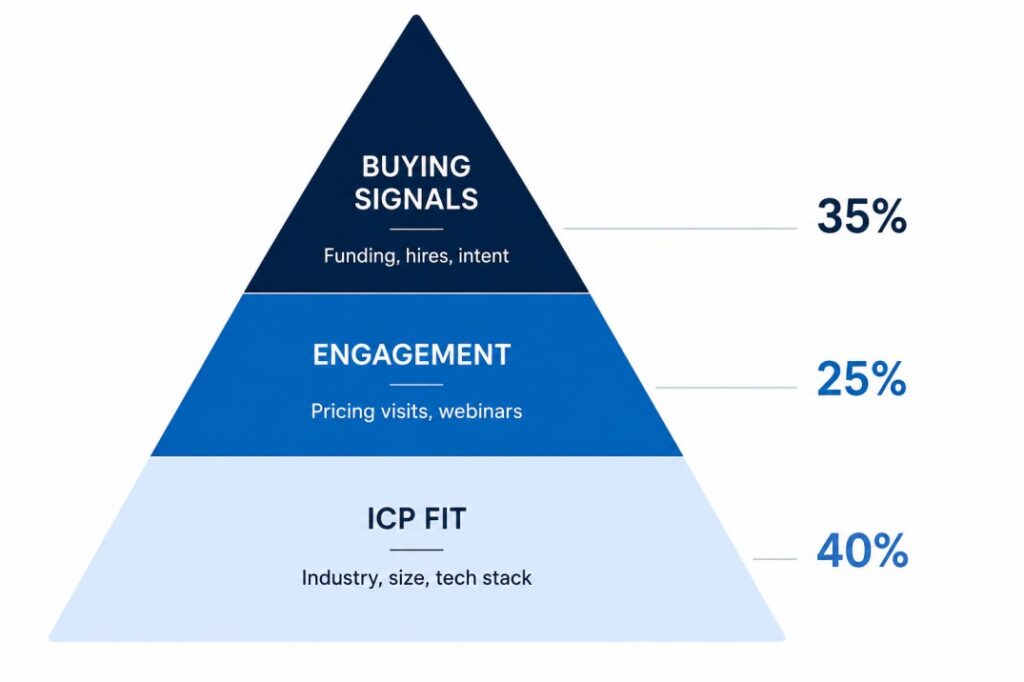
Layer 1: ICP Fit Score (Recommended Weight: 40 Points)
Assign points by ICP centrality. Suggested distribution: exact industry match (15), company size in target band (10), geography (8), tech stack alignment (7). Weights should reflect which dimension most predicts whether the account can be served.
Set a fit floor before an account can progress regardless of engagement or signal score. An account scoring below 25 on fit should not enter the SDR queue. A rep working a poor-fit account at high signal strength is still working the wrong account.
Setting a fit floor is the single most underrated change in a B2B lead scoring model. It removes the false positives that engagement-only models promote to active sequences.
Layer 2: Engagement Score (Recommended Weight: 25 Points)
Score behavioral signals from your marketing automation platform and CRM. Weight higher-intent behaviors more heavily: demo requests and direct contact form fills carry the most weight, followed by pricing page visits, email click-throughs, and event attendance. Content downloads carry the least weight.
Cap engagement at 25 even when raw signal totals exceed that. Apply an engagement decay rule: halve signals older than 30 days and zero them beyond 90 days. This prevents old engagement from inflating readiness scores for leads that went cold six months ago.
Layer 3: Buying Signal Score (Recommended Weight: 35 Points)
This layer pulls data from outside your marketing stack and carries the highest predictive weight. Structural signals (funding rounds, VP-level hires, hiring spikes, tech migrations, etc.) are the primary inputs. Contextual signals, which track what topics an account actively researches across publisher networks, add a second dimension. Behavioral first-party signals complete the picture.
For teams without a signal tool, start with funding events and leadership hires: publicly visible, time-sensitive, and reliably predictive of near-term spend. Manual tracking works under 200 accounts. Above that, automated monitoring is necessary to keep this layer current.
Lead Scoring Criteria Reference Table
The framework below summarizes how each scoring layer contributes to overall lead prioritization and where the underlying data typically comes from.
The Three-Layer Scoring Model at a glance:
| Layer | Criteria Type | Example Signals | Suggested Weight | Primary Data Source |
|---|---|---|---|---|
| Layer 1: ICP Fit | Industry, company size, geography, tech stack, decision-maker presence | Exact SIC match, headcount in target range, relevant tech installed | 40% | CRM firmographics, B2B data providers |
| Layer 2: Engagement | Page visits, email activity, demo requests, event attendance, review site activity | Pricing page visit, direct demo request, webinar attendance | 25% | Marketing automation platform, CRM |
| Layer 3: Buying Signals | Structural signals, contextual topic research, behavioral first-party signals | Funding round, VP of Sales hire, 5+ RevOps job openings, tech migration, intent data | 35% | Sales intelligence platform, buying intent tools |
This framework is based on first-hand GTM practice, publicly documented lead scoring methodology, and commonly reported B2B sales team workflows. Adjust weights to your ICP, deal size, and sales cycle length after 90 days of conversion data.
How to Set Score Thresholds and Prioritize Leads
Once the three-layer score is in place, thresholds determine what happens next. A practical starting tier structure:
- Score 80 to 100 (Tier 1): Route to SDR queue immediately. Personalized outreach within 24 hours.
- Score 60 to 79 (Tier 2): Add to active sequence at lower urgency. Check back in 14 days or when signal score increases.
- Score 40 to 59 (Tier 3): Stay in nurture. Revisit if fit improves (company growth) or new signals appear.
- Score below 40: No active outreach until the account crosses the fit floor.
Calibrate thresholds against conversion data after 90 days. If Tier 2 leads convert at the same rate as Tier 1, lower the cutoff accordingly. Set a contact coverage minimum before routing any Tier 1 account: even a perfect-scoring account is a fragile opportunity if only one reachable contact exists. Three to five relevant contacts is the practical minimum before activating a sequence.
For teams running signal-based scoring at scale, Pintel.ai’s prospect prioritization automates this layer. It scores accounts by ICP fit, buying signals, and contact reachability, then routes only the highest-priority accounts to the SDR workflow, removing the manual threshold-checking step that slows most teams down on lists above 500 accounts.
Where Lead Scoring Breaks Down at Scale
Lead scoring models that work well at 200 accounts often degrade silently as volume grows. Four failure patterns account for most of the drift.
Data Staleness Corrupts Fit Scores Over Time
Firmographic data decays at roughly 25 to 30% annually. A company at 45 employees when first scored may now have 180. Running contact data enrichment on a quarterly cadence keeps fit scores accurate. Without it, lead scoring misses accounts that now qualify while surfacing ones that no longer fit.
The impact is measurable. One B2B sales team found 37% of their CRM records were wrong or missing. After enriching their list through a multi-source process, they hit 95%+ match rate and stalled pipeline started converting. The scoring model did not change. The underlying data did.
Engagement Decay Is Not Applied and Signal Scores Are Not Refreshed
Two related failures usually appear together. First: engagement scores assigned at the point of interaction are never decayed, so an email open from 18 months ago carries the same weight as a pricing page visit from last week. Second: buying signal scores are assigned once at the point of prospect creation and never updated, so a funding event from nine months ago still drives Tier 1 routing. Both inflate scores for accounts that are no longer warm.
Signal timing matters more than signal presence. A funding round has a 90-day peak outreach window before budget is allocated and priorities set. An account showing simultaneous signals (funding event, new VP of Revenue, active category research) is in the buying window now. A model that refreshes signals weekly catches this window. One relying on initial assignments misses it.
Profile-Level Relevance Is Ignored at the Contact Layer
Most scoring models check whether a contact’s job title contains the right keywords. This misses people whose full work profiles match the ICP but whose titles do not. A “Business Operations Lead” at a 150-person SaaS company may be the RevOps decision-maker. A keyword search returns nothing. The reverse also happens: a keyword match on “Sales Director” can include someone managing indirect channels, not the direct motion your product serves.
Pintel.ai’s data intelligence platform tracks structural signals (funding rounds, VP-level hires, hiring spikes, tech migrations, etc.), contextual signals (which topics an account is actively researching across publisher networks), and behavioral first-party signals in one place, keeping all three layers current without manual refresh cycles. Teams using revenue intelligence platforms for signal tracking typically see fewer stale Tier 1 accounts and more consistent pipeline quality from their scoring model.
Final Takeaway
A B2B lead scoring model that works is not a long list of engagement events with point values attached. It is a layered system that scores for ICP fit first, uses engagement as supporting evidence, and weights buying signals as the strongest predictor of near-term conversion.
Lead scoring does not replace rep judgment. It gives reps a structured reason to prioritize one account over another the moment they sit down to plan their day.
Start with the fit layer and set the fit floor. Run the model for 90 days and check conversion rates by tier. Layer in buying signals once the fit foundation is stable. Revisit score weights each quarter. Good data enrichment tools and a reliable signal source are the two infrastructure investments that compound scoring accuracy over time. Without both, even a well-designed lead scoring framework degrades back to activity theater within six months.
Frequently Asked Questions
What is lead scoring in B2B sales?
Lead scoring is a method for ranking prospects by assigning numerical values based on ICP fit, behavioral engagement, and buying signals. It helps sales teams prioritize which accounts to contact first and which to keep in nurture.
What are the most important lead scoring criteria for B2B?
ICP fit criteria (industry, company size, geography, tech stack) form the foundation. Buying signals (funding events, leadership hires, hiring spikes, tech migrations) carry the highest predictive weight. Engagement signals add supporting evidence at a lower weight.
How do you build a B2B lead scoring model?
Use a three-layer model: ICP fit score at 40% weight, engagement score at 25%, and buying signal score at 35%. Set a minimum fit threshold before routing any lead to an SDR, regardless of engagement or signal score.
How often should you update a lead scoring model?
Revisit score weights every 90 days using pipeline conversion data. Enrich contact and firmographic data at least quarterly to prevent decay. Refresh buying signal scores whenever new signals are detected, ideally weekly or in real time.
What is lead scoring criteria?
Lead scoring criteria are the specific data points assigned point values in a scoring model. Common criteria include industry match, company size, job title, page visits, demo requests, funding rounds, and leadership changes at the account.
How do you score leads without a marketing automation tool?
Start with firmographic fit using CRM data or a B2B data provider. Add a basic signal layer by monitoring funding announcements and leadership changes. Engagement signals can be layered in once a CRM or email platform is in place.
What is the difference between lead scoring and lead qualification?
Lead scoring is a continuous numerical ranking of all leads by fit and readiness. Lead qualification is a binary gate that moves a lead from marketing to sales. Scoring informs qualification, but a high score alone does not qualify a lead.
How do buying signals improve lead scoring accuracy?
Buying signals show which accounts are in an active purchasing window right now, independent of content engagement. Adding them to your scoring model surfaces high-fit, high-readiness accounts that engagement-only models miss entirely.