As revenue teams grow, RevOps teams face a choice: keep adding headcount or use AI to handle more of the work.
AI in RevOps can monitor accounts, identify buying signals, prioritize prospects, route opportunities, and flag pipeline risk without requiring teams to manually track every change.
So what does AI in RevOps actually look like?
It comes down to three connected capabilities: signal intelligence, prioritization, and pipeline intelligence.
What Is AI in Revenue Operations?
AI in revenue operations automates three things that traditional RevOps stacks handle poorly at scale: detecting which accounts are showing buying signals, scoring and routing those accounts by fit and timing, and surfacing pipeline risk before deals stall or churn. It is the layer that turns raw data into decisions fast enough to act on.
Where Revenue Operations Teams Lose Ground Without AI
Without AI, RevOps teams often lose ground in three areas: identifying the right accounts, acting on signals quickly, and spotting pipeline risk early.
Too Many Accounts, No Way to Rank Them
Most B2B companies targeting mid-market have tens of thousands of accounts in their ICP. Without AI, two structural gaps mean most of that universe goes unworked:
- Reps default to what they already know. Territory assignments and rep familiarity determine outreach, not which accounts are actually in a buying window. High-fit accounts showing real intent go uncontacted for weeks while reps work familiar names from last quarter’s list.
- The opportunity cost is invisible. There is no system surfacing what is being missed, so no one knows an account was ready to buy until the deal shows up in a competitor win announcement.
- AI-driven prioritization closes the gap. AI monitors the full account universe continuously and surfaces accounts showing movement now, not accounts that were on last quarter’s territory list.
Routing Delays That Kill Intent-Driven Deals
Speed is the variable most RevOps teams underestimate. Studies of B2B companies have documented average response times to inbound inquiries exceeding 40 hours. Three things break when routing is slow:
- Intent signals decay fast. Research tracking B2B intent records found close to half become stale within two weeks of initial capture, as buying committees shift and projects get reprioritized. A signal that was warm yesterday is noise by next week.
- Late routing means a cold start. A company that just raised a round, posted new sales hires, or migrated off a competing platform is in a short decision window. Routing that lead hours later means reaching a buyer who has already talked to three other vendors, and the conversation starts from behind.
- AI routing eliminates the delay. AI evaluates territory, rep workload, account fit, and signal urgency at the moment of trigger, not in the next batch cycle. The right rep gets the right account while the signal is still warm.
Three Teams, Three Versions of the Pipeline
The most common RevOps failure mode is not bad data in isolation. It is three teams running three separate versions of the pipeline at the same time:
- Marketing tracks pipeline by MQL volume. They see strong top-of-funnel activity and report a healthy pipeline, even when the accounts driving that volume are outside ICP.
- Sales tracks by SQL stage progression. They see deals stalling in mid-funnel and flag the pipeline as thin, regardless of what marketing is reporting.
- CS tracks by account health scores. They see at-risk accounts about to churn that neither sales nor marketing has flagged, because their data source is product usage, not CRM stage.
- A shared AI signal layer gives all three teams one view. When an account’s engagement drops, rep activity stalls, or product usage shifts, every team sees the same flag at the same time. The pipeline conversation stops being a negotiation between competing dashboards.
Those three gaps are structural, not operational. At scale, process improvements alone are unlikely to close them. The next section covers the framework that AI-forward RevOps teams use to address all three in sequence.
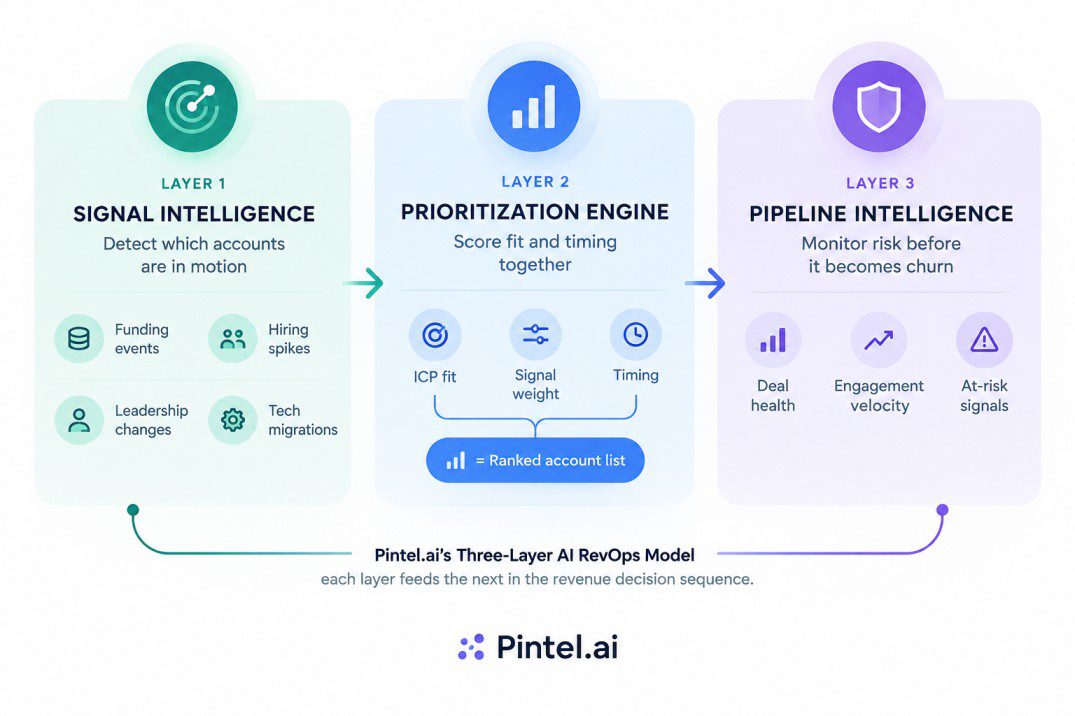
Pintel.ai’s Three-Layer AI RevOps Model
High-performing RevOps teams do not add AI tools at random. They layer AI into their stack in a specific sequence that matches how revenue decisions actually get made. Pintel.ai’s Three-Layer AI RevOps Model describes that sequence: signal intelligence, prioritization, and pipeline monitoring, each feeding the next. The three layers of AI in RevOps follow the revenue decision sequence: detect movement, decide where to focus, then monitor what happens next. Pintel.ai’s Three-Layer AI RevOps Model
Layer 1: Signal Intelligence and Which Accounts Are Moving
Signal intelligence is AI’s ability to monitor high volumes of behavioral and firmographic data simultaneously and surface the accounts that are in motion. Human RevOps teams can monitor a named list of accounts. AI monitors the full ICP universe. The signals it tracks:
- Funding events and leadership changes. New capital or a new VP of Sales at a target account signals a buying cycle is opening, often before any outbound conversation has started.
- Hiring spikes in relevant roles. A company posting a cluster of new sales, RevOps, or finance roles is showing buying intent through behavior, not through inbound form fills.
- Technology migrations and stack changes. A company moving off a competing platform or adopting a new tool category is in an active evaluation window, often without having contacted any vendor yet.
- Engagement patterns across owned channels. Web visits, content downloads, and email engagement from account contacts indicate interest even when no form has been submitted and no rep has been alerted.
The practical output is a shorter, higher-quality account list that is already showing movement, rather than a static territory list that ages as the quarter progresses.
Layer 2: The Prioritization Engine That Scores Fit and Timing Together
Signal alone is not enough to prioritize. A company showing a hiring spike may be outside your ICP on industry, headcount, or geography. The prioritization engine applies ICP fit scoring on top of the signal layer. Three things make it different from a standard scoring model:
- Signal weight is product-specific, not generic. A Series A funding event matters more for some products than for others. The prioritization engine weights signals based on what has actually driven closed deals in your pipeline, not on generic B2B best practices.
- AI scoring learns from outcomes, not just from initial configuration. Traditional scoring rules treat every company that meets the same criteria identically. AI scoring models refine which signal combinations correlate with won deals for your specific product over time, so the scoring improves as your pipeline grows.
- The output is a ranked list, not a segmented list. Unlike legacy lead scoring models that score fit and engagement separately, the prioritization engine combines fit, signal, and timing into a single ranked output. A rep opens a list of accounts ordered by actual readiness, not by category membership.
Layer 3: Pipeline Intelligence and Seeing Risk Before It Becomes Churn
Once accounts enter the pipeline, AI shifts from identifying and scoring to monitoring. Most RevOps teams discover at-risk deals when reps flag them in the weekly review. By then, the deal may have been cold for two weeks. Pipeline intelligence surfaces risk earlier through three categories of signal:
- Rep engagement velocity. How frequently is the rep touching the account, and is that pace slowing? A sustained drop in rep activity is an early warning sign before the deal is officially flagged as at risk in any CRM stage.
- Stakeholder coverage gaps. Deals that involve only one contact from a multi-stakeholder buying group are structurally at risk, regardless of how confident the rep feels about the relationship.
- Time-in-stage outliers. Deals sitting in a pipeline stage longer than historical benchmarks are stalling, not progressing. AI surfaces these before the weekly meeting, while re-engagement is still possible and the deal has not officially gone cold.
The same logic applies post-sale. Usage drops, stakeholder changes, and support ticket patterns are signals CS teams can act on before a renewal becomes a save conversation. The model works as a stack. Each layer feeds the next.
How One Account Moves Through All Three Layers
The framework is easier to grasp with one concrete example. A 400-person SaaS company is inside your ICP but has never shown buying intent. Here is what happens when that changes:
- Signal layer detects movement. Over 30 days: a new VP of Sales joins, 14 new sales and revenue roles are posted, and site engagement from multiple account contacts increases. The company has not submitted a form or contacted any rep. No human RevOps process would have caught this yet.
- Prioritization layer combines signal with fit. ICP fit was already strong. Signal weight now pushes the account into the highest priority tier. The rep sees the account surfaced with the specific signals that triggered the change, so the context for outreach is already there before the first call is made.
- Pipeline layer monitors once engaged. An opportunity is created. If the rep’s contact rate slows over the following two weeks, or if the deal sits in one stage longer than historical benchmarks, the system flags it before the weekly review. Re-engagement happens while the account is still active, not after the deal has gone cold and the buying committee has moved on.
That sequence is what AI in RevOps replaces: a manual process that might have caught the same account weeks later, if it caught it at all.
Traditional RevOps vs AI-Augmented RevOps
The shift from traditional RevOps to AI in RevOps is not about replacing processes. It is about changing which processes happen at human speed and which happen at machine speed. Here is how the key decisions change.
| RevOps Decision | Traditional Approach | AI-Augmented Approach |
|---|---|---|
| Account prioritization | Static territory lists, rep judgment | Continuous signal scoring across the full ICP |
| Lead routing | Batch routing rules, territory maps | Real-time routing by fit, workload, and signal urgency |
| Pipeline forecasting | Rep-reported stage confidence | Deal health signals, engagement velocity, time-in-stage |
| Data freshness | Quarterly or manual enrichment cycles | Continuous enrichment triggered by role or firmographic changes |
| Attribution | Single-source model, manual review | Multi-touch signal aggregation across channels |
What AI Handles in RevOps and What It Does Not
The clearest sign of a team that has genuinely succeeded with AI in RevOps is what they stopped arguing about. Not what tools they use, but what decisions they stopped relitigating every quarter.
Five Things AI Does Better Than Any RevOps Team Alone
Speed, scale, and pattern recognition are where AI outperforms manual RevOps processes. Five specific tasks become more scalable when AI handles them:
- ICP scoring at scale. A human RevOps team can score hundreds of accounts per cycle. AI scores tens of thousands continuously, updating scores as firmographic data changes and new signals appear.
- Signal monitoring. Funding events, hiring clusters, leadership changes, and tech migrations happen daily across thousands of accounts. AI monitors all of them without missing updates between manual reviews.
- Lead routing decisions. Routing that accounts for territory, rep workload, account fit, and signal urgency simultaneously is too many variables for manual rules to handle cleanly. AI does it in real time at every trigger.
- Pipeline anomaly detection. Deals going cold, engagement gaps, and time-in-stage outliers are hard to catch in a weekly pipeline review. AI flags them before the meeting, while there is still time to act.
- Attribution data aggregation. Tracking which touchpoints contributed to a closed deal across channels is a data problem at volume. AI aggregates this at a scale no manual process can match.
Three Things That Still Need Human Judgment
AI depends entirely on the criteria it is given. Three decisions remain human, regardless of how capable the underlying model is:
- ICP definition. AI scores accounts against ICP criteria. But which criteria matter, how to weight industry versus headcount versus tech stack, and when to adjust the ICP as the business shifts are strategic calls. No model makes them well without deliberate human input and regular review.
- Strategic account exceptions. A named enterprise account sometimes needs handling that overrides the score. A strong relationship, a referral from a board member, a competitive threat in a key vertical. Human context matters here in ways that are difficult to systematize.
- Attribution model selection. Whether first-touch, last-touch, or multi-touch attribution fits your business motion is a strategic choice tied to your sales cycle length and channel mix. AI surfaces the data for any model. Choosing the right model for your team is not a question AI answers well on its own.
Knowing what AI in RevOps handles well makes it easier to decide where to start. The following section covers how to layer AI in revenue operations into an existing stack without disrupting what already works.
How RevOps Teams Layer AI Into Their Stack
Start With the Data, Not the Model
The most common mistake RevOps teams make is adding AI scoring tools before the underlying data is reliable. AI is a multiplier. If the contact and account data feeding the model is wrong or missing in significant portions, which is typical in most B2B CRM stacks, AI scoring inherits that error rate and amplifies it across every rep’s queue.
Before adding AI to a RevOps stack, the data layer needs to be stable. That means verified contact records, current firmographic data, and a consistent enrichment cadence for fields that decay fast: job titles, direct phone numbers, company headcount, and tech stack. RevOps data automation (keeping contact and account records clean and current) is the prerequisite for AI, not the next phase after it.
Teams that skip this step spend months debugging scoring outputs. Teams that build data quality first spend those months refining a model that is already producing usable signal.
Choose One High-Friction Workflow First
The teams that struggle with AI in RevOps usually try to implement it everywhere at once: scoring and routing and pipeline forecasting and attribution, all simultaneously. The result is a long implementation, unclear ownership, and a team that loses confidence in the system before it has time to prove value.
A better sequence is to find the single workflow with the most friction or the most downstream impact when it breaks. For most B2B RevOps teams, that is account prioritization or lead scoring. Start with one decision, measure whether AI-scored accounts convert at a higher rate than manually selected ones, then expand.
AI account research can support this first phase by ensuring the accounts entering the scoring model have complete, verified data before a rep ever sees them. The model scores better when the inputs are clean.
Build the Feedback Loop Before You Scale
AI in RevOps scoring gets more accurate over time, but only if there is a feedback signal. The model needs to know which scored accounts actually converted and which did not. Without that signal, the model optimizes against its original training data and never learns from what actually happens in your pipeline.
The feedback loop is the part most teams skip. It requires reps to log outcome data consistently, which requires a CRM workflow simple enough that reps actually use it. If reps do not trust the process, they route around it. If outcome data does not flow back, the model stagnates.
Before scaling AI to new RevOps workflows, confirm that the feedback loop from the first workflow is producing usable signal. A tight feedback loop on one workflow is worth more than a sprawling AI implementation with no signal flowing back in. That leads to another practical question: should the next RevOps gap be solved with headcount or AI tools?
Should You Hire More RevOps Headcount or Buy AI Tools First?
This is the question most GTM leaders are actually asking when they look at their RevOps gaps. The honest answer depends on which gap you are filling, and the mistake is using one to avoid confronting the other. Both can be the right investment at different stages.
What Additional RevOps Headcount Gets You
A new RevOps hire brings judgment, strategy, and structure: capabilities that cannot be scaled through automation. A well-placed hire typically owns:
- ICP definition and maintenance. Documenting which accounts to target, weighting the right criteria, and adjusting the ICP as the market shifts.
- Scoring logic design. Deciding which firmographic and behavioral signals carry weight for your product, not just which ones theoretically should.
- Routing playbook ownership. Building the rules reps actually follow, including handling for strategic accounts a score cannot fully capture.
- Feedback loop management. Ensuring outcome data flows back into the scoring model so it improves over time rather than stagnating against its original training data.
If your RevOps function lacks structure, with undefined ICP criteria, no shared pipeline definition, or routing rules nobody owns, a new hire addresses that. AI applied to an undefined process produces a faster version of the same wrong output. Structure comes before automation.
What AI Gets You That a New Hire Cannot
A strong RevOps hire works business hours and manages a realistic account load. No hire scales the way AI does, regardless of capability. What AI handles that headcount cannot:
- Continuous ICP monitoring. AI watches the full account universe continuously, not just the named list of accounts a rep has decided to follow.
- Real-time account scoring. Every firmographic change or new signal triggers an updated score immediately, not in the next batch cycle or territory review.
- Instant lead routing. Leads are assigned at the moment of trigger, accounting for territory, rep workload, and signal urgency simultaneously.
- Early pipeline risk detection. Deal health flags surface before the weekly review, while there is still time to re-engage the right stakeholder.
If your RevOps function has the right structure but cannot keep pace with volume, AI in revenue operations closes that gap. The ICP criteria exist, the CRM data is reliable, and what is missing is the speed to act on everything the system already knows. That is a scale problem, not a headcount problem.
How to Decide Between Headcount and AI Tools
Most B2B revenue teams need both, but sequence matters. Teams building RevOps from scratch should hire before adding AI tools. You need the judgment layer before you need the automation layer.
The clearest signal: if your RevOps team is debating definitions and process ownership, that is a headcount problem. If the team is aligned on ICP and process but cannot act fast enough across the account universe, AI is the right next investment. In either case, what that investment depends on is the same: a data layer reliable enough to score against.
What AI in Revenue Operations Depends On
AI in RevOps is only as reliable as the data feeding it. Most RevOps AI failures are not model failures. They are data freshness failures that make the score wrong before any prediction runs.
Teams using Pintel.ai’s data intelligence platform layer incoming accounts with real-time signals before they enter the scoring model: funding events, leadership changes, hiring spikes, and tech migrations that indicate a buying window is open. Combined with Pintel.ai’s prospect prioritization, which scores accounts by fit, timing, and signal weight, the output is a short list that AI has already ranked by actual readiness, not by recency or rep familiarity.
Fixing the data layer before adding AI tools is the difference between a RevOps rollout that returns useful signal in the first quarter and one that cycles through noise far longer. The Starr Conspiracy’s B2B Intent Data Benchmarks tracked a median 94 days from intent platform contract execution to first qualified pipeline contribution across 47 deployments.
Final Takeaway
AI in revenue operations does not change what RevOps teams are trying to do. It changes how fast they can do it and at what scale. The teams that get the most from AI are not the ones with the most sophisticated models. They are the ones that started with clean data, picked one workflow to automate first, and built the feedback loop that lets the model improve over time.
Pintel.ai’s Three-Layer AI RevOps Model covers signal intelligence, prioritization engine, and pipeline intelligence, giving RevOps teams a sequence to follow rather than a set of tools to evaluate. Each layer builds on the one before it. The best time to start is after the data is reliable. The worst time is before it is.
Frequently Asked Questions About AI in Revenue Operations
Should we hire more people or use AI tools for RevOps?
It depends on the type of work. If the bottleneck is repetitive data work, account research, or ongoing monitoring, AI can increase your team’s capacity without adding headcount. Hire when you need more strategic ownership, process design, or cross-functional leadership.
Is AI worth it for a small RevOps team?
Yes. AI can help smaller teams handle more accounts, monitor more signals, and automate repetitive work without immediately increasing headcount.
What are the risks of using AI in RevOps?
The main risks are poor data quality, overreliance on AI decisions, and lack of human oversight. Teams should use reliable data and keep humans involved in important revenue decisions.
How accurate is AI for RevOps decisions?
AI can identify patterns and signals at scale, but its accuracy depends on the quality of the data and the signals being used. High impact decisions should still have human oversight.
How do RevOps teams measure AI ROI?
Teams can measure time saved, qualified pipeline generated, conversion rates, forecast accuracy, and other revenue outcomes before and after implementation.
What is the difference between AI and RevOps automation?
Automation follows predefined rules to perform tasks. AI can analyze data, identify patterns, and make predictions or recommendations based on those patterns.