A 10-person SDR team turns on outreach automation before fixing their contact data. Within a week, they are sending three times the volume of the same wrong message to the same wrong people, just faster.
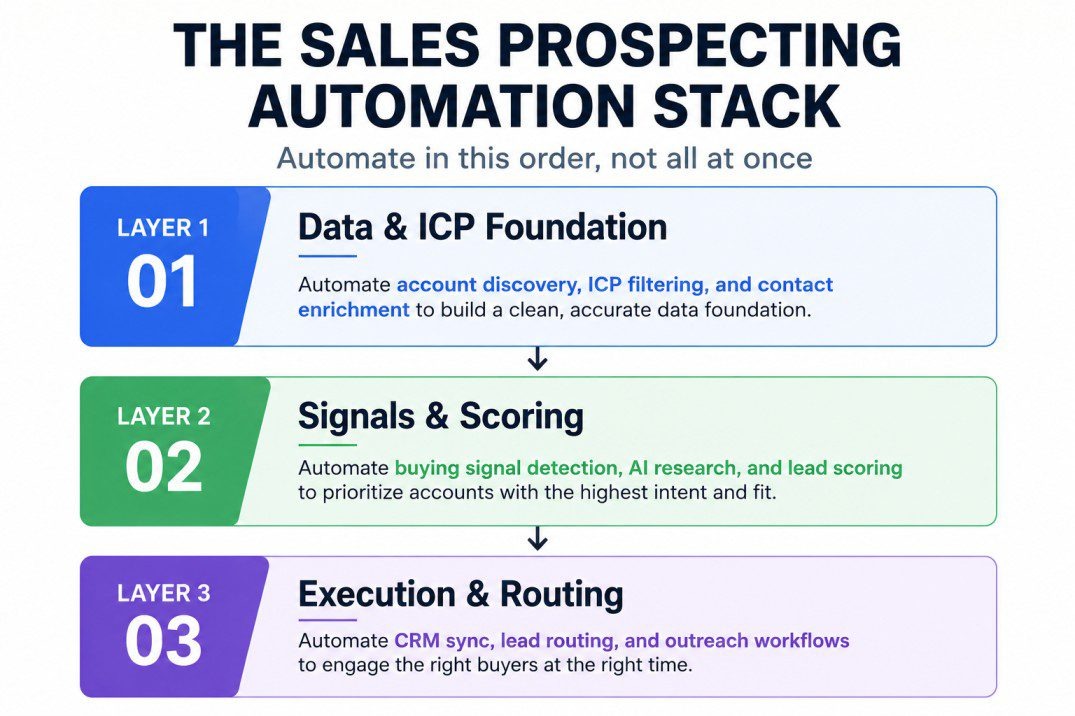
This happens because most teams treat sales prospecting automation as one switch to flip, when it is actually three separate layers: data and targeting, signals and scoring, and outreach execution. Automating the wrong layer first is the single most common reason automation projects stall instead of scale.
This guide breaks down what to automate first, what comes second, and how to tell you are actually ready to move to the next layer.
What Is Sales Prospecting Automation?
Sales prospecting automation is the use of software to automatically find, enrich, score, and route potential buyers, so reps spend less time on manual research and more time selling. It works across three layers: a data and ICP (ideal customer profile) foundation, buying signals and scoring, and outreach execution, in that order.
Skipping straight to the execution layer, sequencing and sending, without a reliable foundation underneath it is why so many automation rollouts generate more activity without more pipeline.
What Should You Automate First in Sales Prospecting?
Automate your data and ICP foundation first, not outreach execution. Sending automated sequences against an inaccurate or badly targeted contact list just repeats the same mistake at a higher volume. Fix account targeting and contact accuracy first, then add signals and scoring, then automate execution once both layers are reliable.
Call this the Prospecting Automation Stack: foundation, signals, execution, built and automated strictly in that order. Most teams that struggle with automation did not pick the wrong platform. They automated layer three before layer one was solid.
Layer 1: Data and ICP Foundation, Automate This First
This layer covers finding accounts that match your ICP, verifying contact details, and keeping company and role data current. Everything else in sales prospecting automation inherits its accuracy from this layer, so it has to be right before anything else is switched on.
Teams that skip this step usually find out the hard way. One team targeting DACH pharmaceutical accounts was paying $160K a year for a database that was 37% wrong or missing. After moving to a multi-source enrichment approach instead of a single static list, match rates reached 95%+ and previously dead pipeline started converting again.
Account discovery tools that filter by ICP criteria and waterfall contact enrichment across multiple data sources both belong to this layer. Pintel.ai combines company discovery with multi-source enrichment specifically so this foundation layer does not need three separate tools to get right.
Building this layer properly starts with a clear target account list and a consistent ICP scoring model, not a spreadsheet a rep built from memory. Once that foundation is dependable, it is safe to move to the next layer.
Layer 2: Signals and Scoring, Automate This Second
This layer covers detecting buying signals, hiring spikes, funding events, tech migrations, website visits, etc., and scoring accounts and contacts based on fit and timing. Signals only add value once you already know you are pointed at the right accounts, which is exactly what layer one establishes.
A useful way to check this: pull last week’s top-scored accounts and ask whether they would have made your target account list even without a signal attached. If the answer is no, the scoring model needs work before it is worth automating routing on top of it.
Detecting buying signals and running them through an lead qualification framework is what separates a static contact list from a prioritized queue. Pintel.ai’s buying signal detection and AI research capability handle this layer directly, surfacing which in-market accounts to prioritize without a rep manually cross-checking each one.
Scoring only holds up if someone periodically checks it against what actually closed. A model built once and never revisited drifts, quietly rewarding signals that stopped predicting anything months ago.
Layer 3: Execution and Routing, Automate This Last
This layer covers enrolling accounts into sequences, routing them to the right rep, and syncing activity back to the CRM. It should be the last thing automated, not the first, because automating execution on top of a weak foundation just sends the wrong message to the wrong account faster.
This is also the layer most likely to accumulate CRM debt if it runs unchecked. Automation writes to the CRM at volume, so duplicate accounts, mismatched fields, and inconsistent ownership rules get amplified rather than cleaned up. CRM hygiene tools matter here as much as the automation itself.
Workflow automation and native CRM integrations belong to this layer. Pintel.ai syncs qualified accounts and contacts directly into CRM systems once they have passed through the first two layers, so records enter sequences already qualified rather than needing rep cleanup afterward.
Full automation at this layer also is not always the goal. High-value or complex accounts often benefit from a human review step before a sequence fires, even once the first two layers are solid. Automation should remove the busywork, not the judgment call on an enterprise account.
With all three layers mapped, the next question is why teams still get the order wrong even when they know it exists.
Why Automating Execution Before Foundation Backfires
Execution is the most visible layer, so it is usually the first one teams automate. A sequencing tool feels like progress. A data cleanup project does not. That visibility bias is exactly why the order gets reversed so often.
Where this breaks: a team buys a sales engagement platform, plugs in a contact list they have not audited in six months, and turns on full sequencing automation. Send volume goes up. Reply rates and meeting rates do not, because the list underneath was never the problem being solved.
The fix is not to avoid execution automation. It is to sequence the rollout: prove the foundation layer is accurate, confirm the scoring model actually predicts conversion, and only then automate execution at volume. Teams that reverse this order are not using the wrong tool. They are using the right one in the wrong sequence.
This sequencing problem is not unique to sales prospecting. Harvard Business Review’s ongoing coverage of sales strategy covers the broader pattern across sales organizations: technology adopted on top of an undefined process tends to amplify whatever is already happening, good or bad, rather than fix it. Gartner’s research on sales strategy frames the same idea from the buyer-facing side, technology is a multiplier, not a substitute, for a defined process.
This sequencing question is also what separates automation from the manual process it replaces, worth comparing directly.
Sales Prospecting Automation vs. Manual Prospecting
| Factor | Manual Prospecting | Automated Prospecting (Correctly Sequenced) |
|---|---|---|
| Speed | 20 to 30 accounts worked per rep per day | 150+ accounts worked per rep per day |
| Data freshness | Depends on individual rep diligence | Continuously refreshed against source data |
| Prioritization | Gut feel or spreadsheet order | Score-based, signal-driven |
| Consistency | Varies by rep and by day | Systematic across the whole team |
| Failure mode | Slow, but errors stay contained to one rep | Fast, but a bad foundation gets amplified team-wide |
The trade-off is direct: manual prospecting gives full control but caps output at headcount. Automated prospecting removes that cap, but only rewards teams that got the layer order right first.
Understanding that trade-off is one thing. Knowing what to actually look for in a sales prospecting platform before buying is the next step.
How to Evaluate a Sales Prospecting Platform
Before comparing named tools, name which layer you are actually buying for. A sales prospecting platform built for one layer will underperform if you expect it to solve all three.
- Data accuracy: How often are records refreshed, and against how many sources? A single-source database ages faster than a multi-source, waterfall-style approach.
- Signal coverage: Does the platform detect real buying signals, hiring, funding, tech changes, etc., or does it stop at static firmographic filters?
- Scoring transparency: Can you see why an account was scored the way it was, or is it a black box your team cannot adjust?
- Workflow flexibility: Can ops configure routing and scoring logic without engineering support?
- CRM integration: Does data sync both ways without manual exports, or does it create cleanup work downstream?
- Layer coverage: Does one platform cover foundation, signals, and execution, or will you need to stitch together two or three separate tools and keep them in sync yourself?
- Review controls: Can you insert a manual review step for high-value accounts, or does everything that qualifies fire automatically regardless of deal size?
Platforms Built for One Layer of Sales Prospecting Automation
Most platforms on the market are built for a single layer: a contact database for foundation, an intent tool for signals, or a sales engagement platform for execution. That is not a flaw, it is a design choice, but it means the layers still need to be connected manually or through a separate integration.
Single-layer platforms often go deeper on that one layer than a combined platform can. A team with a genuinely difficult signal-detection problem, for example, may still want a specialist tool there and a separate execution layer on top of it. The trade-off is depth in one place versus one connected workflow across all three.
Platforms Built for the Full Sales Prospecting Automation Stack
A smaller set of platforms, Pintel.ai among them, are built to cover foundation, signals, and execution in one connected workflow rather than as separate purchases. That reduces the integration work, though it is still worth confirming each layer meets your specific bar rather than assuming full coverage means full depth everywhere.
If you want named, vendor-by-vendor comparisons rather than a category framework, our breakdowns of the best sales prospecting tools and choosing the right B2B sales prospecting software compare specific platforms feature by feature and layer by layer.
Knowing which layer you need is only useful if you also avoid the mistakes that undo it once automation is live.
Common Mistakes When Automating Sales Prospecting
Automating before the ICP is defined. Automation scales whatever targeting logic you feed it, good or bad. An undefined ICP just produces more low-fit accounts, faster.
Treating enriched data as permanently accurate. A contact record enriched six months ago describes what a company looked like then, not now. Titles change, people leave, tools get replaced.
Skipping the feedback loop. Most teams turn on automation and never check which signals actually predicted a conversion. The scoring model never improves, and after 90 days the results quietly plateau.
Letting CRM debt accumulate. Automation writes to the CRM at volume. Duplicate records and inconsistent fields do not stay small problems, they get amplified every time the workflow runs.
Removing every human checkpoint. Full automation suits high-volume, low-value motions well. For enterprise or multi-stakeholder deals, a rep or manager reviewing the top of the queue before outreach fires catches context an algorithm cannot, without slowing down the accounts that do not need it.
Avoiding these is less about picking a better tool and more about respecting the order the three layers need to go in.
How Pintel Fits Into the Sales Prospecting Automation Stack
Teams that reach this point usually are not looking for another single layer tool. They want one platform that supports the entire prospecting automation workflow, from finding the right accounts to executing outreach.
Pintel.ai helps automate each layer of the Prospecting Automation Stack:
- Foundation: Discover ICP-fit companies, enrich contacts with waterfall enrichment across 30+ data sources, and keep company and contact data accurate.
- Signals and Scoring: Identify buying signals, research accounts with AI, and prioritize opportunities based on fit and buying readiness.
- Execution: Sync qualified accounts and contacts to CRM platforms like Salesforce and HubSpot, then trigger downstream workflows without manual handoffs.
Instead of stitching together separate database, intent, and workflow tools, GTM teams can manage the entire prospecting process in one connected platform. That means less operational overhead, more reliable data, and a sales queue reps can trust before outreach begins.
What Correctly Sequenced Automation Looks Like
A mid-market SaaS SDR team automated in the wrong order: engagement sequencing first, against a contact list nobody had audited in months. Send volume tripled. Reply rates stayed flat, then dropped, because the increased volume was landing on the same stale, badly targeted accounts as before.
They paused execution automation and rebuilt in the correct order. First, they rebuilt the ICP foundation: re-verified contact records and tightened account filtering criteria. Second, they layered in signal-based scoring, hiring activity and tech migrations, and checked the top-scored accounts by hand for two weeks before trusting the model. Only then did they re-enable automated sequencing, now pointed at a queue that had already passed through both earlier layers.
Reply rates recovered within a month and pipeline volume grew from there, not because the sequencing tool changed, but because it was finally automating a foundation and scoring layer that were both accurate.
That sequencing discipline, not a bigger tool budget, is what separates automation that compounds from automation that just adds noise faster.
Building a Sales Prospecting Automation Workflow That Scales
Sales prospecting automation is not one decision, it is three, made in a specific order. Fix the data and ICP foundation first, add signals and scoring second, and automate execution last, once the first two layers are proven.
Teams that reverse this order usually blame the tool. In most cases, the tool was fine. The workflow just automated the wrong layer first.
If your team is stitching together separate tools for each layer, a connected sales prospecting platform like Pintel.ai is worth evaluating before adding a fourth subscription to the stack.
FAQ: Sales Prospecting Automation
What is sales prospecting automation?
Sales prospecting automation is the use of software to automatically find, enrich, score, and route potential buyers. It works across three layers: data and ICP foundation, signals and scoring, and outreach execution, built in that order.
What should you automate first in sales prospecting?
Automate your data and ICP foundation first, not outreach execution. Fixing account targeting and contact accuracy before adding signals or automating sends prevents automation from scaling the wrong message to the wrong accounts.
What is the difference between sales prospecting automation and lead generation?
Lead generation attracts inbound interest through content, ads, and SEO. Sales prospecting automation is outbound: it identifies and prioritizes accounts to reach proactively, based on fit and buying signals.
Do I need a separate tool for each layer of automation?
Not necessarily. Some platforms cover one layer well; others, including Pintel.ai, connect foundation, signals, and execution in a single workflow. The right choice depends on how much integration work you want to manage.
What is the difference between a sales prospecting platform and a sales engagement platform?
A sales prospecting platform identifies, enriches, and scores which accounts to target. A sales engagement platform manages how those accounts are contacted through sequences. Most outbound motions need both, applied in that order.
How long does it take to see results from sales prospecting automation?
Most teams see workflow improvements within 2 to 4 weeks. Measurable pipeline impact typically appears in 6 to 8 weeks, once the scoring model has been calibrated against real conversions.
Is sales prospecting automation only useful for large sales teams?
No. Even a two-person SDR team benefits, since automation removes manual research time regardless of headcount. The three-layer order matters the same way at any team size.
How do I know if my sales prospecting automation is actually working?
Check reply rates, meeting rates, and pipeline generated, not just activity volume. Rising send volume with flat conversion usually means the foundation or scoring layer needs fixing, not the execution layer.