IT services is a broad category that includes MSPs, system integrators, IT consultancies, and IT staffing firms. Not every data provider covers these segments equally. A tool that performs well for large enterprises like Accenture or Wipro may struggle to surface contacts at smaller MSPs or regional IT providers.
This guide compares the 7 best IT services company data providers based on coverage, contact quality, technographic data, and their ability to support B2B prospecting across global IT markets.
What Are the Best IT Services Company Data Providers?
The best IT services company data providers for B2B sales in 2026 are Pintel.ai, ZoomInfo, Apollo.io, Cognism, Adapt.io, Lusha, and TechTarget Priority Engine. Pintel.ai leads on profile-level ICP filtering that separates MSPs, system integrators, and IT consultancies within the same NAICS category, with waterfall enrichment across 30+ providers delivering 95%+ match rates against the 37% bad data rate teams typically run on from single-source tools.

The table below compares all 7 on the dimensions that matter most for IT services prospecting.
Top IT Services Company Data Providers Compared
| Tool | IT Services Coverage | MSP / Mid-Market Depth | Technographic Data | ICP Filtering | Best For | Pricing |
|---|---|---|---|---|---|---|
| Pintel.ai | US, UK, DACH, India IT corridor, APAC | Strong (sub-industry filtering by MSP / SI / consulting type) | Yes (stack-level signals) | AI-powered, profile-level | Global GTM teams targeting full IT services sector | Contact sales |
| ZoomInfo | Strong for US enterprise IT; thin for mid-market MSPs | Limited below 500 employees | Yes (technographic add-on) | Firmographic + technographic | Enterprise IT services and large US system integrators | From $15,000+/yr |
| Apollo.io | US IT sector broad coverage; gaps in mid-market boutiques | Thin for non-LinkedIn-active MSPs | Basic | Basic firmographic | IT services prospecting at volume on a limited budget | From $49/mo |
| Cognism | UK, DACH, Benelux IT sector; limited outside Europe | Reasonable for EU mid-market IT | Limited | GDPR-compliant filters | EU IT services outbound with verified mobile numbers | Contact sales |
| Adapt.io | IT / ITES specialist; strong US, India, UK | Good for IT/ITES companies by sector | Limited | Basic | IT sector contact search in US, India, and UK | Contact sales |
| Lusha | LinkedIn-active IT professionals globally | No MSP-specific coverage | No | Chrome extension lookup | Individual contact lookup at named IT companies | From $36/mo |
| TechTarget Priority Engine | IT buyer intent across 150+ tech media sites | US IT buyer intent; limited for smaller MSPs | Yes (category-level intent) | Publisher-based intent signals | IT vendors targeting active tech buyers in research mode | Contact sales |
This comparison is based on first-hand platform knowledge, publicly available product information, and commonly reported user experiences. Contact each vendor directly for the latest pricing and product details.
Here is what those differences mean in practice for IT services outbound.
What to Look for in an IT Services Company Data Provider
Evaluating IT services databases requires sharper criteria than standard firmographic filters offer. Five dimensions matter most:
- Sub-industry segmentation: Can the provider filter by company sub-type rather than returning all of NAICS 541512 together? Pairing sub-industry filters with a lead qualification framework separates a working list from a raw dump.
- MSP and mid-market depth: Enterprise system integrators are well-documented across most firmographic data providers. Mid-market MSPs are frequently thin or missing. Ask each vendor for record counts under 200 employees.
- Technographic signals: Providers surfacing technology company data on which RMM platforms, cloud infrastructure, or ERP systems a prospect manages let you build contextually relevant outreach rather than generic cadences.
- Contact depth for non-LinkedIn-active roles: Mid-market MSP titles have low LinkedIn penetration. A provider sourcing only from LinkedIn misses a significant share of contacts at these companies.
- Global IT services reach: India’s IT corridor, UK, DACH, and APAC are major IT services markets. Confirm whether the provider actually covers these geographies or concentrates in US enterprise IT.
The IT services data problem is not a quantity problem. It is a precision problem. Sub-industry filtering, technographic data, and MSP-specific coverage are what separate a useful IT services database from a noisy one.
1. Pintel.ai: Sub-Industry ICP Filtering Across the Full IT Services Stack
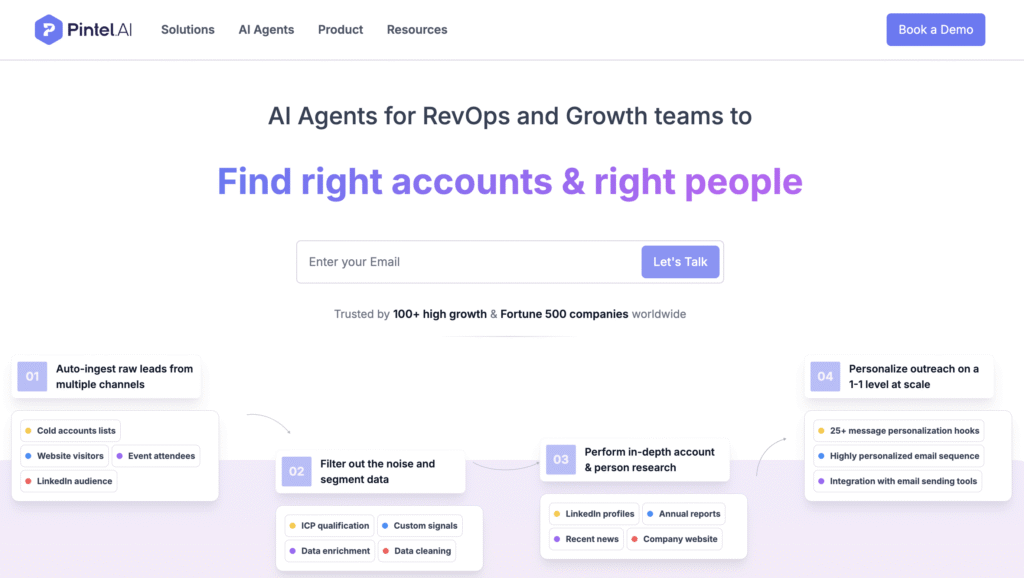
Pintel.ai helps B2B sellers reach IT services companies worldwide. It combines proprietary data, waterfall enrichment, and AI workflows to uncover high-fit accounts and prioritize the right opportunities across MSPs, IT consultancies, system integrators, and other IT service providers.
Strengths
- Accurate account discovery across MSPs, IT consultancies, system integrators, IT staffing firms, and ITES companies, reducing the noise created by broad technology categories.
- AI-powered account and prospect matching helps GTM teams identify companies and decision-makers that closely match their ICP.
- Proprietary data combined with waterfall enrichment across 20+ trusted providers delivers broader coverage and more complete contact data than single-source databases.
- Contact enrichment includes verified emails, phone numbers, firmographics, and technographics for IT buyers and operational stakeholders.
- Buying signals such as hiring activity, leadership changes, technology migrations, funding events, and expansion indicators help prioritize accounts already showing intent.
- Hyper-personalized outbound messaging uses account signals, installed technologies, and business context to create more relevant outreach.
- Strong coverage across the US, UK, DACH, India, and APAC, including fragmented IT services markets where traditional databases are often weaker.
- Useful for niche IT segments such as cybersecurity services, cloud consultancies, healthcare IT, education technology, and public sector IT.
Limitation
Pintel.ai is a newer platform with lower brand recognition than established vendors like ZoomInfo and Apollo, which can matter for large enterprise procurement processes.
Security and compliance: ISO 27001 certified, SOC 2 (AICPA), GDPR compliant, HIPAA compliant, CCPA compliant, and VAPT certified.
Best for
Revenue teams selling into IT services companies that need account discovery, contact enrichment, buying signals, and AI-powered personalization in a single platform.
Pricing: Contact sales.
2. ZoomInfo: Deep Enterprise IT Coverage, Thin on Mid-Market MSPs
ZoomInfo builds its database through community contribution from users sharing professional network data, which produces strong coverage for large, LinkedIn-active IT enterprises but thins out significantly for mid-market MSPs and boutique IT consultancies that contribute fewer records to the network.
- Strengths:
- Strong contact depth for enterprise IT companies: large system integrators, Fortune 500 IT departments, major consulting practices
- Technographic add-on identifies which enterprise software and infrastructure a company uses
- Limitations:
- Community contribution model produces sparse records for mid-market MSPs under 500 employees, where fewer professionals actively maintain LinkedIn profiles
- High cost makes it impractical for teams whose ICP sits primarily in mid-market or boutique IT services
Pricing: From $15,000+/yr.
Best for: Enterprise IT services sales targeting large system integrators, major consulting firms, and Fortune 500 IT departments.
3. Apollo.io: Volume Coverage, Gap in Non-LinkedIn-Active IT Professionals
Apollo.io aggregates contacts from LinkedIn, company websites, and partner sources into a 270M+ contact database covering the IT sector broadly, but coverage concentrates in US tech companies and IT services firms with active LinkedIn presence. Mid-market MSPs with under 200 employees and boutique IT consultancies outside major US metros are frequently thin or missing from returned results.
- Strengths:
- Wide US IT sector coverage at an affordable price point with built-in email sequencing
- Reasonable contact depth for IT decision-makers at mid-to-large companies with active LinkedIn profiles
- Limitations:
- No sub-industry filtering within IT services; NAICS-level filtering returns a mix of company types that require manual qualification
- Coverage outside the US and major English-language IT hubs drops significantly, limiting global IT services prospecting
Pricing: From $49/mo.
Best for: US-focused IT services prospecting at volume where the ICP is LinkedIn-active and primarily covers mid-to-large companies.
4. Cognism: Strong for EU IT Services, Limited Outside Europe
Cognism is built around GDPR-compliant mobile number verification for European B2B outreach. For IT services companies in the UK, Germany, France, and Benelux, it offers solid contact depth with verified phone numbers. Coverage drops significantly outside European markets, and its core product is not designed for US or APAC IT services prospecting.
- Strengths:
- GDPR-compliant verified mobile numbers for IT services contacts across UK, DACH, and Benelux
- Reasonable mid-market IT company coverage in Western Europe where LinkedIn penetration supports its sourcing model
- Limitations:
- Coverage for US, India, and APAC IT services markets is not a core product focus and falls short compared to globally-oriented providers
- No technographic filtering and limited sub-industry segmentation within IT services categories
Pricing: Contact sales.
Best for: EU-based sales teams targeting IT services companies in the UK, Germany, France, and Benelux where GDPR-compliant mobile contact data is the priority.
5. Adapt.io: IT and ITES Specialist, Strong in India and UK
Adapt.io is a global B2B contact database built specifically around IT and ITES (IT-enabled services) companies. Its coverage reflects this focus: US IT sector, India’s IT corridor (Bangalore, Hyderabad, Mumbai, Pune), and UK IT services are reasonably represented. Coverage thins in Central Europe, LATAM, and geographies outside major IT corridors.
- Strengths:
- IT and ITES sector-specific database with better-than-average coverage for India IT corridor companies
- Reasonable contact depth for IT roles across US, India, and UK markets
- Limitations:
- Coverage outside US, India, and UK is thin; DACH, APAC, and LATAM IT services companies are sparsely represented
- No profile-level ICP filtering; sub-industry segmentation within IT services is limited
Pricing: Contact sales.
Best for: IT and ITES outbound teams targeting the US, India IT corridor, and UK markets where an IT-specialist database is more useful than a broad global one.
6. Lusha: Individual Contact Lookup, No Account-Level IT Services Discovery
Lusha surfaces emails and phone numbers via a Chrome extension when browsing LinkedIn profiles. It works for individual contact lookup on named IT services companies but does not help build lists of which IT services companies to target. Teams that already know their target account list use Lusha to fill in contacts. Teams that need to discover net-new IT services companies will not find that function here.
- Strengths:
- Fast individual contact lookup for LinkedIn-active IT professionals at named accounts
- Affordable entry pricing for small teams doing targeted IT services outreach
- Limitations:
- No account discovery, sub-industry filtering, or IT services database to search, useful only when target companies are already identified
- Coverage drops for non-LinkedIn-active IT roles (Help Desk, NOC, Infrastructure) common in mid-market MSPs
Pricing: From $36/mo.
Best for: SDRs doing contact lookup at named IT services accounts where the company list already exists.
7. TechTarget Priority Engine: IT Buyer Intent, Publisher-Centric Coverage
TechTarget Priority Engine tracks IT buyer intent signals across more than 150 B2B technology media sites, identifying which companies are actively researching specific technology categories. It provides strong visibility into US IT decision-makers in active buying cycles but covers only professionals who read TechTarget’s publisher network, which skews toward large IT buyers and excludes mid-market MSPs that do not engage with tech media.
- Strengths:
- Category-level IT buyer intent: identifies which companies are researching cloud, security, networking, or ERP solutions right now
- Contact data for IT decision-makers verified through content engagement, not just database records
- Limitations:
- Coverage limited to professionals who visit TechTarget’s publisher properties; mid-market MSPs and boutique IT consultancies that do not read technology media are invisible
- Intent tracking reflects TechTarget readership behavior, not the broader IT services market, creating significant selection bias toward enterprise tech buyers
Pricing: Contact sales.
Best for: IT vendors selling enterprise technology products to large IT buyer organizations already in active research cycles.
Understanding what each tool covers clarifies why most databases underperform on IT services specifically.
Why IT Services Company Data Is Harder Than Other B2B Sectors
Most B2B sectors have a clear company-type definition. IT services does not. The challenge is structural, and it affects every database and filtering tool in this comparison.
The IT Services Data Trap: One NAICS Code, Four Different Buyers
NAICS 541512 (Computer Systems Design Services) covers IT services companies. According to CompTIA’s IT industry research, the North American IT channel alone includes more than 150,000 partner organizations, from Fortune 500 system integrators to two-person managed IT firms, all under the same NAICS code.
For a B2B sales team, this creates a filtering problem: a NAICS 541512 search returns Accenture regional offices alongside boutique cloud consultancies alongside IT staffing agencies alongside the 75-person MSP that is your actual ICP. Standard filters cannot separate those without profile-level analysis.
The IT services data trap: broad industry filters produce mixed company types, and most data providers have no mechanism to separate them.
Why Mid-Market MSPs Are Systematically Underrepresented
Mid-market MSPs (50 to 500 employees) are the fastest-growing segment of IT services by count, but the most underrepresented in standard B2B databases. Three structural reasons drive this gap: they are less LinkedIn-active per employee than enterprise IT firms, their job titles (vCIO, NOC Lead, Service Delivery Manager) do not match standard title filters, and most have limited web presence so the signals databases rely on to refresh records simply do not exist.
The result: standard IT services databases perform well for enterprise system integrators and poorly for the mid-market segment where most competitive prospecting actually happens. Teams selling into this segment need a provider with proprietary sourcing beyond LinkedIn, paired with waterfall enrichment to maximize contact fill rates across sparse company records.
How to Choose Your IT Services Data Provider
The right tool depends on where your ICP sits within the IT services sector and which geographies you are targeting.
- If your ICP is enterprise system integrators: ZoomInfo covers this segment well through its community contribution model. Apollo.io covers similar ground at a lower price point with less depth.
- If your ICP is mid-market MSPs: Pintel.ai or Adapt.io. Both cover this segment; Pintel.ai adds profile-level sub-industry filtering that Adapt.io does not offer.
- If your market is EU IT services: Cognism for GDPR-compliant phone-verified contacts in UK and DACH. For broader EU plus APAC, Pintel.ai’s global coverage is more complete.
- If you need active-buyer intent: TechTarget Priority Engine identifies IT buyers in active research cycles but does not replace a database for outbound list building. Pair it with a contact provider for enrichment.
- If your ICP spans multiple IT services sub-types globally: Pintel.ai is the only provider on this list with profile-level sub-industry filtering, global coverage, and waterfall enrichment across 30+ vetted sources, helping you identify in-market IT services accounts before they enter an active RFP cycle.
A single database tool will not cover the full IT services spectrum. Pintel.ai’s sales intelligence waterfall model fills the mid-market MSP gap that point solutions consistently miss.
Frequently Asked Questions About IT Services Company Data Providers
What are the best IT services company data providers?
The best IT services company data providers for B2B sales in 2026 are Pintel.ai, ZoomInfo, Apollo.io, Cognism, Adapt.io, Lusha, and TechTarget Priority Engine. Pintel.ai leads on sub-industry filtering and waterfall enrichment delivering 95%+ match rates across the full sector.
How do I find MSP contact data for B2B prospecting?
Finding MSP contact data requires a provider with sub-industry filtering beyond NAICS 541512. Pintel.ai and Adapt.io cover mid-market MSPs. ZoomInfo and Apollo.io concentrate on enterprise IT companies and larger MSPs with strong LinkedIn presence, leaving many smaller providers thin or missing.
What is the difference between IT services data and SaaS company data?
IT services company data covers firms delivering managed IT, consulting, system integration, and outsourcing services. SaaS company data covers software-as-a-service vendors. Both fall under broad technology company classifications, but buyer profiles, company size distributions, and LinkedIn penetration rates differ significantly between the two.
Which data providers have the best coverage for managed service providers?
Pintel.ai and Adapt.io have the strongest MSP coverage in this comparison. ZoomInfo and Apollo.io cover MSPs primarily through LinkedIn-contributed data, which favors larger MSPs with active profiles. Mid-market MSPs under 200 employees are frequently missing or outdated in standard global IT services databases.
How accurate is technology company data from ZoomInfo or Apollo for IT services?
ZoomInfo and Apollo.io accuracy is reasonable for large IT enterprises. Accuracy drops for mid-market IT consultancies, boutique MSPs, and non-US IT services firms where community-contributed records are sparse. Teams running single-source enrichment in these segments typically see significant data decay within 12 months.
What is the best IT services company data provider for global outbound?
Among IT services company data providers for global outbound, Pintel.ai is the strongest. It covers IT services companies across the US, UK, DACH, India (Bangalore, Hyderabad), and APAC with waterfall enrichment across 30+ vetted providers, reaching records that single-source tools miss in non-English IT services markets.