Looking for an Apollo.io alternative because your B2B sales team has reached the next stage of growth? As you expand into new markets, scale outbound, or demand higher-quality contact data, Apollo may no longer meet every requirement. Many growing sales teams eventually need broader global coverage, stronger buying signals, more reliable contact data, or a pricing model that scales with their outbound efforts.
This guide compares the 15 best Apollo.io alternatives across data quality, global coverage, pricing, buying signals, workflow capabilities, and ideal use cases. Whether you’re replacing Apollo completely or evaluating a platform that better supports your next stage of growth, you’ll find the information you need to make a confident decision.
What Are the Best Apollo.io Alternatives?
The best Apollo.io alternative depends on which problem is driving the switch: stale or region-thin contact data, credit-based pricing that gets expensive at scale, or a clunky all-in-one interface. In this Pintel.ai comparison guide, we compared 15 Apollo.io alternatives across data sourcing, pricing models, phone and mobile coverage, and key capabilities to help you choose the right platform for your sales team.
The four constraints that usually decide the switch:
- Data accuracy and freshness: single-source databases go stale as people change jobs, and accuracy drops fastest outside the US
- Credit and pricing friction: phone credits, export caps, and per-seat pricing multiply faster than the headline price suggests
- Regional and niche coverage: most Apollo.io competitors are strong in US tech and thin elsewhere, including specialized industries
- Platform depth: some tools replace Apollo’s data, others replace its sequencing, and few replace the whole workflow
15 Apollo.io Alternatives: Pricing and Key Differences
Here is a quick comparison across pricing, data sourcing model, and phone or mobile data depth for all 15 alternatives.
| Platform | Best For | Starting Price* | Coverage | Key Limitation |
|---|---|---|---|---|
| Pintel.ai | Global B2B company and contact data with buying signals | Contact sales | Global companies, decision makers, emails, phone numbers, and buying signals | Custom pricing |
| ZoomInfo | US and Europe prospecting | ~US$15,000/year | US, Canada, and Europe companies and contacts | Expensive annual contracts |
| Cognism | Europe and North America prospecting | ~US$16,500/year | Europe, UK, and North America companies and contacts | Quote based pricing |
| Lusha | Contact prospecting | US$49.90/month | Business contacts, emails, and phone numbers | Credits run out quickly |
| Clay | Data enrichment workflows | US$149/month | Depends on connected data providers | Requires paid data providers |
| Seamless.AI | US prospecting | ~US$147/month | US companies, contacts, emails, and phone numbers | Data accuracy concerns |
| RocketReach | Contact lookup | US$39/month | Professional profiles, emails, and phone numbers | Limited enrichment features |
| Hunter.io | Email prospecting | US$49/month | Business email addresses | No phone numbers |
| Snov.io | Email prospecting and outreach | US$39/month | Business email addresses | Limited phone data |
| UpLead | North America and Europe prospecting | US$99/month | Companies, contacts, emails, and phone numbers | Smaller contact database than Apollo |
| Lead411 | US prospecting | US$99/user/month | US companies, contacts, emails, and phone numbers | Limited global coverage |
| Kaspr | LinkedIn prospecting | €49/month | LinkedIn contacts, emails, and phone numbers | Works only with LinkedIn |
| LeadIQ | SDR prospecting | US$45/user/month | LinkedIn prospects, emails, and phone numbers | Phone lookups consume more credits |
| ContactOut | LinkedIn contact lookup | US$29/month | LinkedIn profiles, emails, and phone numbers | Limited company intelligence |
| AI Ark | B2B contact prospecting | US$49/month | Companies, contacts, emails, and phone numbers | Credit-based usage |
This comparison is based on first-hand platform knowledge, publicly available product information, and commonly reported user experiences. Contact each vendor directly for the latest pricing and product details.
How We Evaluated These Apollo.io Alternatives
Whether a team calls these Apollo.io competitors, alternatives to Apollo.io, or just websites like Apollo.io, the same criteria decide whether switching is worth the effort. Several of the accuracy and pricing patterns below match what shows up repeatedly in verified user reviews on G2’s sales intelligence category.
Data Accuracy and Freshness
Static databases degrade as people change roles, the single most reported reason teams researched what separates reliable data providers from risky ones before switching off Apollo.
Regional and Niche Coverage
US-only strength does not help a team selling into EMEA, APAC, or specialized industries. We checked how each tool performs outside its strongest region.
Pricing and Credit Structure
Credit-based tools often cost more at real volume than the headline price implies. We noted whether credits roll over and whether phone lookups draw from the same allowance as email.
Phone and Mobile Data Depth
Some tools that look like full Apollo replacements are email-only finders with no phone data at all. We flagged which include verified phone numbers by default.
Buying Signals and Workflow Completeness
Contact data alone does not tell a rep which account is ready to buy. We checked whether each platform includes buying signals or intent data natively, or whether that needs a separate subscription.
With those five criteria set, here is how each of the 15 alternatives actually performs.
Deep Dive: 15 Apollo.io Alternatives in 2026
Below is our detailed evaluation of 15 Apollo.io alternatives, comparing each platform across data quality, coverage, pricing, features, and the sales teams it’s best suited for.
Pintel.ai: The Apollo.io Alternative for Next-Generation Sales Intelligence
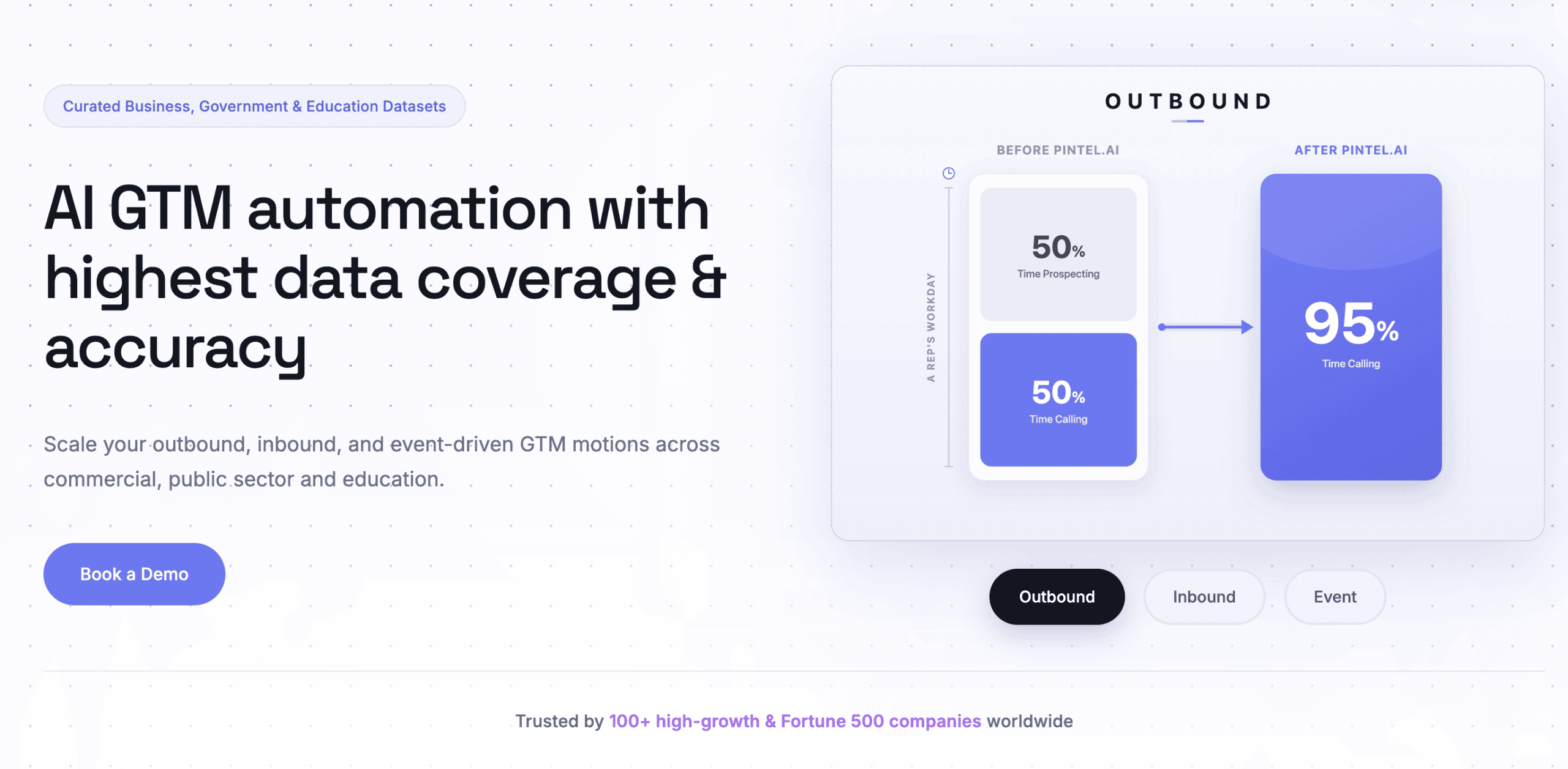
Pintel.ai is an AI-powered GTM platform that helps B2B sales teams find global companies, identify verified decision-makers, enrich company and contact data, and prioritize high-fit accounts for their ideal customer profile (ICP). It combines AI-powered account research, buying signals, and multi-source enrichment to help sales teams build targeted prospect lists, identify verified decision-makers, and prioritize high-fit accounts.
Why teams switch from Apollo.io to Pintel.ai
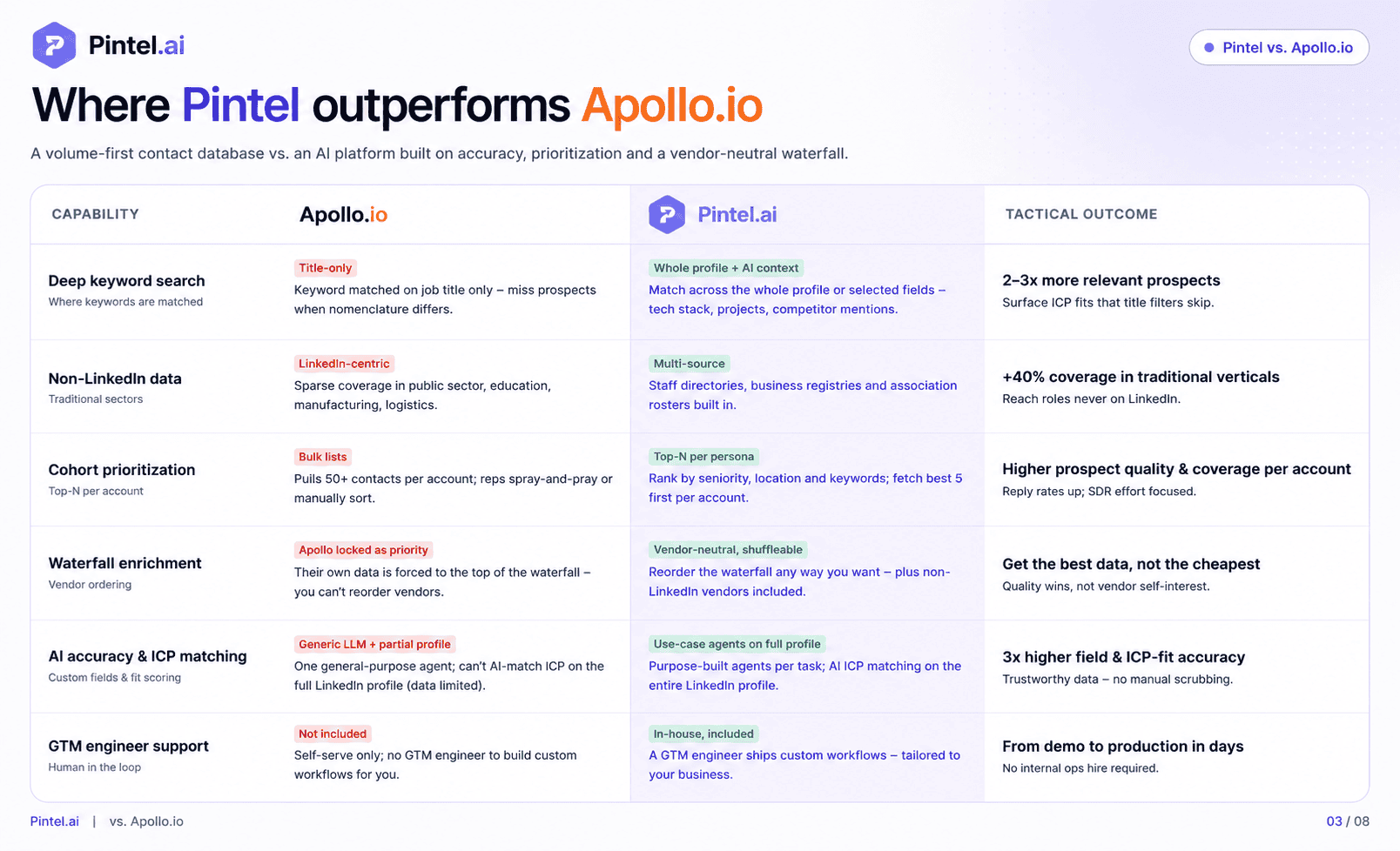
More complete global coverage: Pintel.ai is a strong Apollo.io alternative for sales teams that need company and contact data beyond North America. It combines proprietary data with multiple trusted data sources to improve coverage across Europe, APAC, GCC, LATAM, and other global markets.
Higher data accuracy: Pintel.ai combines proprietary company data with multi-source waterfall enrichment for contact data to improve data accuracy and completeness, helping sales teams reach the right decision-makers with fewer bounced emails and outdated contacts.
Built-in buying signals: Instead of relying only on contact data, Pintel.ai helps teams prioritize accounts using funding events, hiring trends, technology changes, leadership moves, and other buying signals.
No credit-based phone pricing: Phone lookups, exports, and enrichment are not tied to separate phone credits, making costs more predictable for high-volume outbound teams.
AI agents for account discovery: AI agents understand your ideal customer profile and identify the right companies and decision-makers within your target market.
For example, you can ask, “Find SaaS companies in the UK with a mobile app that recently raised funding and match my ICP,” and Pintel.ai will return matching companies, verified decision-maker contacts, and hyper-personalized LinkedIn messages, emails, and call talk tracks.
End-to-end AI GTM platform: Pintel.ai combines account discovery, contact enrichment, buying signals, AI-powered research, and CRM workflows in one platform, reducing the need for multiple point solutions.
Security and compliance: ISO 27001 certified, SOC 2 (AICPA), GDPR compliant, HIPAA compliant, CCPA compliant, and VAPT certified.
Best for: Global B2B teams leaving Apollo because of data staleness, credit-based cost creep, or thin coverage outside the US, who want signal-based account discovery and enrichment built into one workflow instead of stitched from separate point tools.
AI Ark: Fresh Global Data with Send-Ready Verified Emails
AI Ark was built by an outbound agency that got tired of paying for outdated data and had experienced emailing people using their old roles.AI Ark addressed this issue by updating their entire database of over 400 million profiles and 70 million companies every 30 days, instead of on demand. Emails are verified at the moment of export with a timestamp in the CSV, so lists load straight into Smartlead or Instantly without a second verification pass, and invalid emails never cost credits. The focus is squarely on data quality and coverage rather than an intent layer, which suits teams that already run signals elsewhere.
Pricing: Roughly $2–$4 per 1,000 credits by volume, from $49 for 5,000 credits, with pooled team credits and rollover up to 2x the monthly allowance.
Best for: Agencies and outbound teams at real sending volume who left Apollo over stale records and credit costs and want send-ready emails rather than a list that needs a separate verification tool.
ZoomInfo: Enterprise Contact Database, but Expensive Annual Contracts
ZoomInfo aggregates one of the larger B2B contact databases through direct integrations and community-sourced data, but per-seat licensing and platform fees usually cost several times more than Apollo at a comparable seat count. Its sequencing and dialer tools are also less developed than Apollo’s, which is why teams comparing ZoomInfo against other data providers often end up choosing based on budget rather than capability.
Pricing: Custom, quote-based, typically starting around $15,000 per year for a small team, with renewals carrying additional increases.
Best for: Enterprise teams that already budget for a premium data platform and mainly need contact volume rather than built-in sequencing.
Cognism: EMEA Mobile Numbers, but Limited Coverage Outside EMEA
Cognism provides phone-verified mobile numbers under its Diamond Data tier and GDPR-aligned sourcing for Europe, but coverage outside EMEA is noticeably thinner, and Cognism does not publish pricing, so buyers negotiate a quote before knowing the real cost.
Pricing: Custom pricing only, previously estimated at $15,000 to $25,000 per year in platform fees plus per-user licensing.
Best for: Teams whose primary ICP is the UK, DACH, or Nordics and who need verified mobile numbers more than global reach.
Lusha: Contact Lookup Platform, but Credit Based Phone Pricing
Lusha offers a Chrome extension for fast contact lookups at one of the lowest entry prices here, but its credit system charges 10 credits per phone number, so phone-heavy prospecting burns through a Starter or Pro allocation within days.
Pricing: Starter from $37.45/user/month (annual), Pro from $52.45/user/month (annual).
Best for: Individual reps or very small teams doing occasional contact lookups rather than team-scale outbound volume.
Clay: Custom Data Enrichment Workflows, but Requires Multiple Paid Data Providers
Clay orchestrates waterfall lookups across 30 or more third-party providers so technical teams can customize enrichment logic, but Clay holds no data of its own. Output quality depends on which providers a team pays to connect, and each of those subscriptions is billed separately from the Clay plan.
Pricing: Launch from $185/month (2,500 Data Credits), Growth from $495/month, Enterprise custom.
Best for: Technical RevOps teams with a dedicated owner who wants full control over provider order and workflow logic.
Seamless.AI: Real Time Contact Search, but Data Accuracy Concerns
Seamless.AI uses AI-assisted real-time web sourcing to build large contact lists quickly, but it charges credits on every lookup attempt, even ones that return no valid email or phone number, and its accuracy trails premium tools, which shows up later as higher bounce rates.
Pricing: Free tier with 50 lifetime credits, Basic from $147/month (250 credits).
Best for: Early-stage teams testing high-volume outbound where list-building speed matters more than per-contact accuracy.
RocketReach: Contact Data Across Multiple Sources, but Annual Lookup Limits
RocketReach charges by annual lookup allotment rather than monthly credits, with phone-inclusive plans from the Pro tier upward, but overage lookups beyond the annual cap are billed at $0.30 to $0.45 each, and team plans carry a five-seat minimum that raises the entry cost for small teams.
Pricing: Essentials from $27/month annual (email-only, 1,200 annual lookups), Pro from $69/month annual (adds phone, 3,600 annual lookups).
Best for: Individual contributors or small teams that can predict their annual lookup volume and rarely exceed it.
Hunter.io: Domain Based Email Search, but No Phone Numbers
Hunter.io finds and verifies business email addresses through domain search and pattern matching, but it does not provide phone or mobile numbers at all, so teams needing Apollo’s dialer-ready contact data must pair Hunter with a separate phone source.
Pricing: Starter from $49/month (2,000 credits), Growth from $149/month, Scale from $299/month.
Best for: Teams whose outbound motion is email-only and do not need phone numbers in the same tool.
Snov.io: Email Finder with Built In Outreach, but Credits Run Out Quickly
Snov.io bundles email finding, verification, and a built-in outreach sequencer into one credit-based plan, but credits are split across search, verification, and sending, so high email volume burns through a Pro tier’s allowance before the month ends.
Pricing: Starter from $39/month, Pro S from $99/month, Pro M from $189/month.
Best for: Small teams that want email finding and sending in one subscription and do not need phone data.
UpLead: Real Time Email Verification, but Monthly Credits Expire
UpLead ties every credit to a verified email plus a mobile direct dial delivered together, which keeps its data usably accurate, but unused monthly credits expire at the end of each billing cycle, and the entry Essentials tier caps out at 170 credits a month.
Pricing: Essentials from $74/month (annual, 170 credits), Plus from $199/month (400 credits).
Best for: Teams that want combined email and phone verification in a single credit rather than managing two separate data types.
Lead411: Built In Intent Data, but Export Limits on Lower Plans
Lead411 adds Bombora-powered intent data on its annual plans and includes direct-dial phone numbers, but the entry Spark tier caps exports at roughly 200 per month, and the intent-data add-on requires an annual contract rather than month to month billing.
Pricing: Spark from $75/user/month (annual), Ignite from $150/month.
Best for: Teams that specifically want bundled intent signals with contact exports and are comfortable on an annual plan.
Kaspr: LinkedIn Chrome Extension, but Limited Phone Credits
Kaspr pulls contact data directly from LinkedIn profiles through a Chrome extension, fast for prospecting straight out of LinkedIn, but phone and email credits are tracked and capped separately, so a phone-heavy rep exhausts the smaller phone allotment long before the email credits run out.
Pricing: Starter from $45/user/month (annual), Business from $79/user/month (annual).
Best for: SDRs who prospect primarily inside LinkedIn and want one-click contact reveal without leaving the browser.
LeadIQ: LinkedIn to CRM Capture, but Phone Lookups Use More Credits
LeadIQ captures contacts from LinkedIn and syncs them to a CRM through its Universal Credits system, but phone lookups consume 10 times more credits than email lookups, so a team leaning on direct-dial numbers moves through a plan’s credit allowance faster than the pricing page suggests.
Pricing: Essential from $36/user/month (annual), Pro from $79/user/month (annual), Enterprise custom (typically $15,000 to $30,000/year for a mid-size team).
Best for: Teams whose prospecting workflow starts on LinkedIn and needs fast capture-to-CRM sync more than a phone-heavy dialer motion.
ContactOut: LinkedIn and GitHub Contact Search, but Monthly Usage Caps
ContactOut finds personal and work emails plus phone numbers from LinkedIn and GitHub profiles, but its paid plans market unlimited access while capping real usage around 2,000 emails and 1,000 phone numbers a month, and phone access requires upgrading past the base email-only plan.
Pricing: Sales (email) from $79/month (annual), Email+Phone (Recruiter) from $199/month.
Best for: Recruiters and sales teams that prospect heavily on LinkedIn and GitHub and can work within its monthly usage caps.
How to Choose the Right Apollo.io Alternative for Your Team
Run through these questions to match the switch to your biggest constraint, rather than choosing based on the lowest sticker price.
Is stale or incomplete data the main problem?
If outdated contacts, bounced emails, or missing decision-makers are slowing your outbound efforts, look for a platform that combines proprietary data with multi-source enrichment. Pintel.ai uses proprietary company data and waterfall contact enrichment to improve data accuracy and completeness. Traditional databases can become stale as people change jobs, leading to lower connect rates.
Does your team sell outside North America?
If your sales team targets Europe, APAC, GCC, LATAM, or other international markets, Pintel.ai is a strong choice because it combines proprietary data with multiple trusted data sources to improve global company and contact coverage. ZoomInfo and Cognism are strong in specific regions, but organizations with a broader international footprint may find their coverage less consistent across every market.
Is credit-based pricing becoming expensive?
Many sales intelligence platforms charge separate credits for phone lookups, exports, or enrichment, which can become costly as outbound volume grows. Pintel.ai does not use credit-based phone pricing, making costs more predictable for teams running high-volume outbound campaigns.
Do you need a contact database or a complete GTM platform?
If all you need is email discovery, specialist tools like Hunter.io or Snov.io may be sufficient. If your team needs AI-powered account discovery, verified contacts, buying signals, personalized outreach, and CRM enrichment in one place, Pintel.ai offers a broader GTM platform without relying on multiple point solutions.
Choosing an Apollo.io alternative is rarely about finding the biggest database. It’s about selecting the platform that best solves your team’s biggest challenge, whether that’s global coverage, data accuracy, predictable pricing, or a more complete AI-powered GTM workflow.
FAQs: Apollo.io Alternatives
What Are the Best Apollo.io Alternatives?
The best Apollo.io alternative depends on which problem is driving the switch: stale or region-thin contact data, credit-based pricing that gets expensive at scale, or a clunky all-in-one interface. This guide compares 15 Apollo alternatives across data sourcing, pricing model, and phone or mobile coverage, so you can match the switch to the actual constraint your team is running into.
What are the best Apollo.io competitors for accurate contact data?
Pintel.ai leads on accuracy through waterfall enrichment across 30+ providers plus proprietary data. Cognism manually verifies EMEA mobile numbers. ZoomInfo offers deep US enterprise records. Accuracy outside North America varies the most between tools, so match the choice to your target regions.
Is there a free alternative to Apollo.io?
Hunter.io, Snov.io, Lusha, Kaspr, LeadIQ, ContactOut, and Seamless.AI all offer limited free tiers for testing. None match Apollo’s free-tier volume at scale, and most free plans cap out within days of real prospecting use.
What is the best Apollo.io alternative for phone numbers and cold calling?
UpLead pairs every credit with a verified email and mobile number together. Cognism manually verifies EMEA mobile numbers. Pintel.ai includes phone data through waterfall enrichment without a separate phone-credit tier, avoiding the credit drain Apollo, Lusha, and Kaspr charge for phone lookups.
Which Apollo.io alternative is cheapest for small teams?
Lusha, Hunter.io, and Snov.io have the lowest entry prices on this list. Cheapest is not always most cost-effective though, since credit-based tools often cost more per verified contact at real usage volume than their advertised starting price suggests.
Do any Apollo.io alternatives cover data outside the US and Europe?
Most tools on this list are strongest in the US or Europe and thinner elsewhere. Pintel.ai covers the US, EMEA, APAC, and GCC/MENA with no regional limitations, plus non-traditional sources like government and school directories that standard databases miss.
Are there Apollo.io alternatives with built-in buying signals?
Pintel.ai includes structural, contextual, and behavioral signals built into the platform. Apollo, Lusha, Clay, and most tools on this list have no native signal layer and require a separate intent-data subscription to track buying activity.
How do companies like Apollo.io differ on pricing models?
ZoomInfo and Cognism use custom, quote-based annual contracts. Apollo, Lusha, RocketReach, and Kaspr use per-seat plus credit systems. Pintel.ai uses custom pricing scoped to usage rather than expiring monthly credits.