
A team buys a lead database expecting sales-ready accounts. What arrives is a list of names and emails with no signal that any of these companies are actually in-market, or even a fit for the product. A contact is not a lead. A lead is a contact your team has reason to believe is ready to buy.
Most lead database comparisons skip this distinction and just rank tools on record count and price. This guide ranks 10 lead database providers on the three things that actually make a record a lead: fit, in-market intent, and contactability.
What Is a Lead Database?
A lead database is a structured collection of prospect records that combines company fit data, verified contact details, and often buying signals, used by sales teams to build outreach lists of accounts likely to convert.
This is different from a plain contact list. A B2B database provider in the general sense may return accurate names and emails with no indication of fit or timing. A true lead database adds the qualification layer on top.
The distinction matters because stale or unqualified leads data creates the same wasted effort as no data at all. A rep calling into leads data that was never checked for fit spends the same hour as a rep calling into a verified list, with a fraction of the result.
10 Best Lead Database Providers: Quick Comparison
Here is how the 10 providers compare on the three qualities that separate a lead database from a plain contact list: fit data, in-market signals, and contact depth.
| Provider | Fit Data | In-Market Signals | Contact Data Depth | Starting Price | Best For |
|---|---|---|---|---|---|
| Pintel.ai | Profile-level ICP filtering | Structural, contextual, behavioral | Verified, multi-region | Contact sales | Global teams needing fit, intent, and contacts in one platform |
| D&B Hoovers | Deep firmographic (registry-based) | Limited | Moderate | Contact sales | Enterprise teams screening leads by company fit |
| 6sense | Predictive ICP scoring | Strong (AI-driven intent) | None, requires a separate source | Contact sales | ABM teams prioritizing in-market accounts |
| ZoomInfo | Firmographic filters | Bombora-powered (add-on) | Strong in US enterprise | $15,000+/yr | US enterprise teams already on the platform |
| Apollo.io | Basic firmographic | Job change alerts only | Moderate, US-focused | From $49/mo | SMB teams needing bundled database and sequencing |
| Cognism | Basic firmographic | Job change alerts only | Strong in UK/W. Europe | Contact sales | European phone-first outbound teams |
| Lusha | None | None | Moderate, LinkedIn-indexed | From $29/mo | Quick lookup once a lead is already qualified |
| Dealfront | None | Website visitor identification | Company-level only | Contact sales | Turning anonymous site visitors into inbound leads |
| Bombora | None | Third-party topic research (Company Surge) | None, data layer only | Contact sales | Layering intent onto an existing lead database |
| LeadFuze | Basic firmographic + persona | None | Moderate | From $132/mo | SMB teams building fit-based lists with light automation |
This comparison is based on first-hand platform knowledge, publicly available product information, and commonly reported user experiences. Contact each vendor directly for the latest pricing and product details.
Fit, intent, and contact depth rarely show up together in one row. That gap is exactly what the reviews below unpack for each provider.
How to Evaluate a Lead Database Provider
Most teams evaluate a lead database on size and price, then find out after signing that half the “leads” are companies with no real fit or no way to tell if they are actually in-market.
Run the Lead Readiness Check before committing to any provider. The Lead Readiness Check looks at whether a record is a fit for your ICP, shows signs of being in-market now, and includes a verified way to reach the right person, all three together, not just one. Most providers cover one or two well and leave the third to a separate tool.
Three Checks Before You Sign
- Fit: Does the provider filter by actual ICP criteria, industry, size, and role, or just a broad firmographic range?
- In-market intent: Does the record show a buying signal (funding, hiring, topic research, site visits), or is it a static entry with no timing context?
- Contactability: Is there a verified email or direct number attached, or does the record stop at a company name and require separate enrichment?
According to HubSpot’s marketing research, lead quality consistently outranks lead volume as a driver of pipeline conversion for B2B teams. This is why refresh cadence matters as much as initial accuracy: intent data providers that update signals weekly keep leads data current, while static exports go stale within weeks of purchase.
10 Lead Database Providers Reviewed in Detail
With those three checks in mind, here is how each of the 10 lead database providers actually performs, starting with the platform built to cover fit, intent, and contactability together.
1. Pintel.ai
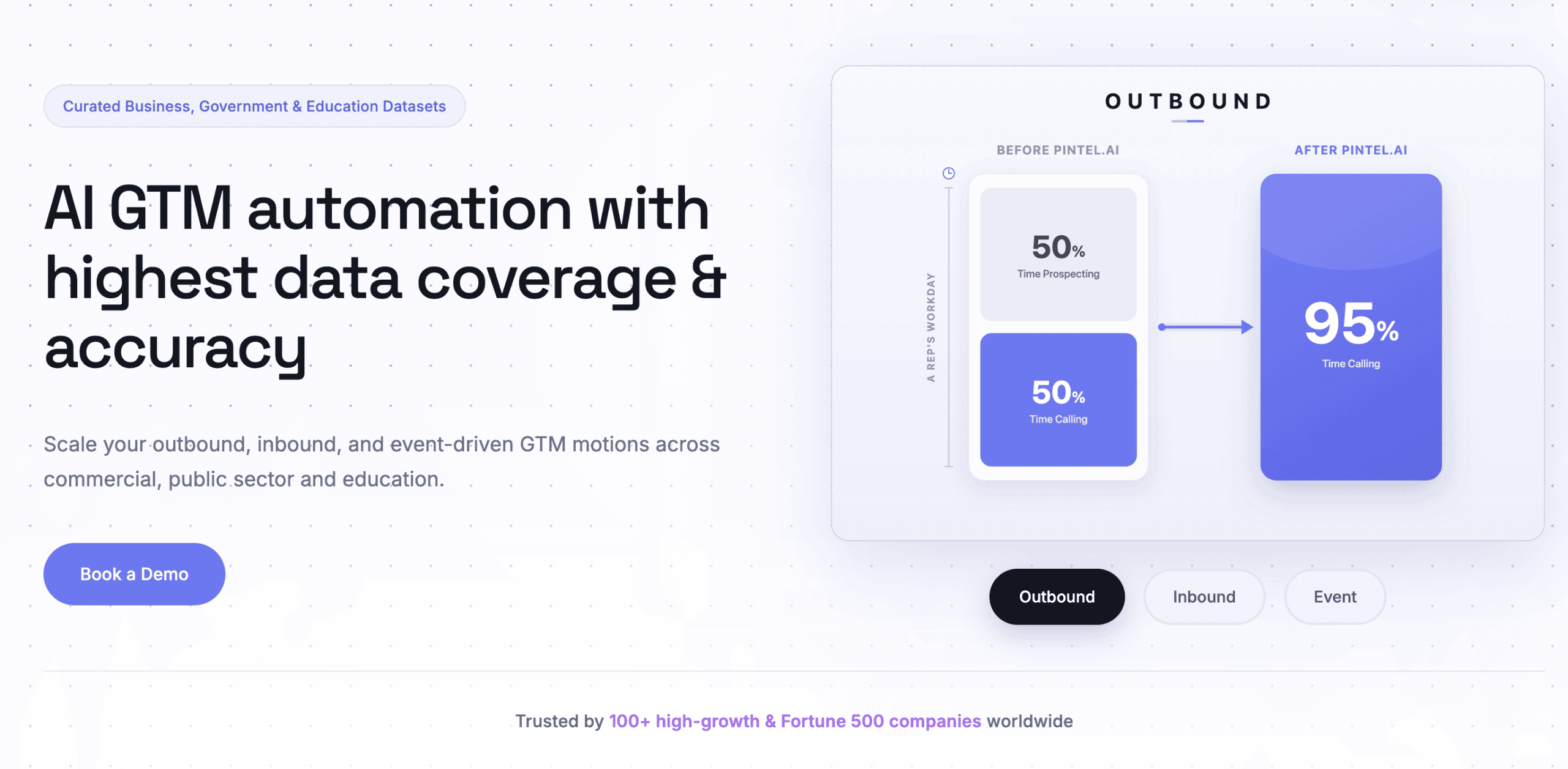
Pintel.ai is a B2B lead database and sales intelligence platform that helps GTM teams build qualified lead lists by discovering companies, finding verified decision-makers, enriching company and contact data, and identifying buying signals from a single platform.
It combines waterfall contact enrichment across 30+ verified data sources with company intelligence and AI-powered prospect research to help teams prioritize sales-ready leads instead of static contact records.
Strengths
- Discover qualified companies: Find companies that match your ICP using firmographic, technographic, and company intelligence filters instead of building lists manually.
- Find verified decision-makers: Access verified work emails, direct dials, and mobile numbers with waterfall enrichment across 30+ vetted data providers.
- Improve lead quality: Use profile-level ICP matching to identify the people most likely to evaluate, influence, or approve a purchase.
- Prioritize leads with buying signals: Identify accounts showing funding activity, hiring growth, leadership changes, technology adoption, and other purchase signals.
- Enrich company and contact data: Complete CRM records with company, contact, and account intelligence before launching outreach.
- Support global outbound: Build qualified lead lists across the US, EMEA, APAC, and LATAM from a single platform.
- Enterprise-ready security: ISO 27001 certified, SOC 2 (AICPA), GDPR compliant, HIPAA compliant, CCPA compliant, and VAPT certified.
Security and compliance: ISO 27001, SOC 2 (AICPA), GDPR, HIPAA, CCPA, and VAPT certified.
Limitations
- Less brand recognition than decade-old vendors, typical for a fast-growing platform
Pricing: Contact sales
Pintel.ai is best for teams that need fit, intent, and verified contacts in one lead database, but falls short on the market familiarity of older vendors.
2. D&B Hoovers
D&B Hoovers draws on Dun & Bradstreet’s business registry data for genuinely deep firmographic fit screening, but its intent signals are limited and contact-level depth trails purpose-built prospecting tools.
Strengths
- Extensive, registry-sourced company data for fit screening at scale
- Long operating history with broad industry classification depth
Limitations
- Limited in-market intent signals compared to dedicated intent platforms
- Contact-level records are moderate, often requiring a separate enrichment step
Pricing: Contact sales
D&B Hoovers is best for enterprise teams screening leads by company fit, but falls short as a standalone source for timing or verified contacts.
3. 6sense
6sense uses AI-driven intent modeling to flag which accounts are actively in-market, genuinely strong at the timing half of the Lead Readiness Check, but it is not a contact database and requires pairing with a separate source.
Strengths
- Predictive intent scoring surfaces accounts before they fill out a form
- Strong fit for account-based marketing programs already scoring accounts
Limitations
- No native contact database; requires a separate provider for verified contacts
- Enterprise pricing and setup complexity limit fit for smaller teams
Pricing: Contact sales
6sense is best for ABM teams prioritizing in-market accounts, but falls short as a complete lead database on its own.
4. ZoomInfo
ZoomInfo pairs firmographic fit filters with a large US contact database, and its Bombora-powered intent add-on covers the timing signal, but all three layers weaken quickly outside large US enterprise accounts.
Strengths
- Strong US enterprise contact depth alongside firmographic filtering
- Bombora intent add-on covers timing signals for existing customers
Limitations
- Fit, intent, and contact accuracy all decline outside large US accounts
- Intent data is third-party, not proprietary to the platform
Pricing: $15,000+/yr (custom)
ZoomInfo is best for US enterprise teams already invested in the platform, but falls short as a lead database for global or mid-market ICPs.
5. Apollo.io
Apollo.io bundles basic firmographic fit filters with a contact database and sequencing tool, but its intent layer stops at job change alerts, leaving most of the timing signal to guesswork.
Strengths
- Database, basic fit filters, and sequencing in one affordable tool
- Fast self-serve setup for teams building lists quickly
Limitations
- Intent signal limited to job change alerts, not broader buying activity
- Contact accuracy is inconsistent outside North American tech accounts
Pricing: From $49/mo
Apollo.io is best for SMB teams needing a bundled database and sequencing tool, but falls short on genuine in-market signal depth.
6. Cognism
Cognism delivers strong verified contact data for UK and Western Europe, but its fit and intent layers are both limited to basic firmographic filters and job change alerts.
Strengths
- Human-verified mobile numbers for UK and Western European contacts
- GDPR-compliant sourcing with documented lawful basis
Limitations
- No meaningful in-market intent layer beyond job change alerts
- Coverage outside Western Europe is inconsistent
Pricing: Contact sales
Cognism is best for European phone-first outbound teams, but falls short on fit and intent depth.
7. Lusha
Lusha is a fast contact lookup tool, useful once a lead has already been qualified elsewhere, but it has no fit filtering or intent layer of its own.
Strengths
- Quick contact lookup with low onboarding friction
- GDPR and CCPA compliant data handling
Limitations
- No fit filtering or in-market signal capability
- Coverage quality drops outside LinkedIn-active professionals
Pricing: From $29/mo
Lusha is best for quick lookup once a lead is already qualified, but falls short at qualifying one to begin with.
8. Dealfront
Dealfront identifies companies visiting your website, turning anonymous traffic into a genuine in-market signal, but it only surfaces leads already engaging with your site and stops at the company level.
Strengths
- Converts anonymous website traffic into a real intent signal
- Useful complement to inbound marketing and content programs
Limitations
- Limited to inbound visitors; does not build a net-new lead database
- Company-level only; contacts require separate enrichment
Pricing: Contact sales
Dealfront is best for turning inbound website traffic into leads, but falls short as an outbound lead database.
9. Bombora
Bombora tracks content consumption across a publisher co-op to flag which companies are researching relevant topics, a genuine intent signal, but it is a data layer, not a database, with no contact records of its own.
Strengths
- Third-party intent data (Company Surge) across a wide publisher network
- Integrates into many existing sales and marketing platforms
Limitations
- No contact data or fit filtering; intent signal only
- Requires a separate lead database to act on the signal
Pricing: Contact sales
Bombora is best for layering intent onto an existing lead database, but falls short as a standalone provider.
10. LeadFuze
LeadFuze builds prospect lists from firmographic and persona criteria with light automation, reasonable for SMB fit-based list-building, but it has no intent layer and accuracy is inconsistent at scale.
Strengths
- Persona-based list building with basic automation for SMB teams
- Straightforward setup without a long onboarding process
Limitations
- No in-market intent signal of any kind
- Contact accuracy is inconsistent at scale
Pricing: From $132/mo
LeadFuze is best for SMB teams building fit-based lists with light automation, but falls short on timing and accuracy at scale.
That covers all 10 lead database providers on this list. For the broader question of company data versus contact data, the guide on how sales teams choose B2B data covers the full evaluation picture.
How to Choose the Right Lead Database Provider
The right lead database depends on which piece of the Lead Readiness Check your current process is missing.
Fit is the gap: D&B Hoovers and Pintel.ai both go beyond basic firmographic ranges. Most other tools on this list stop at industry, size, and location.
Intent is the gap: 6sense and Bombora both surface in-market accounts, but neither includes verified contacts, so plan to pair either with a contact-first provider.
Contactability is the gap: Cognism, ZoomInfo, and Lusha all deliver solid verified contacts once fit and intent are already handled elsewhere.
You want all three in one contract: Stitching together a fit tool, an intent tool, and a contact tool creates three vendor relationships and three sources of truth for the same account. A platform that qualifies and scores leads against all three checks in one workflow removes that overhead.
Before signing, pull 25 to 50 records from your actual ICP and score each one against all three checks separately. Teams that build a target account list this way avoid discovering, after the contract is signed, that half the “leads” were never contactable.
Final Takeaway: Choosing a Lead Database That Actually Converts
The best lead database is not the one with the most records. It is the one that passes the full Lead Readiness Check: fit, in-market intent, and a verified way to reach the person, together.
Most of the 10 providers here are strong on one piece and thin on the other two. Fit-focused tools like D&B Hoovers screen well but say nothing about timing. Intent tools like 6sense and Bombora flag the right accounts but hand you no contact. Contact-first tools like Cognism, ZoomInfo, and Lusha reach people accurately but do not tell you whether they fit or whether now is the right moment.
Gartner’s research on B2B buying behavior has also found that buyers are well into their own research before a vendor ever hears from them, which is exactly why a lead database with no intent signal leaves reps guessing at timing.
For BOFU teams that need every lead in the database to actually be sales-ready, a provider covering all three checks under one contract removes the guesswork that three separate point tools leave behind.
FAQ: Lead Database Providers
A few questions come up repeatedly once a team starts comparing lead database providers side by side.
What is the best lead database provider for B2B sales?
The best lead database provider depends on which gap you have. Pintel.ai covers fit, intent, and verified contacts together. D&B Hoovers leads on fit; 6sense leads on intent; Cognism and ZoomInfo lead on contact accuracy.
What is the difference between a lead database and a contact database?
A contact database returns accurate names, emails, and phone numbers. A lead database adds fit and in-market intent on top, so a record represents a company likely to buy, not just a person you can reach.
What is lead intelligence?
Lead intelligence combines fit data, buying signals, and contact details into a single view of whether a prospect is worth pursuing now. It answers whether a lead matters, not just whether it is reachable.
How do I verify a lead database before buying?
Pull 25 to 50 records from your real ICP and score each on fit, in-market signal, and contact accuracy separately. Most vendor trials only prove contact accuracy, which hides the more common gap.
Do lead databases include buying signals?
Most do not by default. ZoomInfo bundles Bombora-powered intent as an add-on. 6sense and Bombora specialize in intent but exclude contact data. Pintel.ai layers structural, contextual, and behavioral signals directly onto verified contacts.
Is a business lead database the same as a sales lead database?
The terms are used interchangeably. Both describe a structured collection of prospect records used to build outreach lists, whether the buyer is described as a business lead, sales lead, or B2B lead.
How often should a lead database be refreshed?
Contact and firmographic details typically decay 20 to 30% per year, so a lead database should refresh core fields monthly and buying signals continuously. A provider that cannot explain its refresh cadence is likely running on ICP contact data that is already out of date.