Most B2B teams know how to find prospects on LinkedIn.
What separates high-performing teams is how they turn those prospects into pipeline.
They do not rely on more outreach or bigger lists. Instead, they run a structured process that identifies the right accounts, prioritizes them based on real signals, and activates outreach at the right moment.
LinkedIn lead generation, when done well, is not a volume game. It is a system that connects targeting, timing, and execution.
In this blog, you will learn how B2B teams actually generate pipeline from LinkedIn, what their workflows look like in practice, and how to build a repeatable system that delivers consistent results.
Why Most LinkedIn Lead Generation Fails
The failure is rarely in the initial targeting. It is in everything that happens after the list is built.
Here is what the breakdown actually looks like in most B2B teams.
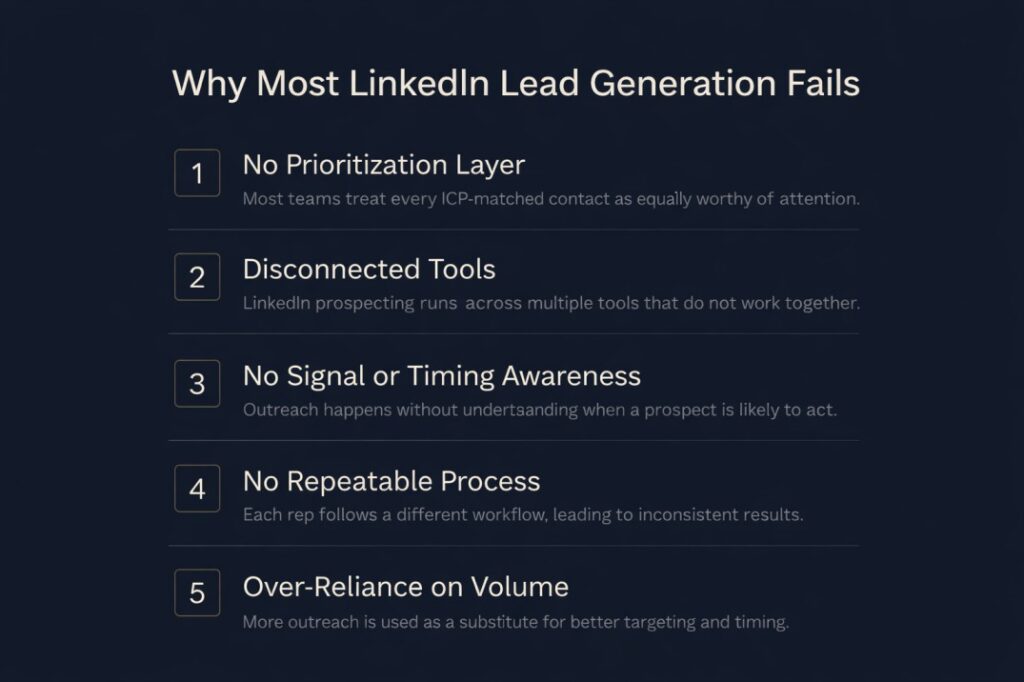
No Prioritization Layer
Most teams treat every ICP-matched contact as equally worthy of attention. That is the first structural mistake.
A head of sales at a 150-person SaaS company who has been in the role for three years and just renewed their CRM contract is not the same opportunity as a head of sales who joined 45 days ago at a company that just raised a Series B and posted four SDR roles this week.
Same title. Same company size. Completely different buying situations.
Without a prioritization layer, reps spend equal time on unequal opportunities. The best prospects get average outreach. The lowest-probability contacts get the same attention. Nothing converts well.
Disconnected Tools
Most teams run LinkedIn prospecting across three to five disconnected tools. LinkedIn for search, a separate enrichment tool, a sequencing platform, and a CRM updated manually when someone remembers.
Data does not move cleanly between these systems. Signals seen in one place do not surface in another. Reps spend time on data hygiene instead of conversations, and the fragmentation creates inconsistency even when individuals are working hard.
No Signal or Timing Awareness
Reaching out to a well-matched prospect at the wrong moment produces the same result as reaching out to a poorly matched prospect: no reply.
Most linkedin lead generation workflows are built entirely on static data. Job title, company size, industry. These attributes do not change week to week, which means the workflow has no mechanism for identifying when a prospect’s situation has shifted in a way that makes them more likely to act.
Timing is the variable most teams are missing. And without it, conversion rates stay low regardless of message quality or volume.
No Repeatable Process
Ask three SDRs on the same team how they build their weekly prospect list and you will get three different answers. One runs a manual search. One reuses last month’s list. One relies on a tool they half-configured six months ago.
The variance in process produces variance in results. A linkedin prospecting workflow that works only when the right rep runs it correctly is not a workflow. It is a collection of individual habits.
Repeatable systems produce consistent pipeline. Individual habits do not.
Over-Reliance on Volume
When pipeline is low, the instinct is to send more messages. This compounds every problem above.
More volume on a poorly prioritized list does not generate more pipeline. It generates more noise. It burns through your total addressable market faster, trains your best prospects to ignore your brand, and creates a false data set where high send volume masks a broken conversion rate.
The output of a broken LinkedIn lead generation system is not zero activity. It is a lot of activity that produces very little revenue.
What High-Performing B2B Teams Do Differently
High-performing teams treat LinkedIn lead generation as a system with defined inputs, a repeatable process, and measurable outputs. Not a set of individual tasks.
The framework they operate from has four parts.
The 4-Part LinkedIn Lead Generation System
1. Targeting: ICP Plus Context
High-performing teams do not just define who they are targeting. They layer in context. Which market segments are in motion right now? Which verticals are showing buying signals? Which company stages align with the current product and deal size?
Targeting is not a one-time exercise. It is reviewed and refined on a regular cadence based on what is converting.
2. Qualification: Signal-Based, Not Assumption-Based
The qualification question is not “does this person match our ICP?” It is “does this person match our ICP and is something happening right now that makes them more likely to buy?”
High-performing teams qualify on signals, not just profile attributes. Funding rounds, leadership changes, hiring surges, technology switches, content activity. These events create urgency and context that static data cannot provide.
3. Prioritization: Score Before You Sequence
Every ICP-matched, signal-qualified prospect gets a score before they enter an outreach sequence. The scoring model is simple: ICP fit plus signal recency plus signal strength.
High-priority accounts get customized outreach with specific signal references. Medium-priority accounts get templated outreach with key variable personalization. Low-priority accounts stay in a nurture bucket until a signal elevates them.
This ensures that the best opportunities get the best outreach, not just the first outreach.
4. Execution: Outreach Tied to Context
Every message is tied to a specific reason for reaching out. Not “I help companies like yours.” A direct reference to the signal that triggered the outreach.
“Saw you just brought on a VP of Revenue” or “noticed you have five open SDR roles” is not just personalization. It demonstrates that the outreach is timely and relevant, which is the core reason a prospect decides to reply.
Real Workflow: How Teams Actually Generate Pipeline
Framework is only useful if it translates into execution. High-performing teams run this as a continuous process, not a weekly task.
Signals create a short window of relevance. The goal is to identify, enrich, prioritize, and act quickly while context is still fresh.
Day 1: Capture and Review Signals
Signals are captured automatically and reviewed at least once per day:
- ICP-matched accounts with new funding
- Leadership changes in key roles
- Hiring surges in sales, marketing, or RevOps
- Contacts publishing relevant content
With the right tooling, this takes minutes. The focus is on identifying accounts that are most likely to convert right now.
Day 1: Enrich Accounts and Identify Decision-Makers
Once a signal is detected, enrich the account with context:
- Key decision-makers and their roles
- Company size, growth stage, and tech stack
- Recent activity tied to the signal
This ensures you are not just targeting the right company, but the right person with the right context.
Day 1: Score and Prioritize
After enrichment, accounts are evaluated:
- High: strong ICP fit with multiple recent signals
- Medium: solid ICP fit with one relevant signal
- Low: ICP fit with no recent activity
High-priority accounts move immediately to outreach. Others remain in a monitored pool until new signals increase relevance.
Day 1: Execute Outreach by Signal Context
Outreach happens the same day while the signal is still relevant.
Accounts are grouped by trigger:
- Recently funded companies
- Leadership changes
- Hiring surges
Write one strong message per signal type and personalize key details like company, role, and trigger event.
Day 3–5: Follow-Up with Context
Follow-up is part of the system:
- Reference the original signal
- Add a new observation or insight
- Keep it concise
Day 10–14: Final Touchpoint
Close the loop. If there is no response, return the account to monitoring until a new signal appears.
Ongoing: Track and Improve
Every interaction feeds back into the system:
- Signal type
- Message used
- Response outcome
This helps teams understand:
- which signals drive replies
- which segments convert
- which messages perform best
Metrics That Define Success in LinkedIn Lead Generation
Most teams measure activity: connections sent, messages sent, acceptance rate. These measure effort, not outcomes.
High-performing teams measure outputs.
Reply Rate
A well-targeted, signal-based outreach campaign should produce reply rates of 20 to 35 percent. Generic cold outreach lands between 5 and 10 percent. If your reply rate is below 15 percent consistently, the targeting or signal layer is not working. Sending more messages will not fix it.
Meeting Conversion Rate
Of all replies received, how many convert to a booked meeting? A healthy LinkedIn lead generation process converts 30 to 50 percent of replies into a next step. Below that threshold, the qualification layer needs review. Replies that do not convert usually came from contacts who were not ready, regardless of ICP fit.
Pipeline Contribution
What percentage of new pipeline each quarter comes from LinkedIn? Teams with a functioning LinkedIn lead generation system should see LinkedIn contributing 20 to 35 percent of total new pipeline depending on their go-to-market motion.
If LinkedIn generates high activity but less than 10 percent of pipeline, the system is producing leads, not opportunities.
Time Per Qualified Opportunity
In a manual workflow, moving a prospect from list to qualified meeting takes three to five hours per opportunity. In a signal-based workflow with the right tooling, that drops to 30 to 60 minutes.
That difference determines whether LinkedIn produces two qualified opportunities per month or ten.
Which LinkedIn Lead Generation Approach Actually Produces Pipeline?
| Approach | Speed | Targeting Accuracy | Signal Awareness | Scalability | Pipeline Impact |
|---|---|---|---|---|---|
| Manual | Slow | Inconsistent | None | Limited | Low |
| Structured (Signal-Based) | Moderate | High | Partial | Team-level | Medium–High |
| Automated (System + Tooling) | Fast | High | Continuous | High | High |
Manual workflows are useful for learning, but they do not scale. They rely heavily on individual effort, making pipeline inconsistent and difficult to predict.
Structured, signal-based workflows introduce discipline. Teams prioritize accounts based on relevance and timing, which improves conversion and consistency.
Automation builds on this foundation. It removes manual research, keeps data updated, and allows the workflow to run continuously. The result is a system that produces pipeline more reliably, without increasing effort.
Why Even Structured Workflows Break Without System Support
Even with a defined process, most teams struggle to execute it consistently.
- Signals are scattered across tools
- Enrichment happens in separate systems
- Scoring is manual or inconsistently applied
- CRM updates depend on rep discipline
The result is a workflow that looks structured on paper but breaks in execution.
Reps spend time stitching together data instead of acting on it. Timing windows are missed, prioritization becomes inconsistent, and outcomes vary by individual effort rather than a shared system.
Where Tools Fit in LinkedIn Lead Generation
Tools are not a substitute for a linkedin lead generation strategy. Teams that buy tooling before fixing their process end up with an expensive version of the same broken workflow.
The order matters: fix targeting and qualification criteria first, build a repeatable weekly process around those criteria, then add tooling to remove the manual research and data work.
When tools are introduced in the right sequence, they do three things:
Eliminate information fragmentation. Signal data stops living across five platforms and surfaces in one layer, attached to the accounts you already care about.
Enforce process consistency. The workflow runs the same way every week regardless of which rep runs it or how much time they have.
Improve outreach timing. The most valuable thing a tool can do in a linkedin prospecting workflow is tell you when to reach out, not just who to reach out to.
The right expectation: LinkedIn lead generation tools make a functioning system faster, more consistent, and scalable. They do not replace the system.
How Pintel Enables This System
Pintel is built as a signal-based prospecting infrastructure for B2B GTM teams.
It does not replace the linkedin lead generation strategy. It operationalizes it.
Here is how Pintel fits into the workflow described above.
ICP-Filtered Account Discovery
Pintel continuously surfaces accounts matching your ICP criteria: company size, industry, stage, and tech stack. New matching accounts are surfaced automatically based on your defined ICP criteria. So you are working from a pre-filtered set of relevant accounts, not the entire LinkedIn population.
Continuous Signal Monitoring Across 150+ Sources
Pintel monitors ICP-matched accounts across more than 150 data sources for buying signals, including funding events, hiring surges, leadership changes, technology stack shifts, and market expansion activity.
When signals are detected, they are surfaced directly alongside the account record. This removes the need to manually check multiple sources like LinkedIn, job boards, or company databases.
Signal-Based Scoring and Prioritization
Accounts are automatically ranked based on signal recency, type, and volume. High-momentum accounts move to the top of the working list without manual scoring.
This ensures reps focus on the most relevant opportunities first, based on signal data instead of guesswork.
Contact Enrichment and Role Mapping
Knowing the right account is not enough. Pintel enriches account records with verified contact data for relevant decision-makers, mapped by role, seniority, and influence.
This provides not just the account, but the right people to engage, with clear context.
Message-Ready Context and CRM Activation
Pintel converts signal data into outreach-ready context before the rep writes a message. The signal reference, relevant observation, and reason to reach out are surfaced alongside the contact.
Qualified records sync directly into your CRM and outbound tools, reducing manual effort and ensuring a consistent workflow.
What This Means in Practice
The result is a LinkedIn lead generation system that runs continuously and helps teams act with better timing and relevance, without relying on fragmented tools or manual coordination.
Make LinkedIn Lead Generation Work as a System
LinkedIn lead generation does not fail because of messaging. It breaks when the process behind it is inconsistent.
Teams that generate pipeline reliably are not doing more outreach. They are working from a structured system where targeting, qualification, prioritization, and execution are connected and driven by real signals.
Finding leads is straightforward. Turning them into pipeline requires consistency, timing, and the ability to focus on the right opportunities.
Start by building a system that your team can run every day. Then scale it.
Pintel.ai supports this shift by helping teams move from disconnected lead lists to a structured, signal-driven pipeline workflow.
Frequently Asked Questions
What is a LinkedIn lead generation strategy for B2B teams?
A B2B linkedin lead generation strategy is a defined system for identifying ICP-matched accounts, qualifying them on buying signals, prioritizing outreach by signal strength, and executing repeatable outreach that drives pipeline. Most teams have the targeting layer. The breakdown is in qualification, prioritization, and execution consistency.
Why is my LinkedIn lead generation not producing pipeline?
The most common reasons are: no prioritization layer (treating all ICP contacts equally), no signal awareness (reaching out at the wrong moment), and no repeatable process (each rep running a different workflow). High activity with low pipeline contribution is usually a system problem, not a messaging problem. Fix the workflow before increasing volume.
How do high-performing B2B teams scale LinkedIn prospecting?
They build a signal-based workflow on a consistent weekly cadence covering signal review, account scoring, batched outreach by signal type, structured follow-up, and CRM logging. Tooling removes the manual research layer so reps spend time on conversations, not data work. Scaling happens at the system level, not the rep level.
What response rates should I expect from LinkedIn outreach?
Generic cold outreach produces 5 to 10 percent reply rates. Targeted outreach with basic personalization lands at 10 to 20 percent. Signal-based outreach, where the message references a specific, relevant event and is sent at the right moment, consistently reaches 20 to 35 percent. If your current reply rates are below 15 percent, the issue is timing and relevance, not message length or tone.
Where do tools fit in a LinkedIn lead generation system?
Tools come after strategy and process. The right tools surface buying signals, automate account discovery, enrich contacts, and push qualified records into CRM. They compound a working workflow. The question to ask before buying: does this make a working process faster, or does it create the illusion of one?
What metrics should I track for B2B LinkedIn lead generation?
The four metrics that matter are reply rate, meeting conversion rate, pipeline contribution, and time per qualified opportunity. Activity metrics like connection acceptance rate and send volume are inputs, not outcomes. A functioning linkedin sales strategy built on LinkedIn should produce reply rates above 20 percent, convert 30 to 50 percent of replies to meetings, and contribute 20 to 35 percent of new pipeline per quarter.