Federal agencies award multi-year government contracts that eventually expire. When they do, the agency re-solicits the work, and vendors who knew the expiration date 12 months out have already introduced themselves, shaped requirements through Sources Sought responses, and built a track record with the contracting officer. Vendors who found out when the RFP appeared on SAM.gov are filling out proposal templates for a competition they largely already lost.
This is not a small timing gap. It is the difference between responding to evaluation criteria written around your approach versus evaluation criteria written around someone else’s.
This guide covers where expiring government contracts are published, how to read contract records for true expiration timelines, how to use pre-solicitation signals to get positioned early, and how to build a monitoring system that scales. The real competitive window opens 12 to 18 months before the RFP posts.
What Are Expiring Government Contracts?
An expiring government contract is an active federal, state, or local agency contract approaching the end of its authorized performance period, where the agency will need to either extend the work or re-solicit it competitively.
For BD teams, expiring government contracts represent the highest-intent procurement opportunities available. The agency has a proven operational need, an allocated budget, and a decision timeline set by statute. The question is not whether the work continues. It is who does it next.
The Base Period and Option Year Structure
Most federal contracts are structured as a base period, typically one or two years, plus a set of option years the agency can exercise at its discretion. A five-year contract is usually one base year plus four one-year options. The competitive event, called a recompete, happens when all option years are exhausted or when the agency decides not to exercise a remaining option.
Tracking only base period end dates produces misleading expiration signals. A contract showing a base period end date of late 2025 may run through late 2029 if four options remain unexercised. Treating the base period as the expiration date triggers premature BD activity and wastes relationship capital with program offices that are not yet thinking about recompete.
Why Expiration Tracking Beats Solicitation Monitoring
Active solicitation monitoring captures roughly 10 to 20% of the available competitive window. By the time a formal solicitation is published, the agency has already completed pre-solicitation market research and shaped performance requirements around approaches they trust. Vendors who track government contracts by expiration date enter the conversation six to twelve months earlier. That earlier entry is where proposal wins are built.

Where Expiring Government Contract Data Is Published
Federal contract data is distributed across several government systems. Each has different depth, update frequency, and utility for expiration tracking. Using the right source for the right purpose prevents wasted effort and missed recompete windows.
| Source | What It Contains | Expiration Intelligence | Coverage | Best For |
|---|---|---|---|---|
| SAM.gov | Active solicitations, award notices, Sources Sought postings | Limited. Shows new awards but no structured expiration timeline filtering | Federal agencies | Monitoring active RFPs and Sources Sought notices; government contracts for bid currently open |
| FPDS-NG | Complete federal procurement transaction history including all modifications | Strong. Shows base period, option year structure, and period of performance end dates | Federal agencies | Researching incumbent contracts and calculating true expiration timelines |
| USASpending.gov | Federal spending data with award amounts and recipient detail | Moderate. Period of performance data available but not optimized for expiration filtering | Federal agencies | Agency spend analysis and incumbent contract value research |
| State eProcurement portals | State agency contracts and solicitations, varies by state | Varies. Some states publish award data with performance periods; others do not | State and local government | State and local government contracts for bid and opportunity monitoring |
| Commercial contract intelligence platforms | Aggregated contract data with expiration alerts and recompete signals | Strong. Expiration date alerts, incumbent identification, and pre-solicitation tracking | Federal, some state and local | BD teams running systematic opportunity pipelines at scale |
This comparison is based on publicly available platform information. Data quality and update frequency vary across sources. Verify directly with each source before making business development decisions.
Knowing where the data lives is the first step. Reading contract records accurately enough to calculate true expiration dates is the more valuable skill.
How to Identify Government Contracts Nearing Expiration
Contract records on SAM.gov and FPDS-NG look straightforward but contain structural details that frequently mislead BD teams unfamiliar with how multi-year government contracts are structured.
Reading Option Year Actions in FPDS-NG
On FPDS-NG, every contract record shows a “Period of Performance” field with start and end dates for the current contract action. Cross-reference this with the action type labeled “Exercise an Option.” Each option exercise creates a new contract action record. Counting the option exercises tells you which option year the agency is in and when the final option will be exhausted.
A contract currently in option year three of four is one year from its last competitive opportunity. That is your 12-to-18-month window to begin positioning.
Bridge Contracts as a Near-Term Competitive Signal
Agencies sometimes skip an option year and issue a bridge contract instead, particularly when preparing for a scope change or a new competitive procurement. A bridge contract, typically a short-term extension at existing terms, signals that a recompete solicitation is likely within six to twelve months.
Bridge contracts appear in FPDS-NG as contract modifications. When you see a bridge action on a vehicle you are tracking, accelerate BD activity and respond to any pending Sources Sought for that agency.
How to Spot Government Opportunities Before the RFP Is Published
Before releasing an RFP, government agencies often publish Sources Sought notices to gather information from potential vendors and understand available solutions in the market. For B2G sales teams, these notices are one of the earliest indicators that a procurement opportunity is being planned.
Most teams focus only on active solicitations and ignore Sources Sought notices. That is often a costly mistake. A Sources Sought notice can appear six to twelve months before the formal RFP, giving vendors an opportunity to understand agency requirements, build relationships, and position themselves before the competition intensifies.
What Responding to Sources Sought Actually Accomplishes
An agency that receives well-reasoned capability statements during Sources Sought will often draft performance requirements that reflect those capabilities. Not because of favoritism, but because the program office now has concrete technical approaches to reference when writing the performance work statement. Vendors who do not respond are invisible when requirements are drafted.
Contracting officers also use Sources Sought responses to determine set-aside category. A well-timed capability statement from a qualified small business can directly influence whether a multi-year contract is restricted to small businesses or opened to full and open competition.
Setting Up Sources Sought Monitoring
SAM.gov allows filtering by notice type, including “Sources Sought.” Set a saved search for Sources Sought notices in your target NAICS codes. Most responses are due within 15 to 30 days of posting. Building a standing process for reviewing and responding, rather than treating each one as a one-off decision, is what creates consistent pre-solicitation presence with target agencies.
Teams running a structured B2G sales pipeline consistently identify Sources Sought response discipline as the highest-leverage activity for improving win rates on recompetes.
How to Find Expiring Government Contract Opportunities
Filtering for relevant expiring government contracts requires a systematic approach across the data sources above. The following steps apply to federal contracts. State-level processes vary by portal.
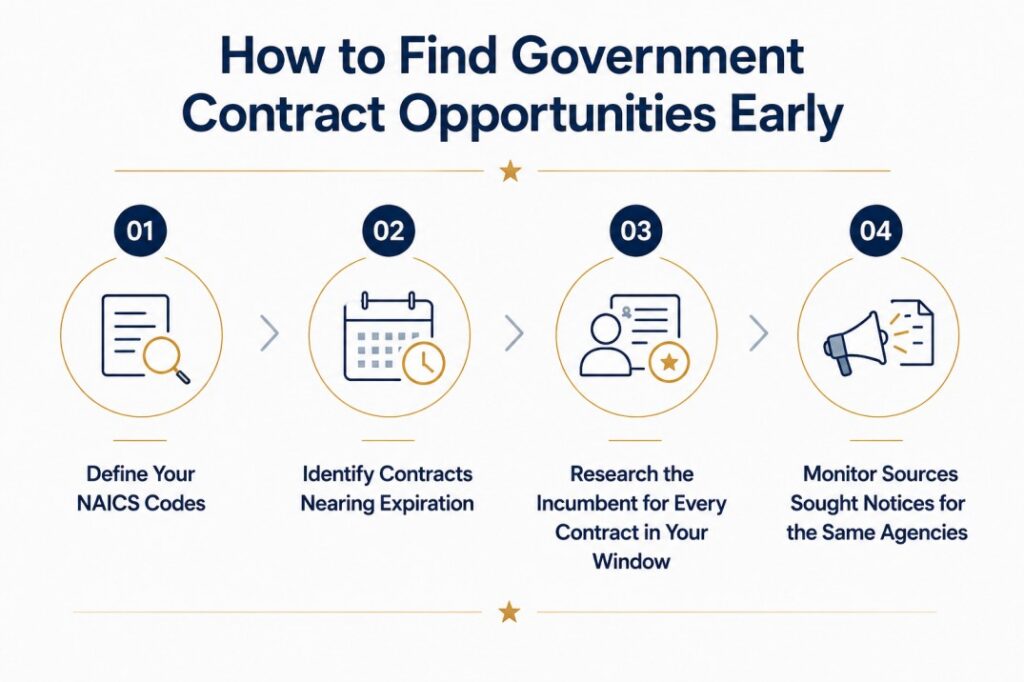
Step 1: Define Your NAICS Codes Before Searching
Every government contract is assigned a North American Industry Classification System (NAICS) code identifying the category of work. NAICS codes are the primary filter for a federal contracts search on FPDS-NG and SAM.gov.
Identify the two to five NAICS codes matching your products or services. Keyword searches alone produce either too many irrelevant results or too few relevant ones. NAICS filtering also supports automated alerts rather than repeated manual pulls.
Step 2: Set a 12-to-18-Month Expiration Window
On FPDS-NG Advanced Search, filter by “Period of Performance End Date” falling within the next 12 to 18 months, combined with your target NAICS codes and relevant awarding agencies. This produces the list of government contracts for bid consideration that are entering their competitive window.
Contracts expiring in under six months are typically already in the solicitation process, in a bridge extension, or being extended without competition. The 12-to-18-month window is where early positioning changes outcomes.
Step 3: Research the Incumbent for Every Contract in Your Window
FPDS-NG contract records show the current awardee name and full contract history. For each contract in your target window, pull the incumbent’s award history with the same agency. An incumbent in their fourth consecutive option year with no performance flags is strongly positioned for recompete. An incumbent in their final option year after a program office change or budget restructuring is a real competitive opportunity.
CPARS (Contractor Performance Assessment Reporting System) ratings add another signal. Repeated “Satisfactory” rather than “Exceptional” ratings sometimes indicate the agency is open to alternatives if scope is expanding.
Step 4: Layer Sources Sought Monitoring for the Same Agencies
Cross-reference your expiring contracts list with agencies posting Sources Sought notices in your NAICS codes. When both signals align for the same agency, you have a high-confidence recompete signal. Respond to the Sources Sought with a capability statement that directly addresses the implied scope of the expiring contract.
The government procurement process explained covers how agencies move from market research to RFP publication, which helps BD teams place each signal accurately within the procurement timeline.
Where BD Teams Lose Recompetes Before the RFP Appears
Most government contract losses are not decided at proposal evaluation. They happen in the months before the solicitation is published. These are the patterns that consistently produce predictable losses.
- Monitoring SAM.gov for active solicitations only. By the time a competitive solicitation appears, performance requirements have been drafted and evaluation criteria set. Entering at the RFP stage means responding to a document partly shaped without your input.
- Misreading the base period end date as the expiration date. A contract with a base period ending in 2025 and four unexercised option years does not reach its competitive window until 2029. Acting on the wrong date wastes BD resources and reaches program offices before they are thinking about recompete.
- Skipping Sources Sought responses. Most agencies use Sources Sought as genuine market research. Not responding means you are absent from the conversation that shapes requirements. A capability statement that takes a few hours produces influence over evaluation criteria for a multi-year contract.
- No incumbent research before positioning. Pitching generic capabilities against a vendor with three years of performance history requires a specific differentiation story. Without knowing the incumbent’s scope and documented performance, BD conversations lack the precision that program managers respond to.
- Ignoring set-aside eligibility. Federal contracts under specific thresholds are set aside for small businesses, 8(a) firms, woman-owned small businesses, and HUBZone companies. Pursuing contracts your firm is ineligible for wastes BD capacity without producing opportunities.
Each failure has the same root cause: entering the procurement cycle too late. The fix is a monitoring system that surfaces expiration signals earlier, not one that just catches more solicitations.
How BD Teams Track Expiring Government Contracts at Scale
Manual FPDS-NG searches do not scale past a handful of agencies. A BD team tracking 50 agencies across 10 NAICS codes cannot run reliable weekly monitoring through manual portal searches. Relevant expirations get missed, Sources Sought windows close, and the pre-solicitation window closes without action.
The BD teams with the most consistent government pipeline build an automated monitoring layer covering automated FPDS-NG pulls by NAICS code and expiration date, SAM.gov alerts for Sources Sought in target codes, Congressional Justification (CJ) document tracking for funded program signals, and news monitoring for target agency announcements.
The Contact Intelligence Gap in Government Sales
Tracking contract expiration data is only half the challenge. Sales teams also need to identify the right program managers, contracting officers, and stakeholders involved in upcoming purchases, many of whom are difficult to find through traditional B2B databases.
Pintel helps teams uncover contacts, procurement signals, and buying intelligence from public sector data sources, making it easier to prioritize opportunities and engage agencies earlier in the procurement cycle.
How Pintel Helps You Identify Expiring Government Contracts Automatically
Manually searching FPDS-NG, monitoring Sources Sought notices, and tracking incumbent contracts across multiple agencies is difficult to scale. Pintel.ai helps B2G sales teams track expiring contracts, Sources Sought notices, buying signals, and government decision-makers in one platform.
With Pintel, teams can:
✓ Automatically identify contracts approaching expiration
Track contracts nearing the end of their performance period across target agencies and NAICS codes.
✓ Monitor recompete opportunities
Spot contracts entering the 12 to 18 month competitive window before formal solicitations are released.
✓ Track Sources Sought and early procurement signals
Identify agencies actively researching future requirements and engage before the RFP is published.
✓ Discover key decision-makers
Find program managers, procurement officials, and stakeholders associated with target opportunities.
✓ Combine contract intelligence with buying signals
Layer contract expiration data with budget signals, agency activity, and account intelligence to prioritize outreach.
✓ Build a repeatable B2G pipeline
Replace manual portal monitoring with a systematic process for identifying and qualifying government opportunities at scale.
Final Takeaway: Government Contracts Go to Vendors Who Start Early
Expiring government contracts are the highest-intent opportunities in B2G sales. The agency has a proven need, an existing budget, and a procurement timeline already in motion. The competitive question is not whether the work will be re-solicited. It is whether your team is visible when the evaluation criteria are being written.
The practical sequence that produces better win rates:
- Pull government contracts expiring in your NAICS codes 12 to 18 months out on FPDS-NG
- Research the incumbent: option year position, performance history, CPARS ratings
- Monitor Sources Sought for the same agencies and respond with targeted capability statements
- Track bridge contracts as near-term signals for imminent recompetes
The guide to finding government tenders covers the qualification layer once you have a list of relevant opportunities. The account intelligence research methods guide covers building deeper agency intelligence before BD outreach begins.
The vendors who win recompetes consistently are not the ones who write the strongest proposals. They are the ones who made themselves visible before the requirements were written.
FAQ: Government Contracts
What is a recompete in government contracting?
A recompete is a new competitive solicitation for work previously awarded to another vendor. It happens when a government contract expires and the agency re-bids the requirement rather than extending with the current vendor. Recompetes are the most predictable opportunity category in government sales.
Where can I find expiring government contracts?
FPDS-NG is the most detailed source for federal contract expiration timelines. Filter by NAICS code and period of performance end date. SAM.gov covers active solicitations and Sources Sought notices but does not provide structured expiration alerts for existing contracts.
What is a Sources Sought notice?
A Sources Sought notice is a pre-solicitation document an agency publishes to assess market capability before writing an RFP. Responding positions your firm with the program office while requirements are still being shaped, typically six to twelve months before the formal solicitation.
How early should I start pursuing an expiring government contract?
Start 12 to 18 months before the contract expiration date. This window allows time to respond to Sources Sought notices, attend industry days, and build a relationship with the contracting officer before evaluation criteria are set.
What is the difference between a base period and an option year in a government contract?
The base period is the initial contract duration, typically one or two years. Option years are additional periods the agency can exercise at its own discretion, usually in one-year increments. A five-year government contract is typically one base year plus four option years.
How do I find government contracts for bid in my industry?
Use NAICS codes to filter government contracts for bid on FPDS-NG and SAM.gov. Identify two to five NAICS codes matching your products or services, then filter for contracts with period of performance end dates in the next 12 to 18 months.
What is FPDS-NG and how does it support federal contracts search?
FPDS-NG is the official database of all federal procurement transactions. It shows contract history, period of performance, NAICS codes, and incumbent vendor names. Federal contracts search by NAICS code and expiration date on FPDS-NG is the primary method for identifying upcoming recompete opportunities.