Most vendors discover a government opportunity the moment the RFP appears on SAM.gov. By that point, requirements have been shaped, an incumbent may have spent six months with the contracting officer, and the evaluation criteria may already favor a specific capability profile. Vendors who win government procurement consistently do not simply respond to solicitations. They understand how government procurement works from budget approval to contract award, and they position themselves at every stage before the formal process begins.
This guide covers the stages agencies follow, the contract vehicles that govern purchasing, the evaluation methods that determine winners, and the actions that separate consistent winners from one-time responders.
What Is Government Procurement?
Government procurement is the process public sector agencies use to purchase goods and services from private vendors. At the federal level, it operates under the Federal Acquisition Regulation (FAR), a legal framework requiring open competition, transparency, and full documentation of every spending decision.
Unlike commercial sales, government procurement is not driven by a single buyer’s preference. Every purchase must be justifiable, documented, and defensible to oversight bodies. The rules are public, the process is predictable, and vendors who understand the mechanics can position themselves to win consistently.
Public procurement at the state and local level follows the same logic but uses each jurisdiction’s own code and portals.
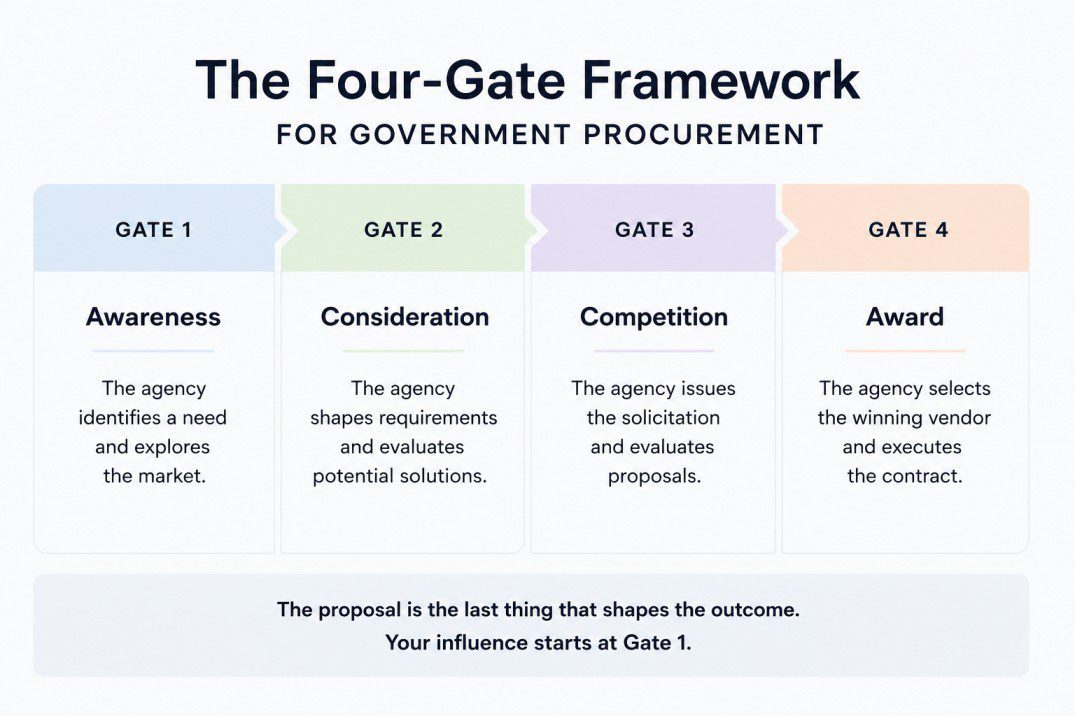
The Four-Gate Framework for Government Procurement
The Four-Gate Framework maps every stage a vendor must clear before a government contract can be won: Registration, Qualification, Contract Vehicle, and Award.
Gate 1: Registration
Before responding to any federal solicitation, your company must be registered in SAM.gov (System for Award Management). Registration issues a Unique Entity Identifier (UEI) number, your legal identity in the federal procurement system. It is free and requires annual renewal. An expired registration disqualifies you from award even if your proposal is the strongest submission.
Gate 2: Qualification
Qualification means proving your company has the legal, financial, and technical standing to perform government work. This includes business certifications (small business, 8(a), HUBZone, WOSB, SDVOSB), NAICS codes, and a documented past performance record. Certifications determine which solicitations you are eligible for. Set-aside contracts can only be awarded to certified vendors. Agencies often search by NAICS code before a solicitation is published, so uncoded companies may never see the opportunity at all.
Gate 3: Contract Vehicle
Many government purchases bypass open competition. They flow through pre-established contract vehicles that allow agencies to buy from an approved vendor pool without running a new full acquisition each time. Getting on the right vehicle places you in the buying pool before the formal government procurement process begins. Contract vehicles take months to join, and agencies cannot buy from vendors who are not on the vehicles they use.
Gate 4: Award
The final gate is the proposal. By the time a vendor reaches Gate 4, the outcome has been partially shaped by Gates 1 through 3. Vendors who are registered, certified, on a relevant contract vehicle, and engaged during market research start the proposal competition in a structurally stronger position than vendors who appear only at the solicitation stage. It is the last gate, not the only one.
How Government Procurement Works: Stage by Stage
Every government procurement follows a defined sequence from identifying a need to signing a contract. Each stage has specific windows for vendor engagement.
Budget Request and Internal Approval
Every government purchase starts with an approved budget. Federal agencies operate on a fiscal year from October 1 to September 30. Budget requests move through a Congressional appropriations process months before the fiscal year begins. Agencies cannot obligate funds until appropriations are confirmed, which means contracts stall even when both sides want to proceed. Q4 (July to September) typically produces a surge in government procurement awards as agencies move to obligate remaining funds before the year closes.
Market Research and Sources Sought
Before writing an RFP, agencies are legally required to conduct market research. This commonly takes the form of a Sources Sought notice: a public announcement asking vendors whether they can meet a specific requirement and under what business size classification they would respond.
Most vendors treat Sources Sought as optional in the government procurement process. It is not. Agencies use Sources Sought responses to determine whether full competition is feasible, whether to set the contract aside for small businesses, and what technical requirements to include in the RFP. Vendors who respond get visibility with the contracting officer while requirements are being written. A Sources Sought response is a two-to-four-page capability statement, and responding is the most underused tool in B2G sales.
Pre-Solicitation and Request for Information
Some acquisitions include a pre-solicitation notice or Request for Information (RFI) before the formal RFP is issued, giving vendors a documented chance to demonstrate capability before evaluators form initial impressions. Industry days (formal briefings where agencies explain an upcoming requirement and take questions) also fall here. Attending reveals what the agency values, who the key stakeholders are, and what problem the acquisition is solving. That context directly improves proposal quality and pricing accuracy.
Solicitation: RFP, RFQ, and IFB
The formal solicitation is published when market research and internal approvals are complete. Three solicitation types appear most often in public procurement and federal procurement:
- RFP (Request for Proposal): Used for complex acquisitions evaluating technical approach, past performance, and price. The standard path for services and solutions contracts.
- RFQ (Request for Quotation): Used for simpler purchases, often through existing contract vehicles like GSA Schedule task orders. Faster and less document-intensive than an RFP.
- IFB (Invitation for Bid): Used for construction and commodity purchases with precisely defined requirements. Award goes to the lowest responsive bid.
Federal solicitations are published on SAM.gov; state-level ones appear on state procurement portals. The solicitation package includes the Statement of Work, evaluation criteria, instructions to offerors, and contract terms.
Proposal Evaluation and Source Selection
After the submission deadline, an evaluation team scores proposals against the published criteria using a Source Selection Plan the agency prepared before issuing the solicitation. The Source Selection Authority (a senior agency official) makes the final award decision. In Best Value acquisitions, the SSA must document the tradeoff rationale when the selected proposal is not the lowest-priced option.
Award, Debrief, and Protest
After award, losing vendors can request a debrief revealing where their proposal scored lower and what the winning submission offered. Skipping the debrief forfeits the clearest feedback available in the government procurement cycle. Vendors who believe an award was improper can file a bid protest with the Government Accountability Office (GAO) within 10 days of the debrief.
Each stage of the government procurement process is shaped by the contract vehicle the agency is using. Understanding those vehicles explains why some competitors win opportunities you never knew existed.
Contract Vehicles in Government Procurement
A contract vehicle is a pre-established agreement that defines the terms, pricing, and eligible vendor pool for a category of government purchases. Agencies use contract vehicles to avoid running a full competitive acquisition each time. For vendors, being on the right vehicle is the difference between being in the consideration set and being excluded before the solicitation is even written.
| Contract Vehicle | What It Is | Best For | How Vendors Get On | Bypasses Full RFP? |
|---|---|---|---|---|
| GSA Schedule | Long-term government-wide contract with pre-negotiated pricing and terms | IT products, professional services, commercial solutions | Submit an offer to GSA; review takes 3 to 9 months | Yes: agencies issue RFQs directly to Schedule holders |
| IDIQ | Indefinite Delivery, Indefinite Quantity contract establishing a defined vendor pool | Recurring services, large agency-wide programs | Compete for a pool spot during an open on-ramp competition | Partial: task orders still require competition within the pool |
| BPA | Blanket Purchase Agreement for recurring purchases in a specific category | Lower-value recurring purchases; agency-specific requirements | Awarded by a contracting officer, often to existing vendors | Yes: orders placed with minimal additional process |
| OTA | Other Transaction Authority agreement for prototype and R&D work, primarily used by DoD | Defense innovation, prototype development, technology testing | Apply through a DoD OTA consortium or direct agreement | Yes: OTAs are intentionally exempt from FAR requirements |
| Set-Aside | Competition restricted to specific certified business categories | Small businesses, 8(a) firms, HUBZone, WOSB, SDVOSB | Hold the relevant SBA certification before the solicitation | No: full competition within the certified category |
This comparison is based on publicly available government procurement guidance and commonly reported vendor experiences. Contact each contracting vehicle’s governing body directly for current eligibility requirements and process details.
GSA Schedules: The Most Common Entry Point
Getting on a GSA Schedule takes three to nine months, and civilian federal agencies often treat Schedule membership as a prerequisite to reviewing a vendor for a task order. Start the GSA Schedule application before you have a specific active opportunity. Waiting until a requirement surfaces means you will miss it while your application is being processed.
IDIQ Contracts: The Pool That Spans Years
IDIQ contracts establish a vendor pool through an upfront competition. Once set, agencies issue task orders to pool members across a period spanning five to ten years. Task orders still require competition within the pool, but vendors outside it cannot compete at all. Getting onto a major IDIQ means staying eligible for task orders across the full period without re-competing.
OTA Agreements: The Innovation Lane
Other Transaction Authority agreements bypass the FAR for prototype and research work, primarily as a DoD tool. For commercial technology vendors, OTA consortia (organizations that pool multiple vendors under a single OTA agreement) offer the fastest path into DoD programs without traditional government procurement overhead. Contract vehicles define who can compete. Evaluation methods define who wins.
How Agencies Decide Who Wins Government Procurement Awards
Government evaluations follow documented scoring criteria published in the solicitation. Two methods dominate federal government procurement, and which one applies changes how you write every section of your proposal.
LPTA: Lowest Price Technically Acceptable
Under LPTA, the award goes to the lowest-priced vendor whose proposal meets the minimum technical requirements. Technical quality above the minimum threshold earns zero additional credit. The only strategy that matters is meeting the threshold cleanly and pricing competitively. Writing a detailed technical proposal for an LPTA acquisition wastes budget and signals the vendor did not read the solicitation.
Best Value Tradeoff
Best Value acquisitions score proposals across technical approach, management plan, past performance, and price. The Source Selection Authority can select a higher-priced proposal when the technical and past performance advantages justify the premium. In a Best Value government procurement competition, your past performance is scored before a single evaluator reads your technical volume. Agencies pull CPARS (Contractor Performance Assessment Reporting System) ratings for every prior contract. One poor CPARS rating can suppress your score across future competitions for years.
CPARS is the most underestimated factor in government procurement. Most vendors focus on proposal quality and ignore the performance record evaluators have already reviewed.
The account prioritization logic from commercial sales applies in government markets too: pursue opportunities where your certifications, contract vehicles, and CPARS profile are already a strength rather than chasing every open solicitation.
What Most Vendors Get Wrong About Government Procurement
The common assumption is that winning government procurement awards is about writing better proposals. It is not. Vendors with the highest win rates in government markets share one pattern: they are engaged with agencies six to twelve months before any solicitation is published. By the time an RFP appears on SAM.gov, the government procurement process has been in development for months, requirements have been shaped, and the incumbent has a performance record that challengers can only counter with comparable documented past performance elsewhere.
The counterintuitive truth about government procurement: the proposal is the last thing that shapes the outcome, not the first. What actually determines outcomes earlier:
- Sources Sought responses that establish your capability while requirements are still being written
- Industry day attendance that reveals agency priorities before the solicitation is drafted
- CPARS performance history already in every Best Value scoring rubric before evaluators open your proposal
- Contract vehicle positioning that determines whether you are in the eligible pool at all
- Teaming arrangements with prime contractors that build performance records through subcontracting before you propose as a prime
How to Find Government Procurement Opportunities Before the RFP
SAM.gov is the starting point for any government procurement pipeline, but it is also the last moment to engage strategically. By the time a solicitation is public, the pre-positioning window has typically closed. Teams that engage early draw from a broader set of sources:
- USASpending.gov: Historical contract award data showing which agencies buy what, from whom, on which vehicles. Award history is the most reliable predictor of future procurement activity in a category.
- Agency acquisition forecasts: Major federal agencies publish annual forecasts listing planned procurements with estimated values and timeframes. These are public and almost never read by vendors outside an agency’s existing supplier base.
- Procurement conference calendars and industry days: These appear on agency websites before surfacing on SAM.gov, giving you preparation time and priority attendance.
Incumbent contract expiration dates are public record. They appear in contract databases and non-traditional data sources such as government procurement filings and contract registry data that standard search tools do not index. Teams that know a contract is expiring nine months out have a nine-month runway to build agency relationships, respond to Sources Sought, and position for the re-compete. Teams that find out when the solicitation drops have weeks.
For teams targeting public sector accounts across government, education, healthcare, manufacturing, and similar verticals, Pintel.ai’s account discovery surfaces procurement decision-makers using proprietary government databases and contract renewal data that standard B2B prospecting tools do not reach.
Final Takeaway
Government procurement is a structured process with defined stages, legal rules, and predictable decision points. Vendors who understand the mechanics can engage at every stage rather than arriving only at the proposal.
For vendors new to government markets: register in SAM.gov before you have a live opportunity, pursue certifications as soon as you qualify, respond to every Sources Sought notice in your category, and apply for a GSA Schedule before you need it. For vendors already in the market: track incumbent contracts, know when they expire, and start pre-positioning nine to twelve months before the solicitation drops.
A B2G sales strategy built around the full government procurement lifecycle consistently outperforms one built around the RFP response alone. Most B2B data providers do not cover the government procurement data layer, which is why teams that build it early hold a lasting advantage over competitors who improvise it deal by deal.
Frequently Asked Questions About Government Procurement
What is government procurement?
Government procurement is the process public sector agencies use to buy goods and services from vendors. It follows the Federal Acquisition Regulation (FAR), requiring open competition, transparency, and documented justification for every spending decision.
How do I register as a government vendor?
Register at SAM.gov to receive a Unique Entity Identifier (UEI). Registration is free and renewed annually. Without an active registration, you cannot receive a federal contract award.
What is a Sources Sought notice in government procurement?
A Sources Sought notice is a market research document agencies publish before writing an RFP. Responding demonstrates capability with the contracting officer and can directly influence the final requirements before the solicitation is issued.
What is the difference between LPTA and Best Value in federal procurement?
LPTA awards to the lowest-priced vendor that meets minimum technical requirements. Best Value weighs price alongside capability and past performance. Best Value gives vendors with strong track records a competitive edge in public procurement beyond offering the lowest price.
What is a GSA Schedule in government procurement?
A GSA Schedule is a long-term government contract with pre-negotiated pricing. Once approved, agencies can purchase from Schedule holders without a full competitive bid, shortening the government procurement sales cycle significantly.
How long does the government procurement process take?
A full competitive government procurement acquisition takes 6 to 18 months. Task orders through existing contract vehicles can close in 30 to 90 days, depending on agency requirements and complexity.
What is federal procurement and how does it differ from state procurement?
Federal procurement follows the FAR and covers agencies like DoD, HHS, and GSA. State and local public procurement uses each jurisdiction’s own code. Federal contracts are typically larger; state and local contracts are often more accessible for vendors new to the market.