Most B2B companies confuse having a GTM strategy with having executable GTM documentation. Leadership agrees on target segments, positioning, and channel priorities during board meetings, but those decisions never translate into enforceable standards that sales, marketing, and RevOps actually follow.
Six months later, SDRs prospect outside the ICP, AEs discount inconsistently, and CSMs onboard accounts the product wasn’t built for. The breakdown happens because strategy documents describe what to do, while execution requires documented standards for how to do it.
A GTM template is the operational artifact that sits between strategy and daily execution. It defines the rules, thresholds, boundaries, and handoff protocols that keep revenue teams aligned as headcount scales.

What a B2B GTM Template Actually Is
A GTM template is an execution worksheet that documents the operational standards your revenue organization follows to implement GTM strategy. It’s not a strategic document explaining why you target specific markets. It’s the reference document that defines who gets prospected, how accounts get qualified, when handoffs occur, and what constitutes pipeline.
The template serves three functions:
It standardizes execution across distributed teams so every SDR, AE, and CSM operates from the same qualification criteria. It creates enforcement mechanisms that prevent strategic drift when individual reps make judgment calls. And it provides the operational baseline RevOps uses to measure whether execution matches intent.
Most companies operate without a formal GTM template. Strategy lives in slide decks. Process definitions exist in scattered wiki pages. Qualification criteria vary by rep tenure and manager interpretation. The GTM template consolidates all execution-critical standards into a single operational artifact that the entire revenue org references and RevOps maintains.
GTM Strategy vs GTM Plan vs GTM Template
Revenue teams use these terms interchangeably, but they serve distinct purposes.
GTM Strategy defines what markets you target, why those markets matter, and how you differentiate. It includes ICP definition, competitive positioning, and revenue targets. GTM strategy is the executive-level narrative that explains the market opportunity. It changes infrequently and lives in board decks.
GTM Plan translates strategy into time-bound initiatives with ownership and resources allocated. It includes quarterly campaign calendars, headcount plans, pipeline targets, and budget allocation. The GTM plan is the project plan that organizes execution over a defined period. It updates quarterly.
GTM Template documents the operational standards and execution rules that implement both strategy and plan at the transaction level. It includes ICP qualification thresholds, segment routing logic, opportunity stage definitions, and handoff protocols. The GTM template is the operational playbook that ensures daily execution reflects strategic intent. It evolves continuously.
Why the distinction matters: Teams that conflate these artifacts create operational confusion. Sales reps receive strategy slides when they need qualification criteria. RevOps builds reporting dashboards without clear definitions of what constitutes a qualified account.
The GTM template is where strategy becomes enforceable. It answers: What exact firmographic attributes qualify an account? At what deal size does routing shift from mid-market to enterprise AEs? What data must exist in the CRM before an opportunity advances?
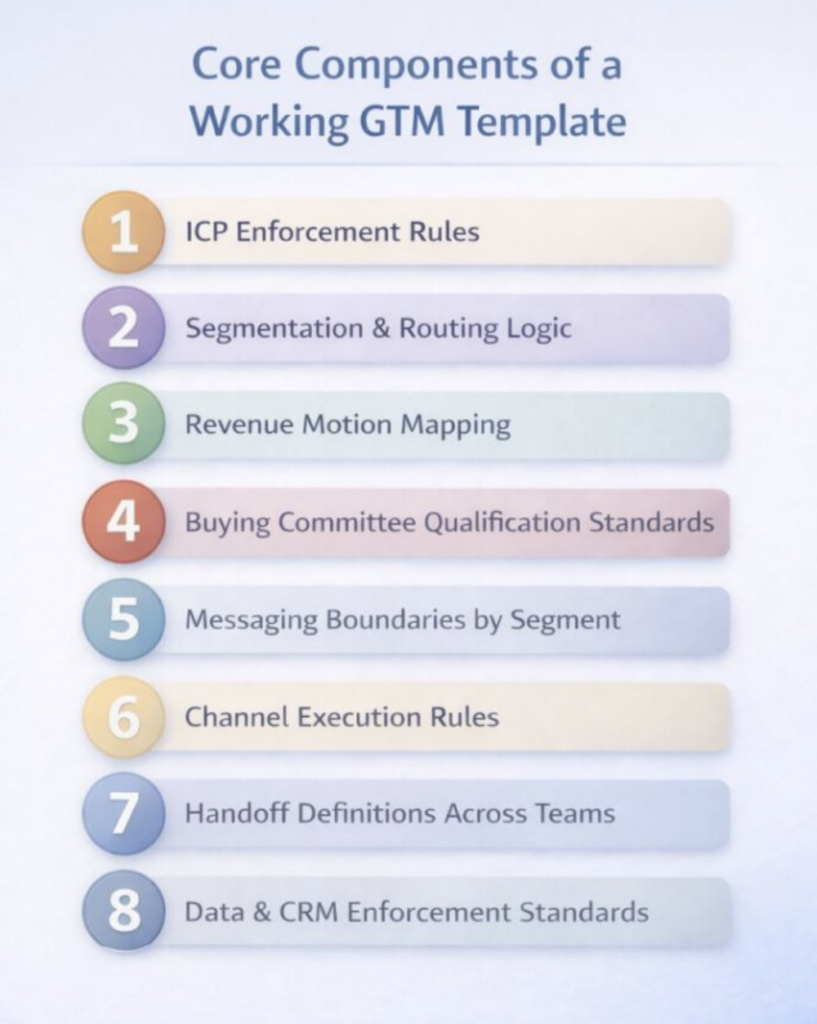
Core Components of a Working GTM Template
A complete GTM template includes eight operational sections that define execution standards across the revenue org.
1. ICP Enforcement Rules
What belongs here: Firmographic ranges (employee count, revenue band, geography), industry inclusion/exclusion lists, technology stack requirements, organizational attributes, disqualification rules, and behavioral signals.
Without this: Every rep interprets “mid-market” differently. Pipeline inflates with accounts that won’t close, forecasting becomes unreliable, and product builds features for customers outside the target segment.
Good enforcement: ICP rules are coded into your CRM and prospecting tools. Accounts outside defined thresholds get flagged automatically. RevOps tracks what percentage of pipeline meets documented ICP standards.
2. Segmentation and Routing Logic
What belongs here: Segment definitions with exact firmographic boundaries, deal size thresholds that trigger routing changes, geographic territory assignments, vertical specialization routing, account complexity scoring, and routing exception protocols.
Without this: Ambiguous routing creates internal conflict, slows response time, and mismatches account complexity with rep capability. High-value inbound leads sit in queues while junior reps chase logos they can’t close.
Good enforcement: Routing logic is automated in your CRM with clear ownership assignment at lead creation. RevOps monitors routing accuracy and reassignment frequency.
3. Revenue Motion Mapping
What belongs here: Motion types (self-serve, sales-assisted, enterprise, PLG, expansion), entry criteria for each motion, sales involvement levels, process variations by motion, handoff definitions between motions, and success metrics.
Without this: Reps apply enterprise sales processes to mid-market deals and lose on velocity. Self-serve accounts get over-serviced, destroying unit economics. Expansion opportunities fall through cracks.
Good enforcement: Each motion has documented playbooks with stage-gate criteria. CRM workflows enforce process variations automatically. RevOps tracks conversion rates and cycle time by motion.
4. Buying Committee Qualification Standards
What belongs here: Required roles by deal size and segment (economic buyer, technical buyer, champion), minimum stakeholder engagement thresholds, multi-threading requirements, decision-maker validation protocols, and red flags indicating inadequate coverage.
Without this: Deals advance to late stage with single-threaded champion relationships. Opportunities stall in procurement because economic buyers were never engaged.
Good enforcement: CRM requires minimum contact roles before opportunity stage advancement. Managers review buying committee mapping in weekly pipeline reviews.
5. Messaging Boundaries by Segment
What belongs here: Core value propositions by segment, approved use cases and customer stories, feature emphasis guidelines, pricing messaging standards, competitive positioning by segment, and messaging guardrails.
Without this: Every rep delivers different value propositions. Enterprise prospects hear SMB messaging. Reps promise capabilities that don’t exist.
Good enforcement: Sales enablement maintains messaging matrix accessible during calls. Demo environments are configured by segment. Regular call reviews identify messaging drift.
6. Channel Execution Rules
What belongs here: Channel ownership, channel-specific qualification criteria, outreach cadence standards, channel conflict resolution protocols, partner referral handling, and channel performance benchmarks.
Without this: Marketing and sales both contact the same accounts with conflicting messages. Partner-referred deals languish because no one knows who owns them.
Good enforcement: CRM tracks channel attribution with clear rules for multi-touch scenarios. Cadence tools enforce documented outreach patterns.
7. Handoff Definitions Across Teams
What belongs here: MQL to SQL handoff requirements, SDR to AE handoff standards, sales to CS handoff protocols, expansion to renewal handoff criteria, and failed handoff protocols.
Without this: Leads sit unworked because no one knows who owns them. AEs receive meetings with zero context from SDRs. New customers onboard without sales documenting key commitments.
Good enforcement: CRM workflow automation triggers handoff tasks with required field completion. SLA monitoring alerts managers to missed handoffs.
8. Data and CRM Enforcement Standards
What belongs here: Required fields by object and stage, data quality standards, activity logging requirements, opportunity hygiene rules, account enrichment standards, and reporting field dependencies.
Without this: CRM becomes a data junkyard. Reporting breaks because required fields are blank. Forecasting fails because opportunity data is incomplete.
Good enforcement: Required fields prevent record progression until populated. Validation rules enforce data formats. RevOps dashboards surface data quality scores by rep.
Template Ownership
| Section | Owner | Enforced In | Reviewed By |
|---|---|---|---|
| ICP Rules | RevOps | CRM + Prospecting Tools | Sales Leadership |
| Routing Logic | RevOps | CRM Automation | Sales Ops |
| Revenue Motions | Sales Leadership | Process Docs + CRM | RevOps |
| Buying Committee | Sales Leadership | CRM Required Fields | Sales Managers |
| Messaging | Sales Enablement | Content Library | Marketing + Sales |
| Channel Rules | Marketing Ops | Attribution Model | CMO + CRO |
| Handoff Protocols | RevOps | Workflow Automation | Cross-Functional |
| CRM Standards | RevOps | Validation Rules | Data Governance |
B2B GTM Template Framework (Copy-Paste Worksheet)
Use this structured framework to document your own GTM execution standards. Fill in each section with your specific criteria, then enforce through CRM automation.
Section 1: ICP Definition
Company Size Range:
Minimum employees: _____
Maximum employees: _____
Revenue Band:
Minimum ARR/revenue: _____
Maximum ARR/revenue: _____
Industry Focus:
Included verticals: _____
Excluded verticals: _____
Geographic Scope:
Target regions: _____
Tech Stack Requirements:
Must have: _____
Incompatible with: _____
Disqualification Criteria:
Automatic disqualifiers: _____
Competitive conflicts: _____
Behavioral Signals Required:
Intent signals valued: _____
Engagement thresholds: _____
Section 2: Segmentation and Routing
Segment Name: _____
Employee Count Range:
Minimum: _____ Maximum: _____
Deal Size Range:
Minimum ACV: _____ Maximum ACV: _____
Assigned Sales Role:
SDR team: _____
AE team: _____
Routing Logic:
Round-robin / skill-based / named account
Routing triggers: _____
Exception handling: _____
Section 3: Revenue Motion Mapping
Motion Type: _____
(self-serve / sales-assisted / enterprise / PLG / expansion)
Entry Criteria:
How accounts enter: _____
Triggering events: _____
Required Process Steps:
Discovery requirements: _____
Demo/trial requirements: _____
Handoff to Next Motion:
Trigger criteria: _____
Receiving team: _____
Success Metrics:
Conversion rate target: _____
Cycle time target: _____
Section 4: Buying Committee Standards
Segment: _____
Required Roles:
Economic Buyer:
- Title/role: _____
- Engagement requirement: _____
Technical Buyer:
- Title/role: _____
- Engagement requirement: _____
Champion:
- Title/role: _____
- Engagement requirement: _____
Multi-Threading Requirements:
Minimum active contacts by deal size:
<$25K: _____
$25K-$50K: _____
$50K+: _____
Section 5: Messaging Guardrails
Segment: _____
Primary Value Proposition:
What this segment cares about: _____
Approved Use Cases:
Use case 1: _____
Use case 2: _____
Feature Emphasis:
Lead with: _____
Mention if asked: _____
Messaging Restrictions:
Claims reps cannot make: _____
Features not to promise: _____
Section 6: Handoff Protocols
Handoff Name: _____
(MQL→SQL / SDR→AE / AE→CS)
Trigger Criteria:
What causes handoff: _____
Required Documentation:
Fields that must be completed: _____
Context that must be captured: _____
SLA Timeline:
Handoff must occur within: _____
Receiving team must respond within: _____
Section 7: CRM Standards
Object: _____ (Lead / Account / Opportunity)
Required Fields by Stage:
Stage 1:
- Field 1: _____
- Field 2: _____
Stage 2:
- Field 1: _____
- Field 2: _____
Activity Logging Requirements:
What gets logged: _____
Logging frequency: _____
Opportunity Hygiene:
Update frequency: _____
Staleness threshold: _____
How GTM Templates Evolve Across Stages
Seed Stage (Pre-$2M ARR): Basic ICP definition, simple qualification checklist, minimal CRM enforcement. Teams are small enough for verbal alignment.
Series A-B Scaling ($2M-$20M ARR): Formal segment definitions with routing logic, revenue motion documentation, buying committee standards, structured handoff protocols. This is where execution drift becomes expensive without documentation.
Series C+ Enterprise ($20M+ ARR): All eight components fully documented, vertical-specific playbooks, multi-motion orchestration, complex buying committee mapping, global routing with compliance requirements.
Diagnostic Checklist: Is Your GTM Execution Drifting?
ICP Enforcement:
- [ ] Can every rep recite exact firmographic boundaries?
- [ ] Does your CRM automatically flag out-of-ICP accounts?
- [ ] What percentage of pipeline meets ICP standards?
Routing and Segmentation:
- [ ] Do routing rules exist in writing?
- [ ] How often do reps dispute account ownership?
- [ ] What percentage of leads get reassigned?
Revenue Motion Clarity:
- [ ] Can you name every distinct sales motion?
- [ ] Are process differences documented and enforced?
- [ ] Do handoffs have clear ownership and SLAs?
Buying Committee Coverage:
- [ ] What percentage of closed-won deals had economic buyer engagement?
- [ ] Do late-stage opportunities advance without stakeholder coverage?
Data Integrity:
- [ ] What percentage of opportunities have required fields populated?
- [ ] Can you forecast from CRM data without manual cleanup?
If you answered “no” to more than three questions, your GTM execution is drifting. A documented GTM template with enforcement mechanisms fixes this.
Conclusion
GTM strategy defines where you’re going. GTM plans allocate resources to get there. GTM templates ensure everyone executes the same way once they arrive.
Most revenue organizations operate with strategy and plans but no enforceable template. The result is predictable: execution quality varies by rep, manager, and region. Strategic decisions made in planning sessions don’t translate into daily behavior.
A working GTM template creates execution consistency. It documents the standards that keep distributed teams aligned. It provides the enforcement mechanisms that prevent drift. And it gives RevOps the baseline needed to measure whether execution matches strategic intent.
Build the template. Document the standards. Enforce them systematically. Revenue predictability follows.
Frequently Asked Questions
Who owns the GTM template?
RevOps owns documentation and enforcement. Sales leadership approves updates. Marketing, sales, and CS provide input on their sections. Treat the template like code: version control it and update systematically.
How often should the GTM template update?
Review quarterly, update as needed. Major changes (new segment launch, ICP shift) trigger immediate updates. Minor refinements batch into quarterly reviews.
What’s the difference between a GTM template and a sales playbook?
A sales playbook documents how to execute specific activities (discovery frameworks, objection handling). The GTM template documents what gets executed when (which accounts qualify, how they route, when handoffs occur).
How do we enforce the template without creating bureaucracy?
Automate enforcement through CRM workflows, validation rules, and routing logic. Manual enforcement focuses on high-impact areas: buying committee coverage, ICP adherence, handoff quality.