Most RevOps teams evaluating Indian company and contact databases make the same mistake: they compare record counts, accept the vendor demo, and sign the contract without testing against their actual ICP. Six months later, their SDR team is hitting invalid emails, stale job titles, and coverage gaps across the non-tech sectors they actually target.
The problem is not the vendor. It is the evaluation process. This guide gives you the India Database Audit, a six-layer framework to assess any Indian company and contact database before committing budget around it.
What Are Indian Company and Contact Databases?
Indian company and contact databases are B2B data platforms that provide two layers of records: firmographic data for companies registered in India, and verified contact information for decision-makers within those companies.
Two data layers every platform should cover:
- Company database: organization details including industry, headcount, city, and revenue
- Contact database: decision-maker names, job titles, verified emails, and direct phone numbers
Two sourcing models, and why the difference matters:
- India-native sourcing: Ministry of Corporate Affairs (MCA), IndiaMART supplier and buyer databases, the MSME (Micro, Small, and Medium Enterprises) national registry, and local trade directories. Covers the full India B2B landscape including manufacturing, logistics, and healthcare
- LinkedIn-derived sourcing: strong for tech companies in Bangalore, Hyderabad, Delhi, and Pune. Thin for manufacturing, logistics, healthcare, and local services that are not LinkedIn-active at the same rate
That sourcing gap is what most evaluation processes fail to catch, because demos and free trials typically showcase the tech sector, not the full India B2B landscape.
Why Indian Databases Fall Short Without the Right Evaluation Criteria
According to Gartner, poor data quality costs organizations an average of $12.9 million annually. For India outbound, the failure mode is consistent: one team found 37% of their contact data was invalid before switching Indian company and contact databases. After switching to India-native sourcing, their match rate reached 95%+.
The three sourcing failures behind most bad India data:
- Coverage skewed to tech: Most global databases are LinkedIn-centric. They miss manufacturing, logistics, healthcare, and local services companies that are not LinkedIn-active
- Records that age faster: Indian company data ages faster than US data. People change roles frequently and MCA filings update before LinkedIn profiles do. A database refreshing from MCA and IndiaMART stays current; a LinkedIn-contribution model does not
- Company records without contact coverage: Many platforms have solid company records but weak contact coverage for those same companies, forcing teams into a two-tool dependency
Proper evaluation catches all three failure modes before you sign. The India Database Audit below gives you a consistent structure across any vendor.
The India Database Audit: 6 Layers to Evaluate Before You Buy
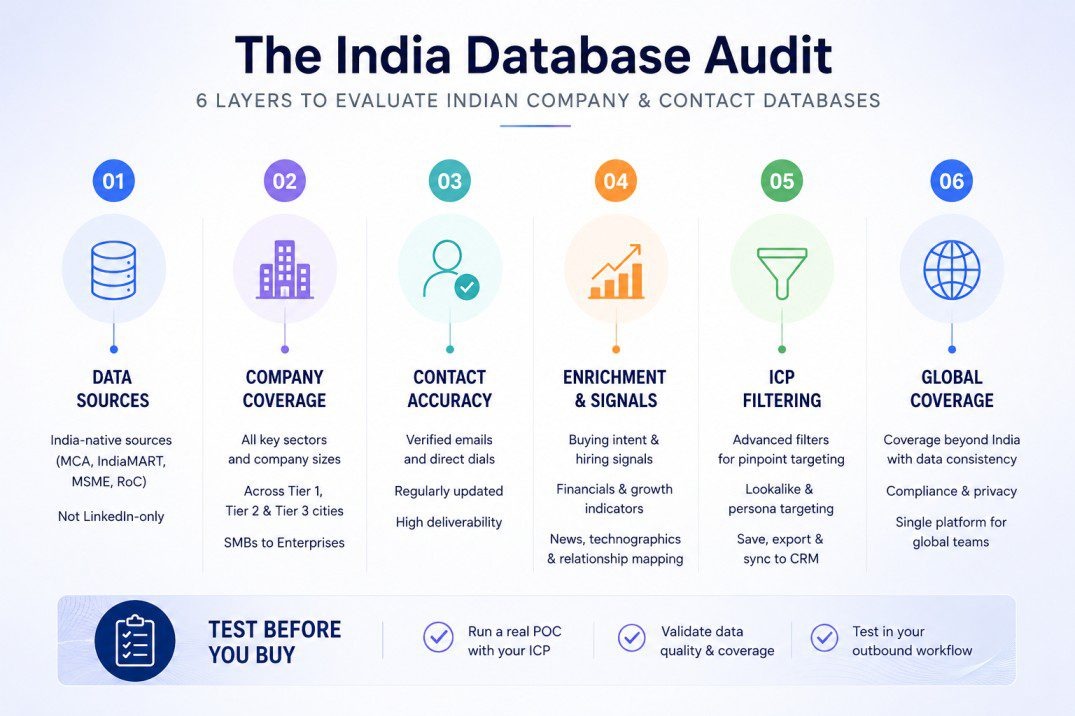
The India Database Audit tests any Indian company and contact database across six layers: sourcing model, company coverage, contact verification, enrichment depth, ICP filtering, and global coverage, using your actual ICP as the test case.
Layer 1: Where Does the Database Get Its India Records?
The sourcing model is the most critical factor in any Indian company database evaluation. Two databases with similar pricing produce entirely different results if one pulls from India-native registries and the other from LinkedIn community contributions.
India-native sources to ask the vendor about:
- MCA (Ministry of Corporate Affairs) company filings
- IndiaMART supplier and buyer databases
- MSME national registry
- Registrar of Companies (RoC) records
What LinkedIn-only sourcing misses:
- Mid-market manufacturing across Pune, Coimbatore, and Ludhiana
- Logistics operators across port zones and industrial corridors
- Healthcare providers outside metro areas
- MSME-registered SMBs with no LinkedIn presence
Ask every vendor: what specific India-native sources does this database draw from? If the answer is vague, that is the answer.
Sourcing model determines coverage breadth, record freshness, and which sectors you can prospect into. The next layer tests whether that coverage matches your target market.
Layer 2: How Broad Is the Company Coverage Across India’s Sectors?
India’s B2B market extends well beyond Bangalore tech. Manufacturing contributes 17% of GDP, logistics is a $220 billion sector, and healthcare, education, and financial services span tier-1, tier-2, and tier-3 cities. Most are not LinkedIn-active at the same rate as SaaS companies.
Sectors to test during B2B company database India evaluation:
- Manufacturing: MSME-registered companies in Gujarat, Maharashtra, Tamil Nadu, and Haryana
- Logistics and supply chain: companies in port-adjacent zones and industrial corridors
- Healthcare: hospital groups, diagnostic chains, and pharma distributors with tier-2 city presence
- Local services: professional services, construction, and trade outside metro tech clusters
The practical test: pull 30 to 50 companies from two of these sectors in your target regions. Coverage gaps appear in minutes.
Layer 3: How Accurate Are the Contact Records for Indian Professionals?
Contact accuracy in India has a structural challenge: job title standardization is inconsistent. A decision-maker at a mid-size manufacturing company might be titled “Director – Operations,” “VP Works,” or “Head – Manufacturing” for the same role. Title-keyword matching alone misses 30 to 50% of relevant contacts and surfaces false positives that do not match the ICP.
Profile-level analysis reads the full job description and responsibility context, not just title keywords. This produces more accurate contact matches, particularly for India’s mid-market where titles are less standardized than in US enterprise accounts.
Three contact accuracy dimensions to evaluate in Indian company and contact databases:
- Email deliverability: ask for the India-specific accuracy figure, not the global average. The two often differ substantially for mid-market India records
- Direct phone coverage: LinkedIn-derived databases underperform for non-tech sectors. Direct lines for senior contacts at manufacturing and logistics companies are particularly hard to find
- Refresh frequency: India’s job-change rate is high. Databases refreshing less than quarterly produce rising bounce rates within months
Contact accuracy determines whether outbound volume translates into conversations. The signal layer determines which contacts are worth reaching out to now.
Layer 4: What Enrichment and Buying Signal Data Is Available?
A contact database gives you a starting list. An enriched Indian company database tells you which accounts are worth contacting now. Buying signal data provides real-time indicators of company change or growth that typically precedes a purchase decision.
Most actionable India buying signals:
- Funding rounds: VC and PE rounds filed with SEBI or MCA, especially Series A to Series C companies in a growth-and-hiring phase
- Leadership hires: new VP, CXO, or department head appointments indicating team-building and new buying authority
- Hiring spikes: clusters of open positions in sales, RevOps, or operations functions
- Tech stack migrations: movement between CRM, ERP, or cloud infrastructure vendors, etc.
Single-source intent data is unreliable because one signal can represent noise. Platforms that triangulate across three or more signal types consistently outperform single-signal tools. Waterfall enrichment across 30+ providers pushes match rates from 60-80% to 90%+. How sales teams choose B2B data covers the multi-signal approach in full.
ICP filtering determines whether you can act on that signal data for the specific accounts in your India target market.
Layer 5: How Does the Platform Handle India-Specific ICP Filtering?
Standard ICP filters (revenue range, headcount, industry vertical, city) work for initial segmentation. They do not work for nuanced India-specific ICPs. A team targeting “Indian manufacturing companies that export to Europe and use SAP” cannot build that list using dropdown fields.
Profile-level ICP scoring reads the full company and contact description to match on intent and operational context. A title-keyword filter for “Head of Operations” at manufacturing companies might return 800 companies. Profile-level analysis checking whether the company is export-oriented and SAP-using returns 80 genuinely qualified accounts.
Two edge cases to test in a live vendor session:
- Can it distinguish between a software company and a company that uses software internally?
- Can it find contacts at Indian subsidiaries of multinationals, separated from the global HQ?
A vendor who cannot demonstrate this on your actual ICP description, not their own examples, cannot deliver it in production.
The final evaluation layer addresses whether the same platform covers your non-India ICPs as well.
Layer 6: Does the Platform Cover Global Markets Beyond India?
GTM teams targeting India rarely target only India. Running separate vendors for each region multiplies contracts and splits prospecting workflows.
What to test for global coverage:
- Pull a sample list from a non-India ICP (EMEA, US, or APAC) on the same platform during the trial
- Compare record quality and coverage depth against the India output
- Ask whether the global records use the same enrichment model or a different sourcing layer
Coverage gaps outside India reveal whether the global coverage claim is real. With all six layers mapped, the table below translates them into the exact questions to ask any vendor.
The India Database Audit: Evaluation Criteria at a Glance
Use this table during vendor demos and trial calls. A vendor who cannot complete a row in a live session cannot complete it in production.
| Evaluation Layer | Question to Ask | Strong Answer | Red Flag |
|---|---|---|---|
| Data sourcing model | “What India-native sources does your database draw from?” | Names MCA, IndiaMART, MSME, or RoC by name | “Our database covers India comprehensively” with no source detail |
| Company coverage breadth | “Show me 30 companies from manufacturing and logistics in [your region]” | Returns complete, accurate records across sectors and company sizes | Thin or empty results outside Bangalore or Hyderabad tech clusters |
| Contact verification | “What is your verified email accuracy specifically for Indian contacts?” | Provides India-specific accuracy figure (80%+) separate from global average | Only provides global accuracy; no India-specific breakdown available |
| Enrichment and signals | “What buying signal types are available for Indian accounts?” | Names specific signal types: funding rounds, leadership hires, hiring spikes, tech migrations | “Intent data is available” with no specification of signal types or India coverage |
| ICP filtering | “Filter for this ICP: [describe a nuanced India ICP]” | Demonstrates profile-level filtering beyond title keywords and firmographic dropdowns | Relies entirely on industry, headcount, and title keyword filters |
| Global coverage | “Show me comparable records from [non-India ICP]” | Returns clean records with accuracy comparable to India output | Coverage drops sharply or vendor suggests a separate product for non-India markets |
A vendor who answers every row in a demo but cannot replicate those answers in a structured proof of concept is providing sales answers, not production answers.
How to Run a Proof of Concept Before Buying an Indian Company Database
Most database vendors offer a trial environment or a sandboxed demo account. The mistake most teams make is using this access to explore rather than to test systematically. A structured proof of concept takes two to three hours and answers the evaluation questions the demo cannot.
Step 1: Write your India ICP in plain English. Do not simplify it for the trial. The ICP description is the test case, not a generic category filter.
Step 2: Pull 30 to 50 records matching your ICP using the vendor trial. Do not let the vendor pre-filter the list.
Step 3: Verify 10 records manually. Confirm: does the company match the ICP? Is the contact’s role still accurate? Does the email follow standard formatting? Note every failure mode.
Step 4: Assess the failure rate. More than 15% failure on a curated trial indicates much higher failure rates in production. Trial datasets are the best any company database for sales will ever perform.
Step 5: Test a second ICP segment, a different sector or Indian region. A database that passes for Bangalore tech and fails for Pune manufacturing will create gaps as soon as your India outbound expands beyond the initial target.
A structured POC separates databases with genuine India coverage from those that demo well on curated data. The guide on B2B company data provider selection covers this across all regions.
How Pintel.ai Is Built for Indian Company and Contact Database Evaluation
Pintel.ai’s India coverage starts with a proprietary database built from MCA filings, IndiaMART supplier and buyer records, and MSME registry data, not from LinkedIn scraping or community contributions. Coverage extends to Indian manufacturing, logistics, healthcare, education, and local business sectors that LinkedIn-derived databases consistently miss.
Data sourcing for India:
- Proprietary India database built from MCA, IndiaMART, and MSME registries
- Covers manufacturing, logistics, healthcare, education, and local business sectors
- Waterfall enrichment across 30+ vetted providers fills contact gaps that any single source leaves
- One team went from 37% valid data to 95%+ match rates after switching, a result single-source enrichment cannot replicate
ICP filtering for India:
- Profile-level relevance scoring reads the full company and contact description, not just title keywords
- A prompt like “Indian manufacturing companies exporting to Europe that use SAP” runs against full company profiles, returning accounts that actually match
- Handles nuanced ICPs that dropdown fields cannot: subsidiaries, export orientation, tech stack context
Signals, global coverage, and compliance:
- Buying signals: funding rounds, leadership hires, hiring spikes, tech migrations, etc. layered on top of company and contact records
- Global coverage with no regional limits: India, US, EMEA, APAC, and global accounts from a single platform
- For teams targeting public sector, education, healthcare, manufacturing, etc., Pintel.ai also reaches non-traditional data sources like government procurement records, school directories, and local business data that standard India databases do not index
- Security and compliance: ISO 27001 certified, SOC 2 (AICPA), GDPR compliant, HIPAA compliant, CCPA compliant, and VAPT certified
The same six evaluation layers apply to Pintel.ai as to any other vendor. Running the structured POC against your actual India ICP is the right test regardless of which platform you assess.
Final Takeaway: Evaluating Indian Company and Contact Databases for B2B Sales
The most expensive mistake in buying an Indian company and contact database is accepting a demo without a structured evaluation. Demo datasets are curated. Production data is not.
The India Database Audit gives you a consistent framework: sourcing model, company coverage, contact verification, enrichment depth, ICP filtering, and global coverage. A database that cannot pass all six layers on your actual ICP will slow your India outbound, even if it performs well on the vendor’s benchmark dataset.
Evaluate shortlisted Indian company and contact databases against your specific ICP, not against a tech sector demo, and use failure rate on the trial to predict production performance. For teams comparing specific platforms, B2B database providers in India covers the top tools in detail. For contact enrichment specifically, contact data providers in India compares India coverage depth across leading enrichment tools.
FAQ: Indian Company and Contact Databases
What are Indian company and contact databases used for in B2B sales?
Indian company and contact databases are used by B2B sales and RevOps teams to build prospecting lists, find decision-maker contacts, enrich CRM records, and identify buying signals. GTM teams use them to build and prioritize outbound pipelines for the Indian market.
What is the difference between an Indian company database and an Indian contact database?
An Indian company database holds firmographic records: company name, industry, size, location, and revenue. An Indian contact database adds individual-level data: decision-maker names, job titles, verified emails, and phone numbers. Most platforms provide both layers, but coverage quality often differs significantly between the two.
How do I know if an Indian company database sources data from India-native registries?
Ask the vendor to name specific India-native sources: Ministry of Corporate Affairs (MCA) filings, IndiaMART, MSME registries, or RoC records. Platforms sourcing only from LinkedIn community contributions cannot answer this specifically. A vendor who cannot name their India sources is sourcing from LinkedIn.
What is the best way to test an Indian contact database before buying?
Pull 30 to 50 records from your India ICP using the vendor trial. Verify 10 manually: check email deliverability, confirm job titles on company websites, and check phone numbers. A failure rate above 15% indicates much higher failure rates in production.
Why do global databases often fail for Indian company data outside the tech sector?
Global databases are built primarily from community contributions in US-heavy professional networks. Indian manufacturing, logistics, and healthcare records are underrepresented because those sectors are not LinkedIn-active at scale. India-native sourcing from MCA, IndiaMART, and MSME registries produces better coverage for these sectors.
How often should Indian company and contact database records be refreshed?
Indian contact records should be refreshed at least quarterly. India’s professional job-change rate is high, and MCA filings update faster than LinkedIn profiles are manually corrected. Databases refreshing less than quarterly produce rising bounce rates and stale job titles within months.
What is the India Database Audit?
The India Database Audit is a six-layer evaluation framework for assessing Indian company and contact databases before purchase. The six layers are: data sourcing model, company coverage breadth, contact verification accuracy, enrichment and buying signal depth, ICP filtering capability, and global coverage quality.